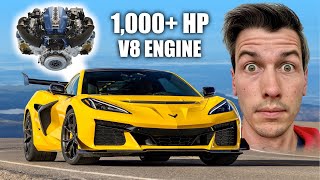

1,064 HP Corvette ZR1 Beats Bugatti & Demon!
42sShocking horsepower comparisons with hypercars and muscle cars grab attention immediately.
▶ Play Clip"Title accurately reflects the insane power figures—delivers exactly what's promised with detailed engineering context."
The new Corvette ZR1 boasts a twin-turbocharged 5.5L V8 engine producing 1,064 horsepower and 828 lb-ft of torque, making it the most powerful production Corvette ever. This video provides an in-depth technical breakdown of the engine, including its architecture, turbocharging system, and performance implications.
The ZR1's 1,064 hp exceeds Bugatti's new V16, Lamborghini's twin-turbo V8, and even the Dodge Demon 170 on pump gas.
The LT6 (Z06) and LT7 (ZR1) share a 5.5L flat-plane crank architecture. The LT7 adds twin turbochargers, reduced compression, and separate intake manifolds.
Compression ratio dropped from 12.5:1 to 9.8:1 via larger combustion chamber and shorter connecting rods (4.5mm). Cam profile changed to reduce overlap.
New port injection supplements direct injection, reducing carbon buildup and particulate emissions, though engineers claim buildup is a non-issue.
Short exhaust and intake paths, plus a strategy that closes the wastegate and maintains intake pressure during lift-off, reduce lag.
Over 800 lb-ft from 3,000 to 7,000 RPM. Redline reduced to 8,000 RPM (vs. 8,600 in Z06) but massive torque increase compensates.
Z06 already traction-limited in 2nd gear; ZR1 likely similar 0-60 (~2.7-2.8s) despite more power. Quarter mile under 10 seconds.
Using gear ratios, ZR1 delivers 80% more force at the wheels than Z06 in any gear. In 2nd gear, it has more wheel torque than Z06's 1st gear.
The ZR1's engine is a masterpiece of engineering, combining massive power with clever anti-lag and cooling solutions. The car is expected to be blisteringly fast, with quarter-mile times under 10 seconds and astonishing mid-range acceleration.
What is the horsepower and torque of the Corvette ZR1?
1,064 hp and 828 lb-ft of torque.
00:04
What compression ratio does the LT7 engine use?
9.8:1.
02:10
What is the redline of the ZR1 compared to the Z06?
ZR1 redlines at 8,000 RPM; Z06 at 8,600 RPM.
08:40
How does the ZR1 reduce turbo lag?
By short exhaust/intake paths and a strategy that closes the wastegate and maintains intake pressure during lift-off.
05:29
What is the 0-60 mph time estimate for the ZR1?
Approximately 2.7-2.8 seconds, similar to the Z06 due to traction limits.
09:40
What is the estimated quarter-mile time for the ZR1?
Under 10 seconds.
10:23
Power Comparisons
Shows the ZR1 engine's dominance over other high-performance engines.
00:04Compression Ratio Reduction
Key engineering trade-off for forced induction.
02:10Anti-Lag Strategy
Clever mechanical solution to minimize turbo lag.
05:29Traction Limited 0-60
Demonstrates that more power doesn't always improve acceleration due to physics limits.
09:40Wheel Torque Math
Quantifies the enormous improvement in acceleration feel.
10:54[00:04] 1,64 horsepower what the that's more power than Bugatti's new V16 engine that's over 250 more horses than Lamborghini's
[00:16] new twin turbo V8 engine that's more than than 1,64 Subaru cross TRS combined based on what it feels like accelerating in a Subaru cross Treck okay and one more cuz
[00:30] I can't help myself that's more horsepower than the Dodge Demon 170 and the demons using stat boosting ethanol cheater fuel while the Corvette is doing it with your trusty old 93 octane pump gas if none of this has raised your
[00:46] blood pressure congratulations on living a healthy lifestyle so let's talk about a healthy lifestyle so let's talk about the Gemini engine so Gemini is some space reference and GM did some stuff with space and astronauts like Corvettes
[01:00] look I don't know just Google it the point is Gemini in Latin means Twins and in this case what it is referencing are the lt6 used in the Corvette Z6 and the
[01:12] lt7 used in the Corvette ZR1 both of them originating from that same flat plane 5.5 L engine architecture and then going there different ways as far as a very powerful naturally aspirated engine and a very powerful turbocharged engine
[01:29] all right so is as far as the air flow on the ZO6 engine you've got your air your intake manifold through your cylinders and out the 421 exhaust now on turbochargers so a turbocharger on each side so you've got your air coming in
[01:44] again from the back routed to that compressor wheel through an air to water into your intake manifold into your cylinders and then right out the cylinders pour spinning up that turbine for the turbocharger so as far as what
[01:57] is the same well it's sharing that 5.5 block you also have the same valve Trin layout and you have the same direct injection system now what is different with this new engine well of course the big change being twin turbochargers
[02:10] running about 20 psi of boost in standard conditions now running boost that compression ratio so it's been reduced from 12.5 in the lt6 to 9.8 to1
[02:22] in the lt7 how do they do this well they've changed the head casting so it has a slightly larger combustion chamber they've ALS Al shorten the connecting rod length so pulling that piston down a little bit by 4.5 mm enabling a larger
[02:35] combustion chamber and reducing that compression ratio of course because this is a boosted engine you don't want a lot of valve overlap like you might have with a naturally aspirated engine so they have changed the cam profile and
[02:48] overlap they have also improved the internals of this engine of course to compensate for all that added power now one interesting and unique thing about this Engine versus the lt6 is that you have separate manifolds so whereas
[03:02] previously you had your intake manifold with these three butterfly valves in the middle so they were actually linked now the manifolds are completely separate so instead of like a V8 acting all as one it really is two independent four
[03:15] it really is two independent four cylinders both making 532 horsepower so pretty Bonkers you've got these two you know four-cylinder engines single turbo made it to a common crank Chef same flat plane crank same firing order uh but
[03:27] acting very independently you also now have port injection as well because they need a lot more fuel to make all that extra power this also helps with particulate emissions and it can reduce noise when you're only running on the
[03:40] when you're just sitting there and idling now I know people will rejoice because port injection means no Carbon on the intake valves but every time I ask a Powertrain engineer about this they remain indifferent to the benefit
[03:53] consumers worry about it but internally they don't see negative impacts from Carbon on the intake so yeah port fuel injection will keep things shiny and clean on direct injection engines Corvette Engineers say buildup occurs
[04:07] with a mellow drive cycle but once you ask for performance you knock it off so it's really just a visual thing in other words if you're buying a direct injection Z6 drive it like you bought a Z6 oh and on the subject of vehicle
[04:21] reliability a big thanks to today's sponsor Carly which offers a scanner compatible with OBD2 ports that has a huge variety of features depending on your vehicle make and model with the basic free version of the app you can
[04:34] access OBD level Diagnostics to recheck engine codes and understand what's wrong with your vehicle upgrading to the premium subscription unlocks all kinds of additional features such as live data or even coding in new features to your
[04:47] car personally I love the live data say you're towing and you want to monitor coolant temperature you can keep a gauge up or perhaps you've modified your car and you want to monitor your manifold pressure or timing Advance you can also
[05:00] watch this live or you can monitor your intake temperatures and discover that your cold air intake is actually a hot air intake and if you're just buying the scanner it comes with a 14-day money back guarantee so that you can check the
[05:13] committing you can find a link to the Carly scanner in the video description and you can use the discount code explained for 15% off all right say it with me why do we hate turbocharged engines turbo lag cool okay so what did
[05:29] Corvette Engineers do about said turbo leg well several things first of all the turbocharger is integrated into the exhaust manifold so this means a really short distance from those cylinders to that turbine which is critical because
[05:42] getting those exhaust gases to that turbo then on the intake side you also see it's super direct it goes straight from the turbo right up through a small
[05:54] the throttle right into the intake right into the cylinders very short path Corvette Engineers have seemingly always found a way to take a giant engine and make it look really small it's a pretty cool achievement here and so you've got
[06:07] short paths that's critical from the beginning but then you can also put in some strategies as far as anti-ag so this is what the engineers told me they the first thing that's going to happen you're going to cut fuel you're going to
[06:20] close your throttle of course and then you're going to close the wastegate in the turbo so all the gases that are going through the engine are now passing through the turbo and trying to spool up that turbine next you're going to
[06:33] maintain pressure on the intake side right because this turbocharger spooling the engine and it's trying to create some boost on the intake side on the trying to create pressure and then the second you open up that throttle valve
[06:48] well you've got that builtup pressure to go in the engine now you're not using any fuel to do this so there's not like an obscene amount of air flow going through that engine right but there is going to be some air flow and this is
[07:00] the strategy they're using which they say helps reduce turbo lag and gets you immediately it's got a very short distance to travel to get into those cylinders now if you were sad because the ZO6 had less engine torque than a
[07:15] base C8 Stingray well you don't have to be sad any longer because the ZR1 has 828 lb feet of torque and for the rest of the world that doesn't understand what the heck a pound foot is hey don't worry need neither do we all you have to
[07:31] know is that more is good and this has more all right so looking at horsepower and torque it's absolutely absurd here we have RPM here we have horsepower torque and looking at these here okay so light red is Z6 torque darker red is Z6
[07:47] horsepower light blue is ZR1 torque dark blue ZR1 horsepower and as you can see look at this huge shift in the torque curve so whereas previously from about curve so whereas previously from about 3500 to a little over 8,000 we've got
[08:01] 3500 to a little over 8,000 we've got great torque uh well yeah we've added great torque uh well yeah we've added 80% on top of that now from about 3,000 RPM to about 7,000 RPM Corvette says it
[08:13] has over 800 lb feet of torque from 3,000 RPM to 6500 RPM and at 7,000 RPM it's something like 798 so really from 3,000 to
[08:26] 3,000 to 7,800 lb ft it's absurd it's absurd now they did reduce red Lin slightly so now in the Z1 you're only revving to 8,000 in the Z1 you're only revving to 8,000 RPM versus 8600 RPM in the Z06 but
[08:40] you've got so much more torque going from 460 to 828 and so much more power from 460 to 828 and so much more power going from 670 to 1,64 almost 400 horsepower added now let's take a moment to Chad 0 to 60 because when Corvette
[08:55] moved the engine from in front of the driver to behind the driver it shifted the weight weight distribution back which unleashed the car's potential for which unleashed the car's potential for accelerating quickly so on July 24th
[09:07] 2019 which just so happens to be exactly 5 years ago as of this recording I predicted the rear wheeel drive CA platform would have a best case 0 to 60 of 2.76 seconds if the weight distribution is 4060 well guess what car
[09:24] and driver tested the ZO6 the current fastest version of the Corvette C8 and fastest version of the Corvette C8 and they did a 0 to 60 in about 2.8 seconds true 0 to 60 no roll out nonsense math is cool it checks out so another thing
[09:40] that math says is that the Corvette is traction Limited in second gear meaning if you gave the Z6 more power it wouldn't accelerate to 60 any quicker because it's already at the limit of traction so I don't really think we're
[09:54] going to see a much better 0 to 60 time for the ZR1 unless it has significantly better tires but I think the tires are going to be pretty similar so really it's just going to come down to is there a lot more weight because of these added
[10:09] could have a slightly better 0 to 60 time but it won't be a huge difference again sometimes you have to see what do the manufacturers say what do they not say and in this case they're not talking about the zr10 to 60 probably because
[10:23] the eay might have a better 0 to 60 anyways what's interesting here they do share quarter per mile under 10 seconds and they do share an 80 to 200 to 80 cuz that's what we all care about 80 200 80 I don't know doesn't matter point is I
[10:38] of an improvement on 0 to 60 probably somewhere around 2.7 2.8 seconds now if you've watched this channel you've probably heard me say torque doesn't matter power does which is true like in the context of you know nothing really
[10:54] matters like this is just a dude in front of a whiteboard but torque doesn't matter because you can take advantage of gearing but it does matter because it represents what you feel so let's talk about our feelings all right some
[11:06] whiteboard therapy so in order to understand what we feel pressing us back into the seat as we're driving we need to understand the force that is being applied to the ground by the tire to accelerate that vehicle well we can
[11:20] calculate this using what we know from the engine torque the transmission ratios the final drive ratio some assumed efficiency as well as what is the radius of your tire but we need to know the gear ratios of the Corvette
[11:34] well Trac does provide the gear ratios for the C8 transmission and GM confirmed the ZR1 does use the exact same gear ratios and same final drive as the Z6
[11:46] though the gears are physically wider as in thicker in order to accommodate the added torque all right so let's calculate what is the force that the tires are pushing against the ground in in first gear as that Peak torque in
[12:00] three different options the standard C8 z51 the Corvette Z6 and the Corvette ZR1 and we'll do all of these in first gear and so for the z51 that number is about
[12:13] and so for the z51 that number is about 6,254 lb of force and the ZO6 you know much more powerful engine right well that number is only 6,427 so not much more what does this mean well it means the feeling of
[12:26] acceleration in the Z6 and the B Stingray is going to be very similar the difference is the Z6 is going to hold on to that speed for longer so it's going to go up to a higher speed in second gear your second gear is longer you get
[12:39] that feeling for longer but it's not really much different as far as what does the feeling feel like as far as acceleration ZR1 cranks this all right
[12:56] amount that we could apply to the ground in first gear and accelerate it without spinning the tires that number is going to be something like 3 to be something like 3 63 0 so all of these can do burnouts
[13:08] great but what matters is as you start to get to higher gears well then that gear ratio is lower and so your acceleration drops now as far as the ZO6 holding on to gears for longer if you're in third gear in the standard C8 z51
[13:24] you'll accelerate in third gear up to about 83 mph in the ZO6 you'll have pushing you a little bit more into your seat but you'll hold on to it much seat but you'll hold on to it much longer in third gear up to 105 mph so
[13:38] that's why it is a significantly faster car again power playing a role here now car again power playing a role here now in the ZR1 any gear you're in versus the in the ZR1 any gear you're in versus the Z6 you get an 80% boost in how much that
[13:51] force is pressing you against the seat assuming you have the traction to put it down absolutely absurd so some silly stats of the ZR1 versus the Z6 in second gear the ZR1 has more wheel torque than in first gear in the Z6 in sixth gear in
[14:09] the ZR1 you have a greater force at the tire than you have in fourth gear in the Z06 all right but here's two more stats that are absolutely ridiculous first it has the wheel torque to do a burnout starting in fourth gear now it'd be a
[14:26] situation because you need to get the engine revs up high and probably slip that clutch in order to keep that wheel torque really high in order to make it all happen so it may or may not actually do it but it has the wheel torque in
[14:39] theory to make that happen also if you were to start an acceleration run from Z miles hour in fourth gear and you were to apply that same strategy where you slip the clutch and you hold the engine at Peak torque it could get a 0 to 60
[14:54] at Peak torque it could get a 0 to 60 starting in fourth gear of about 3.1 1 seconds versus the previous generation ZR1 which does 0 to 60 in 3.2 seconds in
[15:06] other words this car starting in fourth gear in theory could be quicker than the gear in theory could be quicker than the last generation ZR1 absolutely Bonkers how fast this thing is going to be okay but a quick comment because if for some
[15:20] impression that combustion engines are red and EVS are boring well consider this the ZR1 has deleted the Corvette's frunk in order to accommodate the
[15:32] increased cooling requirement of the new potent engine no frunk all right I'm out if you have any questions or comments feel free to leave questions or comments feel free to leave them below thanks for watching



⚡ Saved you 0h 15m reading this? Transcribe any YouTube video for free — no signup needed.