
Drug Turns to Crystals: Crisis Unleashed
45sThe sudden failure of a life-saving drug due to mysterious crystals creates immediate suspense and curiosity.
▶ Play Clip"Title is dramatic but accurate: the video explains how a crystal polymorph could theoretically render many drugs ineffective."
This video explores the phenomenon of disappearing polymorphs through the real-world case of the HIV drug Ritonavir, which suddenly and inexplicably changed its crystal structure, rendering it ineffective. It traces the history of isomer discovery, explains the science of polymorphism using chocolate and tin, and highlights the unpredictable risks this poses to pharmaceutical manufacturing.
In 1998, Ritonavir capsules start failing dissolution tests; clear capsules turn white and cloudy with microscopic needle-like crystals.
Researchers cannot reproduce the original form; all attempts yield white paste. Production halts but patients need the drug.
A factory in Italy successfully makes Ritonavir, but after a visit from Chicago scientists, it too becomes contaminated with the new crystal form.
In the 1800s, chemists Liebig and Wöhler discovered isomers—compounds with same atoms but different arrangements—explaining different properties.
Spectroscopy shows the white paste has the same bonds as Ritonavir, but slight deviations indicate a different polymorph.
Chocolate has six polymorphs; tempering controls which form dominates, affecting texture and melting point.
The new polymorph is less soluble, so it doesn't dissolve properly, making the drug ineffective.
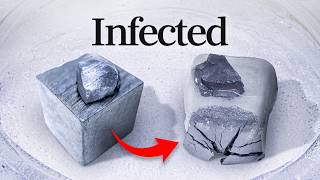
Tin transforms from silvery to gray form at low temperatures; a seed crystal lowers activation energy and spreads the transformation.
A tiny amount of form two acts as a nucleation site, converting all form one; seed crystals become airborne and contaminate other sites.
Over half of compounds may have multiple polymorphs; even aspirin has a form two discovered by accident.
Pharmaceutical companies now spend millions screening for polymorphs; Ritonavir's liquid formulation became the only option.
The Ritonavir case shows that a seemingly stable drug can spontaneously transform into a more stable, ineffective polymorph, and once seeded, the new form can spread globally. This unpredictable phenomenon remains a rare but serious risk for all pharmaceuticals.
What is a polymorph?
Different crystal structures of the same compound, with different properties.
15:45
What caused the Ritonavir capsules to fail dissolution tests?
A new, more stable polymorph (form two) that is less soluble and does not dissolve properly.
20:05
What historical discovery did Liebig and Wöhler make?
They discovered isomers: compounds with the same atoms but different arrangements, leading to different properties.
10:01
How does a seed crystal lower the activation energy for polymorph transformation?
It acts as a nucleation site, allowing other molecules to attach and convert more easily.
26:10
What is tin pest?
The transformation of silvery tin to gray tin at low temperatures, which spreads like a disease via seed crystals.
25:29
Why couldn't Abbott revert Ritonavir form two back to form one?
The energy barrier between the two forms is too high; form two is much more stable and cannot be converted by heating or cooling.
22:43
What is the melting point of form five chocolate?
Around 34°C.
15:59
How did the Chicago team accidentally seed the Italian factory?
They carried seed crystals on their clothes, which contaminated the Italian production line.
27:06
What is the approximate percentage of compounds that may have multiple polymorphs?
Over half (more than 50%).
30:48
What was the final solution for Ritonavir?
Abbott abandoned the capsule form and returned to an older liquid formulation.
32:12
Explosive silver fulminate demo
The unexpected loud bang from a tiny amount of the compound startles both the presenter and the audience, dramatically illustrating the difference isomers can make.
06:48Chocolate tempering demo with Chris Young
A Michelin-star chef explains polymorphism using chocolate, making complex chemistry delicious and accessible.
13:17Tin pest time-lapse
Watching the gray tin 'infection' spread across the silver tin over 14 hours is visually striking and perfectly illustrates the seeding concept.
25:29[00:03] [music] And by 1998, 75,000 patients across the every day. [music] It's called Retonavir, and it turned a certain death
[00:16] into a manageable condition. This particular pill is on its way to [music] quality control, to a dissolution tester. Here, analysts monitor each batch of [music] capsules, checking that they do dissolve in around 30 minutes,
[00:29] which is quickly enough to be absorbed properly. It's a rigorous precaution for a drug that for 2 years and 240 consecutive lots, has never failed. But
[00:41] now, an analyst sees something unusual. This capsule hasn't dissolved properly. So, they follow protocol and trigger an emergency shutdown. They destroy [music] the entire batch and deep clean the production line to
[00:56] eliminate any possible traces of [music] contamination. But the next day at quality control, the same thing happens. On the line, the clear capsules are turning white [music] and cloudy. Technicians at the nearby research and
[01:09] development lab study the paste under a microscope and find they're filled with millions of tiny needles. They're crystals, but no one has seen them before. They need a control to compare the needles against. So they make some
[01:23] of their own retonavir in the lab. But to their horror, it also comes out cloudy. So they try again. But all attempts yield the same result. A white paste every time.
[01:37] The researchers are stumped. They had been making retonavir for 2 years. They composition and every part of the process used to make it. So they check
[01:49] all the input ingredients again all the settings, every temperature setting and procedure. But all of it seems to be done [music] correctly. Yet at the factory, the cloudy capsules are appearing more and more frequently.
[02:02] Within a week, every tablet produced by either the lab or the factory comes out cloudy. Abbott needs to halt all production of retonavir [music] immediately. But they can't just cut off the supply because people need these
[02:16] tablets. We called on as many resources as we could. We tried everything. We conducted countless experiments. We rebuilt facilities and new lines. We looked at alternative sites to see if we could start clean in a new environment.
[02:32] >> And they found an alternative site, a factory in Italy. They start retonir production there. And to their relief, all the pills pass the dissolution test. This is great news, but it also means that Chicago must have been making a
[02:46] mistake. So, a team of scientists flies over to look at what the Italians are doing differently. They check everything. The pressure, temperature, humidity, the exact weight of all the chemicals, but it all matches perfectly
[02:59] with what they're doing in Chicago. None of it makes any sense. But at least of it makes any sense. But at least Italy can keep making the medicine. But when the Chicago team returns home, they get a call. It's from Italy. Within
[03:14] days after their visit, one of the tablets fails the dissolution test. There was no gradual trend. There was no early warning. In a matter of weeks, maybe five or 6 weeks, every place the product was became contaminated with the
[03:28] crystals. We did not know how to detect it. We did not know how to test for it. We did not know what caused it. We did not know how to prevent it. We did not know how to get rid of it. And we kept asking the question, why now?
[03:47] had happened before and in theory could happen again to just about any drug or chemical compound. It spreads like a disease, but the [music] thing that's getting infected is the medicine. One day you can make it, the [music] next
[04:00] it's gone forever. It is frightening that this could happen to any drug that we take and on which we're dependent. And the scariest part is you can't predict if it will happen, when it will happen, or to which medicine or
[04:14] compound. Overnight, drugs we all rely on might just disappear. So what was happening inside those Retonavir capsules? What were those crystals inside? They appeared to be an entirely [music] new compound, but when
[04:28] they tested them, everything indicated they were retonavir. It sounds impossible, but something similar had actually been the center of a heated actually been the center of a heated debate 170 years earlier.
[04:41] In his Paris laboratory, chemist Justice Fon Libbe was reading a paper. It was about a newly discovered compound and what elements it was made of. This kind of work was at the cutting edge of chemical research. research. He knew
[04:56] better than almost anyone because he had personally pioneered most of it. This had made him highly respected in his field, but he also had a reputation for being difficult to work with. He was arrogant, hot-tempered, and didn't
[05:09] suffer fools. And the more he read this paper, the more incensed [music] he got because to him, it was clearly written by a fool. Friedrich Ver. So, we headed over to the lab at Imperial to recreate what Bowler claimed
[05:24] >> So, I've got it here wrapped in foil because it is a bit photosensitive. >> Yeah. >> Beige powder. >> Okay. Made of one sulfur, one nitrogen, one oxygen, and [music] one carbon.
[05:38] >> You want to light it up? [laughter] >> Sure. Let's do it. >> You You seem quite [music] excited. >> I am quite excited.
[05:50] Oh, it's melting a little or it's like it is getting a little discolored. Yes, it is. >> I guess the issue was he said, "Okay, I exactly what it's made of. One silver, one carbon, one nitrogen, and one
[06:04] oxygen." He publishes this. The paper reaches lie. And he's like, "There's no way because I've just discovered that compound, and when I try to put a flame to it, it behaves completely differently." And we've got some of that
[06:19] >> Should we try to burn this one? >> Yeah. I made some fresh this morning. Let's just see how a small amount behaves. So, we're going to go with I don't know, maybe a few milligs. I've left it a bit moist. Um, when it's in
[06:33] its moist state, I mixed that. >> So, [laughter] >> it's very sensitive. >> And that was just a small amount. >> Oh my god, my ears. What? I was not
[06:48] >> Yeah, I wasn't ready for that either. I I made it moist so that it's less likely >> but clearly >> I was wrong. >> Clearly, Vooler had made a mistake. These can't possibly be made of exactly
[07:01] the same elements. So, Liebig wrote a paper slamming Verer's work, calling him a hopeless analyst and saying he should go back, check his work, [music] and mistake. And Vooler does exactly that. He checks
[07:16] his work but finds no mistakes. So now he's even more sure that he's correct. So he writes up his results in a second paper. But Lee wasn't having any of this and replies with another paper saying he must [music] be wrong. So this public
[07:30] back and forth continues for 2 years with each side becoming more and more convinced that the other is out of their mind until finally they agreed to meet on neutral ground in Frankfurt to put this whole thing to [music] bed once and
[07:43] for all. they would replicate each other's work and let the results speak for themselves. But when they did, they were stunned. Before we continue, I want to quickly thank SoFi for sponsoring this part of
[07:56] the video. You know, one of the simplest ways to build wealth over time is by your money. There's this quote from Albert Einstein that says, "Compound interest is the eighth [music] wonder of the world. He who understands it earns
[08:10] the world. He who understands it earns it. He who doesn't pays it. And yet, many people don't put their money in a savings account, which kind of makes you next to nothing, a fraction of a percent worth of interest. And at that
[08:24] rate, you can't even keep up with inflation. But with today's sponsor, SoFi, you can change that. SoFi is an all-in-one finance app that lets you bank, [music] borrow, and invest. When you open a SoFi checking and savings
[08:38] deposit, you earn a competitive [music] APY and you don't have to pay any account fees. That means your money isn't just sitting there, it's working. And every dollar you put in can earn more and more interest. And over time,
[08:53] that really adds up. Einstein called it the eighth wonder for a reason. Of course, the exact amount depends on several factors like your starting interest rate, and any additional deposits. So, check if it's right for
[09:08] you. But right now, SoFi is also offering a special sign up bonus. If you set up a new high yield [music] savings account with an eligible direct deposit of $1,000 or more, well, then [music] you can get either $50 or $400 cash
[09:23] bonus. So, start putting your money to work by heading over to sofi.com/ve. [music] You can scan this QR code or click the link in the description. I want to thank SoFi for sponsoring this part of the video. And now back to what
[09:36] part of the video. And now back to what was happening with Lee Big and Vuler. both had a compound that was made of exactly one carbon, one nitrogen, one
[09:49] oxygen, and one silver atom. And one could be boring as hell [laughter] and the other one can well blow up your face.
[10:01] This was surprising because at the time a compound was thought to be just the atoms that made it up and nothing more. But now this whole conception had to change. Von Liebig and Vuler had discovered that the way those atoms are
[10:15] arranged also matters. At the time they had no way to work out that ordering, but today we can. When you shine light on a molecule, its electric field tugs
[10:27] on the electrons and nuclei. They get pulled back and forth as the field changes direction. This can stretch, squeeze, and bend the bonds in the molecule. As the atoms oscillate back and forth, but each bond responds
[10:40] differently to the light depending on how strong it is and the mass of the atoms it connects. It's like each bond is a boat on the ocean. If the waves are small and rapid, they won't rock it very much. And if the waves are very slow,
[10:54] like the tides coming in and out, that also won't rock the boat very much. The boat just gets lifted up and down. It's only when the waves are just the right size that the boat gets tossed around. Because of this, each bond will react
[11:09] strongest to a specific frequency of light, which we can measure. By hitting the molecule with a range of infrared frequencies, we get a spectrum like this with peaks that tell us when bonds are reacting. This acts like a fingerprint
[11:23] for the molecule and tells us which bonds are there. [music] Ver's compound has a broad peak which corresponds to bending an N double bonded to C double bonded to O group. A lie compound on the other hand has a
[11:37] spectrum that looks like this with these two prominent peaks. One at high These correspond to stretching a double bond between a carbon and a nitrogen and a single bond between a nitrogen and an oxygen. We now know that Verer's
[11:52] compound was silver cyanate and it looks like this. The carbon nitrogen and oxygen are joined with those two strong double bonds which is why it's so stable. In contrast, Liebig's compound silver fulminate looks like this. The
[12:07] silver is bonded to the carbon instead. So the other elements are arranged this way. The bond between the carbon and nitrogen is a triple bond. But the oxygen and nitrogen are very weakly connected. This [music] single bond is
[12:21] very easy to break. And once it does, the atoms can rearrange into much more stable gases, which is why it's so explosive. They had discovered isomers. that it's not just the atoms in a molecule that dictate how it behaves,
[12:36] molecule that dictate how it behaves, but its bonds as well. So naturally, the scientists at Abbott suspected something similar might be happening to Retonavir. They knew that the spectrum of Retonavir should look like this. So they put a
[12:49] sample of white paste [music] into a spectrometer expecting to see something completely different. But instead, they saw this. The [music] same peaks. The paste had all the same bonds as retonavir. So it must be retonavir.
[13:04] But they also noticed it wasn't exactly the same. There were these small deviations between the [music] two. The arrangement of the atoms was the same, but something about the bonds had changed [music] slightly.
[13:17] Well, it turns out there's another way to change the properties. And I can show you how with probably the most delicious demo I'll ever do. Because this, of course, is a piece [music] of chocolate. It's nice. It's shiny. It's durable. And
[13:31] it has that nice snap when you [music] crack it. But you'll notice that if you've ever let your chocolate melt, then it never returns to being [music] quite the same. Suddenly, it melts in your hand when you pick it up. You know,
[13:43] it's dull, it's bendy, [music] and it doesn't quite taste the same. You're not difference. And I can explain what's happening with a little help from my friend Chris over here. >> Hey. Hello. So, Chris runs his own
[13:56] YouTube channel, Chris Young Cooks. And this is way overkill for what we need here probably because the head development chef at a free Michelin star >> Yes, we've got some nice shiny chocolate
[14:08] here. But look what happens when we turn up the heat. Oh yeah, that goes quite quick.
[14:23] that goes quite quick. Oo, that is surprisingly satisfying. Obviously melted some of the chocolate. No surprise. But this is what happens, warm. The chocolate gets above body temperature. It starts to melt and then
[14:35] harden again. >> So, got the chocolate. >> I know. >> Like you you've seen this. You've opened your car sitting in a sunny [music] window. Touch the edge. Like you can
[14:48] feel >> feel how that just soft and kind of >> immediately. >> Compare it to a nicely tempered piece of with your bare hands. Will eventually melt in your hand, but much more slowly.
[15:02] to you, we'll show you how to get it back to the nice and shiny form. But what's interesting here is that we didn't change any of the ingredients and yet the properties changed completely. Chocolate is made of three main
[15:17] as well, but three main ones to focus on. It's got cocoa solids. That's what gives it its color. There are sugar, of course, for sweetness. And then there is cocoa butter. That's what gives it its texture. And this cocoa butter is the
[15:32] culprit. It's a fat made from three long carbon chains bonded together in the middle to make this sort of Y-shape. And that [music] Y shape can form together to form solids. But there are multiple ways they can stack together. There are
[15:45] many forms the crystal can take, each with different properties. And so we call these polymorphs. chocolate actually has six polymorphs. The dull chocolate is mostly form four and that has a melting point of around
[15:59] and that has a melting point of around 27° C while the shiny chocolate which is the one we want is mostly form five and that has a higher melting point of around 34°C. [music] So the challenge and the art of chocolate making is
[16:13] managing these polymorphs to get the right form of crystal by managing both nice thing about chocolate is you can start over. You just need to heat it back up to 4550 CC to wipe the memory [music] of the wrong crystals. That's
[16:26] hot enough to melt out all of the crystals, but not too hot to start um evaporating a lot of the volatile aromatics. [music] >> After around 10 minutes, at roughly 50° C, all the crystals should have fully
[16:40] >> So, at this point, we're trying to cool it back down to the temperature where crystals start to form [music] again. And that's going to start at about 34 C. You'll start getting form five crystals forming at 34. As we cool even lower, we
[16:52] start to get [music] form four and form three. Those can all form at these temperatures. And that's okay. We want all of these crystals initially. We want >> Yeah. We we we want to have [music] sort of shotgun of nucleation going on
[17:05] >> lots of everything. >> That's surprising. >> It does seem surprising >> because we just want form five, right? >> We do just want form [music] five. The trick is if we just come down to the
[17:17] temperature where form five forms. So if we just went to [music] like 32° 33° and very long time and you'd get a very random [music] process of of of when does that crystal form and maybe only a few crystals would form and so they
[17:31] bringing the temperature all the way down to 27, we get lots of nucleation course is we get the crystals we don't want as well, lots of small form five. Yeah. >> So once we have that starting to form,
[17:46] by [music] raising the temperature back out >> and melting the form three and form five us form five, but importantly lots of form five. >> After holding the chocolate at around
[17:59] 32° C for [music] 5 to 10 minutes, we can pour it into the mold. >> Okay, I think we're going to be okay here. So, >> oh, I don't know what I was expecting, but I was not expecting [music] it to go
[18:13] like this. Really comes out as a sort of sheet. trapped air bubbles. >> Yep.
[18:28] >> It's like liquefaction. >> Yeah. >> But actually, now we need to lock in that crystal pattern that we created,
[18:40] liquid oil in there, and we're going to drop back down through the temperature >> So, what we need to do is we need to come down through that temperature relatively quickly so that we get mostly form five growing and lock them in by
[18:55] getting rid of most of the liquid oil. So, we really need to get this down [music] to about 12C. So, we put it in the fridge and waited for around 20 to >> Get the door closed. >> All right.
[19:08] >> If we did this correctly, it should be mostly form five, which means all the molecules should have stacked tightly together, resulting in a shiny and [music] snappy bar. >> Oh. Oh, that was satisfying.
[19:22] >> Wow. >> And uh you can see the nice >> shiny. >> This is all form five. This is all form five and we've got a nice shiny surface. Um, got a couple spots where maybe the
[19:36] bit more, but give it a snap. Just see how that is. >> Yeah, that's a nice >> It's very sturdy. >> Is how you can temper a chocolate bar. >> Amazing.
[19:51] >> But the stacking of the molecules in the crystals also changes something else. surrounded by other molecules, it changes how the bonds inside can move. This is what the scientists at Abbott had seen in the spectrum. The needles
[20:05] they had seen under the microscope were a new polymorph of retonavir and a more stable one at that. Form one crystals look like this instead. Now, at first [music] was still Retonavir, even if it looked a bit different. It's just like
[20:21] how dull chocolate, even if it's not quite as nice, is still chocolate. But the problem was this new polymorph was far too stable. Ratonavir [music] form far too stable. Ratonavir [music] form two is substantially more stable than
[20:36] form one. And the way we know it's more stable is because it's less soluble. But if that crystal structure happens to [music] be much more stable, then it [music] be much more stable, then it won't dissolve properly and then it's a
[20:51] bit like you haven't taken the drug at all. But with chocolate, we can change which polymorph we have. We just had to heat it up to switch it from shiny to dull. And then by cooling it down again in a specific way, we could get back to
[21:04] shiny. So you might expect that Abbott could just do something [music] similar with Ritavir. and they tried, but the problem was that no amount of heating or cooling could turn form two back into form one. They were stuck. [music] We
[21:19] can see what's happening by taking a look at this here. See, each polymorph has different energy levels. And in the case of chocolate, that looks something like this, [music] where form four has a higher energy level and form five a
[21:34] lower one. And they're separated with this sort of hill in between. Now, after heating up the chocolate bar, we were mostly left with form four. So, let's drop this little ball in there. Uh, and then you'll see it will slowly settle
[21:48] then you'll see it will slowly settle down into that valley, but not to the because there's this little hill in between. But now, imagine adding some heat to this. It's like giving the ball a little bit of a kick. And you can see
[22:03] that the ball will suddenly start to move around. And if I give it enough of a kick, whoop, it will roll down into form [music] five. And now it is stuck there. Now, you could keep adding more heat and you could get it back over the
[22:17] heel back to form four. But then you would just end up with a mass of bow forms because whenever you start cooling it down again, you know, the ball could valleys. So that's what happened when we melted the chocolate uncontrollably. We
[22:31] just got a mixture of these two forms. But with written the situation is a between the two forms is now much taller. But the form two fell is also
[22:43] So once the ball does get down there, it's basically impossible to get it back out of there. Which is why no matter what the scientists had ever tried, [music] they couldn't get back to form one.
[22:59] two was suddenly everywhere. [music] Nothing had changed in their procedures. the barrier between the two forms should still be there. So, it shouldn't have been possible to make this much form two at all. And yet, 300 years earlier,
[23:13] legends of such a transformation spread across Northern Europe. It was a bitter winter morning, and it had been like this for months. The organist was on his way to a cathedral. The cold had been messing with the organ pipes. It's gone
[23:28] out of tune again. But that wasn't what the congregation thought. There were stories of other organs getting sick with warts or leprosy eating away at the pipes. Some thought it was the devil attacking the [music] organ to punish an
[23:43] unfaithful flock. It was even said that when it was very quiet, you could hear these organs [music] screaming and groaning in pain from the lesions. Nonsense, of course. It was just the metal contracting and expanding.
[23:59] Except these pipes weren't just contracting. They were cracked. And others are indeed covered in what looks like these lesions, black groves all like these lesions, black groves all over the organ.
[24:18] people thought that this was the work of Satan. Of course, that's not what was going on. And we can explain what was actually happening. So, we've got some normal tin right here, which is what those organ pipes were made out of. It
[24:31] kind of looks silver. It feels pretty strong. And this sort of the form we're used to. Exactly. But here we have a slightly different form of tin. You can look at it. It's a bit more gray. It's a bit more crumbly. And at room
[24:45] temperature, normally the silvery tin is sort of more stable. But if you cool tin sort of more stable. But if you cool tin down uh to like below 13° C and ideally way cooler, then it can transform into this new kind of gray tin. And we're
[25:00] going to see what happens when we put it on top of the silver tin. We want to try and get it to around -30°. >> And what better to get us to those temperatures is dry ice. So dry ice is frozen carbon dioxide
[25:14] >> and that is around -78°. Yeah. Now, we've taken a thermal flask and filled it up with dry ice and then put a platform on top on which we'll [music] put our tin. This should cool it down to around -30°.
[25:29] [music] Now, we left this here for around 14 hours. And what you'll see is that initially there's a very tiny speck of tin that suddenly transformed into great tin and then it spreads from there almost like an infectious disease which
[25:43] almost like an infectious disease which is why this is also known as tin pest. And because gray tin is less dense, the tin expands. And so if you look closely, you can see it start to tear apart the metal.
[25:56] Now, normally it takes a lot [music] of energy to transform some silver tin into gray tin. But once you get a tiny bit of gray tin, something strange happens because now it acts as this nucleation [music] side that other tin can attach
[26:10] to and it effectively brings that hill way down. It lowers the activation energy. And so now it becomes very easy to switch [music] from silver tin to gray tin. And so it starts to spread. It starts to take over.
[26:23] those organ pipes. Once you got a lesion on one of those pipes, well then it would grow and spread everywhere. Little flakes would come off the pipes and seed all the others and it would spread. And that's also exactly what happened with
[26:38] that's also exactly what happened with written. Once a tiny bit of form 2 appeared, it acted as a nucleation site. lowering that massive activation energy [music] and causing all the form one to crystallize into form two. Tiny seed
[26:52] crystals then broke off could become airborne and spread [music] attaching themselves to people's clothes and making it to other parts of the production line [music] effectively seeding them so that when new written
[27:06] was synthesized it contained these seed crystals and turned [music] the entire capsules into form two. And because everyone likely had these seed crystals on their clothes, when the Chicago team flew over to Italy, they seated that
[27:20] flew over to Italy, they seated that factory too. And in this way, soon not a single place was able to manufacture form one. Retonavir is arguably the most dramatic case of what we now call a disappearing polymorph. The YouTube
[27:35] about this that involves lots of physical demos, so I highly recommend you check it out. When this happened to us, we conducted an extremely thorough something that we did which would have caused this. While we've speculated on
[27:50] transformation, we do not have conclusive proof of what happened. It might be that a mistake on the production line caused some chemicals to dry out. This might have created a new crystal similar in shape to form two
[28:05] retonavir which acted like a seed. Or it might have just been a bad luck that a chance. >> Even if you have a seed crystal, if >> Even if you have a seed crystal, if there are some dust particles or some
[28:21] scratches in the recipient where actually crystals can start to to nucleate that can induce then different crystal structures. So it happens that uh in in some pharmaceutical companies
[28:34] where they produce the same polymorph for years and years that suddenly there is I would say a hair or some other particle that kind of gets into the
[28:46] process and will change the entire crystallization of of the compound and is then very difficult to control. And once a more stable form has appeared, it can spread and quickly seed the entire planet.
[29:00] >> It might be that you will never ever get the initial polymorph again. >> After 5 months of research, Abbott's researchers held a press conference to share their findings. >> Good afternoon. Uh my colleagues and I
[29:12] are here today to explain what has happened, why it has happened, how we've responded to the problem, and what we're going to do to correct the problem. Sometime during this summer, the semi-olid formulation of Ratonavir began
[29:26] to change into a crystal form. A transformation that we believed was a transformation that we believed was a scientific and chemical impossibility.
[29:41] Your scientists are obviously smart. How could this happen? A company's size and the collective IQs of their scientists have no relationship to this problem. This phenomenon is, I believe, unpredictable. We are in some
[29:55] sense the victim of bad luck. There are many mysteries of nature that we've not solved. Hurricanes, for example, continue to occur and often nothing that we can do today to prevent [music] a hurricane from striking any
[30:09] community or polymorphism from striking any drug. Science cannot provide a any drug. Science cannot provide a solution to all our problems.
[30:22] everything polymorphic? So, nobody had discovered a polymorph of aspirin, right? So, it had been around. It's one of the earliest drugs. It had been crystallized in industry for what [music]
[30:35] [music] 130 140 years. And so can you say because nobody had discovered a polymorph of aspirin therefore no right. polymorph of aspirin therefore no right. The only problem is uh I discovered form
[30:48] two of aspirin by accident. Right? >> It turns out over half of all compounds could be more. >> The number of polymorphs is proportional to the amount of time and money you spend researching that compound. In
[31:03] fact, nowadays we know there are not two forms of retonavir, but at least five. So, are new cases of disappearing polymorphs something to worry about? It's quite quite rare. We we certainly know a lot more than we did uh when
[31:19] know a lot more than we did uh when Ratonavir occurred, but I wouldn't be surprised to see it happen again. If there's a 1% chance the world's going to end, you're going to do something about it, right? If there's a 1% chance a
[31:32] plane is going to crash, you're not going to fly, right? Uh so so yeah, so we're at that situation where it might only be in that order of 1%, but if it
[31:45] of a lot more than a few weeks of research on polymorphs. Bratton was uh one of the red flags that that caused a lot of regulatory activity and a lot of
[31:59] scientific activity around polymorphs. >> Nowadays, pharmaceutical companies can spend hundreds of thousands to millions of dollars screening for polymorphs. [music] In the end, there was no way of getting form one reton back
[32:12] successfully. There were attempts, but all were incredibly costly and they risked [music] being infected again. So instead, Abbott went back to an older liquid formulation of the drug and abandoned form one entirely. Our initial
[32:27] eliminating form 2 from our environment. We finally accepted that we could not. Our subsequent activities were directed towards figuring out how to live in a form two world. Nature would appear to favor it.
[32:43] The liquid formulation was not ideal. It had worse side effects and not all worked. >> It is frightening that this could happen to any drug that we taken on which were dependent even though it is not that
[32:57] common. This time it has happened to Avid and to the tens of thousands of people taking this semi-olid capsule. Thankfully we had the liquid formulation as a safety net. Next time it may happen to another drug that may not have the
[33:09] to another drug that may not have the safety net.
⚡ Saved you 0h 33m reading this? Transcribe any YouTube video for free — no signup needed.