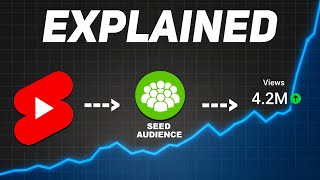
Why Your Shorts Die After 100 Views
53sReveals the secret of YouTube's random seed audience test, explaining why most shorts fail.
▶ Play ClipThis video explains how the YouTube Shorts algorithm works, focusing on why Shorts often get a spike in views then go flat. It covers the seed audience testing process, key metrics like viewed vs. swiped away, and tips for improving retention and hooks.
The algorithm selects a random seed audience to test your Short. If they engage, it pushes to more similar viewers; if not, views stop.
The key metric is 'viewed vs. swiped away' (percentage of viewers who intentionally stop to watch).
Paddy Galloway's study of 5,000+ Shorts found viral Shorts have 70-90% viewed percentage; 60% or less underperforms.
The first 3 seconds are the hook, equivalent to a long-form video's title and thumbnail. Use curiosity-sparking lines or visuals.
Shorts algorithm prioritizes audience retention (90-100% ideal) over average view duration, but longer Shorts with good AVD can still perform.
Let the story dictate the length; some niches need quick shorts, others benefit from storytelling.
"The title promises a full algorithm explanation, and the video delivers exactly that, including seed audience, metrics, and tips."
What is a seed audience in the YouTube Shorts algorithm?
A small group of viewers randomly selected by the algorithm to test your Short.
0:37
What is the key metric for Shorts, equivalent to CTR in long-form videos?
Viewed vs. swiped away (percentage of viewers who intentionally stop to watch).
2:24
According to Paddy Galloway's study, what viewed percentage do viral Shorts typically have?
70-90%.
3:19
How many seconds do you have to hook a viewer in a Short?
3 seconds.
4:29
What does the Shorts algorithm prioritize over average view duration (AVD)?
Audience retention (percentage of video watched).
6:19
What is the recommended best length for YouTube Shorts according to YouTube employees?
Make a short that aligns with your story.
7:05
Seed Audience Randomness
Explains why Shorts often fail: the algorithm tests with a random audience that may not be your target.
0:37Viewed vs. Swiped Away Metric
Defines the critical metric for Shorts success, analogous to CTR for long-form videos.
2:24Hook Examples
Provides actionable hook templates like 'I'm sure you don't know about...' to spark curiosity.
4:57Retention Over Watch Time
Highlights that Shorts algorithm prioritizes audience retention, not total watch time.
6:19Story-Driven Length
Advises creators to let the story dictate Short length, not arbitrary time limits.
7:05[00:00] How does the YouTube Shorts algorithm
[00:02] exactly work? Why do Shorts get a spike,
[00:04] but then the graph becomes flat? How
[00:06] will the algorithm decide whether your
[00:08] Shorts will get views in millions or
[00:10] thousands? The answer to all these
[00:12] questions will be found in this video.
[00:14] Let's begin. So, we know that big
[00:16] YouTubers keep getting views on their
[00:18] Shorts, but in your case, the views are
[00:20] 100 or 1,000. But after that, the graph
[00:23] becomes completely flat. So, let's
[00:25] understand why this happens. Todd
[00:27] Sherman, who is the product lead of
[00:29] YouTube Shorts, which obviously means
[00:31] that he can tell us a lot about the
[00:32] Shorts algorithm. In an interview, he
[00:35] told that whenever you upload a Short,
[00:37] the algorithm finds a random seed
[00:39] audience for a Short. This seed audience
[00:41] is basically a small group of viewers
[00:44] with whom the algorithm wants to test
[00:45] your Shorts. Because the algorithm
[00:47] doesn't know much about your channel and
[00:49] its content yet. The word random is
[00:51] important here, because it's possible
[00:53] that the seed audience isn't your target
[00:55] audience. The algorithm randomly
[00:57] selected these audiences to test your
[00:59] Short. So, let's say that seed audience
[01:01] doesn't engage properly with your Short.
[01:03] So, after a while, YouTube stops pushing
[01:05] your content to audience, which means
[01:07] there will be almost no views. Let's
[01:10] assume that by chance that seed audience
[01:12] is your actual target audience. And if
[01:15] your content is good, then naturally
[01:18] viewers will engage well with your
[01:19] Shorts. This is the positive signal for
[01:21] the algorithm. After this, the algorithm
[01:24] finds more viewers that match the seed
[01:26] audience. If this new group of viewers
[01:27] also engage properly with your Short,
[01:30] then your Short will be pushed even
[01:31] more, and this will keep on repeating.
[01:33] So, now you must be understanding how
[01:35] the algorithm of Shorts exactly works.
[01:38] Almost every Short creator has a
[01:40] question in their mind that if our Short
[01:42] was performing well in the initial
[01:43] phase, then why did the algorithm stop
[01:45] its views? You have to understand that
[01:47] the algorithm of long video and short
[01:49] video is not the same and can never be
[01:52] the same. In case of long-form video, a
[01:54] view means that the viewer is
[01:55] intentionally choosing to watch the
[01:57] video. However, this is not the case
[01:59] with shorts because here there is no
[02:01] concept of thumbnail. Here the viewer
[02:02] watches the video through the short
[02:04] feed. This means that if the algorithm
[02:06] wants to know if your video is good or
[02:08] not, then the algorithm has only one
[02:09] option. That is testing your videos to
[02:11] seed audience. The next question that
[02:13] will come to your mind will be what are
[02:15] the important matrices which algorithm
[02:18] decided that your short has performed
[02:20] well and has been shown to other people
[02:22] besides the seed audience. The first
[02:24] metric, how many choose to view? Just
[02:26] like in long video, we have CTR.
[02:29] In the shorts, we have how many choose
[02:31] to view metric, also known as viewed
[02:34] versus swiped away. This metric tells
[02:36] you how many percentage of viewers
[02:38] intentionally stopped to watch to your
[02:39] short and how many swiped it without
[02:42] watching the video. The percentage of
[02:43] viewers who stopped intentionally to
[02:45] watch your video, only their views will
[02:47] count. Your next question will be how
[02:49] much should this viewed versus swiped
[02:51] away percentage be? So, you must know
[02:53] Paddy Galloway. He's a YouTube
[02:55] strategist and he has worked with a lot
[02:57] of big creators including Mr. Beast. So,
[03:00] last year Paddy and his team conducted a
[03:02] study where they studied more than 5,000
[03:05] shorts across 33 YouTube channels in
[03:07] different niches. According to his
[03:09] study, shots whose viewed percentage was
[03:12] 60% and less than that, those shots
[03:14] didn't perform as well. The best
[03:17] performing shorts which went viral,
[03:19] their viewed percentage was on an
[03:20] average between 70 to 90%. Again, this
[03:24] is just a study. So, I recommend you to
[03:26] not obsess over these numbers. But yes,
[03:28] you can take a rough idea from this that
[03:31] if your viewed percentage is 80% or more
[03:33] than that, then there's a high chance
[03:35] that your short will go viral. Even I
[03:37] personally, all the viral shots I've
[03:39] seen, their viewed percentage is above
[03:41] 75%.
[03:43] Now, I know that the maximum creators
[03:45] who are watching this video, their
[03:46] viewed versus swiped away ratio is not
[03:48] that good. So, now let's understand how
[03:51] to improve this number.
[03:53] So, as I said, in the case of long
[03:54] videos, we have CTR. Similarly, in the
[03:57] case of shorts, CTR is equivalent to how
[04:00] many choose to view. If we want to
[04:02] improve CTR, we work on the title and
[04:04] thumbnail of the video. That is, the
[04:06] thing that the viewers see first. So, if
[04:09] we talk about shorts, then which is the
[04:11] thing that the viewers see first? You're
[04:13] right, the first 3 seconds. So, it's not
[04:16] wrong to say that the first few seconds
[04:18] of your short, that is, its hook, plays
[04:20] the same role as in the case of long
[04:22] videos of the title and thumbnail. Now,
[04:24] in a long video, we have 30 seconds to
[04:26] hook the viewer. In shorts, we have only
[04:29] 3 seconds. This is why in both these
[04:32] formats, creating a hook is very
[04:34] different. But even though long-form and
[04:36] shorts need different types of hooks,
[04:38] the foundation of both is the same. That
[04:41] is, you have to spark curiosity in the
[04:43] viewer's mind in some form.
[04:45] You can create this curiosity with a lot
[04:47] of things. For example, depending on the
[04:50] type of video you're creating, you can
[04:51] say some lines in your hook, which will
[04:53] immediately stop any viewer who is
[04:55] mindlessly scrolling. For example, in
[04:57] the start of the short, you can say,
[04:59] "I'm sure you don't know about ABC."
[05:02] Here, simply replace ABC with something
[05:04] about which you have a video. Example,
[05:07] "I'm sure you don't know about this
[05:09] YouTube setting. I'm sure you don't know
[05:10] about this recipe. I'm sure you don't
[05:12] know about this new Minecraft update."
[05:14] And this will work as a very good hook.
[05:17] But it's not necessary that you say
[05:19] something in your hook. Because the more
[05:21] powerful a line is to grab the viewer's
[05:23] attention, the more powerful and
[05:25] intriguing visual. Let's take a look on
[05:27] Mr. Beast's shorts. Can you slice a
[05:29] bullet with a katana? Yes, sir. In this
[05:31] short, Mr. Beast shows the visual of the
[05:33] first 3 second, in which bullet almost
[05:36] hit the katana.
[05:37] But just before the climax, that scene
[05:39] has been cut so that viewers can watch
[05:41] the video till the end. But if you
[05:43] really want to make your shorts viral,
[05:45] then just creating a hook is not enough.
[05:47] You also need a good audience retention.
[05:50] When we make long videos, the focus of
[05:52] YouTube is on watch time. Because the
[05:54] algorithm wants your content to keep the
[05:56] viewer on the platform for as long as
[05:58] possible. That's why if a video is 1
[06:00] hour long and an average viewer is
[06:02] watching it for just 15 minutes, even if
[06:05] its retention is bad, the algorithm will
[06:07] promote that video a lot because it
[06:09] keeps the viewer on YouTube for 15
[06:11] minutes.
[06:12] But in the case of shorts, it's
[06:13] different. Here, YouTube doesn't care
[06:16] about AVD. Instead, the algorithm looks
[06:19] at audience retention. If the audience
[06:21] retention is 25%, then it won't work.
[06:24] The best-performing shorts have a 90% or
[06:27] 100% retention, or even more if the
[06:30] viewer watches the short again. But it's
[06:32] not like the shorts algorithm doesn't
[06:34] care about AVD. According to a study by
[06:36] Paddy Galloway, shorts with more AVD
[06:39] performed better as compared to others
[06:41] with lower AVD.
[06:43] So, keep this in mind if you're thinking
[06:45] of making 5-second shorts to get 100%
[06:48] retention and go viral. I'm sure after
[06:50] hearing all this, you're confused as to
[06:52] what's the best length for shorts.
[06:54] Should we make 10- to 15-second shorts
[06:56] to get good retention? Or according to
[06:58] Paddy's study, should we make long
[07:00] shorts? I'll give you the answer that
[07:02] YouTube employees gave, and that is make
[07:05] a short that aligns with your story.
[07:08] Some niches will have quick, instantly
[07:10] rewarding shorts, while in other niches,
[07:12] you can use storytelling to build a
[07:14] narrative arc with a beginning, middle,
[07:16] and end, and you can make longer shorts.
[07:19] So, yeah, the best length for YouTube
[07:21] shorts is in which you can perfectly
[07:23] deliver your content.
⚡ Saved you 0h 07m reading this? Transcribe any YouTube video for free — no signup needed.