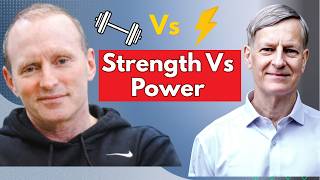

Power, Not Strength, Is Key for Longevity
60sContradicts common focus on strength, explaining power's crucial role in preventing falls and mortality.
▶ Play Clip"Delivers on the promise with expert insight, though the title slightly oversells the novelty."
In this video, Dr. Brad Schoenfeld discusses the critical role of muscle power in longevity and healthy aging, explaining how power—the ability to produce force quickly—is more closely linked to all-cause mortality than strength alone. He highlights the importance of power for preventing falls and maintaining physical independence, and presents compelling evidence that resistance training can reverse sarcopenia and dramatically improve functional capacity even in the very old.
Strength is most closely correlated with all-cause mortality, but power—the ability to produce force quickly—is built on a foundation of strength and is the ultimate factor in longevity.
Beyond mortality, quality of life and physical independence are crucial. These depend on a combination of strength and power, enabling activities of daily living unassisted.
Hip fractures are a major factor in mortality for those over 65. The ability to reverse a fall quickly involves power—producing force in shorter periods of time.
Training specifically for muscle power has been shown to have important benefits in the elderly for functional capacity.
Power is harder to measure than grip strength. Tools like jump mats can measure power, but hand grip dynamometers are easier and correlate with overall strength.
Sarcopenia is age-related loss of muscle, now defined as loss of muscle plus functional decline. It can be reversed with resistance training, including free weights, machines, or bodyweight exercises.
Consistent resistance training doesn't require much: two to three days a week, half an hour per session, can yield pronounced benefits.
Maria Fiatarone's 1990 study on 90-year-old nursing home patients: leg extensions, three sets of eight, three days a week, led to 150% strength gain, 50% functional capacity gain, and three of ten subjects could walk without canes after 8 weeks.
Resistance training can undo many detriments in a relatively short period, though starting at 70 won't return you to your 20s, but remarkable improvements are possible.
Power is a critical, often overlooked component of longevity, and resistance training can rapidly improve strength and functional capacity even in the very old, enhancing quality of life and independence.
What is the ultimate factor in longevity according to Dr. Schoenfeld?
Power
00:19
How is power defined?
Power is strength over time; the ability to produce force in shorter periods of time.
01:30
What is sarcopenia?
Age-related loss of muscle, now defined as loss of muscle plus functional decline.
03:25
What were the results of the Fiatarone study on nonagenarians?
150% strength gain, 50% functional capacity gain, and 3 of 10 subjects could walk without canes after 8 weeks.
05:43
What is the minimal dose of resistance training that yields benefits?
Two to three days a week, half an hour per session.
04:45
Power is the ultimate longevity factor
Challenges the common focus on strength, highlighting power as more critical for mortality.
00:19Hip fractures and power
Connects power to fall prevention, a key mortality risk in the elderly.
01:17Nonagenarian study results
Demonstrates dramatic improvements in the very old with minimal training.
05:12Rapid reversal of detriments
Emphasizes that resistance training yields quick results, not years.
06:11[00:03] >> You said strength is actually most most closely correlated with with all cause mortality. Although I've also seen data that it's it's power. So it's power and strength? It is. So I mean but strength is related
[00:19] Power is built on a foundation of strength. So absolutely the ultimate uh strength. So absolutely the ultimate uh um factor in in longevity is power. But
[00:33] strength you're not going to you can be able to produce a lot of have high velocities but if you're not able to have force behind that velocity uh you're not going to have you're not going to stave off a fall. So
[00:49] issues. Um look it has to do with So we will talk often about mortality and certainly that is a huge factor but I would also argue that the quality of life is extremely important like
[01:04] physical independence and that is both a combination of strength and power. Your ability to carry out activities of daily living unassisted. Um but anyway but to to your point from
[01:17] a mortality standpoint hip fractures are a huge uh factor in in mortality in in the older population those over 65 and the way that you
[01:30] reverse a fall is through quickly rapidly um counteracting the fall which involves power. Power is strength over time. The the ability to produce force in shorter periods of time. So you can have a lot
[01:45] of strength and not be able to induce that strength rapidly. Although usually when you're strong you have good power as well but they're not they're not inherently tied. So there's a certainly a strong
[01:58] relationship, but uh we can talk about this. That is why some power training has been shown specifically training for muscle power has been shown to have uh important benefits in the elderly for functional capacity.
[02:12] Yes. W- Would you think that the reason that power is less talked about is it's just harder to measure? Cuz it's it's so easy to measure grip strength, but it's very it it's harder to measure power.
[02:26] mean, there is different tools. Jump test. I mean, we do very in the lab in laboratory conditions, but even you could conceivably do it with a uh just jump mat costs uh there's other iterations of it costs uh $100. But
[02:42] yeah, and I mean, dynam- hand grip dynamometer is the easiest, as you're saying. But I I will say even though the correlation there's nothing special Usually, it's the correlation that people with strong hand with lot of hand
[02:56] grip strength usually have strength in the other parts of the body as well. So, it's not that hand grip strength per se. if you have strong grip, that means you're going to have less mortality. I
[03:10] mean, there is an association there, but it's because conceivably of strength in other areas. Yes. Yes, I always thought that that it it's just the easiest marker to read, but it's not actually
[03:25] the the strength that matters. So, sarcopenia is something that people you sarcopenia is something that people you know, it's age-related loss of muscle. know, it's age-related loss of muscle. And you know, can sarcopenia be
[03:37] And you know, can sarcopenia be reversed with muscle with uh the right kind of protocol, which would be I guess strength training? Yeah, I I do want to absolutely can, but I want to qualify too that sarcopenia
[03:50] been revised as a classification not only into loss of muscle but in combination with a functional decline. So, generally speaking, when you have a functional declines, but I just do want to clarify that it's both
[04:04] the loss of muscle as well as a loss of the ability to invoke strength and the ability to invoke strength and power. So, but yeah, absolutely there's compelling evidence that the resistance training in particular, meaning that can
[04:18] be by the way lifting weights like free weights, that can be using machines or cables, that can be doing conceivably things like body weight exercise such as push-ups and and wall squats and other things. So, it
[04:32] partially will depend upon your initial strength levels and initial initial functional capacity. Um, but here compelling evidence that um
[04:45] if you do if you consistently resistance train, it doesn't have to be that much train, it doesn't have to be that much either, you know, you can do fairly a minimal dose training, you know, a couple two three days a week, a half
[04:58] hour per session, get really pronounced benefits from it, and um you can see just amazing benefits. The I like to bring up one of the classic studies of all time in the field, which was done on nonagenarians, meaning 90-year-old
[05:12] nursing home patients. Uh, it was carried out by um Maria Fiatarone's group back in 1990. I believe in 1990, but in in the early I believe in 1990, but in in the early 90s. And uh they took a a group of 10
[05:26] frail elderly, you know, 90-year-old average 90-year-old uh subjects, put them through just doing leg extensions, the machine knee extension exercise, three sets uh of eight three days a week. So, again, relatively very quick
[05:43] sessions just for the lower body. And um the gain strength was 150% the gain in functional capacity was 50% but my favorite part of the study 50% but my favorite part of the study was three of the 10 subjects after 8
[05:58] weeks were able to walk without the assistance of their canes. So nothing is more functional than being able to walk unassisted. And it just really I think speaks to the power no pun intended of resistance training
[06:11] and how rapidly you can see results. This is not something that takes years to do. So you can undo a lot of detriments in a relatively short period of time. Now you're not I certainly don't want to make it seem like you can
[06:25] just undo everything if you've never resistance trained before and you start when you're 70 years old you've already lost a lot of muscle and you're not just going to regain you know that muscle.
[06:37] You generally not going back to when you were 20 but you can have serious improvements. I mean remarkable improvements in relatively
[06:49] remarkable improvements in relatively short periods of time.



⚡ Saved you 0h 06m reading this? Transcribe any YouTube video for free — no signup needed.