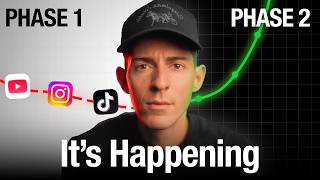

AI Content Revolution: Why Humans Are Rejecting AI
43sTaps into the controversial debate about AI content and predicts a counterculture movement, sparking curiosity and debate.
▶ Play Clip"Delivers on the promise of five trends with actionable advice, though some sections are padded with self-promotion."
The video discusses five major shifts in social media, emphasizing the rise of AI content and a counterculture movement favoring human-made content. The creator advises business owners to lean into human-made content, live streaming, super duper niches, personal storytelling, and in-house brand studios to stay ahead.
The creator, with a million followers and billions of views, introduces five social media trends and opportunities for brands and creators.
AI content is becoming indistinguishable from human-made, leading to a flood of AI content. However, there is a growing human revolt against AI-made content, with platforms banning AI faceless channels and viewers soft-canceling creators suspected of using AI.
The creator advises against playing the AI faceless content game because it trades off human trust, which is crucial for off-platform purchases. The bar for trust rises as AI content floods, making it harder to build trust.
Creators like Gary Vee and Hormozi are shifting to raw, long-form live streams. This format works only for those with existing personal brands or top 1% charisma. For others, it's a poor growth strategy but excellent for nurturing a cold audience.
If you have a personal brand, add live streams as a nurture tool. If not, first sprint to relevance on short-form platforms like TikTok or LinkedIn, build a pool of aware viewers, then add live streams to nurture them.
The rise of 'for you' algorithms enables creators to dominate super duper niches—highly specific sub-niches. Owning a small niche makes it easier to become a category cult brand, as exemplified by Ganon Meyer with Instagram automation via ManyChat.
Storytelling content, especially first-person narratives, is outperforming transactional tactic videos. This format helps verify human authenticity and builds emotional connection, making it a powerful counter to AI content.
Major brands like Dick's Sporting Goods, Sephora, and Chick-fil-A are building in-house content studios to produce organic social media content. This shift creates opportunities for creators and agencies to provide services like editing, scriptwriting, and UGC.
The future of social media lies in human-made content, authenticity, and niche ownership. By focusing on trust, storytelling, and super duper niches, creators and brands can thrive despite the AI content flood.
What is the 'AI content revolution'?
A human revolt against AI-made content, with viewers rejecting anything with even a sniff of AI.
01:36
Why is playing the AI faceless content game not recommended for business owners?
It trades off human trust, which is crucial for off-platform purchases. Buyers do not buy without trust.
04:04
What is the 'content minutes' concept?
The more content minutes someone watches, the faster trust accumulates and the quicker they ascend to purchase.
07:11
What is a 'super duper niche'?
A highly specific sub-niche one level below a general niche, e.g., 'content psychology for social media growth for business owners'.
14:00
What is the formula for finding your super duper niche?
Topic × buyer avatar × method × visual format.
18:40
Why is personal storytelling outperforming on social media?
People are sick of transactional tactic videos and want to verify the human side of content.
19:46
What is the 'Dunbar's number for the internet'?
The maximum number of creators you can list off the top of your head, about 150-200.
17:09
AI Content Revolution
Predicts a counterculture movement against AI content, which is a novel insight.
01:36Trust is Key
Emphasizes that trust is essential for purchases, and AI content erodes it.
04:04Content Minutes Concept
Introduces a measurable metric for building trust through content consumption.
07:11Super Duper Niches
Explains how algorithmic discovery enables niche domination, a strategic shift.
14:00Brands Going In-house
Highlights a major trend of brands building in-house studios, creating opportunities.
22:14[00:02] for brands, for creators, for anyone that's using content to build a reset period. And the future of social media is going to work a lot differently than it has the past couple years. Now, the good news is there are lots of new
[00:15] ways to win that just weren't possible before. I know this because I spend all marketing, and distribution. I have a million followers. I've done billions of views. and I'm starting to see trends and patterns that are not obvious to the
[00:28] opportunities. So, in this video, I'm going to walk through the five most interesting social media shifts happening right now so that you can take right, this first social media opportunity is very interesting. And
[00:41] that trend is the evolution of AI content and how it's affecting the made this video breaking down the trajectory of AI tools and how soon content that was indistinguishable from humanmade. And I said that if that trend
[00:56] continued, social platforms would get flooded with AI content. The supply would go up 10,000x, the demand would stay relatively flat, and so human out. And to some extent, this is playing out exactly how I thought. The AI
[01:10] the point where they're indistinguishable from human-made content. Nano Banana Pro, Veo 3, and soon to come Veo 4, the Cling models, these are all objectively insane. Perfect realism, indistinguishable for
[01:23] 99.9% of people. And so, if you know what to look for, we are seeing fully automated autonomous workflows that are churning out AI content almost automatically. But there's also something else going on in parallel that
[01:36] I did not predict or expect. And I'm calling it the AI content revolution. I'm starting to sense an active revolt from humans towards anything at all that is even remotely AI made. It's as if all humans have a joint understanding to
[01:50] instab anything with even a sniff of AI. level. We're seeing YouTube out of nowhere just banning AI faceless channels. and at the individual level where people are essentially
[02:03] softancelling creators if they sense that any of their stuff is made by AI. the big opportunity for you? What this means is that we are in the very early stages of an AI content revolution and are going to continue to see a
[02:16] divergence in how the social media game is played. On one side, the platforms that do allow AI content are essentially going to become overrun by AI personalities, bot-driven content swarms, and algorithmic content
[02:28] factories. And my initial hunch 6 months ago was that this trend was going to infiltrate and basically ruin the entire content world. But now, I'm more seeing in the comments that there's going to be a counterculture revolution
[02:42] where human-made or human verified actually will exist and thrive in the future. And if for nothing else, simply because human viewers are rejecting the AI made notion a lot more violently than I thought they would. And so if you're
[02:55] questions that matter with respect to how you can take advantage. Number one, should I play the AI content game or the humanmade content game? And number two, if I choose to play the humanmade content game, what tweaks or shifts in
[03:09] my strategy can I make to take advantage of this counterculture movement as it grows? And so let's answer both of those. In my opinion, playing the AI proposition that you should stay away from unless you really know what you're
[03:22] doing. At best, you rack millions of slot views and play the advertising game where you only monetize based on the CPM share from the platforms. But I promise you, this advertising CPM game is going to go to zero over time. It's just math.
[03:36] this. If you play the AI faceless content game, it's basically like every time you post, you pull a slot machine, but whenever you pull, your odds of winning are going down over time in real time. And this is simply because the
[03:49] increasing supply of AI faceless content will compound in a hockey stick curve. business owner, this is the real reason why playing the AI faceless content game is not best. If you play the AI faceless content game, what you trade off is the
[04:04] human trust acrruel that really drives off-platform purchase. And that's still you're playing on social media. Said another way, if there's nobody to trust in the content, then trust will not be acred. And if trust is not acred,
[04:18] purchase will not happen. Buyers just do not buy without trust. And so if you make AI faceless content, the bar for trust goes up as the facilitation of that trust goes down. And so as the bar for trust is going higher on the
[04:32] internet, your content will stay fixed at low trust. Now, the gray area here when it comes to AI content is using an AI avatar of yourself or some consistent character that shows up every single video. This technically counts as AI
[04:45] generated, but psychologically will function as human-made as long as the viewer can't tell. But it's risky because as soon as they can tell you're they will write off the entire channel forever. And again, the reason I'm
[04:58] this video is because I just did not predict humans would have this visceral of a negative reaction against AI content. I thought they would kind of complain about it a little bit, but assuming AI content was the same or
[05:11] people would just watch whatever is entertaining. But I'm really seeing a ton of comments from a lot of different people that are viscerally against this idea of AI made. So my recommendation for any business owner is to lean
[05:24] heavily into the human-made content game. The alpha is to zag towards humanmade while everybody else zigs towards AI content. Now this doesn't mean AI content is not going to work. Of course it will. Over time as the data
[05:37] iteration loops get tighter and faster. AI content will 100% work. But the buyer psychology for trusting and purchasing from humans is such that you will get rewarded way more in the next 5 to 10 years if you can lean into humanmade as
[05:51] brings us to the second question which is how will the humanmade side of content evolve on social media and how should you tweak your strategy so you over the next few years. And so for the rest of the video, I'm going to break
[06:03] down a bunch of other opportunities and shifts that all play into this same shifts that all play into this same macro theme of humanmade is where all And so I'll break down how to take advantage. All right, the second major
[06:16] social media opportunity and trend is the shift towards raw, long form, and Hormosi, you'll notice recently on YouTube, he shifted way into the live stream, raw aspect of content. He basically turns on the camera, riffs for
[06:31] a few hours, and posts relatively uncut. Now, they're tightening up the intro, multicams to try to add a little bit of stimulation, but that's basically it. On a scale of 1 to 10 in terms of retention editing, he's really close to a 1 or two
[06:45] And how is it an insight into the future of how social media and YouTube are easier and more fun for him to make. People that have real sauce, they just have to read line by line scripts. they just kind of want to go off the top of
[06:59] their head and share their insight. But two, and the more important reason, he minutes. Now, if you've been watching this channel for a while, you probably already understand the content minutes concept. But for those who haven't,
[07:11] get someone to watch your content, the faster you can accumulate trust and the quicker you can ascend to purchase. Live streaming is the most efficient way to build a bigger supply of content minutes for someone to consume. Because if
[07:25] you're posting 2-hour long videos every single day, that's 120 fresh content minutes daily that you're adding to the supply. There's just no other way to So, I predict just like Gary Vee and now Hermoszi, a lot of the other bigger
[07:38] educational creators are going to shift to add this live stream layer at the personally am going to start doing this in 2026 as well. Now, the good news is these types of videos are actually easier to make for the creator because
[07:51] what you're talking about is turn on the camera and go. But here is a very big thinking they're going to shift their long- form strategy to just be raw live streams. Live streaming as a format will only work if you have a previously
[08:05] existing personal brand or top 1% charisma. For everyone else, it will not this? Live streaming as a format is inherently high noise. If you watch every second of what someone says over two hours without any filtering, you're
[08:19] inherently going to get a lot of lower value dead time. Now, Hormosi and Gary because A, they're deep enough in the tactics to really know what they're talking about, and B, they're articulate enough in their delivery to compress
[08:32] speed to value so that you get enough value hits over time to make it worth it. Also, Gary is top 1% charismatic, and so that adds another element to make entertaining to watch him as a performer. But for the average person
[08:45] that has not made a bunch of content or doesn't have a very tight articulation on camera, this is not going to be the case. The brutal truth is that most people are either not articulate enough nor charismatic enough to carry a live
[08:59] stream for 2 hours with the value density required to make it work. And this means that when a beginner starts live streaming from scratch, the speed to value slows, the value density decreases, and the new viewer that hits
[09:11] that video will churn in the first couple minutes. And this means your live streams will get weak metrics, not get pushed by YouTube, and you will not grow existing personal brands, especially if you have a lot of proof, have enough
[09:24] trust carryover that viewers that know you from somewhere else, are usually willing to see through that lower value density and give your live streams a brands, even if it's built on a different channel, can work if you start
[09:38] live streaming. So, here's my super tactical advice for every type of person advantage of live streams coming up in the next year. If you have a personal brand already on any platform, you should add live streams in the stack
[09:51] coming up in 2026. Don't think about it, just do it. And the goal with these live You're not going to get a lot of new people discovering you from the live streams. The goal is to be the bottom of the funnel that nurtures with as much
[10:05] already trust and like you. I like to think of live streams as a nurture YouTube, you still need to heavily prioritize the packaging, the title, the thumbnail, the intro, but when it comes to the actual video itself, you should
[10:19] uncut. Now, if you don't have a personal brand, don't start with live streams in 2026. Instead, you need to first sprint to relevance and then add live streams. would use to sprint to relevance. Step
[10:34] skills or a unique perspective that's worth hearing. So if you don't have that, you need to first focus on that. What does that mean? Go out, build a skill actually works. You have a differentiated perspective on how to
[10:48] implement that skill to get the results someone would want. Start there before anything else. Step two, once you have that core set of skills and some proof that you know what you're doing, go to a different platform where your core buyer
[11:00] lives and post a high volume of valued content. Typically, this is going to be Tik Tok, or LinkedIn. And this is critical because what you're trying to do is build a pool of personal brandaw aare viewers. People that know you and
[11:14] give your live streams a chance once you start them. And here's how to think about it. If the content minute threshold to get someone to buy is 100 and you're at a zero, maybe to get them to try your live stream is a 15. And so
[11:27] what you want to do is sprint to 15 using some other platform with a lot of the best way on Instagram, Tik Tok, or LinkedIn. Go from a 0 to 15. And then once you have enough people at a 15, then you can start adding live streams
[11:40] at the bottom of the funnel designed specifically to nurture those people at a 15. It's not meant to grow more zeros. It's meant to get people at 15 to 100 as steps, step three, once you start posting on that short form medium,
[11:55] compound just that for 6 to 12 months to build that critical mass, that pool of people at a level 15 as big as you can. You just need enough critical mass here so that when you do post a live stream, the views of the live stream can be big
[12:08] enough where an incrementally new person doesn't write it off immediately. If you have a YouTube channel with 20,000 subs, but then you post a live stream with 150 viewers, the incremental person coming to that is not going to watch it because
[12:21] too low. So, what you need to do is build enough personal brand relevance on the short form channels to get enough people that are willing to try your live streams so that that view number doesn't look suspiciously low. And that leads us
[12:34] to step four. Once you have a critical mass of personal brand value, let's call it 25,000 followers on Instagram. You'll then have a big enough pool so that when you do live streams, you can get the people at the level 15 from zero to go
[12:48] give you a chance. The point is, and I really want to underscore this, super raw, long-formed live streams are a horrible way to grow an audience from zero, but they're an amazing way to nurture a cold audience into a super
[13:01] YouTube algorithm today is just not built in a way to really reward a super raw, long- form live stream from someone that has a very weak personal brand. But they're an amazing way to heat those people up quickly to get them to
[13:17] owner and you're trying to figure out how to get better at content, whether the way I explain these things, but you really want more tactics, I built a free community with 65 free trainings just for you. I cover things like algorithm,
[13:32] storytelling, editing, formats. Everything you'd need to go from zero to really getting going on short form social media or YouTube is in there. It's called Wavy World. It's completely free. We got 39,000 other business
[13:44] trainings and are all working together to improve their content as a want an accountability group, you want more in-depth focused trainings, Wavy got a link in the description if you want to join. The third opportunity I'm
[14:00] seeing on social media is the emergence of what I call a super duper niche. Think of a niche like the first level topic selection. So, for example, social super niche would be one level below that. So let's say social media
[14:14] marketing for business owners. Now a super duper niche would be one level below that. So let's say focusing only on content psychology for social media growth for business owners. Now in the past super duper niches would not work.
[14:28] They were way too narrow for you to be able to grow big enough to monetize. And that's because there was no method for algorithmic discovery on these social platforms. So, even if there were 30,000 people that were huge fans of the niche
[14:41] for you to find them or for them to find you. But now, the riches actually are in the niches. And that's because the for you algorithms have created a way for you to find those 30,000 people really fast. Their matching is super super
[14:56] sophisticated. And because of this, the big opportunity on social media for the next couple years is to dominate and own a super duper niche category. Here's media, all you have to do is to become a category cult brand. And this is just a
[15:10] fancy way of saying you need somebody to think of you when they have a problem that you sell a solution for. You don't need to become the most well-known personal brand in a huge category. You just need to own a super small slice of
[15:23] that category that matches with an offer that you sell. And this is because when you're able to own a super duper niche, people will attach that term to your name and store it in their personal brand mental library. A good example of
[15:36] this is this guy Ganon Meyer. When I think many chat automation on Instagram, this guy occupies that row in the database in my head. Now, he could have He could have made content about marketing and business, still huge, but
[15:51] slightly smaller. But no, he decided to own Instagram automation via many chat reason this is so brilliant is because by picking that small super duper niche, there's a lot less surface area that he
[16:04] has to cover in order to dominate and own that plot of land. Imagine if you were a king in the old days and you had to govern over tens of thousands of miles of land. It's just a lot of surface area to control when other
[16:17] people might come and try to slice off a corner. But if you have a very small kingdom 10 m wide, you can easily monitor that and dominate it forever. about big niches versus super duper niches. For Herosi to own the category
[16:31] of business, he either has to have a super large army patrolling or make so much content that it's just impossible for anyone to cut through. He's choosing option B. But it's much easier for you to pick a super duper niche slice way
[16:44] over there in the corner that no one's paying attention to and easily own it. because as the proliferation of AI content goes up and the number of fake creators that you're exposed to goes up, it'll be harder and harder for the
[16:57] viewer to remember your name in mass in their brain. I like to think of this like the Dunbar's number for the internet. If I ask you to list all the creators that you think of that you really like, at the most you could list
[17:09] 150 to 200 off the top of your head, at the absolute most. But if you tie a name to a super duper niche term, as soon as I say that term, those 200 go away and you just think of the one person that owns that term. So this term ownership
[17:22] will become extremely valuable as AI content begins to flood social media. Now, the tactical suggestion for how you take advantage of this is the following. product, service, or offer you're going to sell. The truth is, a lot of the
[17:35] facing, not being able to figure out what term to own, stems from the fact that you don't have anything at the bottom of the funnel anchoring you to making. The reason you feel lost is because you don't know what super duper
[17:48] niche will help make money for you once you do have an offer at play. So, just flip the tables and start with figuring out what the offer or product or service is going to be. Start there and work backwards. Now, based on that offer, you
[18:00] want to think about what is the narrowest set of terms or keywords that I could own so that when a stranger hears those words and sees my channel, the offer I'm selling feels like a compliment. The ramp is clean from one
[18:13] to the other. Whatever that term is, you want to go allin on owning that super duper niche category. Now, the way to own it is actually very simple. You just make a ton of content specifically on that super duper niche term or small set
[18:26] of keywords and you do not deviate beyond that for 12 to 18 months. Now, by doing this, your views and aggregate will go down because the TAM is just smaller than a super broad category, but your trust and your sell through and
[18:40] still struggling with how to come up with your super duper niche, this is kind of the formula that I like to look at. It's topic time buyer avatar time method time visual format if you're making a visual form of content. Those
[18:55] super duper niche. So for me on this channel it would be social media marketing is the topic. The buyer is a business owner. I'm making social media marketing content for a business owner. The method is kind of like educational
[19:07] breakdowns. That's kind of the type or method that I cover. And then the visual format are these visual explainers where I include motion graphics and charts to help visualize what I say. There's not a clean word for that. Those four things
[19:19] multiplied together is my super duper niche. That's the lane I own on YouTube. I would challenge you to find anybody else that would beat me at that lane. That's cuz I narrowed it down so it was easy for me to own. You want to use that
[19:32] formula to help guide how you position your super duper niche so you have more Another huge opportunity for the next 6 to 12 months on social media is to lean into personal narrative-driven storytelling as a content format,
[19:46] this complements perfectly what I was saying before about the counterculture movement against AI. People are starting to get sick of the transactional tactic type videos that people repeat over and over again. For one, these tactics are
[20:00] copying everybody else and nobody's coming up with new stuff. And two, when the human viewer is not able to verify the human side of the content, they just like it less. People are sick of seeing the faceless AIdriven and they want to
[20:14] verify with their own eyes that the content is being made by a human. And so storytelling is really starting to outperform on social media. Now, when I say personal storytelling, what exactly do I mean? I like to think of it as
[20:28] story wrapped education. Imagine you had like a a gobstopper. You have education in the middle and then there's a story that wraps around that educational value. Personal stories usually include some type of learning experience, some
[20:40] situation, scenario, some arc that the creator went through. It's usually told from a point of eye instead of point of view. So it's like I read 350 books this year. Here's what I learned from it. Then the creator usually frames how they
[20:53] it's about emotional transfer. And usually it ends up sharing a lesson, piece of wisdom, or tidbit. That's that educational piece. Now, some really good this narrative-driven style would be Khloe Sha, Ken Jandra, and Yanni
[21:09] highlighted before on the channel because they're really blowing up right now using this style. Now, storytelling content is a bit harder to produce than pure educational because A, it requires you to figure out what the narrative arc
[21:22] is going to be of the story. And B, and probably more important, it's kind of hard to come up with visuals that are not shot by you when you're describing a narrative story that you experienced. And so, this is why the visual format
[21:34] that works for this is this like visual narrative style where people are almost acting out the scenes they're overlaid. Now, will this personal storytelling be the most popular
[21:47] storytelling structure that works for short form forever? Probably not. But is there a huge opportunity to lean into this narrative-driven firstp person Absolutely. If you're in a niche where
[22:00] couple people that are doing this narrative driven first-person storytelling style, you should own this right now. There's no better switch to flip in terms of growth than using this narrative storytelling in a niche that
[22:14] now, it is working super well. All right, another massive shift in the that not a lot of people are talking about is the emergence of massive companies and big brands building in-house studios to produce organic
[22:28] social media content. Simply put, the big brands are going in-house for their content. They're building these huge production houses and studios to double because every modern CMO is realizing
[22:40] that their company is actually a media company in disguise. And most of them organic content, or farming it out to trenches with what they should be doing.
[22:52] sporting goods store in the US, is building an in-house production house. They just announced it. Sephora has been doing the in-house content studio play down on it. Chick-fil-A is trying to build a Netflix streaming service
[23:05] read that headline. So, they're doubling down as well. And this is just the tip of the iceberg, the start for these massive companies going allin on short form organic content because the truth is every major brand is going to realize
[23:19] they need to bring the content to the core of the marketing flywheel. Before content was a spoke in the marketing stack. Now content is the core and everything else funnels off of the content. So between whether it's organic
[23:32] content or Tik Tok shop or these vertical episodic series, brands can just not afford to take lightly the organic social media platform and the And so these contest studios are going to look like a lot of different things.
[23:46] They're going to be pods of UGC creators. They're going to be more They're going to be repurposed ad agencies that go under that then go different flavors of what these look like over the next few years. But here's
[23:59] to this and you're trying to figure out, okay, what's the point of this, right? If I'm not a CMO, how can I take advantage? When there's a huge shift from one marketing category to another, from legacy media to social media, there
[24:11] are millions of picks and shovel providers, whether they're individual creators or small agencies that need to help these companies make this you run an editing agency, huge opportunity. If you do script writing,
[24:25] if you're a UGC creator, if you run a small pool of talent that are all creators for brands in a certain category, an entirely new infrastructure built for these big companies where they're all going in-house, but they
[24:37] don't know what they're doing. So, closing that gap is a huge tens of billions, if not hundreds of billions of dollar opportunity that really nobody is is, if you run a lean agency, it only takes one of these Fortune 500 clients
[24:49] business per year, it's super profitable. So, I expect to see a lot updates on the brand side, I will let you guys know and keep you in the loop. this video. As a recap, we covered the five most interesting trends happening
[25:02] right now in social media and the tactics for how you can take advantage always, I'm trying my best to share unique and novel takes that you just don't hear everywhere else. If you're trying to get an edge, this is the best
[25:15] regurgitate stuff that's out in the market. I'm really trying to come up with cutting edge different approaches for how you can help dominate social owner and you want to improve your content, you should definitely join Wavy
[25:27] World. Like I said, it's free. I pretty much couldn't put more value into it. 65 entrepreneurs. So, you get a peer group in the world, all for free. It's better than 99% of paid courses. That's what I
[25:41] where we're at. You get a free invite link in the description if you want to join. All right, we'll see you guys on the next video. Peace.




⚡ Saved you 0h 25m reading this? Transcribe any YouTube video for free — no signup needed.