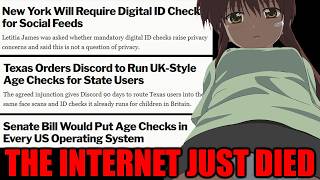

NYC Wants Your ID for Social Media
45sImmediate hook about a major privacy change in NYC sparks curiosity and concern.
▶ Play Clip"Title is dramatic but content delivers on the core claim, though with some repetition and tangents."
The video discusses New York's new law requiring digital ID checks for social media feeds, arguing that it is a Trojan horse for surveillance and censorship rather than child protection. The creator highlights similar moves in Texas and the UK, warning of data breaches, doxing, and swatting risks, and criticizes the lack of mainstream attention.
New York will require digital ID checks for social feeds, following similar actions in Texas and the UK, indicating a broader trend.
A Texas judge forced Discord to enable age checks originally built for the UK, showing cross-jurisdictional influence.
Requiring ID and personal info increases risks of data breaches, doxing, and swatting, as companies may not protect data.
The anonymous nature of the internet will die, leading to censorship, shadowbanning, and worsened debanking.
The law is a Trojan horse for surveillance and control, not child protection, as claimed.
The law will be voted on August 5th, affecting all platforms like Facebook, YouTube, Google, Twitter, and Wikipedia.
Data breaches happen continuously, so trusting companies with sensitive data is risky.
Few are talking about this, possibly due to corporate interests in invading privacy for ad revenue.
Politicians who oppose voter ID as racist are fine with digital ID for internet access, showing control motives.
The Kids Act requires age verification via digital ID before algorithmic feeds or notifications after midnight, effective January 25, 2027.
Even though written for under 18s, age checking reaches all users, requiring government IDs, face scans, phone numbers, and emails.
Attorney General James rejected privacy objections, stating rules are not a question of privacy, but platforms must offer alternatives like selfies or cross-checked emails.
The law allows platforms to collect biometric data and cross-reference against other data, building a database on users.
Minors get chronological feeds and no overnight notifications unless parental consent, but parents also undergo ID checks.
Age checks must meet accuracy rates: 0.1% for under 7, 1% for 8-13, 2% for 14-15, 8% for 16, 15% for 17, and block 98% of bypass attempts.
Companies must keep testing results for at least 10 years, meaning personal data is stored long-term.
Platforms must delete data after use, but de-identification is ineffective in the AI era, and companies often shift blame to third parties.
Instagram, TikTok, Facebook, Snapchat, X, and YouTube are named, but any service with users spending 20% of time on addictive feeds is covered.
Sites with fewer than 5 million monthly users or 20,000 minors are exempt, but bot traffic may affect counts.
The law may apply to pirate sites, as they may have enough users, though unclear.
A representative suggested using AI to figure out if users are under 18, raising concerns.
Both Republicans and Democrats support digital ID, making it likely the Senate will pass the Screen Act on August 5th.
The creator urges viewers to call senators and vote out politicians who support these laws, as the only way to stop them.
The video concludes that digital ID requirements are a bipartisan effort to control and surveil internet users, with serious risks to privacy and safety. The creator urges viewers to take political action, as the laws are likely to pass.
What is the effective date for New York's digital ID requirement?
January 25, 2027
05:45
What are the accuracy rate requirements for age checks for children aged 8-13?
1%
10:15
Which platforms are officially named in the announcement?
Instagram, TikTok, Facebook, Snapchat, X, and YouTube
12:05
What is the exemption threshold for small websites?
Fewer than 5 million monthly users or fewer than 20,000 monthly minor users
12:33
What did the creator suggest as the only way to stop these laws?
Voting out the politicians who support them
15:32
New York's Digital ID Requirement
Highlights the start of a significant policy change affecting all social media users.
00:01Privacy Invasion and Swatting Risks
Connects ID requirements to real dangers like swatting, making the issue tangible.
00:42Not About Protecting Kids
Challenges the stated purpose of the law, revealing potential ulterior motives.
02:02Hypocrisy on Voter ID
Points out political inconsistency, strengthening the argument against the law.
04:33Accuracy Standards for Age Checks
Provides specific technical details that show the complexity and invasiveness of the system.
10:15[00:01] And you're wondering why I'm probably saying that. NEW YORK WILL REQUIRE DIGITAL ID CHECKS FOR SOCIAL FEEDS. And if you think that this is going to stop at New York, you are very much mistaken. You want to know why? Just two days ago,
[00:14] we had this with a Texas judge forcing Discord to turn on age checks built for Discord to turn on age checks built for the UK. The same draconic dystopian 1984 like laws that the UK has implemented on the internet. the a Texas judge, a
[00:28] Republican judge, forced Discord to do this. And then now we have New York City, which is a blue state, the exact opposite of Texas, now doing the exact same thing, but honestly to a higher degree on all social feeds. And so what
[00:42] I'm trying to say here is is that you know what this is going to do? Like I it it's going to lead to not just the invasion of your privacy and all that. It's going to lead to this. And you're probably wondering, why am I even
[00:54] showing a man that got crippled and paralyzed by swatting? Well, I'm going to give a very obvious explanation. When you have your personal information out there, you put your ID out there. You put your personal like home address and
[01:08] everything to be able to verify yourself, you're putting yourself at that that company that you're giving your ID over is not going to lose your ID to some form of data breach. Spoiler alert, there's going to be a
[01:22] data breach. I mean, Discord already proved that at the beginning of this Everybody talked about it. You know about it. I talked about it. The point here is is that this will lead to swattings. This will lead to doxings.
[01:36] That's not even getting into the other stuff with how it is the invasion of your privacy. The the anonymous nature of the internet will just straight up die. You will have people getting censored and shadowbanned all over the
[01:49] internet. debanking will get a lot worse. Everything in between. This is NOT ABOUT PROTECTING KIDS. Everything about what New York is doing, what Texas House of Representatives is doing, what the Senate's doing in a few days, it is
[02:02] not about protecting kids. It is a Trojan horse to be able to just basically know what you're doing and censor you. That is it. That That's all it's about. And it is so incredibly annoying how there is so many people
[02:15] that are just not talking about this. Like honestly, this is the most important thing I think almost any content creator could be talking about right now because this is so unbelievably dangerous. Like I mean this
[02:27] alone already proves that because like look what these laws are trying to do, that's going to be getting voted on on August 5th of this month. What New York is doing and everything. This is making it to where every single platform like
[02:41] for instance not just Discord but Facebook, YouTube, Google, Twitter, you know, every individual site you access, Wikipedia, whatever, you will need an yourself. Face scan and everything. You will need to literally dox your
[02:57] information over to these companies, these different sites that are not governmental sites, by the way. And the point here is is that you got to trust information. And as I already said, data breaches happen. We know this. They
[03:10] happen continuously. And so you you have to put your faith that these companies will protect your stuff when you know they're not. And when your data gets out through it and it's going to lead to potential doxings and swattings and
[03:23] disastrous. And like I said, the fact that there is literally nobody talking about this, barely anyone talking about at the very least is legitimately insane. And I don't know if it's because people just are unaware of it and it's
[03:37] YouTube and everybody else doesn't want you to see this. It's very possible different corporations have a lot to gain for your privacy being invaded. I mean that gets into the whole money part of it. I mean the whole reason why these
[03:51] scanning and your address and everything is that they could sell you ads. They place sell your data and ads because your data is worth money to different companies and investors. So there is that avenue of everything about this. So
[04:06] these companies stand to gain by invading your privacy. They might act they're not really pushing it back. They're pushing back on it. They're probably sliding money under the table to make these law lawmakers actually
[04:18] push and advocate for this even more. It is so crazy to me. But I I'm going on a tangent. I let Let me Let me bring it back for a second and let's just take a few moments to talk about this. the New York will require digital ID checks for
[04:33] social feeds. So, you know what I find really situation? Okay, besides what I've already talked about, what I find incredibly blackilling is that this is the same group of politicians that will
[04:46] swear up and down if you were to implement voter ID, it is quote unquote racist. But for some reason, they're completely fine with profiling you and you having to present your ID just to access the internet in any given moment.
[05:02] It is very obvious what's going on here. It is not about any good intentions. There's no good intentions here. It is literally about control and invasion of doing, who you're potentially going to vote for as well, and maybe getting rid
[05:16] platform because you have the wrong think, you have the wrong opinions. they will shadowban you into the ground. That type of stuff does happen. So, everything about this is just insane. But let let's read this. Okay, so the
[05:30] Kids Act, once again, we know that's It's not about kids, will require users to verify their age, which means a form of digital ID before an algorithm can curate their feed or a platform can send notifications after
[05:45] midnight. Attorney General uh Lati Latia or Latia James or whatever uh released the rules on July 28th alongside Governor Cathy. They take effect January Governor Cathy. They take effect January 25th, 2027. So FYI, this is passed like
[06:00] will go into effect next year at the already said and done for New Yorkers. You're screwed. I'm just I'm just going you know, the the Supreme Court or anyone turns it down, which it's looking
[06:13] like it might not happen, especially since it's clear as day that both political sides want digital ID. The red and blue, Republicans and Democrats both want it. The point here is is that I just with the political environment and
[06:27] how the world is, I don't think this is going to be shot down. I could be wrong. wrong, but it's not looking like it. I'm just going to be honest. But anyways, the law is written for under 18s, but as always has to be the case. The age
[06:41] checking reaches everyone. To keep an algorithmic feed or overnight algorithmic feed or overnight notifications, a user above 17 has to prove to the platform that they are an adult. Here we go. Confirming who counts
[06:54] as an adult means collecting government IDs, face scans, phone numbers, and email addresses from people who until now typed a birth date and moved on. James rejected the privacy objection to all this. The rules are not a question
[07:09] all this. The rules are not a question of privacy, she said. Yeah. Okay. Okay. That's some and we all know it. Platforms can accept a governmentissued ID upload and the rules force them to offer at least one other option. James'
[07:22] office also listed a selfie image or video or an email address or phone uh phone number cross checked against other data that is held on to a person. So, Straight up. This is confirmed from literally the politicians at the top
[07:36] that they are going to be holding on to your data.
[07:48] And you know what? There's going to be kids to be face gang and try to get past it. What? So, they're they're going to be holding on to images of kids and stuff, too. like it just
[08:03] that refused to release the full unredacted Epstein files. Just gonna say just saying it. Just saying it like it is. Anyways, um okay. It's clear that
[08:15] the law isn't shying away from allowing platforms to collect sensitive user data, including biometrics and allowing cross referencing against other data. internet. that that's what's happening, which is exactly what I talked about
[08:28] different things like that, censoring be making a paper trail on everything with your digital footprint and being given time. That's what they're doing. They they are going to be building a
[08:42] database on all of your information. And obviously if someone is able to get into information is lost there's potential possibility that they might be able to get access to all of your data which is
[08:54] horrifying to think about because of how these systems work. Um anyways for miners the the default changes instead of a personalized feed users under 18C sequence such as chronological order unless a parent consents to the
[09:09] algorithm version. Notifications between 12:00 a.m. and 6:00 a.m. also stop without parental consent. And it's not clear how that works with travel or time zones. So, I want to point something out here that is really insane. So, they're
[09:22] putting in parental controls that is technically already been in place for a stop any of this, parents should be parents and do their job. FYI, but basically, they're putting in parental controls to keep kids off. and you have
[09:35] past these parental controls, but you'll still need an ID and everything just to be able to access it, which basically it's clear that the intention is not about keeping kids off. It is literally just gathering everything about adults
[09:49] and everybody accessing these different sites. That's what's clearly going on here. A a minor can ask a parent to switch either feature back on, but their quest only goes through if the minor agrees to let the parent be notified of
[10:01] it. A parent who wants to grant consent goes through digital ID checks, too. A minor who lacks consent keeps access to the rest of the app, including search. An acceptable check has to mean an accuracy standard. It can wrongly pass a
[10:15] minor off as a no only so often, and the tolerance widens as children get older and harder to tell from adults. The rate has to stay at or below a 0.1% for children up to the age of 7, 1% for ages 8 to 13, and 2% for 14 to 15, 8% at 16,
[10:32] 8 to 13, and 2% for 14 to 15, 8% at 16, and 15% at 17. Those ceilings leave out users who refuse to hand over data or those results come back inconclusive. The check must also block at least 98% of attempts to get around it. companies
[10:45] run annual testing which means a lot of data collection and keep the results for at least 10 years. So what this basically means is all your personal data and stuff will be collected and stored by these different companies all
[10:57] these different sites for 10 years potentially. Yikes. Yikes. Data breach. I talked about it swatting doxings and all that type of stuff. There you go. Anyways, information collected to check age or obtain parental consent cannot be
[11:12] used for anything else and platforms must delete or de identify it immediately after use and collect only the minimum needed. We all know that deidentifying data does very little especially in the AI era where people
[11:25] can be profiled in unlimited new ways and people's identities can be detected from their usage patterns. And we also know that platforms say they delete user Yeah, there's many cases where they say they delete the data, but they really
[11:39] an excuse that they had a third party company or whatever that was holding and the original company that collected your data is not a fault, but it's all you know, shift the responsibility on to
[11:52] fault that caused it. You you get the point. Anyways, that promise holds only as long as the company holding the data honors it or a hack breach or bug gets in the way. Instagram, Tik Tok, Facebook, Snapchat, X, and YouTube were
[12:05] the platforms officially named at the announcement, but the rules reach any service whose users spend at least 20% of their time on addictive feeds. So, basically, if you're someone that is uh, you know, online a lot that uses
[12:19] Twitter, social medias, or whatever, you will be forced to probably require an ID That's that's what's being implied here. websites are exempt if they have fewer than 5 million monthly users or fewer than 20,000 monthly users who are
[12:33] minors. So, this one is a pretty big deal. Basically, this sounds like a um a okay, so they're not going to go after very small websites. But here's here's the issue. Okay, I want to I'm just going to poke a hole in this. Okay,
[12:47] first off, how do they determine 5 million monthly users? Are they people that browse our sites and there's a lot of bot traffic and this can cause million users. I mean, we don't necessarily know what they're counting
[13:01] as 5 million users. But if we're even getting out of that, let's let's be honest, the internet is very centralized now. Most people that browser the internet, they typically go to very few sites. They go to Google, they go to
[13:14] YouTube, they go to Reddit, they go to Twitter, they go to Facebook, Instagram, the same centralized stuff. Like if you're looking up information on games or different discussions on all topics, typically people either go to Wikipedia
[13:29] what will happen. And if it's not that, people will go to YouTube. Those are three big sites right there. Guides and everything is right there as well. Then platforms to basically chat and talk with other people, meet other people,
[13:42] it's going to be Discord, Facebook, Twitter. You get the point. So basically little sites more or less are really not going to be even a big deal at all begin with. But once again, we don't know if it's counting bot traffic or
[13:55] not. But this also implies that if you use a pirate site, for instance, anime piracy sites for example, it will potentially be required to do this. That's what I'm assuming. That's what's being implied here. So yeah, this is
[14:10] definitely an interesting thing that's going on here. So wanted to point that one out. Anyways, um the uh Hoa or patience for any objections to the law. Social media companies tell me we have
[14:23] under 18 or not. I said, "You're smart people. Use AI to figure it out." She people. Use AI to figure it out." She said, "Yikes, yikes. Yikes. Yikes." Okay, so overall, to get to the the big meat and potatoes of the situation, New
[14:38] York, this is the individuals that are uh pushing it. the these are the in New York. The same individuals and groups that will say that it's racist to have voter ID that it's the same group of people by the way, but they will
[14:51] force digital ID on the entire internet. Then we also have Texas doing the exact same thing in its own way. So it's not a issue of one political side doing it. It's both. And both are agreeing to it, wanting to do it. And this is what makes
[15:05] me believe that when it comes to the Senate on August 5th of this month, in just like two days from now, I feel like the law, the Screen Act, is going to pass. I would not be shocked. I would not I would not be shocked at all. But
[15:19] wanted to bring this up. The only thing I can really say to do at this point, which I've been saying, is call your local senator. That's it. But it's clear that they don't really care. They don't really care what we have to say. And the
[15:32] only way now to really stop it is by voting them out. That's really it at people either just don't care about their privacy being invaded to such a degree could lead to a lot of danger or it's being suppressed by the entire
[15:45] internet to not let you know what's going on. Whatever the case may be, it's bad. Anyways, you all have a fantastic day or night wherever you live. Be safe. day or night wherever you live. Be safe. Stay healthy. Chibi out.




⚡ Saved you 0h 15m reading this? Transcribe any YouTube video for free — no signup needed.