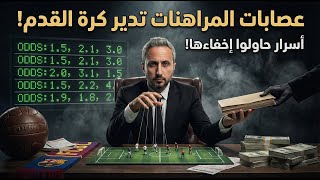

Billions in illegal betting ruining football
44sOpens with shocking scale of illegal betting money, hooking viewers with high stakes and controversy.
▶ Play Clip"The title promises an expose on illegal betting and match-fixing, and the video delivers with detailed cases and shocking numbers."
This video exposes the dark world of illegal betting and match-fixing in football, revealing how organized crime networks manipulate matches for massive profits. It details real cases like referee Robert Hoyzer in Germany and the infamous Dan Tan from Singapore, who controlled hundreds of matches across continents. The video also covers the massive Turkish betting scandal that led to over 1,000 players and referees being suspended.
Billions of dollars circulate illegally in betting, surpassing the economies of entire countries. While licensed betting is legal in some countries, match-fixing and manipulation are universally illegal.
Bets can be placed on specific events like first corner kick, penalty kick, medical staff entering the field, number of shots on goal, yellow cards, etc. These micro-bets are easier to manipulate.
Referee Robert Hoyzer was approached by the Spina Fina brothers, who befriended him and offered money for small favors like awarding a corner kick. He started with small fixes and was eventually blackmailed into fixing a major cup match between Hamburg and Paderborn.
Hoyzer awarded two scandalous penalties to Paderborn, leading to a 4-0 upset win. A journalist noticed unusual betting patterns and reported it. Police found calls predicting a penalty after the 60th minute, and bets from Turkey, Singapore, and Cyprus on a minor match.
$1.7 trillion circulates in betting globally, more than the combined economies of 120 countries. Of that, $500 billion is illicit.
Instead of fixing entire matches, gangs manipulate specific situations like a corner kick or yellow card. This is harder to detect and easier to execute.
Players and referees in lower divisions have lower salaries and less scrutiny, making them vulnerable to bribery. The spotlight is minimal, allowing manipulation to go unnoticed.
Dan Tan controlled a huge organization that fixed over 380 matches, sometimes three matches a day across different continents. He paid players $150,000–$300,000 per match and earned $2–$5 million per game. He was arrested with Interpol and Europol intervention.
Dan Tan used live betting, placing bets on events he knew would happen (e.g., a penalty in the last third). The odds are high, so payouts are huge. He had referees and players in his pocket.
Over 1,000 players and referees were suspended in Turkey after abnormal betting patterns were detected. 571 referees had betting accounts, 152 were actively betting. Players used Telegram groups to coordinate bets on specific events like corner kicks or yellow cards.
Ivan Toney was banned for eight months for betting on football matches, including betting on himself to score. He used inside information about his own participation.
Trippier told friends about his transfer to Newcastle, and they placed bets on it. He was convicted for sharing inside information.
Zaragoza allegedly paid €965,000 to Levante players to ensure a win needed for promotion. The money was disguised as bonuses. Players like Gabi and Ander Herrera were involved but not convicted.
Match-fixing and illegal betting are pervasive in football, especially in lower leagues where players and referees are more susceptible. The industry is highly organized, with gangs using blackmail and bribery to control outcomes. Even top leagues are not immune, as seen in the Turkish scandal and cases involving star players.
What was the total annual global betting volume mentioned?
Over $1.7 trillion.
06:56
How much of the global betting volume is illicit?
$500 billion.
06:56
What is 'spot fixing'?
Manipulating specific situations within a match (e.g., a corner kick or yellow card) rather than fixing the entire match result.
07:26
Who was Robert Hoyzer?
A German referee who fixed matches for a betting syndicate, starting with small favors and eventually fixing a major cup match.
01:13
What match exposed Robert Hoyzer?
Hamburg vs Paderborn in the German Cup, where he awarded two scandalous penalties leading to a 4-0 upset.
04:10
How did police confirm match-fixing in the Hoyzer case?
They found a call where one of the brothers said, 'The referee will award us a penalty kick after the 60th minute. Get ready.'
05:18
Who was Dan Tan?
A Singaporean crime boss who fixed over 380 matches across continents, controlling three matches a day.
08:10
How much did Dan Tan pay players per match?
Between $150,000 and $300,000 per match.
09:23
What is live betting?
Betting on events that happen during a match, such as the next corner kick or yellow card, with high payouts due to unpredictability.
09:54
How many referees in Turkey were found to have betting accounts?
571 referees.
14:19
How many Turkish players were suspended in the betting scandal?
Over 1,000 players.
16:39
What was Ivan Toney's offense?
He bet on football matches, including betting on himself to score, using inside information.
17:54
What did Kieran Trippier do that led to a conviction?
He told friends about his transfer to Newcastle, and they placed bets on it.
19:19
In the Levante vs Zaragoza case, how much money was allegedly paid?
€965,000.
22:01
Global betting volume exceeds $1.7 trillion
Shows the massive scale of the betting industry, with $500 billion illicit.
06:56Dan Tan controlled 380+ matches
Illustrates how one person can manipulate football on a global scale.
08:10Turkish scandal suspended over 1,000 players
Demonstrates the widespread nature of betting corruption even in a major league.
12:15Spot fixing is harder to detect
Explains why micro-manipulation is preferred by gangs.
07:26Live betting offers huge payouts
Reveals the financial incentive for fixers to use live betting.
09:54[00:02] Today I'm here to talk to you about an illegal business where the amount of money involved surpasses the economies of entire countries. Billions of dollars are circulating illegally, and it's not just billions of dollars circulating not just billions of dollars circulating illegally, but things that have literally ruined the game of football.
[00:15] And to be clear, betting itself isn't the crime, because women are licensed in some countries. For us, religiously, betting is forbidden, and in our country, women are prohibited. But in some countries, women are allowed, and it's considered legal and normal. However, what
[00:31] considered legal and normal. However, what I'm here to talk about is illegal, even for people who consider betting normal. When you talk about match-fixing gangs and gangs profiting from betting, you're talking about something completely different. By the way, there are many forms of betting. The most trivial
[00:44] is predicting the result of a match and who will win, but there are many other forms. Bets are placed on who will get the first corner kick, who will get a penalty kick, whether the medical staff will enter the field in the first quarter. Will the number of
[00:59] shots on goal in this match exceed a certain number? Will a certain player receive a yellow card? How many yellow cards will there be in each match? There are so many details, not in the simple, ordinary sense you're talking about. This is where the business comes in, because with a little
[01:13] manipulation, the story takes a completely different direction. I want to explain this to you practically, so let me tell you about a story that happened in Germany in 2004. There was a referee named Robert Hoyzer, 25 years old. He was considered a promising referee,
[01:28] officiating in the lower divisions. He wasn't yet refereeing in the Bundesliga, but his future seemed to hold that position. He was a well-liked, approachable, and this type of person is, by the way, good prey for betting syndicates. But let me finish the
[01:44] story. This guy frequented a certain café, and you can find It's easy for him, meaning if you're targeting him for something specific, you know where he hangs out, who his friends are, and you can easily enter his network. This is where two Croatians, whose name is the Spina Fina Brothers, got to know him.
[01:58] They started talking to him, saying that they had very good connections and that they could help him in his refereeing career because he dreams of refereeing in the Bundesliga. They said, "We can help you with this because we have a good relationship, and we actually like to help good, promising
[02:11] referees." The relationship became good, and they became friends. Then one day they told him, "We want you for a quick favor. There's a nice amount of money involved. You won't have to do anything at all. It's very simple. We'll give you 3,400 euros, and all we want from you is a corner for
[02:27] this team in the first quarter of an hour." Things like this, where I tell him I want a corner kick in the first fifteen minutes, or I want a yellow card for a certain player, or things like that—I'm not trying to ruin the match, I'm not telling you to fix the result. This is
[02:42] how gangs approach people like Heiser. They say, "It's simple, I do n't want anything from you. You're not going to ruin everyone's efforts. No, no, I'm just saying a corner kick isn't the best thing, it makes no difference." As soon as the guy agrees, because he feels it's
[02:57] easy money, and of course, his experience isn't that great as a referee at this level, he commits the biggest crime in history. He imagines he'll do it just once and there won't be any problems, but from that day forward, he's likely been
[03:09] problems, but from that day forward, he's likely been filmed, his calls recorded, and his participation in this major crime officially documented. The well-known method is that these gangs, as soon as they make a deal with someone—whether a referee, a player, or anyone else—film them while they're receiving the payment. In exchange for money, the
[03:23] guy becomes their employee because he can no longer refuse any request. Naturally, if he refuses, they'll start blackmailing and threatening him. They can end his career immediately with the photos they have of him.
[03:38] Anyway, Hoyzer liked it, and gradually started participating in these kinds of things – small matches, minor incidents, insignificant events. It's simple, and he makes a good amount of money. These people, of course, benefit immensely because these kinds of gangs
[03:54] can make huge profits, which I'll explain in the next minute. But to get straight to the point, let's talk about the match that exposed Hoyzer and effectively ended his career. Although he started small, it was a match between Hamburg and Paderborn in the
[04:10] German Cup. Normally, Hamburg would win, but in this particular match, the bet was on Paderborn to win. Heiser had to play a role in this. Heiser awarded a scandalous penalty to Paderborn, a fact that was filmed and documented, as it was a
[04:24] very famous and historic incident in German football. A Hamburg player was fouled, and in the second half, he awarded a second penalty to Paderborn, and Paderborn did indeed win 4-0, contrary to expectations. Consequently, the betting on Paderborn made huge profits, and the
[04:38] gang profited from this match, exceeding half a million euros. After this match, a very diligent German journalist began to investigate the circumstances
[04:50] began to investigate the circumstances exaggerated amount of attention given to this particular match. Why was it that the Paderborn-Hamburg match received so much attention, while a Bayern Munich or Dortmund match didn't? Why was
[05:04] this match given more importance than any other, especially since it was the match where the surprising result occurred? This was the match where the refereeing errors occurred. There was a general consensus that the penalties were fake, so this guy sensed something was off and reported it to the police. They began cooperating fully with the police in the
[05:18] investigation. The police, while tracking Sabina Brothers' calls and reviewing their call logs, found a call where one of them told the other person, "The referee will award us a penalty kick after the 60th minute. Get ready." If you don't understand what this means, it's that
[05:34] you can, of course, bet on whether, say, a penalty kick will be awarded in the last half bet on whether, say, a penalty kick will be awarded in the last half hour or the last fifteen minutes. This kind of thing is unpredictable, so the payouts are huge—not like
[05:47] predicting who will win the match. There was another call between Hizer and a friend where he said, "The hardest part of this is appearing normal, like I can do anything in a match." But the idea that you're trying to make it seem normal is what makes the
[06:00] issue difficult. When the police tracked the bets on this specific match, they found people betting on it from Turkey, Singapore, and Cyprus—countries you rarely see betting on a second-division match or a preliminary round cup match in Germany.
[06:16] So, the activity surrounding this match wasn't normal. With the recordings, it was confirmed that match-fixing had occurred. It was also confirmed that there had been fixing in six other matches in lower divisions, also officiated by Hoyser. All of this was confirmed. Of course, I don't need to
[06:31] tell you that Hoyser was banned from refereeing for life and imprisoned along with Sabine Praz. This was a case, of course. At the time, the police said it was just one instance, but they were certain there were
[06:43] many other similar cases. This story is just a small part of it. And of course, the betting market is a And of course, the betting market is a huge global phenomenon, and the sheer volume of bets... The money circulating in betting annually exceeds
[06:56] exceeds $1.7 trillion, which is more than the $1.7 trillion, which is more than the combined economies of 120 countries. Of that $1.7 trillion, $ 500 billion is illicit. As I mentioned,
[07:11] betting is legal in many societies and countries, and there are international networks involved, which I'll explain in more detail in the coming minutes. However, it's no longer just match fixing; it's more like spot fixing. It's not about manipulating
[07:26] matches, but about manipulating specific situations within a match. Many parties are involved: agents, coaches, players, administrators, and intermediaries. The whole thing is incredibly organized. So why are we
[07:40] specifically focusing on the second and third divisions? Why are they the primary target? Because, firstly, players have lower salaries, so when they get an opportunity like... So, for them, it becomes a simple matter, and they take it, and the referees do the same. The spotlight on the
[07:55] match, the filming, and all that stuff is much less. Consequently, it becomes fertile ground for any kind of manipulation to occur and go unnoticed by the big players in this field. A very famous man from Singapore named Dant Tan. Dant Tan had a formidable gang—a huge organization—
[08:10] connected to women, manipulation, and exploiting certain things that he orchestrated in matches to generate huge profits. This man, by the way, was arrested only after the intervention of the European police, Interpol and Europol. They were the ones
[08:27] who intervened because he had reached a massive level and was involved in fixing more than massive level and was involved in fixing more than 380 matches. It was said that he controlled three matches a day in three different continents,
[08:41] profiting from betting on those three matches. This man treated football as if it were... He manipulated chess the way he wanted, controlling specific leagues, particularly smaller ones where he could do all this, generate profits, and
[08:54] find more collaborators. There was a league in Finland, another in Lavia, a league in Almužad, a league in Estonia, and another in Armenia. Dantan controlled a significant portion of these leagues, able to dictate the synchronizations he wanted for
[09:09] each game. Now, regarding the actual figures—and this man was paying players in these leagues between
[09:23] $150,000. Sometimes, he would even pay an entire team $300,000 to maintain complete control. He was making profits of between $2 million and $5 million per game, depending on the specific league. The match, according to the events
[09:40] he requested, how it unfolded and what he verified precisely, Dantan had another school of thought, a very powerful one, which I'll tell you about now. He played live betting. Live betting is what happens during the match.
[09:54] watching the match, you can open the application and you'll find something called live betting. Live betting is about betting on what will happen in the next few minutes. You can bet on who will get the next corner kick, who will get the next yellow card, whether there will be any more
[10:09] yellow cards in the rest of the match, or even on live events within the match. The payout for these bets is very high, and that's what Dantan played because he knew what would happen. He knew, for example, that there would be a penalty kick in the last third of the match. He had
[10:23] this system in place. The referee was with him, everything was in his pocket, meaning nothing would escape his notice in a situation like that. So, he'd arrive while the match was in progress, acting like a regular bettor, saying things like, "There'll be a penalty kick in the next few minutes." Imagine the odds or probabilities
[10:38] of something like that; normally, if things were going smoothly, they'd be very low, and consequently, the payoff would be very high. So, he wasn't just doing traditional betting, that was one aspect of it. He was playing a much more difficult game:
[10:52] live betting, where he knew exactly what would happen. And by the way, sometimes he even had people in the stadiums giving orders about what would happen during the match because he was completely manipulating it. When he was arrested and the investigation was opened, they discovered he had
[11:07] also controlled matches between entire national teams. For example, there were matches being played in Turkey between Latvia and Estonia, and more. Aref knew that in matches like these, he had complete control over the referees and the teams. He even tried to control some matches in Africa, wanting
[11:22] some matches in Africa, wanting matches that would determine which team qualified for tournaments. He got involved in very big matches and was willing to pay a single player $550,000 and other huge sums. This guy was arrested with great difficulty because he truly was a
[11:36] Escobar and those people, this guy was similar, but in the world of football. An arrest warrant was issued for him, and he was imprisoned without trial for five years. After that, he was tried and then imprisoned
[11:48] again. It was said at the time that his release from prison would be a real, very serious threat and a huge danger to the integrity of football worldwide. We're talking about how easy it is to bet on, and now you probably understand why it's easier in the
[12:02] lower leagues. Let me tell you something that happened recently, and it was a scandal, in a way something that happened recently, and it was a scandal, in a way The word was tinged with big stars, and this shows you how far-reaching this issue is and how it can happen anywhere in the world. This happened in
[12:15] Turkey in the recent incident that led to the suspension of more than 1000 players in the Turkish league. This literally shook Turkey and caused an explosion in Turkish football, leading to the withdrawal of many sponsors and significantly damaging the prestige and
[12:29] reputation of the competition. This scandal began with a very simple match in the Turkish second division, Ankara Demirspor playing against a club called Belediyespor. Companies noticed abnormal betting patterns, something strange
[12:46] happening in the betting on this particular match, and how many people predicted that the match would end without a single shot. This is a kind of betting, a very outrageous kind of betting, where you say that this match will have fewer than five shots, or you don't know how many, or that this match will end
[13:02] without a single shot, and this match actually ended without a single shot. Both teams need to bet, and betting companies are of course very careful to understand what's called an course very careful to understand what's called an
[13:18] I tell you that Al-Ahly is playing Ghazl El-Mahalla, I might find that the bets are on Ghazl El-Mahalla a certain number of times. Or if Bayern Munich is playing against some other team, there's always a logic to it. When you talk about one team being stronger than another, you have to be
[13:35] logical. When I see a lot of bets going towards something illogical, it makes these companies open an investigation because, ultimately, their profits come from regular betting. So when they find something abnormal, they have the right to investigate. The betting law itself
[13:50] prohibits manipulation, so they try to prove that there was manipulation because it harms them significantly. Therefore, in this match, the betting companies knew and confirmed that there was manipulation. Something unusual betting companies knew and confirmed that there was manipulation. Something unusual
[14:04] Companies began reporting the matter to the police, who launched a comprehensive investigation. The initial investigation revealed that 18 players, four club presidents, two referees, and four administrators were involved. Some people called it a scandal, but what does that even mean? It's just a
[14:19] small, isolated incident. But that wasn't the end of it. Just last October, end of it. Just last October, they discovered that 571 referees in Turkey had accounts with betting companies, 350 of whom had accounts with women. And by the way, if you didn't know, it's generally prohibited for any football player or referee to
[14:34] bet, not just on their own matches, but on any football matches at all, not even on other leagues. They found that 350 referees had accounts with betting companies, and
[14:46] that 152 of them were actually betting and placing wagers on football matches. In a ruling by one of the referees, it was found that he had bet on more than 18,000 football matches in his life.
[14:58] on more than 18,000 football matches in his life. 149 Turkish referees, both the head referee and assistant referee, were suspended in one day. Then, in several waves, more than 1,000 players were suspended. Let me tell you how. The first wave was going to the Super Lig, which is the Turkish Premier League, and the First Division
[15:12] below it. These were 102 players. And right now, we're talking about Metinhan Baltashi, a defender who was talking about Metinhan Baltashi, a defender who was arrested and is serving time in prison arrested and is serving time in prison because it was proven that he was involved in betting.
[15:25] So, he has a case against him. He's being held because there's a case against him. He's currently in the process of the case itself. But he's a defender for Galatasaray, a big star in Turkey. The same thing happened to Mert Hakan Yendesh, a player for Fenerbahçe. So, what I want to tell you is that those involved in this matter are the big names, we're not
[15:40] talking about ordinary people, but big stars with established names in the league. And of course, their charge is that they They bet on matches they were personally participating in. So, when you're involved in a match, you can influence its events, whether by betting on your team losing,
[15:54] for example, and causing that, or by betting that your team won't get a clean sheet, since you're a defender and can be the reason for something like that. The second batch consisted of 282 players from the second and third divisions. These players were known to bet on specific situations within the
[16:09] bet on specific situations within the match, such as a particular corner kick, penalty kick, or yellow card. They would agree with each other to implement these events so they could all benefit from the betting. They had Telegram accounts and groups, and they
[16:23] often bet using the accounts of their wives, children, and friends. The accounts of their wives, children, and friends. The third batch consisted of 638 players from even lower divisions, and these were suspended, bringing the total to over 1000 players involved in the betting in Turkey.
[16:39] What exposed these people in this story was that they found a lot of accounts being created under fake names. They found a certain pattern, sometimes appearing repeatedly in the same match. For example,
[16:51] everyone would bet on there being more than 10 corner kicks, or on something specific happening. As I told you, these are abnormal and illogical patterns. One time it's about a goal in the last 15 minutes, another time it's about a penalty kick in the last 15 minutes. If the players had everything arranged
[17:08] together, it would be very easy for them to achieve these things. And the most famous arrests at that time, as I told you, included a player from Galatasaray, a player from Nar Bakhshasha, a Senegalese player who plays for Konyaspor, two referees, and other people. So, for some people, it wasn't just about sports anymore; there were
[17:22] many sports suspensions. As I told you, more than 1000 players were suspended, and their suspensions were extended you, more than 1000 players were suspended, and their suspensions were extended from 45 days to a year. But some of them were also involved in other matters. Civil crimes, so they will face imprisonment. Also, the presidents of three clubs from the
[17:37] Turkish Super League were also involved in this story and have legal problems and may face imprisonment. The charges all included match-fixing, illegal money laundering, suspicious financial transfers, threats to players, bribing referees, and manipulating entire tournaments. There are other well-known
[17:54] incidents, but I can tell you some details about them, like Ivan Toni, the famous English player who currently plays for Al-Ahli Jeddah in Saudi Arabia. Ivan Toni used to play for Brentford, which is common knowledge, and he was hysterical in training and was suspended for
[18:07] eight months. Ivan Toni's suspension meant he was banned from playing football. He couldn't attend a match in the stands, he couldn't even train with his team or play friendly matches with them. A suspension means a suspension. The most you can do is train privately with a coach who has no connection to the club,
[18:23] and don't tell anyone. Ivan Toni was betting, but he wasn't He was betting on betting, but he wasn't He was betting on himself losing matches, meaning his main offense was betting. It's himself losing matches, meaning his main offense was betting. It's
[18:37] negative things he intended to cause. For example, he was betting that he would score a goal. What was he gaining from this? He was benefiting from the information that he was certain he would play. If I were betting normally, I wouldn't know if Ivan would play or not. Yes, he
[18:50] probably would, but anything could happen. He might get injured and not play. This guy was benefiting from inside information within the team. He knew, for example, that the overall game plan favored him, that he was the one who would score today. He also told a
[19:05] friend that he would start the next match, thus helping his friend bet more accurately. And keep in mind, betting isn't just on matches, as I explained, or even on events within matches. There were bets on specific transfers, for example. It will happen, for example, and keep in
[19:19] mind, we're talking about Trippier, for instance, the right-back for the England national team. This guy, the right-back for the England national team. This guy, for example, also mentioned a transfer he was going to make to Newcastle or something like that. When he mentioned this transfer, he told some of his friends that it was confirmed, and
[19:33] his friends placed bets on it and profited greatly. Consequently, he was also convicted in something similar. Joey Barton said that he would bet on his team losing when he was very angry about not playing. One of his things was that he would
[19:49] bet on his team losing, especially if the coach left him out or didn't start the match. And there are famous stories that you all surely know, like Lucas Paquetá, of course. The guy who does strange things, he was acquitted recently, but there are
[20:05] clips of Lucas Paquetá that, when you watch them, make you wonder if he's even human. He gets a normal warning, especially in a famous incident this year, a few months or weeks ago, where a guy gets a second warning and is sent off. It's unbelievable, unbelievable, an abnormal situation. When I first saw it, I
[20:23] was watching live, and I opened X and everyone was laughing hysterically because the guy got a warning and started arguing with the referee. The referee said, "Okay, no problem." He argued again, and the referee didn't say anything. He argued a third time, and the referee still didn't say anything. He argued and argued and argued in an unnatural way. No matter how
[20:38] angry he was, people were saying, "My son, my dear, calm down, please, you have a warning, my dear, you can't go," until he got his second warning and was sent off, applauding the referee, pretending to be upset. The referee was a story, it seemed comical. And then, in the end, he went back to
[20:53] play in Brazil for Flamengo, even though he had offers in Europe. So, it's all a story. What can be proven, what can't be proven, that's another matter, but sometimes you see things you can understand. If you're going to judge her, I want to conclude this story with something that might
[21:06] not be directly related to women, but when you think about it, you might say, for example, "Well, this happens because there are corrupt leagues, leagues where this kind of thing can happen." Actually, there are similar things in many countries. There was a disaster in Greece related to match-fixing, and there was a disaster in
[21:18] Belgium related to match-fixing. But of course, Calciopoli... well, that's a famous story. But today I'm talking to you about what's related to women and what's not. For example, the Juventus story in Italy... this is a case where one particular individual controlled an
[21:35] entire system, like a game-fixing machine. He didn't just control the referees, but the media, the broadcasters, what they said, referees, but the media, the broadcasters, what they said, how they directed public opinion. This kind of thing requires episodes on its own, and many people have made episodes that contained very useful information. But
[21:48] even in Spain, there was a match between Levante and Zaragoza, and Zaragoza... He has to win to get Zaragoza, and Zaragoza... He has to win to get promoted, and at that time he told you that promoted, and at that time he told you that nearly one million euros (965,000 euros) were withdrawn from
[22:01] Zaragoza's safe and given to the players of his team. Just so you understand the story, I'm showing you how the scenarios can happen. Zaragoza gave money to 10 players, 95,000 euros each. Okay, fine. This money, guys, is like a bonus, like incentives, like
[22:18] the management asked the players to give them this money in cash. So, in the end, you're liquidating money in the club's coffers and you want to make it look legal. So what do you want to do? If I
[22:30] need to pay a million euros as a bribe, for example, I can't just withdraw it from the safe like that and say, "Where did it go? It went as a bribe!" So I say, "We gave it to the players because it was for bonuses." Even the players said so, including Gabi, who later became a share player. Atletico Madrid, Ander
[22:46] Herrera (a Manchester United player), and other big-name players were involved. They said they took the money and returned it to the management because the management needed to liquidate funds. When the police investigated, they found there was indeed an unusual money flow between Zaragoza, Zaragoza players, and
[23:01] Levante players who received money in an illogical manner. However, nothing was legally proven to warrant imprisonment. This story could have resulted in imprisonment, not just suspensions.
[23:13] Yes, suspensions and relegation, but if it had been proven, it would have been a complete crime. So far, no proof has been found, but everyone knows no proof has been found, but everyone knows something is wrong. Even the funniest comment
[23:27] on the matter was that either—and by the way, the president of La Liga said this at the time— something was wrong, or there was match-fixing. In a scam, either a team pays to win, which doesn't mean they didn't get the crime or
[23:43] the service they paid for, or they actually got it. So, this happened to me. Either there's manipulation or fraud. The important thing is that there's something illegal about it. The other side of the story, the woman, we'll get to in other episodes. It relates to how a woman can manipulate a person,
[23:59] relates to how a woman can manipulate a person, get inside them, control their mind and get inside them, control their mind and nerves completely, and destroy their home while they feel they can benefit from her. This is a purely psychological story that we can talk
[24:12] about later. But that was today's episode on the business and mafia of betting. We may have covered a very small part. I swear to God, I saw many things with my own eyes. Even my friend, who was playing in an Asian league, told me that sometimes their club sells These are
[24:29] n't deals related to women, they're deals to bring in players. For example, in the upcoming match, so-and-so and so- and-so have [a specific player/sports team], and it's already happening within the club. It's well known that players get their salaries from [a specific source of income]. The
[24:52] receives $200,000 after the deal is executed. Of course, the club benefits from this money and spends from it. So, in the end, football becomes a big charade that takes place in some leagues, as I
[25:04] mentioned. Also, the further you stay out of the spotlight, the more you find [something related to football]. That was our episode today from "The Black Box." I want you to write in the comments the topics you'd like us to cover in future episodes, because this is a topic that could be very important and beneficial to me. I hope to see you
[25:17] could be very important and beneficial to me. I hope to see you in other episodes of "The Black Box."
⚡ Saved you 0h 25m reading this? Transcribe any YouTube video for free — no signup needed.