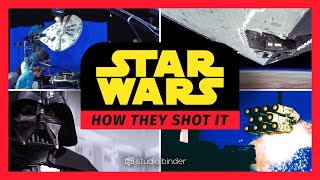
How Star Wars Made Spaceships Look Worn & Real
43sExplains the clever mirror trick to hide wheels and the gritty aesthetic that made Star Wars feel authentic.
▶ Play Clip
[00:00] Few movies are as influential as Star Wars, a new hope. Released in 1977, the film redefined blockbusters and heralded a new age in Hollywood.
[00:16] Part of what made Star Wars a massive success was its groundbreaking special effects. In this video, we'll examine how writer-director George Lucas and his crew made the impossible impossible.
[00:30] This is How They Shot It. In previous episode, we looked at scenes from Titanic and Inception. Be sure to subscribe and click the bell for notifications to stay up to date on all our filmmaking videos.
[00:48] Using StudioBinders' shot list, we look at some of the technical choices Lucas made from scene to scene. For his galaxy far, far away, George Lucas was intent on creating detailed alien worlds.
[01:04] A occudent task for a budget of $11 million, which was large in comparison to most science-fiction films at the time. But much smaller than most blockbusters. I find your lack of faith disturbing.
[01:18] Lucas and cinematographer Gilbert Taylor didn't want to compromise on image quality. So they used a collection of Panavision cameras and an Ari-352C along with Panavision's C-Series lenses.
[01:32] Let's look at what groundbreaking wizardry these cameras captured. Beginning with practical effects. Lucas assembled a super team to create practical on-set effects cheaply that could still basil the audience.
[01:48] Luke's land speeder, for example, is pulled off almost completely using practical tricks. For some shots, the vehicle was placed on a grain arm so that it could move while also appearing to be levitating.
[02:02] For other scenes, a small car was placed within the model. This decision prompted the modeling team to redesign the land speeder from a flying saucer to something lower to the ground.
[02:14] In order to hide the wheels, the crew placed mirrors on the sides of the vehicle so that the desert was reflected back at the camera. A crucial aspect that made Star Wars stand out from other sci-fi films was how the props and models looked worn and lived in.
[02:33] Before this, futuristic worlds were dedicated a sterile and clean. George Lucas was determined to create a grittier atmosphere.
[02:45] This approach also helped the model builders logistically, particularly with the Death Star, which originally was going to be shiny, like the dominant futuristic aesthetic of other films. We eventually knew that it ruins the scale of things to make them shiny, you know, especially silver, it wouldn't look pretty good.
[03:03] So we definitely went to that aged, off-gray. A movie about empires and galaxies needed to feel big. So Lucas's epic needed to achieve grandiosity on a budget.
[03:18] What a piece of junk! I mean, I'd look like much, but she's got it where it counts, kid. One cost-saving solution lay in matte paintings. The technique refers to painting backgrounds and extras on see-through plexiglass, with a portion left clear to capture the live-action portion of the shot.
[03:38] To pull off the effect, the matte painters needed to match the perspective of the camera, along with the lighting and colouring of the scene. The matte painting team were realising the vision of the legendary Ralph McQuarry, who had designed a large portion of the locations in characters.
[04:00] But state-of-the-art models and matte paintings were only half the battle. They also revolutionised the use of compositing effects. Some of the most dazzling visuals in the film come from the space battles.
[04:16] But at the time, sci-fi spaceships had only one speed. Slow. One of the films that I truly enjoyed was influenced by a deviline with 2001 Space Odyssey.
[04:28] And the second two things for 2001 Space Odyssey, along with glacially slow moves, was all the moves were linear. And that was because the systems at that time were capable of changing speed, because changing the speed of the system changed the exposure of the camera.
[04:48] But this limited movement wouldn't work for George Lucas' vision. In order to achieve more dynamic effects, Lucas founded Industrial Light and Magic, a special effects studio, which remains a place for the world.
[05:05] Lucas sent the effects team a collection of World War 2.5 footage as inspiration for what he was looking for in his space battles. I got him! I got him! Great kid! Don't get cocky!
[05:22] ILLM and Special Effects Supervisor John Dijkstra completely overhauled existing compositing techniques to create never-before-seen effects. He created a computer-operated motion camera system called the Dijkstra Flex.
[05:38] The system allowed for elaborate camera movements that could be intricately planned, such as panning, tilting and pushing in. The team would place the model in front of a blue screen and then move the camera around it.
[05:53] When the blue screen was removed and the space background was added, the ship would appear to execute quick and complicated movements. The computer they used was nowhere near as powerful as computers today, so the team had to hand-build their own hardware and manually enter each movement into the machine.
[06:13] Then, these complex camera movements could be repeated exactly again and again. When composited together, all the elements would look like they were filmed in one shot.
[06:26] As Dijkstra explains, a major benefit of shooting this way was how the photography captured realistic movement. During the exposure, things move.
[06:38] Traditional stop motion photography takes a series of sharp stills, in other words, the object doesn't move during the exposure. If you take photography, real life photography, the subject is in motion the entire time and then you get a blur behind it.
[06:53] Because the team could now film the ships in real time, the camera could capture the motion blur in each frame, making each shot feel seamless. Once the models in front of the blue screens were filmed, the footage then had to be layered onto the appropriate background.
[07:12] ILM also pushed the envelope for this process. The separate backgrounds were combined using an optical printer. The machine used projectors to shine multiple images onto a single piece of film to create a shot containing all the composites.
[07:29] Basically, the process works like this. The blue screen footage is reprinted with a series of filters turning the blue to black. This is a foreground mat, a transparent outline of the foreground element, like an X-wing surrounded by black.
[07:45] So, when the original footage and foreground mat are combined using the optical printer, light only exposes the ship, leaving a transparent background. To prepare the background, the opposite process is done.
[08:00] A background mat blocks only the ship and exposes everything around it. Finally, the foreground and background elements are combined in the optical printer to create the final composite.
[08:13] To keep the image resolution high, the team used large format film stock. Cinematographer Gilbert Taylor and the special effects team shot with double frame format vista vision and used a Kodak S-Dar base.
[08:30] The result was a final composited shot of unprecedented quality. But even with all these effects in place, a crucial finishing touch was required.
[08:43] Sound design. Star Wars wouldn't be Star Wars without its iconic sound design.
[08:57] No matter how stunning the special effects looked, their believability depended on an immersive soundscape. Like ILM, a new hope sound designer Ben Burt pushed his field forward with his work on the film.
[09:14] He even created a new role in the filmmaking process. The term sound designer has gotten usage in the last decade, really since the Star Wars films began a new interest in creative soundtracks and motion pictures.
[09:30] A sound designer I called myself a sound designer because I really wasn't functioning just as a production recordist or just a sound editor or just a sound mixer. I did some of the job that all three of those people might do.
[09:43] To create the now instantly recognizable sounds, Burt had to think outside of the box. Take for example the lightsaber. The sound of the weapon came from two different unexpected sources.
[09:58] The humming of a projector and the feedback from a television set. To convey the movement of the lightsabers, Burt played the sound back on the speaker and swung a microphone around in front of it.
[10:12] What happens when you do that by recording with a moving microphone and you get a doctor's shift, you get a pitch shift in the sound and therefore you can produce a very authentic facsimile of a moving sound.
[10:25] Burt also used state-of-the-art synthesizers to create robotic noises like those of R2-D2, whose sounds are a combination of synthesizers and a heavily filtered version of Burt's own voice, which gives R2 a sense of personality.
[10:47] Arguably the most famous sound from a new hope is Darth Vader's breathing. To achieve that sound, Burt placed a small microphone right next to a scuba regulator and then slowed it down.
[11:09] But Darth Vader's iconic breathing wasn't achieved on the first try. The first experiment the mixes we did in Star Wars, he sounded like an operating room, like an emergency room moving around.
[11:25] The combination of practical effects, post-production wizardry and sound design made Star Wars an instant success. Great shot, kid, that was one in a million!
[11:38] Audiences hadn't seen or heard anything like it before and it was no surprise when the film won Academy Awards for both VFX and Sound. Lucas's team updated low-budget techniques to make a blockbuster film with relatively little money.
[11:54] But of course, it all would have gone to waste without a good story. I think one of the key factors in the success is that it's a positive film and it has heroes and villains and it essentially is a fun movie to watch.
[12:11] What film should we dissect next? Let us know in the comments. To pull off Star Wars, George Lucas spent years planning so that he and his team had a clear vision when they began shooting.
[12:26] On your next project, if you want to follow in Lucas's footsteps, be sure to use StudioBinder software which can help with every part of the production process, from shot listing to scheduling.
[12:38] Click the link below to get started. Until next time, good luck young padawan. May the Force be with you.
⚡ Saved you 0h 13m reading this? Transcribe any YouTube video for free — no signup needed.