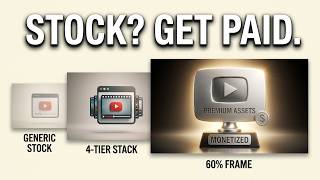

Stock Footage Is Killing Your Retention
44sTaps into the fear of low retention and reveals a common mistake creators make, offering a data-driven insight.
▶ Play Clip"Delivers a solid, actionable framework on stock footage strategy, though the title overpromises with 'The Only Way'."
This video explains why relying on a single unlimited stock footage subscription hurts viewer retention and monetization on faceless YouTube channels. It presents a four-tier resource pyramid for allocating visual budgets, and stresses the importance of a provenance ledger to avoid legal and policy pitfalls.
Viewers instantly recognize generic stock footage, which their brains categorize as cheap, destroying retention before the script even starts.
Building a production workflow around one $30/month unlimited stock subscription traps you in a closed visual loop with everyone else using the same library.
A chart plotting single stock site reliance against view retention shows a clear downward trend: the more a channel relies on one unlimited library, the faster viewers click away.
Shooting 100% original footage solves the aesthetic problem but breaks the financial math of high-volume YouTube, trading retention for a bottleneck in upload consistency and profit margins.
Balancing premium aesthetics with a sustainable budget comes from deliberately engineering a multi-layered stock footage stack, not finding one mythical perfect website.
Faceless channels must prove originality through script, editing, and context. A royalty-free license only answers copyright permission, not YouTube's originality check.
The monetization review splits at the originality check: green route passes with custom visuals and unique commentary, red route fails for standard stock compilations without significant original value.
Even after clearing originality, a free clip can fail if it contains an unreleased corporate logo or depicts a recognizable person in a sensitive context, violating trademark or privacy restrictions.
You cannot rely on bulk downloads alone; you must purposefully curate different tiers of footage to actively prove your channel provides distinct original value.
The blueprint for allocating visual budget: tier four (free support), tier one (unlimited core library), tier two (specialist/archival marketplace), tier three (premium hero shots).
Free platforms cost nothing but rarely carry property and model releases, leaving you exposed to brand conflicts. Use strictly for background gap fillers.
Provides massive volume for generic shots (server rooms, city streets) without per-clip budget calculations, but building a video entirely from it creates a generic look that abandons viewers.
Pay per clip for specific historical moments, verified news broadcasts, or proof. Not for b-roll. Costs $50-$150 per clip, so heavy reliance wipes out profit margins.
Much historical footage is marked for editorial use only, prohibiting commercial advertising context, which can derail sponsor integrations.
High-end cinematic libraries for high-stakes moments (opening hook, major reveal, emotional climax). Use sparingly; a $200 clip for a generic transition is amateur misallocation.
Placing one cinematic hero shot at the beginning sets a premium tone, buying viewer trust and allowing cheaper tier one footage later without retention penalty.
Mixing assets from different tiers requires logging every clip's provider, asset ID, and license type into a master database before publishing to avoid sponsor reuse traps and legal violations.
Without knowing which tier footage came from, you might grant a sponsor commercial rights you don't possess, violating your stock license.
Delivering a finished edited video to a client is permissible, but packaging raw standalone stock clips to the same client is almost always a direct violation.
Maintaining a clip-by-clip ledger adds about 10 minutes per export, but it's the ultimate defense against copyright strikes, retroactive demonetization, and sponsor disputes.
High-volume faceless model allocates 80% to tier one with massive original scripting; premium documentary model weights toward tiers two and three; agency editors use bundled ecosystem tools.
The most resilient and profitable faceless channels engineer a stack: unlimited subscriptions as foundation, archival clips as evidence, premium cinematic footage as the undeniable hook.
To succeed with stock footage in 2026, creators must move beyond a single subscription and engineer a multi-tiered visual stack, using free and unlimited assets for volume, archival clips for proof, and premium hero shots for trust. A provenance ledger is essential to protect revenue from legal and policy risks.
Royalty-free ≠ monetizable
Clarifies a critical misconception that buying a license protects against YouTube's originality policy.
01:41Originality check flowchart
Illustrates the exact decision point where stock compilations fail monetization review.
02:06Archival footage as proof
Shows how real archival footage transforms an explainer into a documentary, building trust.
04:36Hero shot at start buys trust
A single cinematic shot at the beginning sets a premium tone, allowing cheaper footage later without retention loss.
06:2210 minutes of admin friction
Quantifies the cost of a provenance ledger as a small price for protecting back-end revenue.
07:43[00:01] already know the look. The same businessman typing the same drone shot over a generic city. Viewers recognize it instantly, and their brains categorize it as cheap. That friction is visual burnout, destroying retention
[00:16] before your script even gets started. The root cause of this usually traces back to a single decision. Trying to build an entire production workflow around one $30 a month unlimited stock subscription. It feels efficient, but it
[00:30] traps you in a closed visual loop with everyone else using that exact same library. This chart shows the exact consequence of that loop. Plotting single stock site reliance on the bottom axis against view retention on the
[00:43] vertical axis shows a clear undeniable downward trend. The more channel relies on the same unlimited library, the faster viewers click away. The obvious alternative is shooting 100% original footage that solves the aesthetic
[00:58] problem immediately. But it breaks the financial math of high-volume YouTube. You trade a retention problem for a severe bottleneck in upload consistency and profit margins. Balancing premium aesthetics with a sustainable budget
[01:11] doesn't come from finding one mythical perfect website. It comes from deliberately engineering a multi-layered stock footage stack. Before we build biggest hidden risk in faceless production. YouTube's reused content
[01:27] policy. A creator on camera proves they made the video simply by existing in the frame. A faceless channel has to prove its originality entirely through the script, the editing, and the context added to the footage. Many creators
[01:41] assume buying a royalty-free license protects them. It doesn't. A stock license only answers the legal question of copyright permission. It guarantees you won't be sued, but it does absolutely nothing to guarantee YouTube
[01:54] will consider the final video monetizable. This flowchart tracks a downloaded clip through the actual monetization review process. The path splits right here at the originality check. The green route passes because
[02:06] the creator added custom visuals and unique commentary. The blocked red route fails because the reviewer sees a standard stock compilation without significant original value. Even if you cleared the originality hurdle, you can
[02:19] still hit a hard stop at the secondary rights check. A free clip might pass the basic copyright filter, but if it contains an unreleased corporate logo or depicts a recognizable person in a sensitive context, you are still
[02:33] violating underlying trademark or privacy restrictions. Because royalty-free status offers zero protection against the specific originality and third-party rights checks, you cannot rely on bulk
[02:45] downloads alone. You have to purposefully curate different tiers of footage to actively prove your channel provides distinct original value. This four-tier resource pyramid is the blueprint for allocating your visual
[02:58] budget. We use it to match the cost to the narrative impact at the absolute base. Is tier four free support? These platforms cost nothing. Use this tier strictly for background gap fillers. The massive blind spot here is property and
[03:14] model releases. Free libraries rarely carry them, leaving you exposed to brand conflicts. Moving one level up brings us to tier one, the unlimited core library. This subscription platform provides massive volume. The workflow value of
[03:28] this tier is immense. When you need 15 different shots of generic server rooms, city streets, or transitionary environments to cover a dense technical explanation, tier one provides them immediately without you ever stopping to
[03:42] calculate per clip budgets. But there is a firm ceiling to its utility. Building a video entirely out of tier one assets generates that unmistakable generic it was pulled from the exact same subscription library, viewers sense the
[03:56] lack of effort and abandon the video. Tiers one and four give you the raw volume required to maintain an aggressive upload schedule. What they completely lack is the precise visual specificity required to build deep trust
[04:08] and channel authority to get that specificity. We step up to tier two, the specialist and archival marketplace. Here, you abandon the subscription model entirely and pay per individual clip. You do not use tier two for b-roll. You
[04:22] use it to acquire specific historical moments, verified news broadcasts, or that acts as undeniable proof for the stock actor typing on a keyboard communicates nothing. Showing real
[04:36] archival footage of a 1998 product launch instantly proves your research, transforming a standard explainer into a documentary. The financial tradeoff is documentary. The financial tradeoff is harsh. At $50 to $150 per clip, relying
[04:50] too heavily on tier two will wipe out your video's profit margin before it even goes live. There is also a severe licensing trap hidden here. Much of this historical footage is marked for editorial use only. That strict
[05:03] limitation means you cannot use it in a commercial advertising context, which can instantly derail a lucrative sponsor integration. Treat tier two footage like a surgical tool. You deploy it sparingly as irrefutable evidence that deliberate
[05:17] curation is exactly why audiences inherently trust premium documentaries over cheap automated compilations. Finally, we reach the peak of the Finally, we reach the peak of the pyramid, tier three, the premium hero
[05:30] shot. Sourced from high-end cinematic libraries, operating at this tier requires strict adherence to the hero shot rule. You spend your highest dollar premium budget exclusively on high-stakes moments, the opening hook, a
[05:43] major narrative reveal, or the emotional climax of the video. These shots feature intentional lighting, highly precise visual composition, and actual narrative storytelling. They are created by professional filmmakers, contrasting
[05:57] sharply with the stiff, keyword-driven utility assets sitting at the bottom of utility assets sitting at the bottom of the stack. Using a $200 tier 3 clip to cover a generic transition between paragraphs is an amateur misallocation
[06:09] of resources. It bleeds your budget dry for moments the viewer barely registers. But, placing just one undeniable cinematic hero shot at the very beginning of your video sets a premium tone, buying the viewer's trust
[06:22] instantly. This allows you to seamlessly lean on cheaper, high-volume tier 1 footage later on without suffering a penalty to your retention. Pulling assets from four different pricing and licensing tiers solves the visual
[06:35] problem, but it introduces a massive operational risk. To protect your business back-end, you must implement a provenance ledger. When you mix unlimited subscriptions, free downloads, and restricted editorial archive clips
[06:48] into one timeline, memory isn't good enough. You have to actively log every single clip's provider, exact asset ID, and specific license type into a master database before hitting publish. If you skip this, you will eventually walk into
[07:03] the sponsor reuse trap. A brand sponsors your video and asks to run a 30-second cut as a paid ad. Without knowing which tier your footage came from, you might grant them commercial rights you do not possess, violating your basic stock
[07:16] license. This same friction hits agency editors and freelancers. Legally delivering a finished, edited video file to a client is entirely permissible under most licenses. Attempting to package and transfer the raw, standalone
[07:30] stock clips to that same client is almost always a direct violation. Maintaining a clip-by-clip ledger absolutely adds about 10 minutes of administrative friction to every video export. There is no way around the extra
[07:43] work. Those 10 minutes are the ultimate defense mechanism. That simple ledger protects your entire back-end revenue from sudden copyright strikes, retroactive demonetization, and disastrous disputes with high-paying
[07:56] sponsors. So, how much of your budget should go into each tier? The exact allocation depends entirely on your specific business model and output goals. This matrix maps your resources. The high-volume faceless model allocates
[08:10] 80% to tier one, requiring massive original scripting. The premium documentary model weights toward tiers two and three, building undeniable authority, but forcing a slower upload cadence. Agency editors use bundled
[08:23] ecosystem tools to maximize turnaround speed. Buying a royalty-free license only answers the legal question of copyright. It does absolutely nothing to answer the YouTube question of originality. The most resilient and
[08:36] profitable faceless channels do not rely on a single website to solve their visual problems. They engineer a stack. They treat unlimited subscriptions as the foundation, specific archival clips as the evidence, and premium cinematic
[08:50] as the evidence, and premium cinematic footage as the undeniable hook.
⚡ Saved you 0h 08m reading this? Transcribe any YouTube video for free — no signup needed.