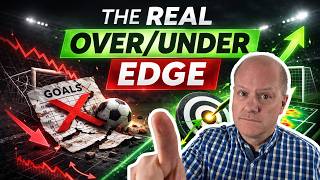

Proven Over/Under Betting System
45sOpens with a bold, surprising claim that a mathematically proven betting system exists, grabbing attention immediately.
▶ Play Clip"Title accurately promises a math-backed system; video delivers the explanation and formula."
This video presents an over/under football betting system validated by an academic paper. The system uses shots and corners as key metrics to predict goal totals, offering a mathematical edge over traditional methods.
An over/under football betting system has been proven to work long-term, backed by an academic paper.
Goals are noisy and not great predictors; shots and corners provide more predictive information.
Shots and corners best measure attacking and defensive capability, offering the most useful predictive information.
A formula calculates the probability of over/under goals, converting it to odds for comparison with market odds.
Home attacking pressure and away defensive pressure are calculated to create a total match pressure rating.
The system weights market odds against its own forecast to nudge predictions in favor of the model.
The paper analyzed 10 European leagues over 12 seasons, placing 68,000 bets and ending ahead.
The system's edge comes from using shots and corners instead of goals, combined with market weighting, to achieve long-term profitability.
What are the two key metrics used in the over/under betting system?
Shots and corners.
04:06
Why are goals considered 'noisy' for prediction?
Because they are not a great predictor of future matches due to randomness.
02:42
How many bets did the academic paper place and what was the outcome?
68,000 bets; ended ahead.
09:41
What is the purpose of market weighting in the system?
To nudge the model's prediction slightly in its favor against market odds.
07:57
Over how many leagues and seasons was the system tested?
10 European leagues over 12 seasons.
09:41
Shots and Corners as Predictors
Identifies the most effective metrics for predicting goal totals, moving beyond goals.
04:06Paper Results
Demonstrates real-world validation with 68,000 bets across multiple leagues.
09:41Market Weighting Technique
Explains how to combine model predictions with market odds for an edge.
07:57[00:00] So what if I told you that there was an over under football betting It had been proven to work in the long term. Not only that, it had had an entire academic paper written on it to explain
[00:13] Would that be interesting to you? Because if it is, you need to watch the rest of this video.
[00:28] that I'm active on and it is actually the core of everything that I do. is a very long time ago, and that led to me doing stuff on the football
[00:43] is my home now, where I spend all of my time and what I do for a living. There's the history and.
[00:55] been endlessly fascinated by it. Um, it can be quite difficult to predict, uh, but predict it, you And I spend all of my time now placing a huge number of bets on a whole
[01:09] variety of different sports, but also I put a lot of work into everything Placing the bets and doing all of those things is the end point Often go off and look at all of the data that I've got and all
[01:23] But I also go around the internet looking at what other people are talking about. And the problem you have with, um, academic papers is they can
[01:35] be particularly verbose and they contain loads of formulas and stuff. this because this was something I was advising about 20 years ago. I would've talked about this, um, the best part of 20 years ago.
[01:53] So it was interesting to see this replicated in a peer reviewed paper. interesting paper, but a lot of people are gonna not really truly understand And that's why I thought I would produce this video on it.
[02:10] Well, what we're trying to solve is how many goals are gonna be scored. That's the most popular market. Well, it seems quite simple really, because you would go to a league table
[02:26] Oh, yeah, on average that's about 2.7 or something, or whatever. But the issue that you have with this particular method, uh, and that is discussed and explained in this paper, is that golds are very noisy.
[02:42] happen to score with both those shots. Um, or you may have a team that has 20 or 30 shots and At the time of recording this video, that team is Nottingham Forest.
[02:58] of them in the back of the net. and not a great predictor of what's likely to happen in the next match.
[03:12] You need a much more refined measure of exactly how strong a team is. Um, and especially against the team that they're likely to be playing. Um, we need to move away from looking purely at goals because
[03:26] that can be misleading and we need to look at something else. under to enough goals, which sounds a bit weird when you first say that, And by noisy we mean they don't have decent predictive.
[03:42] So, so what does, well, if we think about the way a goal is scored, And maybe you're a set piece, a set piece specialist, and therefore,
[03:54] I'm sure you can imagine teams that sort of, you know, are So, yeah, it's the things leading up to a goal that seem to have more predictive
[04:06] capacity, and that is because they contain more information about how the game was played and how the team is playing from an attacking and a defensive perspective. Um, and this, if we look at the paper, they actually went through each of those
[04:19] individual variables and actually looked at each one and tried to assign a value And if you look at the paper, um, I'm sure a lot of you would Well, don't worry about it because I'm gonna explain each of that, each of
[04:35] these things that go behind this system and what was most effective and based The most effective predictive capacity was actually shots and corners that
[04:47] seemed to measure the best, um, attacking and defensive capability of each The most useful predictive information. So rather than talk through you in like minute detail in using mathematical
[05:01] the whole thing from top to bottom. If you want, uh, a copy of it, give me a like.
[05:14] can have a play around with it. 'cause the idea is this illustrates the concept, um, and you can modify But ultimately, um, this bit at the bottom here, this formula.
[05:28] Is the formula that they used to predict, um, and get their edge within the market. And you can see over here, this is the, uh, number that it comes up with here. So I've put the formula under this cell and this takes the data that we've
[05:43] got on this spreadsheet and comes out with this 43.3% chance, which is the chance of overs in this particular match that would create odds of 2.3, And you can see that the market's offering us 2 0 5, so there's
[05:59] However, the opposite is true on unders. So you could just use this little bit of the spreadsheet here with the Um, and that would give you what you need.
[06:12] how the whole thing works. You can see here we've got the number of shots the home team have scored. Um, on average the number of, uh, corners they've been awarded and
[06:26] therefore we turn that into what we call a home attacking pressure. Because effectively that's ones that away teams have, have managed
[06:38] So if we look at the expected home pressure, what we're doing here Which is the home attacking pressure. we're dividing it by two.
[06:51] So we're saying on average the home team does this, the away team does And then we can do the same for the away team. And that gives us a total match pressure aid, uh, a rating, a
[07:05] ranking for how active both of these teams are, and whether this Now the actual formula itself does the next bit for us. it works is for each individual pressure rating that we have within the market, it
[07:24] will actually give us, um, an estimation of how many matches have ended up over or under based upon, um, all of the formulas that they did and the back testing And that ultimately comes out with a sort of a general, uh, chance of over or under.
[07:41] Uh, golds, which we can then convert into odds. However, what the paper does, which is quite clever, is it actually weights, um, 'cause it does look at the actual market odds itself and it sort of
[07:57] And we just want to sort of nudge it slightly in our favor given all So the market weighting you can fiddle with here, uh, which will then sort Against your own forecast.
[08:13] and play with and get to understand the model because you could change the weightings on that particular table and that will give you, um, an indication of to whether, you know, you should adjust the model one way or the next.
[08:28] But ultimately, uh, the formula that you see over here. Is in this particular part of the spreadsheet and that actually The rest is sort of for illustrative purposes, um, altogether, and
[08:44] just to give you a better, deeper understanding of exactly what's going on. And also obviously all of the data at the top here, um, is based around, um. teams in this individual match.
[08:59] together and make it sort of make sense, fiddle with it endlessly. Uh, but if you're interested in having a look at it, I can post it up on the forum. But ultimately, uh, this is taking all of this data above here.
[09:16] the past over many, many matches. And it's coming up with a formula that sort of says, based upon how we've seen this play out in all of these matches, this is the chance that we think it has
[09:28] of actually producing, um, an outcome of either over or under two and a half goals. So this academic paper actually looked at the over and under football betting
[09:41] They did it over 10 European leagues. They did it over 12 seasons, and they placed 68,000 bets and ended up ahead. did 20 years ago, but I jest.
[09:56] Uh, what they discovered was that it wasn't actually the number of goals that but it was actually the amount of pressure that the teams were applying to each other, uh, that actually gave some level of predicted capability.
[10:11] worked out that shots and corners were those two metrics that actually added some capability, um, and predictive capacity to their system, but also they
[10:24] They would basically look at the market and then weight that against And ultimately, that's all that you need is the little edge over the market that will allow you to beat the odds, um, and therefore have a
[10:40] slightly better predictive capability and ultimately make the strategy So yeah, if you wanted a over under football betting There it is.


⚡ Saved you 0h 11m reading this? Transcribe any YouTube video for free — no signup needed.