
The Biggest Secret of Sourdough Bulk Fermentation
45sThis clip challenges common baking myths by revealing that the standard 'double in size' advice is wrong, sparking curiosity and debate among home bakers.
▶ Play Clip"The title accurately reflects the core teaching: measuring dough temperature and percentage rise is the secret method, and the video delivers exactly that."
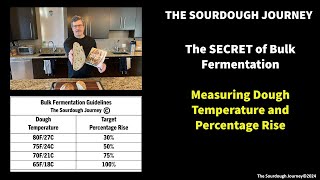
Tom from the International Institute for the Advancement of Sourdough Science explains that the common advice to let sourdough dough double during bulk fermentation is often wrong. He reveals that the true secret is synchronizing the percentage rise with the dough temperature, introducing a two-factor method for consistent results.
The common guidance to let dough double in volume during bulk fermentation is completely wrong for most home bakers.
The percentage rise in bulk fermentation must be related to the dough temperature, as warm dough needs to be cut off earlier.
Tom's initial 2021 experiments showed a discrepancy between Chad Robertson's 30% rise at 80°F and other recipes recommending 100% rise at cooler temperatures.
In January 2023, Tom published a table linking dough temperature to target percentage rise: 80°F = 30%, 70°F = 75%, 65°F = 100%.
The end of bulk fermentation is not the end of fermentation; yeast and bacteria continue fermenting during pre-shape, bench rest, final shaping, and cold retard.
After placing dough in the refrigerator, it takes about 10 hours to reach 39°F (4°C), with significant fermentation in the first four hours.
Bulk fermentation is like running; the cold proof is like throwing a javelin. Warm dough requires a later cut-off (more run) but a stronger throw (more fermentation in the fridge).
Warm dough is like a speeding car on a slippery road; you must hit the brakes (cut off bulk) earlier to avoid overproofing.
You need a digital probe thermometer (not infrared) and a measuring vessel with milliliter/quart markers. Ignore the clock—time will lie, temperature and percentage rise never lie.
Any transparent vessel can be calibrated into a measuring tool by marking every 100g water addition (1g water = 1 ml).
Mark the starting volume of mixed dough (e.g., 750 ml for a 500g flour batch). For standard recipes, starting volume ≈ 1.5 × flour weight in grams (in ml).
Your vessel should hold at least 3× your flour weight in ml to allow for doubling. For 500g flour, use a 1.5L+ vessel.
If dough temperature changes during bulk, use the ending temperature when cutting off bulk fermentation, as that determines downstream fermentation.
By controlling dough temperature with a proofer (warm or cool), you can time fermentation to fit your schedule. Controlled temperature = controlled time.
Mastering bulk fermentation is about ignoring time and instead measuring dough temperature and percentage rise. By using the temperature-rise chart, you achieve perfectly proofed dough every time.
What is the general advice about bulk fermentation that many recipes give?
Let the dough double at room temperature.
0:57
Why is the 'let it double' advice often wrong?
The percentage rise needed depends on dough temperature; room temperature varies widely.
1:10
At which dough temperature (F and C) does Chad Robertson recommend cutting off bulk at a 30% rise?
80°F (27°C).
3:51
At 70°F (21°C) dough temperature, what percentage rise should you target?
A 75% rise.
4:58
At what dough temperature (F and C) is a 100% rise in bulk acceptable?
At 65°F (18°C) or below.
5:14
In the javelin analogy, what does the 'run' represent?
The bulk fermentation phase.
13:02
In the javelin analogy, what does the 'throw' represent?
The cold proof fermentation in the refrigerator.
13:09
Why must warm dough be cut off at a lower percentage rise than cool dough?
Warm dough ferments faster and continues to ferment vigorously during the cooling down in the refrigerator.
8:21
How long does it typically take for dough to cool down to 39°F (4°C) in a refrigerator?
About 10 hours.
9:08
What are the two tools required for the Two-Factor Method?
A digital probe thermometer and a measuring vessel with milliliter markers.
20:01
Why should you NOT use time to determine when bulk fermentation is done?
Time will lie because different starters, flours, and recipes affect rise speed.
21:56
What is the 'water trick' for making any transparent vessel into a measuring tool?
Pour 100g of water at a time (1g water = 1 ml) and mark each 100 ml increment on the vessel.
36:22
What is the rule of thumb for sizing a bulk fermentation vessel?
Ensure the vessel can hold at least 3× the flour weight in ml (e.g., 500g flour → 1500ml vessel).
41:13
When adjusting your target percentage rise, by what increment should you change it?
10% increments (e.g., from 75% to 85%).
51:29
Which two recipes are praised as exceptions for providing both dough temperature and percentage rise?
Chad Robertson's Tartine Country Loaf and Elaine Boddy's recipe.
26:20
Temperature Relates to Percentage Rise
Refutes the generic 'let it double' advice by establishing a scientific, repeatable correlation.
1:10Chart Is Most Shared Content
Demonstrates the breakthrough nature and community impact of the temperature-rule chart.
6:26Javelin Analogy Explained
Creatively explains the distribution of fermentation work between bulk and cold proof.
13:02Speeding Car Analogy
Highlights the margin of error (window) for warm vs. cool dough, reinforcing caution for warm fermentation.
15:43Two Exceptions Among Top Recipes
Praises Chad Robertson and Elaine Boddy for including both key variables, contrasting with 8 of 10 popular recipes.
26:20[00:00] [Music]
[00:10] hi I'm Tom coming to you from The
[00:12] International Institute for the
[00:14] advancement of sourdough science and
[00:16] research of Cleveland Ohio also known as
[00:19] my kitchen thank you for selecting this
[00:22] video in today's video we're going to
[00:24] talk about one of the biggest challenges
[00:26] souro Bakers have and that is trying to
[00:28] figure out when do you cut off off bulk
[00:30] fermentation this is the most
[00:32] challenging aspect of sourdough baking
[00:35] I've done dozens of videos on this topic
[00:38] and people still continue to struggle
[00:40] with it now if you look at the most
[00:43] popular recipes that are out there many
[00:46] recipes will give very simplistic
[00:48] guidance that says you mix your dough
[00:51] you do your stretch and folds and that
[00:53] you let then you let your dough rise at
[00:55] room temperature until it doubles in
[00:57] volume what I'm going to show you in
[00:59] today's video is that that guidance is
[01:02] completely wrong I've done a number of
[01:05] experiments over the years and I've
[01:07] proven that the percentage rise in bulk
[01:10] fermentation that you're looking for is
[01:12] related to the dough temperature warm
[01:15] fermenting dough needs to be cut off
[01:17] earlier than cool fermenting Dough
[01:20] because that dough keeps fermenting in
[01:23] the downstream steps after bulk
[01:25] fermentation is done it keeps fermenting
[01:28] and pre-shaping bench rest final shaping
[01:31] and then when the dough goes into the
[01:32] refrigerator typically for a cold
[01:35] the dough keeps fermenting so that
[01:37] ending temperature of the dough
[01:41] determines what happens after bulk
[01:44] fermentation so you need to synchronize
[01:46] the percentage rise with the dough
[01:49] temperature this is the biggest secret
[01:52] of sourdough bulk fermentation I'm going
[01:54] to explain it here
[01:58] today
[02:00] now before we jump into the details I
[02:02] just want to reply to the people who've
[02:04] been asking about brother Bob now for
[02:07] those of you who watch my videos you
[02:08] know that brother Bob was here around
[02:10] the 4th of July and we were filming the
[02:12] sourdo brothers souro for busy people
[02:14] video and Bob suffered a head injury in
[02:16] my kitchen during the filming of that
[02:19] video brother Tom I'm so happy to be
[02:25] back Bob's doing okay he's back in
[02:28] California he's back at his teaching job
[02:31] but Bob's having a little trouble with
[02:33] his memory Bob thinks that somehow when
[02:37] he was here he was involved in an Amish
[02:39] barn raising I have no idea what he's
[02:41] talking about but I think Bob's going to
[02:43] be fine and we're looking forward to
[02:45] creating more sourdo Brothers videos in
[02:47] the
[02:53] future now let me give you some
[02:55] background on this question of when do
[02:57] you cut off bulk fermentation as people
[02:58] know I've been doing research on this
[03:00] for years the first time I looked into
[03:02] this was in
[03:03] 2021 when I did two videos in my when is
[03:06] bulk fermentation done series episode 7
[03:09] and episode 8 and what I was looking at
[03:11] at that time was this discrepancy
[03:14] between recipes where things like the
[03:17] Chad Robertson tarene country loaf
[03:19] recipe that I follow religiously
[03:21] recommends a 30% rise in the dough in
[03:24] bulk fermentation and then many other
[03:26] popular recipes were recommending 100%
[03:28] rise in the dough and I couldn't figure
[03:30] out how is that possible in those
[03:33] experiments I found the first glimpse
[03:35] into this issue that the percentage rise
[03:38] in the dough needs to be correlated with
[03:40] the dough temperature warm dough needs
[03:43] to be cut off earlier than cool dough so
[03:46] in this example I cut off Chad
[03:48] Robertson's recipe at a 30% rise which
[03:51] is what he recommends because the dough
[03:54] temperature he recommends is 80° fenhe
[03:56] or 27° C that's a very warm fermentation
[04:01] temperature then I compared that to
[04:03] other recipes that were bulk fermenting
[04:05] at 70° F or 21 de c those could tolerate
[04:10] a much higher percentage rise in the
[04:11] dough and I was able to produce the
[04:14] exact same results at the end so I
[04:16] continued doing experiments and in
[04:18] January of 2023 I published this article
[04:22] the mystery of percentage rise and bulk
[04:24] fermentation you can find this on my
[04:25] website and you can find this in the
[04:27] description of the video this was
[04:29] usually a breakthrough where I put all
[04:31] the science together and in this
[04:33] document I published this table which I
[04:36] had proven through multiple experiments
[04:38] that shows when you bulk ferment at warm
[04:41] temperatures you need to cut off the
[04:42] dough earlier when you bulk ferment at
[04:44] cooler temperatures you can go for a
[04:46] higher percentage rise so what you can
[04:48] see on this chart is if your dough is
[04:50] bulk fermenting at 80° fahr you cut that
[04:53] off at a 30% rise if your dough is bulk
[04:56] fermenting say at 70 Dees Fahrenheit the
[04:58] third line here you cut that off at a
[05:00] 75% rise and the only time you go for
[05:03] 100% rise is if your dough is very cool
[05:07] lower than 70° Fahrenheit or 21° C in my
[05:11] experience it needs to be around 65°
[05:14] Fahrenheit or 18° Celsius to tolerate
[05:17] 100% rise in the dough this chart has
[05:20] been cut and pasted out of my document
[05:23] and shared tens of thousands of times on
[05:26] social media this is the most shared
[05:29] piece of content on social media right
[05:31] now around bulk fermentation really
[05:34] around sourdough baking in general
[05:36] everybody is sharing this content
[05:38] because this is a breakthrough it
[05:40] refutes the general guidance of just let
[05:44] your dough double at room temperature if
[05:46] you do that generally speaking your
[05:49] dough will overproof and I've seen this
[05:50] in many many examples hundreds of people
[05:53] over proofing their dough every month
[05:55] because they're following the simple
[05:58] simplistic and an inaccurate guidance of
[06:01] just letting your dough
[06:07] double so now you might be asking the
[06:09] question how does this actually work
[06:11] here's how it works you mix up your
[06:13] dough and when all the ingredients are
[06:15] initially mixed you're going to put that
[06:17] in a measuring vessel and you're going
[06:18] to measure your starting volume of dough
[06:22] then you do your stretch and folds you
[06:24] let your dough rise and as the dough is
[06:26] rising you take the temperature of your
[06:28] dough my D is at 70° f 21° c so I
[06:34] consult my handy chart that says at 70°
[06:38] Fen 21° C I'm looking for a 75% rise in
[06:42] the dough so I take my starting volume I
[06:45] multiply that by
[06:47] 1.75 and I put this second marker on my
[06:50] measuring vessel and I wait for the
[06:52] dough to hit that percentage rise when
[06:54] the dough hits that percentage rise it's
[06:56] perfectly fermented then I shape the
[06:59] dough I pre-shaped the dough I let it
[07:01] rest for 30 minutes I final shape the
[07:03] dough I put it into the refrigerator I
[07:05] take it out the next day anywhere from 8
[07:07] to 16 hours after it's been in the cold
[07:10] in the refrigerator and the dough
[07:12] is perfectly proofed and this works at
[07:16] any temperature if you synchronize the
[07:19] percentage rise with the
[07:21] temperature here are some examples 80°
[07:24] dough cut off at a 30% rise perfectly
[07:27] proofed 75° dough cut off at a 50% rise
[07:31] perfectly proofed 70° D cut off at a 75%
[07:36] rise perfectly proofed 65 degree dough
[07:40] cut off at a 100% rise perfectly
[07:43] proofed this method works and what you
[07:47] can see is the only time you want your
[07:50] dough to double in volume is when your
[07:52] dough is very cold in my example 65° f
[07:56] 21° c so all the guidance out there
[07:59] there that says let your dough double at
[08:01] room temperature if if your room
[08:03] temperature is above 65° F which it
[08:06] usually is in most people's kitchens
[08:08] your dough is going to
[08:13] overproof so now you ask the question
[08:15] how does this work and the reason this
[08:18] works is because we tend to think of
[08:21] bulk fermentation as the end of
[08:23] something I mean we call it that the end
[08:25] of bulk fermentation but you need to
[08:27] think of that as the beginning of
[08:29] something the end of bulk fermentation
[08:32] is the beginning of the rest of the
[08:34] fermentation process so when you cut off
[08:37] bulk fermentation that's an arbitrary
[08:39] point the yeast doesn't know bulk
[08:40] fermentation is over lactic acid
[08:42] bacteria doesn't know bulk fermentation
[08:44] is over they're just going to keep
[08:46] fermenting so you cut off bulk
[08:48] fermentation then you pre-shape the
[08:50] dough you let it rest on the countertop
[08:52] for 30 minutes you final shape it during
[08:55] that 30 minutes or so that dough is
[08:57] still rapidly fermenting it doesn't no
[08:59] bulk fermentation over then when you put
[09:02] that dough into the refrigerator it
[09:04] takes 10 hours for the dough to get down
[09:08] to the refrigerator temperature a lot of
[09:10] people assume I mean it's easy to assume
[09:12] you put that dough in the refrigerator
[09:14] and it just immediately stops fermenting
[09:17] and it goes down to the refrigerator
[09:18] temperature that doesn't happen here's
[09:21] what actually happens take a look at
[09:22] this
[09:23] chart if we take our 80° Fahrenheit
[09:26] dough 27° C we pre shape it bench rest
[09:30] it final shape it that dough temperature
[09:32] drops to about 78° F before it goes into
[09:35] the refrigerator it goes into the
[09:37] refrigerator and for the first hour that
[09:41] dough is still rapidly fermenting it's
[09:43] it takes an hour to get down to 70°
[09:46] Fahrenheit or 21° C which is a lot of
[09:48] people's kitchen temperature the dough
[09:51] thinks it's still fermenting at room
[09:53] temperature then in the next 3 hours
[09:56] that dough drops from 70° F to about
[09:59] about 50° F 10° C that's still a fairly
[10:04] moderate fermentation range there is
[10:06] real fermentation happening there in
[10:08] those 3 hours then the next 3 hours the
[10:12] temperature drops from 50° F to about
[10:14] 41° Fen or 5° C the dough is still
[10:19] slowly fermenting and then in those last
[10:22] 3 hours it drops from 41 degrees
[10:25] Fahrenheit to 39 degrees Fahrenheit or 4
[10:27] degrees celsi and that's where the yeast
[10:31] finally goes to sleep and it starts
[10:33] fermenting very very slowly it never
[10:36] actually stops in the refrigerator but
[10:38] when it hits 39° fah or 4° C you can
[10:41] consider it to be very very slowly
[10:44] fermenting so now if you look at this
[10:46] chart you can see what's happening when
[10:48] you put very warm dough into the
[10:50] refrigerator there are two things that
[10:52] dough is rapidly fermenting before it
[10:55] goes into the refrigerator because the
[10:56] fermentation rate is related to the
[10:58] temperature 80° fah dough 27° C is
[11:03] rapidly fermenting so it goes in moving
[11:06] very quickly and because it's a warmer
[11:09] temperature it takes a longer time for
[11:11] the temperature to get down to 39° F or
[11:15] 4° C where the the yeast goes to sleep
[11:18] so you get a lot of fermentation
[11:20] happening in the refrigerator contrast
[11:22] that with very cool dough 65° Fahrenheit
[11:26] dough 18° C it goes in at a slower rate
[11:31] of fermentation because it's cooler
[11:33] going into the refrigerator and it goes
[11:37] in at a lower point on the curve so it
[11:39] hits the refrigerator temperature more
[11:42] quickly and the yeast goes to sleep more
[11:44] quickly so the cool dough ferments much
[11:47] less in the refrigerator so that's where
[11:50] this formula basically makes sense
[11:53] you're doing the same amount of
[11:55] fermentation between bulk fermentation
[11:58] and the final proof proofing but the
[12:00] amount of fermentation happening in bulk
[12:02] fermentation versus in the refrigerator
[12:04] is different based on that dough
[12:07] temperature and when you cut off the
[12:09] bulk
[12:10] fermentation if you want to learn more
[12:12] about the science behind this chart
[12:14] there's a link to the article in the
[12:16] description of this video and you can
[12:18] find it on my website at the sourdo
[12:20] journey.com
[12:29] so when I think about that cut off of
[12:30] bulk fermentation I think of it a lot
[12:33] like as if you were throwing a javelin
[12:36] when you throw a javelin the moment it
[12:38] leaves your hand you have no control
[12:41] over what happens that's the cut off of
[12:43] bulk fermentation once you decide that
[12:45] cut off basically you have no control
[12:47] over the dough going forward until it
[12:49] comes out of the refrigerator when you
[12:51] throw a javelin the thing you do have
[12:54] control over is the speed of your hand
[12:56] and that trajectory of the javelin that
[12:59] determines where it will land so you can
[13:02] imagine for warm dough where I'm bulk
[13:04] fermenting at 80° fah but I'm doing that
[13:08] cut off at a 30% rise I have a long
[13:11] distance to cover so I need a lot of
[13:13] speed and a steep trajectory to get the
[13:15] javelin to land in the right place if
[13:18] I'm bulk fermenting at cool temperatures
[13:21] that dough is fermenting more slowly so
[13:23] my hand speed is slower and I've already
[13:26] achieved a higher percentage rise so I'm
[13:29] releasing it at a lower trajectory both
[13:31] of those javelins will land in exactly
[13:34] the same place so here's an example of a
[13:36] javelin throwing competition where we
[13:38] have two throwers but in this unique
[13:41] competition each one of them can decide
[13:43] how far they want to run down the field
[13:45] before they stop that's the end of bulk
[13:48] fermentation and then they throw the
[13:49] javelin from there that's the cold
[13:51] so the first thrower represents
[13:54] our 80° Fahrenheit dough which we would
[13:56] bulk ferment to a 30% rise so this
[13:59] thrower runs down the field 30 m towards
[14:02] the target then he stops that's the end
[14:04] of bulk fermentation but this thrower
[14:07] has a very strong arm because at that
[14:10] 80° Fahrenheit dough temperature the
[14:12] dough is fermenting very quickly so he
[14:14] can release the javelin with a fast hand
[14:18] speed and a high trajectory and he can
[14:20] make the distance to the Target doing
[14:22] most of the fermentation after the end
[14:25] of bulk fermentation compare that to the
[14:27] second thrower he represents the 70°
[14:30] fahit dough that we would bulk ferment
[14:32] to a 75% rise before the cut off he runs
[14:36] 75 M down the field he needs to get
[14:39] closer to the Target because he has a
[14:41] weaker arm the dough temperature is only
[14:44] 70° Fahrenheit so he doesn't have the
[14:46] same hand speed or that same trajectory
[14:49] so he goes closer to the Target the 75%
[14:52] rise then he releases his Javelin it
[14:55] lands in the exact same spot so what you
[14:57] can see with this example is that both
[14:59] the javelins travel the same distance
[15:01] they just get there through different
[15:03] means part of the way is through running
[15:05] and part is through throwing the running
[15:07] is the bulk fermentation the throwing is
[15:09] the cold and what you see with
[15:12] warm dough the 80° Fahrenheit dough that
[15:14] travels a long distance in the air
[15:17] during the cold a lot of
[15:19] fermentation is happening in the
[15:20] refrigerator and with cooler dough less
[15:23] of the fermentation is happening in the
[15:25] refrigerator but they both land in the
[15:27] same place but once it leaves your hand
[15:30] you have no control over it its outcome
[15:33] is predestined once you decide that cut
[15:36] off of bulk
[15:43] fermentation here's another example
[15:45] trying to determine that cut off of bulk
[15:47] fermentation is like trying to figure
[15:49] out if you're driving a speeding car on
[15:51] a slippery Road and you see a stop sign
[15:54] up ahead when do you need to hit the
[15:56] brakes that's the cut off of bulk
[15:58] fermentation and you can imagine if
[16:01] you're driving really fast you need to
[16:03] hit the brakes earlier because you're on
[16:05] a slippery Road and you're going to
[16:07] start skidding when you hit the brakes
[16:09] so you need a longer stopping distance
[16:11] if you're traveling more slowly you can
[16:14] wait later to hit the brakes because you
[16:16] have a shorter stopping distance the
[16:18] speed of the car is the equivalent of
[16:21] the bulk fermentation dough temperature
[16:24] warm dough ferments very quickly
[16:27] compared to cold dough so here's a live
[16:29] example of the speeding car we're going
[16:31] to have Santa with a couple of his
[16:33] reindeer in his tricked out Chevy low
[16:35] rider here Santa's going to be driving
[16:38] his car from the beginning of bulk
[16:40] fermentation that's this blue line here
[16:43] this line would be 100% rise in bulk
[16:45] fermentation and then the stop sign that
[16:48] Santa sees ahead is this big red dutch
[16:51] oven that's after shaping and the cold
[16:54] in the refrigerator which was
[16:56] represented here and that's when when
[16:58] the dough is going to get into the oven
[17:00] so basically you're speeding through
[17:02] bulk fermentation you want to hit the
[17:04] brakes on the slippery Road and you're
[17:06] going to slide in here to stop right
[17:08] before it goes into the oven at the stop
[17:10] sign here's Santa he's going to be going
[17:12] 80 M hour that's 130 km per hour and
[17:17] let's assume that's the equivalent of a
[17:18] 80° fah dough temperature 27° C based on
[17:23] our chart that means Santa needs to hit
[17:25] the brakes on the slippery Road at the
[17:27] 30% rise Mark which is way back here
[17:30] early and bulk fermentation because he's
[17:32] going so fast and he's used to driving a
[17:35] sleigh this car has rear wheel drive it
[17:37] doesn't have antilock brakes this is not
[17:38] going to be pretty so if Santa's driving
[17:41] 80 M an hour and let's say he doesn't
[17:44] know about that chart he comes flying
[17:46] through bulk fermentation and he does
[17:48] 100% rise like you read in some recipe
[17:50] and he hits the brakes here he skids out
[17:53] of control there's a rollover accident
[17:55] Christmas is cancelled I mean this is
[17:57] the real you're Without a Santa Claus
[17:59] this is a Christmas tragedy so if you go
[18:02] too far in your bulk fermentation at a
[18:05] warm temperature your dough is going to
[18:07] over
[18:08] prooof then we say Santa check out the
[18:11] chart dude 30% rise you need to hit the
[18:14] brakes right here so Santa comes
[18:17] speeding into bulk fermentation at 80 M
[18:19] hour now he hits the brakes here he goes
[18:21] into a skid he's going past the 100%
[18:24] rise Mark and he Parks it right next to
[18:27] the stop sign goes into the Dutch oven
[18:30] and gets baked into a perfectly proofed
[18:32] loaf of bread because he hit the brakes
[18:35] earlier which he needed to do because he
[18:37] was driving so quickly here's another
[18:40] example Santa got a speeding ticket need
[18:42] to slow down lead foot Santa so now he
[18:45] only drives at 40 mph that's half the
[18:47] speed he was at before and that's
[18:50] actually the equivalent of about this
[18:51] 70° fenhe or 21° C temperature that's
[18:56] almost half of the fermentation speed of
[18:58] the 80° F dough it's much much slower
[19:01] just in that 10° fhe difference so now
[19:04] Santa's cruising along at 40 m per hour
[19:06] that's 65 km per hour he's taking his
[19:09] time he sees a stop sign up ahead here
[19:12] he's got a lot of safe stopping distance
[19:14] so he's going to go for a 75% rise based
[19:17] on the chart so he hits the brakes here
[19:20] he cruises through slides it in boom
[19:24] right into the stop sign Santa goes into
[19:26] the oven and makes a perfectly proof
[19:28] loaf of bread for Christmas dinner so
[19:31] warm dough is just like a speeding car
[19:34] you need to hit the brakes early to
[19:36] ensure that you have a safe stopping
[19:38] distance if you want to learn more about
[19:40] this speeding car example there's a link
[19:42] to the article in the description of
[19:44] this video and you can find it on my
[19:47] website at the souro journey.com
[19:54] now that you understand this in theory
[19:57] let's talk about how do you put put this
[19:58] into practice so most sourdough recipes
[20:01] will tell you you need some specialized
[20:02] tools for sourdough baking you need a
[20:04] digital kitchen scale you need a l you
[20:06] need a banatan you need a dutch oven but
[20:09] what they don't tell you you need is a
[20:13] digital probe thermometer to take the
[20:15] temperature of your dough during bulk
[20:18] fermentation and you need a measuring
[20:21] vessel to measure the change in volume
[20:24] which is the percentage rise in the
[20:25] dough in bulk fermentation here's an
[20:28] example of a measuring vessel this is a
[20:29] large one here's a small one there are
[20:32] all kinds of measuring vessels you want
[20:34] to find something with milliliter or
[20:36] leader or qut markers on it that's how
[20:39] we're going to measure the percentage
[20:41] rise in the dough it's the change in
[20:43] volume which is measured in liters or
[20:46] quarts you can buy small kitchen storage
[20:50] vessels like this one this has Mill
[20:52] markers on it this is perfect for bulk
[20:54] fermenting one small batch of dough if
[20:56] you work in a laboratory you could
[20:58] borrow one of these scientific beakers I
[21:01] like to use this that's a 3 l Beaker I
[21:03] can do a two loaf rise in that vessel so
[21:07] anything with milliliter markers on it
[21:09] this is the one I showed earlier this is
[21:12] a what's called a batter bowl it's
[21:14] basically like a bowl with a handle but
[21:15] that has the milliliter markers on it as
[21:17] well there are a lot of kitchen vessels
[21:20] out there you need to find one of those
[21:22] and the important thing we don't need is
[21:26] a
[21:27] clock with this method you ignore the
[21:31] time you have absolutely no use for this
[21:34] device put it away step away from the
[21:36] clock no need to measure the time let me
[21:39] go back and talk about this chart
[21:42] because I've been talking about the way
[21:44] you do this is measuring the dough
[21:45] temperature and the percentage rise and
[21:47] if you read the whole document those are
[21:48] the two variables that you need I show
[21:51] the timing on this chart just so people
[21:53] can understand how much longer the dough
[21:56] will take to rise if you're bulk
[21:58] fermenting at these low temperatures but
[22:00] you never use the time to determine when
[22:03] bulk fermentation is done the time will
[22:06] lie to you the temperature and
[22:08] percentage rise never lie it's
[22:11] impossible it's physically impossible
[22:13] for them to lie the clock will lie
[22:15] because certain starters will rise
[22:18] faster or slower than others different
[22:19] flower will rise faster or slower than
[22:21] others if you have different recipes
[22:23] that you're using they'll rise faster
[22:25] and slower so you can never rely on the
[22:27] time
[22:28] only rely on the temperature so I use
[22:30] this chart just to show the relative
[22:33] time but we are not going to use
[22:35] this ignore the time this is all we need
[22:39] for the rest of the process temperature
[22:41] and percent rise gives you 100%
[22:44] reliability and it's repeatable no
[22:46] matter how long it
[22:52] takes so this is the point in the video
[22:54] where you might be saying to yourself
[22:57] wow this sounds so simple how come I
[23:00] never heard of this
[23:01] before because most popular recipes are
[23:06] wrong I don't know any other way to say
[23:08] it I looked at the top 10 most popular
[23:11] sourdough recipes out there and eight of
[23:13] the 10 say mix your dough do some
[23:17] stretch and folds and then let your
[23:18] dough rest at room temperature until it
[23:21] doubles in size that is the instruction
[23:24] for bulk fermentation in eight of the 10
[23:27] most popular sourdough recipes that
[23:29] instruction is wrong let's just talk
[23:32] about it the first part let your dough
[23:34] rise at room temperature I mean what the
[23:36] heck is room temperature I mean my
[23:38] temperature in my kitchen right now is
[23:40] 74° fah if I lived in Australia right
[23:43] now my kitchen temperature would be 90°
[23:46] fenhe or 32° C if I lived in Finland
[23:49] right now my kitchen temperature would
[23:51] be 50° F or 10° C so any recipe that
[23:57] tells you to do something at room
[23:58] temperature is completely meaningless
[24:01] because room temperature can be an
[24:03] incredibly wide
[24:05] variation the second problem with these
[24:07] recipes is they say let your dough
[24:10] double which isn't a bad concept but
[24:14] they don't actually measure the doubling
[24:17] if you watch those videos and look at
[24:19] the photos in the recipes they're using
[24:21] a bowl like this with their dough in it
[24:24] and they show a picture that says okay I
[24:27] let my dough double at room temperature
[24:29] and they show a picture of a puffed up
[24:31] ball of dough that's not actually
[24:34] doubled there's no way to tell if it's
[24:36] actually doubled let me say it that way
[24:38] doubling is a mathematical concept if
[24:42] you went into your boss's office and
[24:44] your boss said congratulations I'm going
[24:47] to double your salary you know what that
[24:49] means it's two times your salary that's
[24:53] what double is if your child is 3T tall
[24:57] and they grow to be 6 feet tall you
[25:00] would say oh my gosh my child has
[25:03] doubled in height it's a measurable
[25:06] thing unless you're a Sourdough Baker
[25:09] and then doubling means I look at my
[25:12] dough and it's kind of puffed up and if
[25:15] I feel like I'm ready to go to the next
[25:17] step I just decide it's doubled that's
[25:19] how these recipes work but you say but
[25:22] these Bakers they then show on the video
[25:24] the dough comes out perfectly it's
[25:27] because they're eyeballing the dough
[25:29] they're using other criteria that
[25:31] they're not explaining to you they're
[25:33] smelling the dough you can't even see it
[25:34] but they're smelling it they're shaking
[25:36] the dough they're using the same bowl
[25:39] that they always use so they can tell if
[25:41] the dough is touching the side of the
[25:43] bowl at a at a specific point but that
[25:45] dough I'm telling you is not doubling
[25:48] unless the dough temperature is below
[25:51] 70° fenhe 21° C otherwise their loaves
[25:54] would overproof so it's just a lazy way
[25:57] of doing instruction I don't know any
[25:58] other way to to say it and I hate
[26:00] criticizing other sourdough Bakers and
[26:03] instructors but telling people to let
[26:05] your dough double at room temperature is
[26:07] lazy and it's usually wrong now there
[26:10] are two notable exceptions when I said I
[26:13] looked at the top 10 uh recipes that
[26:16] people
[26:17] use look at this one Chad Robertson
[26:20] taram bread my favorite recipe in the
[26:22] world Chad Robertson is one of the two
[26:25] that does provide do temp in percentage
[26:28] D he specifically says during bulk
[26:31] fermentation the dough temperature
[26:32] should be between 78° F and 82° F that's
[26:36] 25.5 to 28 deges
[26:39] C and he tells you the percentage rise
[26:41] between 20 to 30% rise in the dough when
[26:44] you cut off bulk fermentation that's
[26:46] exactly where my studies came out here
[26:49] for 80° dough 27° C you go for a 30%
[26:54] rise Chad Robertson had this figured out
[26:56] in 2006 he told people how to do it the
[26:59] other
[27:00] example very popular recipe from elain
[27:02] body elain tells you let your dough
[27:06] double in size but she gives you the
[27:08] specific dough temperature 18° C to 20°
[27:12] C which is 64° f to 68° F which is
[27:18] exactly what I found in my studies at 65
[27:22] degree do temperature which is right
[27:23] where Elaine's uh recipe is you go for a
[27:27] 100% rise in the dough elain's method
[27:29] works and Elaine even tells you what
[27:32] bowl to use she specifies this bowl I
[27:35] went out and bought this and she says if
[27:36] you follow her recipe and you let the
[27:38] dough rise up to this line below the rim
[27:41] that'll be 100% rise in the dough I
[27:44] actually measured this I put it on a
[27:45] scale and I measured the milliliter
[27:47] volume up to that line it's actually
[27:49] about 113% rise in the dough not 100%
[27:53] but that's well within the realm of a
[27:55] rounding error when you're trying to to
[27:57] measure the percentage rise in the dough
[28:00] so Elaine good job Chad Robertson good
[28:04] job because they told you the dough
[28:06] temperature and the percent rise in bulk
[28:09] fermentation these are two of the most
[28:11] popular and most successful recipes out
[28:14] there and it's not a coincidence the
[28:16] other eight people I think you have some
[28:18] work to do on your
[28:20] instruction and this is the point in the
[28:22] video where you might say wow this Tom
[28:25] guy sounds like a cranky old dude
[28:28] criticizing other people's recipes let's
[28:31] roll back the clock 5 years to
[28:33] 2018 check out Jack Sturgis from the
[28:36] bake with Jack YouTube channel Jack is
[28:39] the opposite of a cranky old dude and
[28:42] five years ago Jack made this video
[28:45] called leave your D to double question
[28:48] mark and in that video Jack basically
[28:51] said telling people to let their dough
[28:54] double in bulk fermentation is nonsense
[28:57] and and any recipe that recommends that
[28:59] is a bad recipe now Jack did not in that
[29:02] video say the way to do it is by
[29:05] measuring the temperature and the
[29:06] percentage rise he described the
[29:08] techniques for reading the dough and
[29:11] this is what a lot of expert Bakers rely
[29:13] on they shake the dough they smell the
[29:15] dough they look at the Dome they go like
[29:17] this and that Baker's intuition is
[29:20] basically what they're using but as a
[29:23] proxy they're telling you that the dough
[29:25] has doubled just because that's a easy
[29:27] way to describe a puffed up ball of
[29:29] dough that they've expertly assessed to
[29:32] be finished with bulk
[29:34] fermentation but with this method you
[29:36] don't need to be an expert read the
[29:38] chart temperature percent rise tells you
[29:41] when bulk fermentation is
[29:47] done now let's talk about how we
[29:49] actually do this measuring the dough
[29:50] temperature and the percentage rise
[29:52] dough temperature is easy you need a
[29:55] digital kitchen probe thermometer like
[29:57] this you're going to take your bowl of
[29:59] dough and you're going to put that probe
[30:01] right in the center of the dough that's
[30:03] your true fermentation temperature
[30:05] mine's sitting at 70° F and a lot of
[30:08] people are nervous about poking their
[30:10] dough with this thermometer you can poke
[30:13] poke poke it's not a balloon you're not
[30:15] going to deflate your dough by taking
[30:17] the temperature I even do it every half
[30:19] hour sometimes it has no detrimental
[30:21] impact on the dough by poking it with a
[30:23] thermometer so I have 70° fhe 21° C D
[30:28] the other thing I like to know is what's
[30:30] my kitchen temperature so I also keep a
[30:33] small thermometer in my kitchen this is
[30:36] at 74° F which is about 23° C because as
[30:42] my dough is fermenting if I'm not
[30:44] keeping this in some kind of proofing
[30:45] chamber the dough temperature is
[30:47] ultimately going to try to equalize with
[30:49] your kitchen temperature so you always
[30:51] want to be aware of that difference so I
[30:53] know the longer this do sits out at 70°
[30:56] f it wants to be at 74° F why does this
[31:01] create a problem because if people use
[31:04] thermometers like this these infrared
[31:06] thermometers these just test the surface
[31:08] temperature of the dough and if I let
[31:10] this sit here for about a half an hour
[31:12] the surface temperature of the dough
[31:14] will say 74 Dees fah which is my kitchen
[31:17] temperature really quickly but the true
[31:21] fermentation temperature of the dough in
[31:23] my opinion is always that temperature at
[31:25] the center that's what you want to use
[31:28] when you're looking at the chart it's
[31:30] the temperature at the center of the
[31:31] dough another question people ask is
[31:35] what if the dough temperature changes
[31:37] over time because you're bulk fermenting
[31:39] over a long period of time let's say I
[31:41] mix this dough at 70° Fahrenheit but it
[31:44] ends up at 75° fahren which number on
[31:48] the chart should I use should I use 70
[31:50] should I use 75 should I use 72 1/2 the
[31:53] average the most important temperature
[31:55] when you're using this method method is
[31:58] the ending dough temperature and you
[32:00] know why because that is when the
[32:03] javelin is released from the hand the
[32:06] ending dough temperature is what carries
[32:08] forward into pre-shaping bench rest
[32:11] final shaping and into the refrigerator
[32:14] and that Downstream impact of the
[32:16] fermentation that perfectly proofs it is
[32:19] based on the temperature as the dough
[32:22] goes into the refrigerator so if your
[32:24] temperature changes over time use the
[32:26] ending temperature
[32:32] so now for measuring the percentage rise
[32:33] in the dough let's talk about the
[32:35] fermentation vessels I showed some
[32:37] examples earlier these are great
[32:39] examples because these have liters or
[32:40] quarts or cups marked on them I tend to
[32:43] do it in liters or milliliters that's
[32:45] what you want to measure the volume in
[32:47] if you're doing a small batch of dough
[32:49] you can even use these small Pyrex
[32:52] containers those have milliliter markers
[32:54] on them I like this one this is a 2 L
[32:57] vessel with milliliters on it you can
[33:00] buy all these things with milliliters on
[33:02] them that's the best way to do it
[33:04] milliliters are the way that you measure
[33:06] the change in volume that's the metric
[33:09] system equivalent of of cubic inches or
[33:13] cups I guess in the US system or the
[33:15] imperial system but you always want to
[33:17] use milliliters that's the true measure
[33:19] of volume and you want to have that
[33:21] accuracy which is it's a more accurate
[33:23] measurement than using cups or
[33:25] quarts and then some some people say
[33:28] come on do I really need to measure in
[33:30] milliliters I mean does it need to be
[33:32] that accurate can't I just use my trusty
[33:35] bowl and Eyeball this to tell when it
[33:38] doubles let me ask you a question if you
[33:40] went to a golf class and the golf
[33:42] instructor said you only need to bring
[33:44] one thing to class you need to bring a
[33:46] golf club and you show up at the class
[33:48] and you say I don't have a golf club but
[33:50] I have this stick and I really think I
[33:53] could play golf with this stick they
[33:55] would say that is not the tool to play
[33:57] golf with you can't take the class with
[33:59] a stick and then if you went to a
[34:02] baseball school and they said you need
[34:04] to bring a baseball mitt and you showed
[34:07] up with you know a kitchen oven glove
[34:10] and it's even on the wrong hand and
[34:12] you'd said I'm good I got my mitt here
[34:15] they would say you can't play baseball
[34:18] with an oven mitt you need a basball
[34:21] mitt but with sourdough baking for some
[34:24] reason when people say you need to
[34:26] measure the percent rise in milliliters
[34:29] people say I'm good got my bowl got my
[34:33] bowl right here I can tell when this is
[34:35] double it's impossible to tell when your
[34:38] dough doubles in a bowl like this and
[34:41] then you might say okay Marty what about
[34:45] this bowl where I can actually look
[34:47] through the side of it because then I
[34:50] can tell the height change in this and
[34:52] if the height doubles that would be a
[34:54] doubling of my dough wrong
[34:57] answer the doubling of the dough is
[35:00] measured in milliliters not in height
[35:03] because if your bowl flares out on the
[35:05] side like this the first 3 in of height
[35:08] is about 1/3 of the total volume of the
[35:11] bowl and the second 3 in of height is
[35:14] 2/3 of the volume of the bowl so there's
[35:16] no way to measure the percent change in
[35:20] volume the perc rise in the dough using
[35:22] a flared out bowl like this just by
[35:25] eyeballing it you can't just look at
[35:27] engage it based on the height however if
[35:31] you have a perfectly straight sided
[35:34] vessel like this you can use this but
[35:38] you need a ruler so here if you have
[35:40] straight sides on the vessel you can
[35:42] measure the height because then the
[35:44] change in height is the change in volume
[35:47] only with a perfectly straight sided
[35:49] vessel so take a ruler put a piece of
[35:51] tape on here and measure this either in
[35:54] inches or centimeters I recommend doing
[35:56] it in centimeters because the math is a
[35:57] little bit easier to do you can turn
[35:59] this into a measuring vessel I do this
[36:01] all the time and then some people still
[36:04] say not going to do it not going to go
[36:06] out and buy a straight-sided vessel
[36:08] because I got my bowl I just want to use
[36:10] my trusty bowl there is a way you can
[36:13] make any shape or size vessel into a
[36:16] milliliter measuring vessel by doing
[36:19] what I call the water trick here's how
[36:22] you do it take any shape or size vessel
[36:25] as long as it's transparent you need to
[36:27] be able to see through it and you're
[36:28] going to put a piece of tape on the side
[36:31] of this vessel then you're going to put
[36:33] that on the scale you're going to zero
[36:35] out your scale and you're going to pour
[36:37] in 100 G of water at a time 100 G of
[36:42] water equals 100 ml that's how the
[36:45] metric system was designed it's around
[36:47] the density or the volume of water so gr
[36:51] equals milliliters only for water not
[36:53] for other liquids I put in 100 Mill of
[36:56] water I marked my first hash mark I put
[37:00] in another sorry I said milliliters it's
[37:02] the same 100 G more now I'm up to 200 I
[37:06] put my hash mark on the
[37:14] tape then when you finish filling this
[37:16] up to the top you're going to pour the
[37:17] water
[37:18] out and then using your best penmanship
[37:21] you're going to write in those
[37:22] milliliter markers 100 200
[37:28] that's a 2400ml bowl that's 2.4 L I did
[37:32] not know that and now I have another
[37:34] measuring vessel in my kitchen that I
[37:36] can use to measure the percentage rise
[37:38] in my
[37:43] dough so now people ask how do you
[37:45] measure that starting volume of the
[37:46] dough what what is that starting line so
[37:49] the starting line is the volume of the
[37:51] dough after all the ingredients have
[37:52] been mixed together a lot of recipes you
[37:55] mix everything together at the same same
[37:56] time some of them delay adding the
[37:58] starter they delay adding the salt they
[38:00] delay adding some water so you want to
[38:02] wait until you have all the ingredients
[38:03] in the bowl once they're in the bowl
[38:06] then you're going to move that into your
[38:08] measuring vessel to mark your starting
[38:10] line so I'm going to do that right here
[38:12] this is my mixed dough has all my
[38:14] ingredients in it I move that into my
[38:17] measuring vessel and I want to Pat this
[38:19] down so that it's level you want to do
[38:22] the best you can I mean it's dough it's
[38:24] not going to be perfectly level but you
[38:26] get that level then you look through
[38:28] your milliliter markers on the side of
[38:30] the bowl and you measure your starting
[38:33] volume and this is
[38:36] 750 Mill so I'm at 750 I put a piece of
[38:41] blue tape on the side of that bowl where
[38:43] my starting volume
[38:45] is that's my starting line now you look
[38:48] at this and say Tom this is a little
[38:51] crazy you mix this the dough in this
[38:52] bowl then you put it in this bowl but
[38:54] now I still need to do my stretch and
[38:56] fold or my coil folds or whatever what
[38:58] do you do I take the dough
[39:01] out and I put it back
[39:04] in my larger Bowl where it's easier to
[39:07] do the coil folds stres and folds
[39:09] whatever and I don't have to worry about
[39:11] this start if this starts rising in that
[39:12] bowl because I already know my starting
[39:14] line and the other really interesting
[39:17] thing is once you do this for a given
[39:19] recipe it's always exactly the same the
[39:23] volume of the mixed dough is the same
[39:25] for recipe so you only have to do that
[39:27] transfer one time and now I know my
[39:29] starting line is 750 if I mix this exact
[39:32] same bash tomorrow or a month later or a
[39:34] year later the starting volume is always
[39:36] 750 so write that down on your recipe
[39:39] card or sheet so you always know what
[39:41] your starting volume is then you don't
[39:43] have to do this transfer you just Mark
[39:45] the bowl when you mix the dough there's
[39:47] another great trick or shortcut you can
[39:50] use I've done this many times hundreds
[39:52] of times where I've mixed the dough I
[39:53] moved it into the measuring
[39:55] vessel the volume of the mixed dough if
[39:58] you're following a standard sourdough
[40:00] recipe with 75% hydration 20% starter
[40:04] inoculation 2% salt salt it's kind of
[40:07] the standard recipe that you find a lot
[40:09] of times that dough mixes up at 1.5
[40:13] times the flour weight in milliliters so
[40:17] if I'm mixing a 500 G batch of dough I
[40:21] take 500 * 1.5 that's 750 look what
[40:24] number I have here 750
[40:26] it's 1.5 * the weight in g equals the
[40:29] milliliters that really works I mean
[40:31] that will get you very close a lot of
[40:34] the time and again once you validate
[40:36] that for a recipe it never changes so I
[40:40] use that when I'm doing my routine
[40:42] recipes over and over again if I'm
[40:43] making a recipe for the first time I
[40:46] might actually move it into the bowl and
[40:48] Mark that starting line rather than
[40:50] doing the 1.5 Rule now related to this
[40:55] some people will say how do I know how
[40:57] big of a vessel I need for my bulk
[41:00] fermentation because I showed you some
[41:02] examples here how did I decide whether I
[41:04] was using this small one or this bigger
[41:07] one I needed this bigger one because I
[41:09] have to allow for the dough to rise and
[41:11] the way to calculate that is you want to
[41:13] take three times your flower weight in
[41:17] grams and that will equal the maximum
[41:21] height that you need in your vessel in
[41:23] milliliters for the dough to double in
[41:24] size if you wanted it to double which is
[41:26] uncommon but that gives you some head
[41:28] room so here's the example 500 G flour
[41:31] weight recipe * 3 tells me the
[41:33] milliliters I need if that dough were
[41:36] going to double in volume 500 *
[41:39] 3,500 so I need at least a 1,500ml
[41:43] vessel or 1.5 L vessel this vessel
[41:46] happens to be 2,000 M or 2 L so I have
[41:49] plenty of Headroom in this vessel that's
[41:52] how you size it use that rule of three
[41:54] times the flower weight so so now I know
[41:57] my starting point I have my dough in my
[41:59] stretch and fold Bowl I'm doing my
[42:01] stretch and folds I'm doing my coil
[42:02] folds the dough starts Rising do I need
[42:04] to worry about that you don't need to
[42:06] worry about that because it's never
[42:08] going to hit your target before you
[42:10] finish the stretch and fold that would
[42:11] be incredibly uncommon so do your
[42:13] stretch and folds then once your stretch
[42:15] and folds or coil folds are done you're
[42:17] in the middle of bulk fermentation here
[42:19] that's when you're going to carefully
[42:21] take your bulk fermenting dough out of
[42:23] your stretch and fold vessel and put it
[42:25] in into your measuring vessel and you're
[42:27] not going to touch this until it's done
[42:30] so I carefully take my dough out I put
[42:32] it in my measuring
[42:34] vessel now we can figure out what is the
[42:38] target percent rise that we're looking
[42:40] for how do we do
[42:42] this I take the dough temperature and
[42:45] the dough temperature will tell me the
[42:48] Target percent rise I take my dough
[42:51] temperature 70° f 21° c I look at at my
[42:56] chart 70° f 21° c needs a 75% rise in
[43:02] the dough how do I get that number I
[43:05] know my starting line was 750
[43:07] milliliters so I take that starting line
[43:09] times
[43:11] 1.75 that's a 75% increase 750 * 1.75 I
[43:17] think is
[43:20] 13125 mlit computer what's 750 * 1.75
[43:26] 5 good afternoon Tom 750 * 1.75 is
[43:34] 13125
[43:37] 13125 so I Mark that on my
[43:41] tape I find that measurement on my
[43:43] vessel to the top of the tape to the
[43:45] best of my
[43:50] ability that's my 75% rise now I walk
[43:54] away I go do chores I go watch TV I'm
[43:56] not doing anything here I'm not watching
[43:58] the clock at all all I'm doing is
[44:01] watching the dough and when that dough
[44:02] Rises and hits that line the top of that
[44:05] tape 13125 MERS that's a 75% rise bulk
[44:09] fermentation is done shape it pre-shape
[44:12] bench rest final shape put it in the
[44:14] refrigerator for 8 to 16 hours bake it
[44:16] the next day it's perfectly
[44:25] proofed
[44:45] now a lot of people ask questions and
[44:46] ask how do you measure that ending
[44:48] volume because as the D is rising it
[44:52] domes up on the top you can see that
[44:54] here in this example for sure that's the
[44:56] natural way that this D will rise so
[44:59] what I typically do is you have two data
[45:01] points you can look at look at what's
[45:03] the milliliter marker where the dough is
[45:06] touching the side of the bowl and then
[45:08] you look through the bowl and say what
[45:10] would the milliliters be if I could lay
[45:12] something flat on top of the top of the
[45:15] Dome and you so you have those two
[45:17] numbers and basically split the
[45:20] difference between those so in this
[45:21] example if I have the side of the dough
[45:25] tou ing my vessel right now at 1,000 ML
[45:30] and the top of the Dome is at 1100 ml
[45:34] I'm going to call that 1,50 mlit where
[45:37] I'm just splitting the difference
[45:39] between the two another way to think
[45:40] about it is if at that exact moment in
[45:43] time that dough liquefied the sides
[45:46] would come up and the top would go down
[45:49] so splitting that difference is very
[45:51] similar to using that liquefication
[45:52] example it has to be higher than the
[45:55] outside edge top touching the bowl and
[45:57] it has to be lower than the Dome just
[45:58] pick the midpoint it's close
[46:03] enough then people ask the question they
[46:06] say oh my gosh I was watching TV the
[46:08] dough kind of ran away from me I didn't
[46:10] catch it right at the moment of
[46:12] 13125 ml did I ruin my dough you didn't
[46:17] you have a window to let the dough go
[46:19] past the these estimated percentage
[46:22] Rises but it's related to the
[46:26] temperature and again this goes back to
[46:27] the speed of fermentation is related to
[46:30] the temperature of the dough so let's
[46:32] say for example in this case I'm looking
[46:34] for a 75% rise in this dough at at 70°
[46:40] fah 21° C that's a fairly cool bulk
[46:43] fermentation temperature so you have a
[46:46] bigger margin of error on cool dough so
[46:49] let's say I'm going for a 75% rise this
[46:51] could go up to 80%
[46:54] 85% I mean may maybe even up to 90% this
[46:58] dough would still be okay because it's
[47:00] relatively cool with warm dough 80° F
[47:05] 27° C you have about a 5 percentage
[47:08] Point margin I'm serious I mean it is
[47:10] really tight if this called for a 30%
[47:13] rise and you you let it go to 50% it's
[47:16] overproofed you let it go to 40% it's
[47:19] right on the edge of overproof maybe you
[47:21] can go 30 to 35% rise to get it
[47:24] perfectly proed
[47:26] so that window your margin of error
[47:28] depends on the dough temperature cooler
[47:29] dough you can overshoot the target
[47:36] more so we're almost there your dough
[47:39] has perfectly risen you've done
[47:40] pre-shaping bench rest final shaping the
[47:42] dough has gone into the refrigerator
[47:44] from 8 to 16 hours and some people will
[47:46] say wow 8 to 16 that's a pretty large
[47:49] window go back to this
[47:51] chart after eight hours the fermentation
[47:54] is largely done I mean you're down here
[47:57] at 40° F 4.4 de C very very slow
[48:00] fermentation so the difference between 8
[48:03] hours and 16 hours is very minimal
[48:05] fermentation activity happening so you
[48:07] have a big window on the back end of
[48:10] that refrigerator final proofing time
[48:13] which is great if you're trying to work
[48:14] around a busy schedule I've left my
[48:17] dough in the refrigerator for up to 3
[48:18] days and baked it as you start to go
[48:21] past 24 hours the thing that you want to
[48:23] think about because that dough is still
[48:25] very slowly fermenting if you start
[48:28] adding days instead of one day you go to
[48:30] two days two days you go to three days
[48:33] each day that you add in the
[48:34] refrigerator is a little bit I'm going
[48:36] to make a gross generalization it's a
[48:38] little bit like adding an extra hour of
[48:40] bulk fermentation so your dough will
[48:42] continue to proof in the refrigerator
[48:45] but you have a wide
[48:46] window but the refrigerator temperature
[48:49] is an important part of this formula so
[48:53] we've been really hyperfocused on our
[48:56] dough temperature during bulk
[48:57] fermentation and our percentage
[48:59] rise what if your refrigerator
[49:02] temperature is too warm I mean this
[49:04] happens in the summer you have kids
[49:05] going in and out of the house they're
[49:06] opening the refrigerator they're leaving
[49:08] it open for 10 minutes at a time if you
[49:10] have dough in there and your
[49:11] refrigerator is warmer than you expect
[49:14] it to be this chart doesn't get down to
[49:17] 40° Fen or 4° C very quickly it's going
[49:20] to stay a little bit higher than that
[49:22] your dough can overproof in the
[49:24] refrigerator because of the refrigerator
[49:27] temperature not because of where you cut
[49:29] it off for final proofing so those two
[49:32] things are closely connected so what I
[49:35] suggest is when you take your dough out
[49:38] of the refrigerator to bake it the next
[49:40] morning always take the temperature of
[49:43] your dough before you score it and bake
[49:45] it because that will tell you if your
[49:48] dough actually went to sleep and got
[49:51] down here because I'm using this
[49:54] model based
[49:57] on the assumption that your dough
[50:00] temperature will hit 39° fahit or 4° C
[50:04] in the refrigerator if your refrigerator
[50:06] doesn't get down to that temperature
[50:08] these percentages will be too
[50:10] high I made a video earlier this year
[50:12] called post-pandemic sourdough for busy
[50:14] people and in the latter half of that
[50:17] video I talk about how to adjust and
[50:19] calibrate all of these percentages your
[50:22] percentage rise in bulk fermentation
[50:24] your refrigerator temperature the amount
[50:26] of time that's in the refrigerator if
[50:28] you want to really dial this in I
[50:30] recommend watching the second half of
[50:31] that video the link is in the
[50:33] description of this video and it will
[50:36] tell you how to monitor and calibrate
[50:38] all those
[50:44] temperatures so I use that term
[50:45] calibration because this is an essential
[50:48] step in the process I wish that
[50:50] sourdough baking were as simple as just
[50:53] a piece of paper with eight numbers on
[50:55] it it it's pretty close but it's not
[50:57] foolproof so what you need to be able to
[50:59] do is after you apply these criteria you
[51:02] need to assess your Chrome and determine
[51:03] if it's overproofed or underproofed so
[51:05] you bake your loaf you cut it open you
[51:08] look at the bsection of the loaf and
[51:09] then you should consult the video I have
[51:11] how to read a Sourdough crumb and
[51:13] there's a guide that you can print out
[51:15] and you're going to compare your loaf to
[51:16] that guide and it will tell you does
[51:18] your loaf look overproofed or
[51:19] underproofed so let's say for example in
[51:21] our scenario our 70° loaf at 75%
[51:26] let's say that looks a little
[51:27] underproofed if that's the case you want
[51:29] to repeat that process exactly but I
[51:32] suggest going up in 10% increments so
[51:35] the next time you want your percent rise
[51:37] to be 85% rise instead of 75% rise you
[51:41] bake that loaf you cut it open you look
[51:43] at it and you say oh my gosh 85% rise in
[51:47] bulk fermentation my loaf is slightly
[51:51] overproofed 75's under 85s
[51:55] over wonder what would happen if we
[51:58] tried an 80% rise so you make it a third
[52:00] time at the 80% rise in bulk
[52:03] fermentation it's perfectly fermented
[52:06] perfectly proofed you make a note of
[52:08] that on this sheet and say okay my
[52:10] records now say at a 70° Fahrenheit
[52:14] dough temperature I need to go to an 80%
[52:17] rise it will repeat the same results
[52:20] every time I mean once you dial that in
[52:22] for a specific recipe it is repeatable
[52:26] every time that's the beauty of this
[52:28] method it takes the guesswork
[52:50] out now for people who've been watching
[52:52] my videos for years you might look at
[52:55] this method and say wow this is really
[52:57] interesting but this is a little
[52:59] different than the method Tom
[53:01] popularized back in 2020 which was
[53:04] called the bul comatic system the
[53:06] bulkmatic system is a technique where
[53:08] you have nine criteria to determine when
[53:10] bulk fermentation is done it's
[53:12] specifically based on the tarene recipe
[53:15] for that very warm temperature range
[53:17] around 80° fah or 27° C D temperature so
[53:23] there is one exception to this chart on
[53:26] line number one if you're bulk
[53:28] fermenting at 80° F 27° C that 30% rise
[53:33] is a good approximation but you want to
[53:36] augment this chart with the incredible
[53:40] bomatic system nine criteria because the
[53:44] dough is fermenting so quickly at that
[53:48] dough temperature things can go south in
[53:50] 15 minutes I've seen it so you can't
[53:53] rely entirely on the percentage rise
[53:56] that'll get you in the ballpark but then
[53:58] you need to ask the question is it domed
[54:00] on top does it have bubbles on the side
[54:02] does it wobble when you shake it what
[54:04] does it smell like what does the window
[54:06] pane feel like you need to use all your
[54:08] senses and all your tools as a baker to
[54:11] be able to bulk ferment dough at 80°
[54:13] Fahrenheit or 27° C believe me that is
[54:16] really expert level fermentation
[54:18] territory when the dough is at that
[54:21] temperature so for dough fermenting at
[54:24] 75° Fahrenheit or less all you need to
[54:26] measure is the percentage rise and the
[54:28] dough temperature if you're around 80°
[54:31] or higher you want to augment that with
[54:33] the bomatic
[54:39] criteria so in today's example we just
[54:42] fermented this dough at room temperature
[54:43] we didn't try to control the temperature
[54:46] and in our example 70° fah we did the
[54:49] 75% rise and as I've been saying the
[54:52] whole time you want to ignore the timing
[54:54] this is really just to show the possible
[54:56] relative differences here because
[54:58] everybody's starter is different but
[55:00] let's say you do this process three or
[55:03] four or five times and you keep really
[55:04] good records of this and you're getting
[55:06] perfectly fermented dough at 70° fah
[55:10] with a 75% rise and the guidance here
[55:15] says in my kitchen that would take about
[55:17] 12 hours with my starter let's say yours
[55:20] takes 10 hours and it takes 10 hours
[55:22] every time you do it this process
[55:25] becomes incredibly predictable when you
[55:28] repeat it like that and you'll find that
[55:30] your fermentation times will be almost
[55:33] exactly the same at those same
[55:36] temperatures so then people start to ask
[55:38] the question wow this is as predictable
[55:41] as Clockwork what if I actually
[55:44] manipulated my dough temperature then I
[55:47] can make more sourdo because I can get
[55:50] the timing to fit within my window so if
[55:52] 10 hours is a bad time slot for you to
[55:55] work with between mixing the dough and
[55:57] shaping the dough you could say what if
[56:00] I sped that up to 75° fah to try to get
[56:04] it to happen faster that's where people
[56:07] use proofing Chambers so here's an
[56:10] example this is the broad and Taylor
[56:13] proofing box this is incredibly popular
[56:15] it's a great tool this has a thermostat
[56:18] on the side and you dial in what
[56:20] temperature you want your dough
[56:21] temperature to be at so let's say we
[56:22] wanted to do it at 75 degrees Fahrenheit
[56:25] I punch in
[56:27] 75° I put it in put my dough in here and
[56:30] it'll maintain that temperature these
[56:32] things work perfectly I also use this
[56:34] for the tarene method where I'm bulk
[56:36] fermenting at 80° fenhe or 27° C that's
[56:40] way higher than my room temperature
[56:41] would ever be so I bulk ferment my dough
[56:44] in here because it ferments faster and I
[56:47] want that timing I want a shorter time
[56:49] window when I'm making that dough so
[56:51] these warm proofers are great but
[56:53] there's also something really cool which
[56:56] is a warm and cold
[57:02] proofer now if you've seen my videos
[57:05] with Bob the sourdough for busy people
[57:07] video or my post-pandemic sourdough for
[57:09] busy people video I use this incubator
[57:12] this can warm or cool your dough so
[57:15] think about this once you get this
[57:17] fermentation process down where you
[57:20] literally can walk away from your dough
[57:22] you all you look at is the percentage
[57:23] rise now you can focus on controlling
[57:26] timing where you can make your dough
[57:28] work around your schedule so if 10 hours
[57:31] isn't a good time window for you at 70°
[57:33] fah 21°
[57:36] C you could say I want to lower my dough
[57:39] temperature to 65° Fahrenheit because
[57:42] then I can stretch out the time you can
[57:44] do that in here these are warmers and
[57:46] coolers you basically mix your dough
[57:49] after your stretch and folds you put
[57:51] your dough in here you specify what
[57:53] temperature you want your dough to be at
[57:55] and you walk away these things work like
[57:58] a clock I mean once you get this process
[58:00] down if you set this at 65° fenhe and it
[58:04] takes 12 hours it'll take 12 hours every
[58:07] time I mean it's unbelievable because
[58:09] when you control temperature you control
[58:12] time and when you control time you can
[58:15] make more sourdough bread because you
[58:17] can fit it into your busy
[58:19] schedule these are the future of
[58:22] sourdough baking I'm telling you for
[58:23] home Bakers
[58:25] these warm and cold proofers give you
[58:27] the ability to make dough on your
[58:29] schedule if you're interested in that
[58:31] concept watch my videos post-pandemic
[58:33] sourdough for busy people or the
[58:35] sourdough Brothers for busy people
[58:38] thanks again for watching this video and
[58:40] good luck on your sourdough
[58:44] [Music]
[58:53] Journey
[59:03] [Music]
[59:15] he
⚡ Saved you 0h 59m reading this? Transcribe any YouTube video for free — no signup needed.