
Credit Card Dissolved in Acetone!
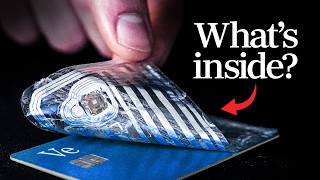
45sThe shocking visual of a credit card dissolving, revealing its hidden antenna, creates an immediate curiosity hook.
▶ Play Clip"The video delivers exactly what the title promises: a deep dive into the spy tech origins and hidden features of credit cards."
This video explores the hidden technologies inside credit cards, tracing their origins back to a top-secret CIA counter-surveillance operation. It covers the evolution from magnetic stripes to EMV chips and contactless NFC payments, and tests the security of modern cards.
A credit card is placed in acetone (nail polish remover) and dissolves within 30 minutes, leaving behind the antenna bands.
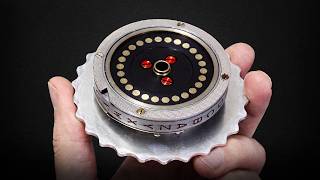
The technology behind contactless payments traces back to 'The Thing', a passive listening device hidden in a plaque at the US embassy in Moscow in 1945.
The bug used a resonant cavity that modulated reflected radio waves via a diaphragm, enabling remote listening without internal power.
Bank of America launched BankAmericard in 1958, the first universal credit card, leading to 2 million cards in circulation by the end of the decade.
IBM engineer Forrest Parry, with his wife's suggestion, ironed magnetic tape onto cards, creating the magnetic stripe for secure ID cards.
Static data on magnetic stripes allowed easy cloning via skimmers, leading to massive fraud; Tony Sales describes running a fraud ring as a teenager.
The chip uses a secret key to generate unique transaction codes, preventing cloning and reducing counterfeit fraud by 63% in the UK.
Chip and PIN added ~10 seconds per transaction, costing 116 million hours annually in the US, prompting a shift to faster contactless payments.
Mario Cardullo invented RFID for toll booths; credit cards use NFC with magnetic fields for short-range, secure contactless payments.
COVID-19 drove a 150% increase in US contactless payments as consumers avoided physical contact.
NFC readers can skim card numbers from pockets, but cloning requires the secret key; CVV is not stored on the chip.
Fraudsters use hidden readers to tap cards in crowds; US lacks contactless limits, risking large losses.
Use Faraday cage wallets, enable bank notifications, and use mobile wallets (Apple Pay/Google Pay) for better security.
Credit card technology has evolved from magnetic stripes to EMV chips and contactless NFC, balancing speed and security. While vulnerabilities exist, modern features like mobile wallets and transaction notifications offer robust protection.
What was the name of the Soviet listening device hidden in the US embassy plaque?
The Thing
01:38
How did 'The Thing' get power to transmit audio?
It had no internal power; it was activated by external radio waves that caused resonance in a cavity, modulating the reflected signal.
03:29
Who invented the magnetic stripe for cards?
Forrest Parry, an IBM engineer, with his wife suggesting ironing the tape onto the card.
08:48
What is the main security advantage of EMV chips over magnetic stripes?
The chip generates a unique code for each transaction using a secret key, making cloning impractical.
14:06
By what percentage did counterfeit fraud fall in the UK after chip and PIN introduction?
63%
16:35
What technology do contactless credit cards use to communicate with readers?
Near Field Communication (NFC), which uses magnetic fields.
22:54
What is the typical maximum range for NFC credit card transactions?
About 2 cm.
25:18
Why did contactless payments surge in 2020?
COVID-19 made people avoid physical contact with keypads and cards.
23:18
What is a Faraday cage wallet used for?
To block RFID/NFC signals and prevent unauthorized scanning of cards.
26:29
What is the recommended way to protect credit card information on a phone?
Use a mobile wallet (Apple Pay/Google Pay) where real card numbers aren't stored and biometric authentication is required.
27:12
Credit card dissolves in acetone
The visual of a credit card melting away to reveal its internal antenna is surprising and visually striking.
00:01Discovery of 'The Thing' bug
The dramatic reveal that a gift plaque had been spying on the US ambassador for years is a shocking historical revelation.
03:01Ironing the magnetic stripe
The story of Forrest Parry's wife suggesting ironing the tape onto the card is a humorous and clever origin for a key technology.
09:18[00:01] card and stick [music] it in a beaker of acetone. So nail polish remover >> Nail polish remover. Okay. It does start to work very quickly. That is crazy. This is one that we started about 30 minutes ago. We'll do a little
[00:15] >> That's a credit card from 30 minutes ago? Yeah. Why does it look Okay, so I see this like this like frame on the inside now. >> Yes. Is that all antenna bands basically? Exactly. That's the antenna
[00:28] Hmm. And what we're going to do now is show it's still working. Ah. Okay. Oh. There you go. That's the important part. All right. That's it? Yeah. That's your credit card.
[00:42] touch that here, that's where I think it would work. Come on, little card. You can do it. Yeah. Mine >> have $20. You got to believe. [music] I guess that's why the antennas are so important. Yeah, right. I'm going to try
[00:55] now. >> That worked? Wow. >> How cool is that? This is just one of the technologies hidden inside a credit >> And you can trace its origins back to a top secret CIA counter surveillance
[01:10] operation. In this pair of videos, we're going to uncover all of the credit cards hidden features and put them to the test to see how secure they really are, including attempting to steal $10,000 from MKBHD's
[01:25] locked iPhone. That's a lot of zeros. Careful with that. Oh my god. I don't Careful with that. Oh my god. I don't like that at all. War, a group of Soviet school children visited the US ambassador to the Soviet
[01:38] Union. They presented him with a hand-carved [music] plaque of the Great Seal of the United States, a gift to acknowledge the country's recent [music] alliance. The ambassador proudly displayed the plaque in his office.
[01:51] But what he didn't know was that hidden inside was a secret listening device, a This bug was the first of its kind. It had no battery, no plug point, no power counter surveillance team swept [music]
[02:06] the office, they couldn't find it. In fact, the bug remained undetected for years. But then in 1951, something strange happened. An operator at the nearby British embassy was monitoring Soviet
[02:19] radio channels when he heard people speaking, not Russian, but English. English that was coming from inside the US ambassador's residence. But despite multiple sweeps of the building, the Americans couldn't find any hidden
[02:33] listening devices. Then in 1952, they detected [music] a radio signal coming from the ambassador's office. They said, "It's coming from over there behind that plaque on the wall." And they took the plaque down and put it down somewhere.
[02:46] So they tore all the plaster out trying to find the microphones that were hidden >> absolutely nothing. Joseph Bezjian, who was a total hero, pointed at that the the plaque and said, "Don't say anything. Just come outside and let's
[03:01] take it to bits." They pried open the seal and to their horror discovered the bug. It looked simple, an antenna attached to
[03:13] a small copper cavity. But what made this device so hard to detect was that it had no power source. It laid totally dormant until it was It laid totally dormant until it was activated remotely by the Soviets.
[03:29] simulate sending some radio waves at the bug and monitor any signal we get back. We'll start at 800 MHz and then gradually ramp up the frequency. At first, nothing much happens. But then around 900 MHz, we get a strong
[03:45] That's because as the radio waves hit the antenna, their electric field tugs on the electrons inside causing them to oscillate and create an alternating current inside the [music] antenna, which in turn re-radiates a signal out.
[03:59] At most frequencies, that signal is very weak, but around 900 MHz, each push from perfectly with how the electrons oscillate. So each cycle reinforces the last and you get resonance. [music] As a result, you get a strongly
[04:14] re-radiated signal. This resonant frequency is unique to a given object or circuit and it changes based on its electrical properties like capacitance. So the Soviets realized they could use
[04:27] this by adding a cavity. What we need to do is have a resonant cavity that's very, very highly tuned, like a tuning fork for radio.
[04:41] between this end and the sheet. And as the diaphragm moves in and out, the capacitance changes. So that changes the tuning of this electronic tuning fork. So as people in the room speak, the sound vibrates the diaphragm and that
[04:56] changes the capacitance between the two plates, which in turn alters the So you've got a 10 nanometer movement, that's enough to move the resonant frequency. That changes the amplitude of
[05:08] the radio waves that get re-radiated. So you end up with this, a return signal that contains the original radio wave, but it's enveloped within the sound wave. It's a technique called amplitude modulation and it's the same technique
[05:21] used to create [music] AM radio. So whenever the Soviets wanted to listen to a conversation, they blasted radio waves from outside, likely from a van or received the radio wave they got back from the bug and extracted the sound
[05:35] information modulating that radio signal. thing since at first they didn't know how it worked. It was created by Soviet inventor Leon Theremin who'd been coerced into building the device while
[05:50] imprisoned in a gulag during the 1940s. This is the same guy who invented the contactless electrical instrument named after him. So what did the president and the CIA do after discovering the bug that had been
[06:03] spying on them for seven years? They told no one. They realized the thing was years ahead of their own spying technology. This was new and nobody done this before.
[06:16] There were no countermeasures. So they secretly began working on their So they secretly began working on their own enhanced version of the device. States, the post-war economy was booming.
[06:30] could afford things that used to be luxuries, TVs, cars, even flights. But paying for these expensive items was clunky. You either had to carry a huge wad of cash or you wrote a check that might take days to clear. So banks saw
[06:45] an opportunity. If you can make buying things even easier, then spending could explode. The first bank to capitalize was Bank of America. In 1958, they launched their >> BankAmericard. It's money in a more
[06:58] versatile form. Allowing customers to buy all kinds of expensive items on credit. This was the first universal credit card. By the end of the decade, 2 million cards were in circulation and over 20,000 merchants had agreed to
[07:11] A few decades later, this card was being used worldwide under a different name, But these early cards had two main problems. First, for each transaction, the seller had to physically imprint the card
[07:25] details on a two slips, one for the customer and then one they'd later send older cards are slightly raised. inconvenient for the customer who was still used to just handing over cash,
[07:38] the seller. They had to mail all these slips to the bank or take them over themselves. The bank would then visually inspect them in order to authorize a days before the seller actually received the funds in their account. So that
[07:51] first problem was speed. And this actually led to the second problem, A criminal could buy something with a stolen or counterfeit card and by the defrauded several days later, well, the criminal was long gone. And as criminals
[08:06] got smarter, fraud kept growing. By the late '60s, credit card fraud was costing the banks $100 million a year, around a billion in today's money. So the banks needed to make a better system, one that was faster, but also
[08:19] more secure. Back at CIA headquarters, they were facing a similar problem. To enter the building, staff presented an ID card to a guard who would inspect it and decide whether to let them in. This process was
[08:33] slow and all the information was clearly visible on the cards. So if you think about it, it wouldn't be that hard for a card to be cloned by, say, a Soviet spy. Then in the early 1960s, they wanted to create a more secure ID card for CIA
[08:48] officials. And to do that, they brought in IBM engineer Forrest Parry. Parry knew that audio cassettes stored their information on magnetic tape the same tape to store data on the ID cards. He managed that part easily
[09:03] couldn't get the tape to stick to the cards. It would just keep falling off. Frustrated, he shared the issue with his wife while she was doing the ironing and legend has it she suggested just ironing the tape onto the card and the idea
[09:18] the tape onto the card and the idea quite literally stuck. magnetic stripes and this is a an old card from our a fellow writer, Casper. going to show that if you get a little bit of iron filings on the back of this
[09:31] here. So you kind of see it's like sticking to that magnetic stripe. Yeah. this, you see there's sort of What? lines and zero ones and zeros. Just cuz it's magnetic. Yeah. So you can read a magnetic stripe with only magnetic
[09:45] filings. I don't know. I guess that makes perfect sense. Wow. Okay. But you right? At the end of the day, it's just ones and [music] zeros, you know, it's And that code can be read by this machine.
[09:59] information [music] there. Casper Mivious. No. Yeah. Yeah. That's the name, the card number. Yeah, right there. The first magnetic stripe credit cards were rolled out in 1970. These new cards slashed the time
[10:14] required to process transactions. Not only did that make spending way easier, quickly identify and block suspicious payments. problem of speed and security. And that's what today's sponsor Saylite is
[10:28] all about. And right now I'm traveling to New York, and when I touch down, I'm I'm seamlessly connected when I land. All you have to do is first download the select the United States, and then you pick a data plan that fits your trip.
[10:41] you can apply the code Veritasium to get 15% off on your order. And the best part of this is the moment I touch down, I can just use my mobile data as normal. I mom to let her know that I got there safely. All this without rushing to get
[10:55] on airport Wi-Fi or any other unsecure public network, or waiting in line for a local SIM, or relying on hefty fees that your carrier charges for roaming. It's also so much better than swapping tiny physical SIM cards. Once the Saylite
[11:07] install a new one when you visit different countries. You just go into there. And Saylite offers plans across over 200 different destinations. So, if countries, get a regional plan or a global plan. And the Saylite Ultra plan
[11:21] takes convenience even further. It gives you unlimited data and special [music] perks like access to airport lounges, fast track services, and advanced online security tools. So, download the Saylite app via the QR code that's on screen,
[11:34] Veritasium, and then you can share your own referral code with your friends to to thank Saylite for sponsoring this video, and now back to the show. So, these new cards seemed to solve the problems of speed and security.
[11:47] But, this magnetic stripe had a critical weakness. This is how you read credit cards, but also you can write to them. >> Right. So, this is just a a blank card. Mhm. So, if we get some like magnetic
[11:59] anything. Um but, if we write to this one, let's anything. Oh. It's reading as if it's the same Casper's card with the triple 09 and the super long stripe number. Exactly. So,
[12:14] does that mean if you put magnetic filings on it now, it will show something. >> Yeah. you can see that they're the same code.
[12:27] Maybe it's a little hard to see in the light. and so effective that some people made entire businesses out of it. Back then, right, we would have what we call a grabber, which is a card reader.
[12:42] I ended up having like 300 people working for me in restaurants, bars. This is Tony Sales, co-founder of WeFightFinCrime. But, around 20 years ago, he had a different title. Britain's greatest fraudster. I'd give
[12:57] to them, "Just swipe the numbers. Just when someone comes to pay, swipe their card, then swipe that one on there." You know, I'm gathering [music] thousands and thousands of numbers weekly. But, I'm also becoming a wholesaler of the
[13:11] numbers. You know, at 16, I was paying like loads of people 300 quid a week wages. The problem is that the data on that magnetic stripe is static. So, if you have a skimmer, you can clone the card
[13:23] in seconds, and then reuse it again and again, draining the funds before the card owners realized. Yeah, well, I had over a million quid under me bed, didn't over a million quid under me bed, didn't I, at 16? It's crazy how easy it was. By
[13:35] the early 2000s, card fraud was costing the UK over 400 million pounds a year, and the single biggest culprit was magnetic stripe skimming. The UK was just getting hit massively with credit card fraud.
[13:50] together to solve the problem. They created the EMV standard, a 700-page document that defined how to make secure card payments. card payments. The result was this, the chip.
[14:06] your card to a payment terminal, and then you enter the PIN. In other words, chip and PIN. Now, the way the chip works is magnetic stripe. That's because the magnetic stripe encodes information
[14:18] statically. So, every time you use it, it sends the same information first onto bank. But, the chip [music] is different. That's because it's basically a mini computer. So, it can encrypt its
[14:30] information using a secret key known only by itself and the issuing bank. sends it a long message containing all the transaction details, as well as a long random number generated by the reader. The chip then uses its secret
[14:43] key to garble the message into a unique code, which it sends back to the reader. bank, along with the raw transaction details and the random number. raw data as well. And if the output matches the code from the card, well,
[14:59] the bank knows the transaction's valid. Then, and only then, does the bank authorize the transaction. This process makes the chip more secure First, each transaction creates a new unique code, so you can't steal a code
[15:14] and reuse it. Second, a chip is incredibly difficult to clone. That's because its secret key is never revealed in a transaction, and it's stored in memory cells buried deep within the chip [music] silicon.
[15:26] have to pry open the [music] card, strip away layers of silicon, and then designed to destroy the data [music] if tampering is detected. would take days of work, hundreds of thousands of dollars of specialist
[15:40] equipment. So, it's not [music] really practical. Unless, of course, you get card. With the move from the mag stripe to the chip, the easiest way to commit fraud was just to steal a card. That's why
[15:52] banks paired each chip with a four-digit PIN, known only to the card holder. But, stealing PIN numbers is not very difficult, and there are multiple ways from you before your card was then compromised. Over the shoulder at the
[16:07] ATM, with a hidden camera at the ATM. Um all these types of different things. It's not that hard, but it's much harder than just forging a signature. When chip and PIN comes in, our business is dead in the water.
[16:20] But, then it weren't. Because America didn't adopt it till in the States. Chip and PIN was introduced in the UK in 2003, and over the next 7 years, counterfeit fraud in the UK fell by 63%,
[16:35] leading to a 27% decline in fraud overall. But, over the same period, US card fraud increased by 70%. It took until 2013 for a huge wake-up call. Criminals stole 40 million card numbers from the superstore chain
[16:51] Target. They used the details to create cloned cards, which they then swiped around the country. Finally, the US began to recognize the need to shift to chip and PIN. And as EMV chip cards were rolled out more widely over the next few
[17:04] rolled out more widely over the next few years, counterfeit fraud dropped by 76%. price. The time it took to do a transaction more than doubled, adding on average around 10 seconds onto each transaction. That may not sound like
[17:18] transactions taking place across the country, it soon adds up. In the US, it's been estimated that chip and PIN added about 116 million hours every year waiting at cash [music] registers. That's why businesses care so
[17:33] to spending. For example, it's been found that one-click checkouts online can increase spending by almost 30%. So, now the banks switched their attention from security back to speed.
[17:46] "What if you could take a second off of every transaction? What about two?" What if you could make each transaction basically instant without having to make sending a signal across a distance and then getting back a reply at the speed
[18:01] of light. Kind of like the Soviets did with The Thing, which brings us back to the CIA in the 1950s. While reverse engineering the Soviet device, the Americans realized its design had one major flaw.
[18:15] The main issue with it is that it is so hypersensitive to disturbance. >> They would have to retune and recalibrate every time the room somebody door. The device is tuned to work over a small
[18:29] transmission signal is too close to the resonant frequency, the change in amplitude due to the movement of the diaphragm is too small to detect. The the resonant frequency. [music] Therefore, you only get enough
[18:43] sensitivity in this tiny region either side of the resonant frequency. something [music] more robust, something that wasn't so reliant on this ultra-precise frequency. And to do that, they stopped thinking about radio waves
[18:58] as something they could modify with sound, and instead, they started power. So, inside the device, they added a alternating current from the antenna into a direct current.
[19:12] And they used that to power a hearing aid amplifier uh with a tiny little microphone. This amplified microphone output was sent created a modulated return signal that was sent out and could be picked up.
[19:27] That microphone and the antenna and everything else was hidden inside pieces They tried it inside the hollow legs. They actually drilled holes lengthwise through the legs of the furniture. They compromised a furniture factory to be
[19:42] work that one was. This became known as Project Easy Chair, and the CIA used it to get back at the Soviets by planting their own listening device in the Soviet Embassy in The Hague.
[20:00] rocket engineer, Mario Cardullo, gave this technology a modern twist to solve a problem involving toll booths. Throughout the states, cars had been queuing to pay for years. To speed up the process and reduce queue times,
[20:12] Cardullo invented a small tag that could be used to identify a vehicle remotely. The tag had two key components: a coil of wire to act as the antenna and a chip. Like the bugs, the antenna receives a radio wave as it passes
[20:27] alternating current, which passes through a diode to power the chip. The chip then flips a series of transistors on and off, which subtly alters the current in the antenna. This modulates the radio wave, encoding the ID number
[20:41] of the card, which the antenna sends back to a reader in the toll booth. So, the process is almost identical [music] to the Cold War spying devices, but whereas they relied on sound to modulate the wave, here it's a tiny circuit
[20:54] This technology is called radio frequency identification, or RFID for short. And today, it's used in toll booths, clothing stores, and warehouses [music] all over the world. And also, your credit card. This is a
[21:09] credit card that we're going to try to buy lunch with. You guys take tap? Yeah. going to see if it works. Okay, here. We're going to put it in.
[21:21] >> [laughter] >> I ran it through the wash. difference in the way credit cards work. See, some of these other RFID devices function over ranges of 10 m or more. But, for a credit card, that's just not
[21:35] don't want to accidentally trigger a transaction from meters away. So, the card providers had to find a way to shorten the range. The solution was to stop relying on radio waves, and instead to rely on magnetic fields.
[21:50] Inside a card reader is a small coil. When you pass an alternating current through this coil, it creates a changing magnetic field. Then, if you move your changing magnetic field cuts through the card's antenna, well, it induces an
[22:03] alternating current in the antenna. And you can see this in action using a special chip with an LED. This is one of those chips. What's very interesting is like that these chips don't have batteries. If I
[22:15] really closely, you'll see it'll start to light up. See? Oh. Yes, that's showing that all the power >> the reader. Yeah. >> That current passes through a diode to
[22:29] power the card's chip. The chip then alters the current in its antenna. This around the antenna, which the coil in the reader detects. That modulated signal carries the unique code for that transaction, which the reader then sends
[22:42] on to the bank. Cryptographically, this works just like chip and PIN, except now, instead of using metal contacts, the chip and reader communicate through a shared magnetic field. This technology is called near field
[22:54] communication, or NFC, and it's what powers all contactless credit cards today. The first contactless payment cards were launched in the mid-2000s, but contactless took much longer to
[23:06] States. Customers were cautious, and banks were waiting for enough retailers to get the right card readers, while retailers were waiting for enough customers to get the contactless cards from the banks.
[23:18] That all changed in 2020. Suddenly, touching keypads and handing over cards felt risky. And tap to pay meant you could avoid physical contact altogether. So, in the first 3 months of 2020, global contactless transactions grew by
[23:31] And over that same year, contactless payments in the US grew by 150%. >> [music] >> contactless, and the first thing that >> contactless, and the first thing that struck me was, what if you could read a
[23:46] contactless card through somebody's pocket? So, this is a a Pixel 4 XL. One there. Okay. So, we're just going to do a read, And then you get the credit card information.
[23:59] expiration. So, this seems kind of crazy, right? That you can just go up about any card that simply. >> pretty quick, yeah. But, the same thing can be done with any old land NFC capable device. Like I I have a credit
[24:13] card reader app right here. And that. Yeah, so there you go. So, the same card number right there. that's actually a lot less useful than you might think. The chip's secret key
[24:27] communication, and without that, you can't clone the card. Now, you might think to use the card details in an online transaction, but for that, you need the CVV, three-digit code that's not stored on the chip itself. It's
[24:39] card physically. So, if you want to read that number, you're going to have to find a way to socially engineer that number out of someone. But, the truth is that if I can clone a card by getting close to it,
[24:52] card as well. I'll take a photograph of that card. That that three-digit number on the back is on the back. So, if I can get access to the card to extra step to get access to the card to
[25:05] But, there's an even easier way to commit contactless fraud.
[25:18] ghost tapping, and when I tried it, I found you had to be within about 2 cm of But, in most countries, contactless transactions have an upper limit. So, you can only lose so much in a single transaction.
[25:31] pounds. But, what if you could do it thousands That's exactly what a 36-year-old woman thought in Italy in 2025. She was unknowing tourists in the busy streets of Rome.
[25:47] vulnerable to even more sophisticated scams. >> [music] >> into a public space, like for example, between the walkway where you go through into the subway or the underground,
[26:00] space. What if I could hide a reader in there? If enough people have cards in position, I could maybe read hundreds or thousands of cards a day. >> And while most countries do limit the amount you can pay in a single tap,
[26:14] the US doesn't. So, in a single tap, you could lose thousands of dollars. pickpockets is keeping your cards in a Faraday cage wallet. Or, having multiple cards next to each other also makes each individual card a lot harder to read.
[26:29] But, of course, that's not much use if you lose your card or it gets stolen. you get a notification on your phone? Does Does the bank tell [music] you? Cuz the banks will offer that service, and you should do it. And I think if
[26:43] I I watch Veritasium, by the way, I'm a fan. I like the I like them a lot. With it, if you can get half of those people just to go onto their phone app and put notifications on, if you do that, you will have the biggest impact on
[27:00] when it comes to contactless payment than anybody. With notifications on, you can contact your bank as soon as you spot a suspicious payment. But, why not go one step further and
[27:12] wallet on your phone? There, your real card numbers aren't stored, so they can't be stolen. And even if you lose your phone, your card is safe, protected by fingerprint or facial recognition. It seems like the
[27:24] mobile phone is the perfect blend of speed and security. >> [music] >> tap to pay has evolved far beyond its Over the last 20 years, new features have been added. Some for security,
[27:36] others for convenience. And that convenience comes at a cost. Coming soon to Veritasium. I'm here with MKBHD, and we're going to try to steal $10,000 from his locked iPhone. Really hope it doesn't work. Really hope
[27:50] I'm going to get you to put that phone down on top of this device. It's just a Nothing weird about that. >> Careful. >> Careful with that. Careful. Careful. That's a lot of zeros. Careful with
[28:02] that. Oh my god. Okay. Do you Do you even think it's possible, first firstly, $10,000? I don't know if Apple Pay will let you do that. I'm like, I haven't changed anything, right? Okay, yeah. It's It's still
[28:16] >> It's locked. Nothing else. Yeah. Okay, we're going to start the script again.
[28:30] What just happened on my phone? >> [laughter]
⚡ Saved you 0h 28m reading this? Transcribe any YouTube video for free — no signup needed.