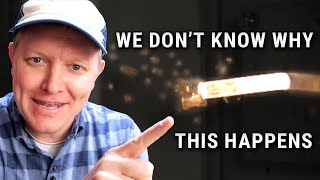

The Mysterious Impact Flash
45sOpens with a visually compelling mystery about unexplained flashes during high-speed impacts, instantly hooking viewers.
▶ Play Clip"The title promises an unsolved mystery and delivers exactly that with thorough experiments and honest uncertainty."
This video explores the mysterious flash of light that occurs when objects collide at high speed. Destin from Smarter Every Day investigates various possible explanations, including triboluminescence, fractoluminescence, and adiabatic compression of gases, through a series of experiments with a high-speed camera and a custom-built Taylor impact test setup.
Destin observes a flash of light when two fast-moving objects impact in slow motion, noting it appears in various contexts like baseball vs. glove, bullet vs. bullet, and glass spheres.
Hitting wintergreen Lifesavers with a hammer produces blue sparks, which is identified as triboluminescence from fracturing crystalline structures.
Shooting a gallon of mayonnaise creates a fireball, demonstrating that impact flashes can occur with non-crystalline materials.
Brett from How Ridiculous describes colliding two glass spheres at ~100 mph, producing a bright yellow flash that surprised them.
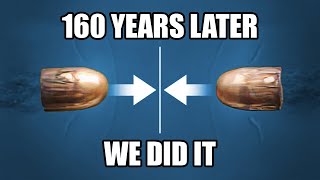
Gavin from The Slow Mo Guys discusses shooting a bullet through another bullet, resulting in a big flash on impact.
Destin explains that triboluminescence occurs in crystalline structures like Lifesavers, but glass is amorphous, so other mechanisms like fractoluminescence or mechanoluminescence may be at play.
Destin introduces the Taylor impact test, a method to relate dynamic stress and yield stress by shooting cylinders at a flat plate.
Shooting a polycarbonate rod at high speed against steel produces a large, directional flash, suggesting gas compression rather than material fracture.
Destin demonstrates with clay that oblique impacts cause gas to squirt out in one direction, matching the directional flash seen in experiments.
A paper by Guo and Chin at Purdue uses mechanoluminescence to measure impact obliquity, but Destin suspects the flash is from compressed gas, not polymer bond breaking.
Don Pettit suggests testing with different gases like argon to see if the flash changes, hinting at shock ignition.
Destin uses a fire syringe to show adiabatic compression: compressing air rapidly heats it enough to ignite cotton.
Filling the fire syringe with oxygen produces a brighter flame; argon with oxygen also seems bright, but pure argon produces no flame.
Destin repeats the Taylor impact test with polycarbonate, observing a directional flash that supports the gas compression theory.
Shooting a wooden rod at steel also produces a flash, ruling out triboluminescence and strengthening the gas compression hypothesis.
Flooding the impact box with argon does not significantly change the flash, suggesting the flash is not from argon ignition.
Filling the box with oxygen produces a larger, whiter flash, indicating oxygen plays a role in the flash intensity.
Shooting marbles in an oxygen-rich environment produces a bright flash, but gunpowder residue complicates the result.
Destin leans toward adiabatic compression of gases as the primary cause, but notes that a vacuum experiment is needed to confirm.
The flash of light on impact is likely due to adiabatic compression of gases, not triboluminescence, as experiments with different materials and gases suggest. Further testing in a vacuum is needed to confirm.
What is triboluminescence?
Light produced by fracturing a crystalline structure.
06:44
Why is glass not expected to exhibit triboluminescence?
Glass is an amorphous solid, not a crystalline structure.
08:15
What is a Taylor impact test?
A method to relate dynamic stress, yield stress, and velocity of a cylinder hitting a flat plate.
10:03
What is adiabatic compression?
Compression that occurs so fast that heat does not enter or exit the system.
20:18
What is a sabot?
A device on the outside of a projectile that takes up the diameter between the projectile and the barrel.
10:50
What did Don Pettit suggest to test the impact flash?
Fill the box with a different gas, like argon, to see if the flash changes.
17:04
What is the Cop-Etchells effect?
Flashes of light when sand hits helicopter rotors.
09:23
What is fractoluminescence?
Light produced when materials fracture.
08:28
What did the fire syringe demonstrate?
Compressing gas rapidly heats it enough to ignite cotton.
19:48
What was the result of flooding the impact box with argon?
The flash did not appear significantly brighter or different.
39:48
Unexpected Fire in Baseball Cannon
Destin's genuine shock at seeing fire from a leather baseball and glove collision sets the mystery in motion.
00:47Mayonnaise Fireball
Shooting a gallon of mayonnaise creates a massive fireball, humorously dubbed 'diesel mayonnaise'.
03:00Polycarbonate Rod Explosion
The dramatic flash and splatter from a polycarbonate rod hitting steel at high speed is visually stunning and key to the investigation.
13:35[00:02] to learn for years. Have you ever noticed when you have two things flying very, very fast and they impact in slow motion, that little spot right there where they touch for the first time, there's often a little flash of light?
[00:18] And and it looks different at different times, but but it's there and we don't really know what it is. So, today's video is all about that. We're going to going to see things that we've done in the past. For example, years ago some
[00:33] friends of mine and I, we built a supersonic baseball cannon and we saw it supersonic baseball cannon and we saw it then.
[00:47] No, no, no, no, no, no. Hold on. Am I seeing fire? Oh, there's fire. Oh my gosh, there's fire. That was unexpected.
[01:01] Where's the fire? It's literally like striking a match. What what causes that? We have a leather glove and a leather baseball. Why is there a flame or fire? What is that? Because this also happens when the
[01:17] sprinkles. 2 1
[01:52] fire/light, whatever it is. Just a couple of frames in the ultra high-speed couple of frames in the ultra high-speed video, but then we also see something like it when we fire a bullet versus a Prince Rupert's drop. So, that's metal
[02:05] Prince Rupert's drop. So, that's metal versus glass. Okay, look at this.
[02:18] Bullet versus bullet. Both of these are lead.
[02:37] when I hit things. In this garage, with that high-speed camera right over there, you hit wintergreen Life Savers with a hammer, you get sparks and it's crazy.
[03:00] And then perhaps the most fun is when we shot a gallon of mayonnaise. That is amazing. We made fire. We diesel mayonnaise. Ken is on fire.
[03:15] This is the best advertisement for Ken's extra ever may- ever mayonnaise ever. you ever heard of How Ridiculous on YouTube? We have 15 giant balloons ALL IN A MASSIVE WAR.
[03:32] OH, WOW. OH, WOW. stuff, right? Our channel is called How Ridiculous and I think that accurately
[03:44] describes what we've done for many years. I love it, dude. So, what were you doing when this thing happened? The this this Yeah, this light. Yeah, so we had two glass spheres. Um probably
[03:59] um I don't know, a bit smaller than a bowling ball, I would say. Um we don't know the exact speeds up, but they're probably going at least 100 mph. And what what happened? Uh well, miraculously we got them to collide
[04:12] um at all. So, the balls didn't fit perfectly in the cannon. So, we had basketballs put in first, then the glass balls. So, then when we fired the glass balls out, in the slow mo it was super
[04:25] left side, and then on the other side a basketball And one of the guys we were with was like, "Did we forget to put the glass ball in the other cannon?" We're like, "No." So, what what happened is the
[04:39] basketball must have been not that inflated or whatever. And the one on the right side's actually come out in front of the glass ball somehow. getting closer and closer to the barrel. And we're like, "Come on, you like you
[04:53] know, we really need this to happen." Um we sort of celebrate cuz we know, "Oh, we're going to see a collision." Which happened. Um and then as they collide there's this
[05:07] flash of light and you'll see from the footage like we just we're completely shocked, surprised. We celebrated like we just knew we'd captured something really really epic. And rare. So so you saw a flash of light when they hit.
[05:22] Yeah, that's right. Another channel you probably heard of, The Slow Mo Guys, Gavin and Dan. Fantastic guys, really good friends of mine. In fact, the reason there's paint on my ceiling right there is because they did that. We
[05:34] have a ton of footage. So, I wanted to talk to Gavin about this. How are you, man? Good to see you. Good to see you. So, you guys were trying to shoot a bullet through a bullet. Uh this one was as simple as I wanted to try and
[05:47] recreate the shot where one character gets shot through the through his own And what happened when they hit? There was just a big flash on impact as one bullet went into the the sort of hollowed out area of the the bigger
[06:02] bullet and everything kind of mulches together. I mean it's it's so hard to thousands of frames a second you see it for a few frames. So we have flashes of light with leather versus leather, leather versus plastic, hammer made out
[06:17] of steel versus sugar. We've got metal versus metal and we have glasses versus glass. We've got all these different things happening and that could possibly describe these things. I think it's pretty obvious that
[06:31] one of these things is not like the others. When we hit the Lifesavers with a hammer and we get this blue light that's happening, it seems to be coming from the fracture itself not from the impact. In fact, later in this video on
[06:44] the second channel, we shot the Lifesavers with a pellet and we saw the blue flashes of light but something interesting happened. We saw the flash of light on the impact surface but we also saw it on the side opposite of the
[06:56] impact surface where the Lifesaver was ripping apart. That tells me that this is happening because of the fracture or the cleaving of those crystalline structures and in the video we refer to this as triboluminescence which has to
[07:09] do with the fracture of a crystalline structure. That's fascinating and that differentiates it from these other impact flashes we're seeing. So what do you think it was? Uh well I
[07:23] I think initially we had no idea. We were like, what is that? Um one of the were like, what is that? Um one of the guys that was with us was a high school uh science teacher and so yeah he ended up having a bit of a look into it and he
[07:37] triboluminescence um which you know mysteriously he's like it's sort of not fully understood. Um, but what we've demonstrated is maybe one of the bigger versions of it that
[07:50] anyone's seen. Like often that's really small things, but we've done it on such a big item that it was such a rare occurrence that he was like I think we've seen something that's like truly special today. So when I first saw the
[08:02] two glass balls hit each other on Brett and How Ridiculous video, I thought, triboluminescence. But the more I started reading, the more I realized that triboluminescence apparently is something that happens on
[08:15] solids with crystalline structures. Glass is an amorphous solid. It's not a crystalline structure solid to my understanding. I really appreciate the humility here. Brett's like, I think this is what it is, cuz that's where I'm
[08:28] well. But I don't know. There's these other things. There's another mechanism called fractoluminescence. When things fracture, they cause light. There's mechanoluminescence, I think is what it's called. There's all these different
[08:43] possibilities that we have here. Another one is just straight-up friction. We've really really hard. Is it creating enough friction that it causes light of some sort? There's a lot of really big
[08:56] words to describe when light is produced. It's almost like the term luminescence is used as a suffix for when we get light from something we don't understand. Sonoluminescence, fractoluminescence, triboluminescence,
[09:08] mechanoluminescence. All these things seem to be rolled into the thing I did even thought about electrostatic discharge when two things come close and zap a little bolt of lightning across the gap there. There's a lot that this
[09:23] Cop-Etchells effect. That's when you have helicopter blades rotating in a sandy environment and when the sand hits the helicopter rotors, you get little flashes of light. There's a lot of things this could be and I want to show
[09:37] you something that happened right here in this garage that makes me think I'm starting to understand this. Okay, so let me show you a paper over here. This is a paper written by a guy named G.I. Taylor. Sir Taylor, the same Taylor that
[09:51] did the ultra laminar flow. Okay, this is a paper by G.I. Taylor, and what he did way back in 1947 is he developed a way using math
[10:03] in 1947 is he developed a way using math to describe the strength of materials trying to do is he was trying to create a relationship between dynamic stress, yield stress, and the velocity of a cylinder hitting a flat plate. This is
[10:20] called a Taylor impact test. So if you're a mechanical engineer and you're element analysis, one of the first things you do is a Taylor impact test, which is why we have this crazy device sitting right here in my garage. Okay,
[10:34] so this is a 12-gauge shotgun and it's bolted to the steel table here. And I've got this crazy box that I designed and had a friend help me make. So what happens is you shoot some cylinders into this thing and you strip
[10:50] off what's called a sabot. Now, this is what the projectile looks like. A sabot, what it means is you have a thing on the outside of the projectile that takes up the diameter between your projectile, which is that rod in the middle, and the
[11:06] side of the barrel of the gun. And you can see I designed this sabot so that the sabots would fall away, they would pedal away like that. And so what pedal away like that. And so what happens is this rod will be fired here
[11:19] as it pedals out, the sabots will be stripped away by this plate, and then it'll go over to this plate and impact this surface. So the idea is to take a cylinder and impact this plate. This is called a Taylor impact test. Now,
[11:36] the velocity that you use um or you generate with the gun, as you hit that, at different velocities, you should get different amount of yielding, like mushrooming. So, Taylor came up with the original
[11:49] relationships between yield stress, and he showed that it was different with dynamic stuff. So, this was an analytical model, meaning he used math. But, then he got some friends. He's got uh Carrington here. Carrington actually
[12:02] did some of the test, and he mushroomed some projectiles, and uh they took microscopy of the results, and he had another guy here named Whiffen, and uh were able to come up with a relationship between the strength of material, the
[12:16] velocity of the cylinder, and how much it squished. So, let me explain what I was doing when what I'm about to show you happened. So, I was doing some initial Taylor impact tests, and I had different uh cylinders that I had
[12:30] created with different photopolymers. There's a company called Formlabs, and you can 3D print. So, I made some cylinders, and I was testing the cure time. I would cure it for 15 minutes in the oven, I'd cure it for 30 minutes,
[12:44] I'd cure it for 45 minutes, and I started getting really different results with impacts. But, one of the things I wanted to do is I wanted to test polycarbonate, and I wanted to do it really, really fast. So, David, who was
[12:56] helping me that day, and I we made a hot load on the shotgun shell. So, I can change the velocity by how much powder I put in this thing. So, we made a really, really fast load, and we shot a rod of polycarbonate against that flat piece of
[13:10] stainless steel, and something amazing happened. 2 1 FIRE.
[13:35] THAT'S NUTS. DUDE, LOOK AT THIS. DUDE, LOOK AT THIS. WE stripped this above.
[13:47] flashed big time, didn't it? That's crazy. WHAT ON EARTH? WHAT THE HECK? WHAT THE HECK? What is even happening?
[14:07] Oh, and then it splattered like crazy. Okay, so that flash was crazy, right? I mean, it looks like a little bitty bomb going off on one side of the impact surfaces there, but one thing that made it so undeniably different from
[14:20] everything else we've seen, glove versus baseball and all this stuff, is that it seemed to have a direction to it. So, when it hit, it almost farted out the side of the impact surface like poof, and it made this little cloud of fire
[14:34] and it made this little cloud of fire over to one side. direction, and that direction seems to somehow be related to the obliquity of
[14:49] Okay, let me try to explain what I'm talking about here. I've got a little bitty booger of clay here, right? And I've got my rod that I'm going to shoot against the surface. If the rod comes along and it hits this thing perfectly
[15:03] straight, it's going to squish out the gas that's in between the rod and the surface, right? And so we're going to get a flat like a flat squish, okay? get a flat like a flat squish, okay? But, if I don't hit at an orthogonal
[15:17] direction, I have a little bit of obliquity to it, meaning I'm I'm tilted like this, As it hits, what's going to happen is it's going to kind of roll that gas out to one side, and you're going to get like this little poof out
[15:30] in one direction. There's going to be some directionality to it. Okay, when I Lewis, I said, "Man, look at this." He's like, "Oh man, look at the little gas." And I was like, "Yeah, I know, right?" He sent me this paper using
[15:42] mechanoluminescence as a low-cost non-destructive diagnostic method for transient polymer impact processes. Now, when I looked at this paper, what's interesting is the researchers basically built a little
[15:56] thing. They said, "Look, you know, when we hit plastics versus something, we're getting this really big flash." And they actually created a device to measure where that flash starts and where it moves to, and they use that as a way to
[16:12] measure the obliquity of impact. And they have this really super cool neat. So, basically, you can see the impacts in the middle there, and then it starts pushing out to the side. And they use that as a way to measure impact
[16:26] obliquity, which I think is really cool. So, these researchers, Guo and Chin, um in Indiana somewhere, they Oh, at Purdue. Oh, Indiana somewhere, Purdue.
[16:38] Okay, so Chin and Guo at Purdue, they say it's mechanoluminescence. They say say it's mechanoluminescence. They say it's the breaking of polymer bonds that create this light. I don't know that I agree.
[16:50] I think it's the gas. So, I showed this video to like the smartest person I know, Don Pettit. Don is a genius. He's really good at surface chemistry. And Don said, "Oh, this is interesting. Destin, what if you fill the box with a
[17:04] different gas and see if you get a different effect?" He says, "Argon is known to flash very brightly when it's activated, so maybe you could do that."
[17:16] There's this thing called shock ignition. And And so, I don't know how that works because noble gases, we're told, don't burn. They're noble. They don't oxidize. So, the idea of burning
[17:30] argon or igniting argon is interesting. It will flash before some of the other to do today. We're going to put argon over in that box, and we're going to see get a different effect. I think that's really cool. So, what I've got here
[17:46] really cool. So, what I've got here is I've got uh this LC320S kind of an overall view of what's going on, not a high frame rate. And then, we're going to use the V2511 here. A little loud, but we're going to set it
[18:00] up, and we're going to try to get a really high frame rate of what's going on. But before I do that, I want to try to recreate the compression of a gas to make fire. So, I purchased a couple of little uh science toys here. This is a
[18:13] thing called a fire syringe. It's literally a syringe, and we're going to compress the gases. Now, if we look at this paper that I found, using the ideal gas law, if you compress, there's a really cool uh example here. If you
[18:29] compress a gas, depending on the value of gamma, then you can go, let's say we compress it seven times. So, we go from one atmosphere to seven atmospheres, the temperature goes really, really high. So,
[18:43] just by compressing a gas, uh and if you do it fast enough and you don't lose temperature to uh conduction and stuff, that's called adiabatic compression, that's what a fire syringe does. This is just a piston, and it's got a O-ring at
[18:58] the end, two O-rings, and this is just a cylinder. So, uh the instructions say fluff in there, and I think the cotton fluff is what's going to catch on fire. Let me shove that down in there.
[19:14] Okay, good. Okay, so let's just put this Okay, so the syringe is in there and this cylinder is charged with just normal room air and we're going to slap normal room air and we're going to slap this thing and see if we can make fire.
[19:29] All right, here we go. 3 2 1 Yeah. Let's go look at that in high speed.
[19:48] gas law the temperature goes really really high till it exceeds the I I cotton, I guess that's what it is. I think because of Ray Bradbury, I know that paper burns at 4 Fahrenheit 451, so I bet cotton somewhere around there. So
[20:03] it got really hot in there, but I don't think that was the actual gases burning. pretty cool though. This is what's known as adiabatic compression. Basically adiabatic is a fancy word that means heat doesn't enter or exit the system
[20:18] and in this case the system is the tube and because it happens so fast heat doesn't have time to leave the system by being absorbed through the side walls of the fire syringe. So this is adiabatic compression.
[20:31] It looks like it almost squishes everything completely and then you see a little bitty ignition on the cotton just in one little spot.
[20:53] got two bottles over here. I've got nitrogen and I've got oxygen. Let's put oxygen in that cylinder. Yeah, it's oxygen. And we'll see if it burns better. 100% oxygen.
[21:08] Okay, so we should have more oxygen in there now. I think this is going to work brilliantly. Yeah. Yeah, that worked. Absolutely. Yes, sir.
[21:31] moment of most compression. And then it's like that is the spark that starts the flame. And then when we expand the fire piston, so it's burning all over. So we must have got a really really flammable mixture there. Man,
[21:47] it's even lighting my hand up. That's so beautiful. I love that. My hand looks really weird from this angle. angle. That's odd.
[21:59] something else. I still don't know if this is what we're seeing. But that's pretty bright. That's very bright. Let's see if we can do argon and oxygen and see if argon makes a brighter flame. Argon, oxygen.
[22:28] 3 2 1. Okay, that felt brighter. That did feel brighter. It also hurt my hand.
[22:48] sensor's messed up, but I'm going to call that brighter. think I kind of wanted it to be brighter. I don't know that it was. Maybe I hit it harder with my hand, but I don't think this is great data. Let's
[23:01] just move on. Just a double check because it's a noble gas, let's do just argon and I expect no burning. Just flood the area with argon. flood the area with argon. Ooh, I did get a smoke, though.
[23:21] you release. You can see vapor in there, but I I don't think I don't know, maybe it got really really hot and some moisture on the the cotton itself vaporized or something. I have no idea. I started trying to figure out the way
[23:34] to explain the sponsor for this video. I I drew up a a Venn diagram of all the but I realized a lot of it has to do with the people. First of all, this is a Canadian company. I like Canadians. I In fact, the thumbnail for this video
[23:47] you're watching probably made by a guy named Jeff from Canada. Really tight with Canadians, but the product that they are doing is cool and it ticks all the Destin boxes. Like number one, machining. I have been learning how to
[23:59] CNC machine for a really really long time now and I just get really excited by the smell of cutting fluid and this product is machined out of aluminum, which is really really cool. The company name is Hensen. They make a razor for
[24:13] shaving and it's just really cool. You open it up, no plastic. Isn't that much anymore. Nowadays, when I see a part, I try to figure out how it's made and I can see under the head here on the razor, you can see the CNC tool path.
[24:27] So, I can see that and I know, oh, that part was CNC'd, but this profile here that holds the razor down in a very precise way, that appears to be ground. I'm not sure about that. It might just be many passes on the CNC at a very fine
[24:40] with all that, you can see why precision is on my Venn diagram. The fact that tolerance all the way across means it supports the blade. This makes it great for shaving. On my Venn diagram, I've got price. The thing about Hensen razors
[24:54] is is only thing you're replacing are the little bitty blades that go in the razor itself. It's cheap. You can buy a whole razor blade for like less than a dime. It's a very smart way to think long-term about how you are using a
[25:09] reason I'm excited to use this product is because of nostalgia. But this is how my grandfather used to shave. He had a razor like this. And so I'm excited to reason I like using film cameras and stuff like that. There's something that
[25:24] connects me to the past about using a real safety razor. So, okay, so I grew my beard out so I could shoot this ad and uh that a normal safety razor like this is
[25:36] longer like this. I hate that I'm telling you this in an ad because it But it's true. All right, if you want to try a Henson razor, you can do that go into hensonshaving.com/smarter. Get a razor like your grandfather used.
[25:51] If you use the promo code smarter at checkout, you get 100 blades, which is basically 2 years of shaving for free. So, I like the Venn diagram that makes SmarterEveryDay. hensonshaving.com/smarter.
[26:04] hensonshaving.com/smarter. Give it a shot. Okay, so um let's go back and see if we can repeat the thing that happened when David and I were shooting in the garage. So, let's get the gun back out and uh
[26:19] let's see if we can make that flash of light again just for repeatability purposes. And I got 12 grains of powder in the shotgun shell. Uh I'm going to to make it where uh I can see through this and see
[26:34] through this front side here. It's kind of dirty, isn't it? And then I've got this shield kind of thing where I can contain it on the back side here. I can contain it on the back side here. So.
[26:52] and we have a see-through side. So I guess now we can just turn the light on here and that's really bright for normal cameras but we should be able to see it with high speed. So we'll give it a shot
[27:04] That's our goal, right? I want to show you how I'm aiming this thing. I 3D printed a I 3D printed a little laser adapter here and I put the laser in the
[27:16] barrel and then over here I turn this thing on right? Which means I got to make sure that the projectile goes through
[27:30] off. So it looks like we're aimed pretty well but I always like to just look down the barrel why not? It looks pretty good.
[27:42] It looks like it's it's pretty aligned. I don't know if you can see that at all but yeah, it looks pretty good. Drop that plastic in there. Don't want it to be too exciting for us. Okay. So for real tailor impact test what we want to
[27:54] do is we want to measure the length of the projectile. This is polycarbonate 75.25 mm. mm. Should be a 50 cal here yet 12.71 mm.
[28:06] How much does she weigh? 11.4 g. Okay, so we can use that 11.4 g. Okay, so we can use that information and we can back out squish stuff if we had the high speed in the correct position which we don't. But
[28:18] let's build this projectile here with my 3D printed sabots. 1 2 3. Okay. All right, that works good. All So that is a 12 gauge shotgun shell
[28:34] right there. I'm going to go over here I'm going to go over here grab this bad boy
[28:46] like this and
[29:01] Ready to go. Camera trigger right here. Nah, I'm just ride this out of my head. Here we go.
[29:20] That's exciting. All right, we'll let the smoke settle there. Let's go look at what we got.
[29:39] Right there, the whole thing. And then you can see it dies out right That is bizarre. We have to go much faster. in the barrel. Hadn't shot it in a while.
[29:54] some flashes right there, that's the bow hitting the steel. bit actually. Still added to it up a little bit. Yeah,
[30:06] same thing. Weird. Oh, we got we got a flash there when that hit, too. Well, we we were able to repeat the flash, that's good. Okay, so we didn't have a high enough frame rate to see exactly what happened,
[30:18] but if you look, if we just go through frame by frame, you can see that it's kind of rolling to one side. It It starts when the bottom contacts, but the last bit of light we see is on the top, and that would that would kind
[30:32] earlier with the little booger of clay. You remember it hits and it rolls to one side? So, that could be a thing. I I what we should do now is we should tighten the camera up and go a lot faster. So, I'll take this resolution
[30:45] and I'll just make it a lot smaller and then I'll up the frame rate and we'll see if we can see something again even faster. Maybe more powder, too. Just because. Okay, we're going to go 15 this time.
[31:04] This is a little hot, so I'm going to stay further back. 2 1 stay further back. 2 1 Ooh, that was hot.
[31:17] That is a lot of chaos. I love it.
[31:32] Oh, man. Yes, a burst. Oh, it maxed it out. Definitely saw the gas. It was so bright, the sensor didn't know what to do with it. Nice. And then we have these little secondary flashes
[31:46] as it goes through. Now, that really feels And that's the booger um theory that I have. You see it's lit up on this corner down here and then it rolls out
[32:00] and then it shoots and then it confuses the sensor. Okay, so Okay, this time I'm going to use an opaque plastic. This is PETG and we've been shooting polycarbonate, the the question is will we also get the little
[32:13] question is will we also get the little flame pooting out the side? This is not and not contain the gas, but I don't seeing a triboluminescent kind of thing or if we're compressing a gas and shock
[32:26] or if we're compressing a gas and shock ignit- igniting it, maybe. 74.56 I think something weird happened. I think the sabot came out before the
[32:41] think the sabot came out before the projectile. Very slow rod. So we sheared.
[33:00] fire on this. Because it's going so slow.
[33:15] Even though it was going slow and it did the That's the booger technique. I'm convinced at this point that a lot of times it's gas. So I did see it in you've seen and we did a video a little bit before that. It might have even been
[33:29] back record, but we were just shooting straight into steel targets around And that kind of gave a little bit more freedom to see the flash because it wasn't being squished into a tiny little area of a bullet. It was being allowed
[33:44] steel plate. And what's your theory on what I've read and I feel like thankfully I have really smart people in people were saying it was the just gases in the air being compressed
[33:58] they're they're physically lighting up like they're getting that hot briefly because I was seeing it get squished between all the where the hollow point little petals kind of meet around the bullet. It was
[34:12] getting fired out of every available space. Now, the question is what gas? What's Is it burning? Like is something oxidizing? Or I've read about something oxidizing? Or I've read about this thing called uh shock ignition of
[34:26] gases. I've read about that. And um I think it's possible that we might be doing that because it's trying to move that gas so fast because it's 90° out of phase from the or it's 90° out of line from the flight
[34:41] axis when it hits, it's sending that gas out at an incredibly fast speed. Okay, out at an incredibly fast speed. Okay, so it created a little puff of fire with PETG, which is a plastic still. What happens with wood? This is like an
[34:56] insulator. It's not going to be triboluminescence. If we get fire with wood, then that would be amazing. Plus, this is way lighter weight and we can make it go way faster. This feels like basswood. This is going to be nothing. 4
[35:10] g, so it's like 25% of the mass. I wonder if we even come up to enough chamber pressure just on the shot in terms of ballistics. I'm worried about that. I don't know what's going to happen here. 3 2 1
[35:22] happen here. 3 2 1 I want to see. Splinters everywhere. Oh man, that's so good. Look at that. This is just like total carnage. Oh man, if we see a
[35:37] fireball in this, that's going to be nuts. What What are we even doing? This uh which one we look at first? Let's look at the big one first.
[35:54] powder. Ton of unburnt powder because we don't get enough chamber pressure to to barrel. Man, that is moving.
[36:09] Man, that is moving. Can wood make fire on steel? That's nuts. It's gas. It's got to be gas.
[36:21] Yeah, you can see the flame where it contacts first, and then it rolls it forward and looks like it got hotter, Not unlike the fire piston, right? But it goes out pretty quickly. Like it extinguishes it
[36:33] much quicker. We don't see the rolling poof. That makes me wonder if the rolling poof has something to do with the material. I really want to do argon and I don't want to asphyxiate myself or suffocate myself.
[36:47] myself or suffocate myself. So argon is heavier than air, I'm told. So what we're going to do is we're going to open the garage here to get some fresh air in and more importantly let argon roll
[37:00] out. I don't think I'm going to use that much argon. But what I want to do is I want to flood this box with argon now to see if we can get a flash because I have a Wikipedia article over here.
[37:13] It's it's on something called argon flash. uh fancy pants scientists in real labs, not garages like my garage, they use Check this out. Typical argon flash devices
[37:27] consist of an argon-filled cardboard or plastic tube with a transparent window on one end and an explosive charge on the other end. Many explosives can be the other end. Many explosives can be used. PETN, comp B, RDX.
[37:40] So basically they put argon in a tube and then they drive it with an explosive and somehow that makes a big flash. Now what actually happens to make that I don't know. Um I don't think it's the argon burning
[37:54] but it's the shock ignition somehow of the argon. It's It's like it requires a detonation in a supersonic shockwave in the argon but I don't know if it's the other gases in the tube that are making the flash or the argon itself that's
[38:08] making the flash. I don't know. But what I do want to know is if we fire polycarbonate, which gave us the most impressive flash, impressive flash, into a box that's flooded with argon,
[38:21] want to do that is I've got this tube right here. This is an argon tank. I right here. This is an argon tank. I want to run a tube into into the box like this. Basically, what I want to do is I want to take that hose
[38:38] that. So, we're going to put argon in this side over here. I'm going to get some tape. I'm going to tape the to get some tape. I'm going to tape the box up so that we don't get leakage uh
[38:51] around all this and we can just kind of fill the box up over here with argon and let it flood over into this box. And then right before I I fire, I'll pull that hose out and then fire and trigger the high-speed camera all at one time.
[39:08] holes. Very scientific. Okay, let's turn it up. Flooding the box now. Gun is ready. Okay, I'm going to pull the hose out. Here we go.
[39:26] Hose is out. Ready to trigger. 3 2 1. Argon is off.
[39:48] There was a bright flash for sure. There's other things flashing as they hit and that those are pieces of the sabot, are they not? Doesn't seem to be any brighter. Interesting. I think it's safe to say that we didn't
[40:01] see very big flashes there for whatever reason, maybe because argon's a noble gas. But, what I do know is that I I'm starting to feel like the gaseous environment that the impact occurs in dictates how big the flash is, which
[40:14] means we need to fill the box up with oxygen. And we're going to make an oxygen-rich environment.
[40:31] Yeah, there's a lot of oxygen in there, that's for sure. Polycarbonate, but on this about 3 2 1. I don't know why. Okay. All right, cut off the oxygen. Yeah, it
[40:46] All right, cut off the oxygen. Yeah, it did. It felt bigger.
[41:08] It's white. And it kept flashing. It also hit more orthogonal than normal. So, I wonder if that's and other stuff that hit kept flashing. That's pretty
[41:21] big. That's a pretty big flash. I'd say it was bigger. Yeah. I feel like the flashes that we're seeing might not be triboluminescence or mechanical mechanoluminescence. I think sometimes they are.
[41:35] But I feel like this might be adiabatic compression or something like it. So, we're compressing gas. And I think the beautiful thing about that shot is it was done at a 90° angle.
[41:48] surface. And I think that makes the gas have to rush out from the front of the impact surface faster. if you have a string and it's got some slack in it and you
[42:04] pull the string really tight, the if you do the math, like if if you pull here, it takes an infinite amount of force to to on that
[42:17] direction. I guess what I'm saying is tangent is coming into play. So, the velocity the velocity of that gas running out from under the impact surface is a function of how orthogonal you hit.
[42:36] Which makes me interested in the the glass balls hitting because no matter where the glass balls hit, there's always going to be a 90° point because there're two tangents on
[42:49] And so, there's always going to be one little spot where you're perfectly tangent. This is interesting. We have learned And I want to shoot a marble now. I'm going to shoot a marble. Would you say
[43:03] the light was blue or the light was orange? I thought it was like it was like a white like a whitey blue. When I first saw yours, I thought that it cracked the whole sphere and then the light from around
[43:16] like the light from the sun was illuminating the balls. And then think that's what that is. It looks different. So, I because it goes away. It does. Yeah, it does go away very
[43:28] soon. Oh, wait. Yeah, I'm about to watch it right here. I'm watching it. No, it is quite yellow. It's yellow. Definitely. And there's nothing yellow around like as in it was like snowing active snow. Oh, that's a good point.
[43:42] So, it was yellow. I'm toying with the idea that this is gas. This is like the nitrogen in the air igniting between the balls. And and then it's illuminating the glass like a fiber optic.
[43:55] Like it's like a lens, which is what the balls are. They're a big lens. But see, I it could also be like I'm looking at the the Wikipedia page on triboluminescence. And there's a special one called fractoluminescence.
[44:08] So, I think it's possible yours is that weird thing, too. So, I I don't know. the plate now, so I have to take the Sabot stripper plate out. So, let's do Sabot stripper plate out. So, let's do that.
[44:24] directly through here with I don't know, I guess we'll use some felt or something, and uh just impact directly. I've got some marbles shoved in shotgun shells here, and we're going to see we're going to see if we can make it do
[44:38] it with glass. All right, here we go. Oxygen, and lots of it. All right, so there's oxygen going in the tank. Two marbles. Kind of an attempt at making it work there.
[45:00] Marbles in the tank. Box full of oxygen. 3 2 1 Oh, man. That's crazy. So, like gunpowder was still burning right there.
[45:31] And then the marble hitting the marble behind it flashed as well. need to do a better job of putting the gases in the box. I need to uh I need to
[45:44] do some research and uh figure this out. But, anyway, this was a good exploratory thing. Uh so, the question is, is it triboluminescence, or is it
[45:56] uh adiabatic compression, or is it fractoluminescence? What is going on? I I think it has to do with oxygen for sure. The question is particulating and then burning instantly?
[46:11] I I really think it has a lot to do with the gases. The The question that's remaining for me is are those gases burning? I don't know. I I'm leaning away from triboluminescence right now and I'm
[46:23] in a vacuum. I need to fire that in a vacuum. That's what I need to do. Okay, anyway, I hope you enjoyed this episode of Smarter Every Day. Um we're just playing and learning and I
[46:37] all this in the comments below. You know how on the internet sometimes people say, "Well, actually." I would love to hear your well, actuallys down in the comments below. So, please leave those. I'd be grateful. Big thanks to everybody
[46:50] that supports Smarter Every Day on Patreon at patreon.com/smartereveryday. I am grateful. I'm going to keep working on this and uh more to come. Thank you so much. I'm Destin, be getting smarter every day.
[47:03] Have a good one. Bye.

⚡ Saved you 0h 47m reading this? Transcribe any YouTube video for free — no signup needed.