
AI Summary
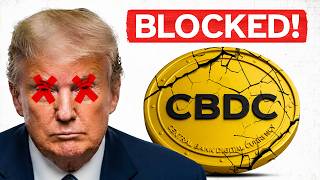
The video explains how the United States banned a central bank digital currency (CBDC) without President Trump's signature, as the ban was attached to a housing bill that became law automatically. It details the political maneuvering, the role of commercial banks, and the global context of digital currency development.
Chapters
On July 11, 2026, a ban on a Federal Reserve digital dollar became law automatically after President Trump neither signed nor vetoed the housing bill within 10 days, as per Article 1, Section 7 of the Constitution.
The 21st Century Road to Housing Act passed the Senate 85-5 and the House 358-32, making a veto futile. Trump let the 10-day clock expire as a protest over the SAVE Act (voter ID bill).
The ban began as the anti-CBDC Surveillance State Act, introduced by Tom Emmer, which passed the House 219-210 but died in the Senate. It was then attached to the housing bill to ensure passage.
A CBDC is a direct liability of the central bank, unlike commercial bank money. It enables direct accounts, programmability (e.g., expiring balances), and traceability of all transactions.
Commercial banks lobbied against CBDCs because they would drain deposits, undermining their lending model. Banking groups like the American Bankers Association opposed it.
The housing bill also raised the cap on bank public welfare investments from 15% to 20%, streamlined exams, and exempted certain custodial deposits from scrutiny.
China's digital yuan has processed 3.48 billion transactions ($2.37 trillion) and the mBridge platform settles in 7-8 seconds, bypassing SWIFT. Europe approved a digital euro framework, and Russia is launching a digital ruble.
The dollar still holds ~58% of global reserves, the euro 20%, and the yuan barely 2%. The yuan lacks capital convertibility and deep markets, so it's not a reserve threat yet.
The ban is framed as a freedom win, but it also protects commercial banks and removes the US from the digital currency race, potentially disarming it in a currency war.
The CBDC ban, passed without a signature, illustrates how complex monetary policy can be buried in unrelated legislation. While framed as a freedom win, it primarily serves commercial bank interests and leaves the US out of the global digital currency race.
Mentioned in this Video
Study Flashcards (6)
How did the CBDC ban become law without Trump's signature?
medium
Click to reveal answer
How did the CBDC ban become law without Trump's signature?
Under Article 1, Section 7, if a president neither signs nor vetoes a bill within 10 days while Congress is in session, it becomes law automatically.
01:09
What was the original name of the CBDC ban bill?
easy
Click to reveal answer
What was the original name of the CBDC ban bill?
The anti-CBDC Surveillance State Act.
03:36
What are the three key consequences of a CBDC?
medium
Click to reveal answer
What are the three key consequences of a CBDC?
Direct accounts at the central bank, programmability (e.g., expiring balances), and traceability of all transactions.
05:46
Why did commercial banks oppose a CBDC?
easy
Click to reveal answer
Why did commercial banks oppose a CBDC?
Because it would drain deposits from commercial banks, undermining their ability to make loans.
07:29
What is the mBridge platform?
medium
Click to reveal answer
What is the mBridge platform?
A cross-border payment platform linking China, Hong Kong, Thailand, UAE, and Saudi Arabia, settling transactions in 7-8 seconds.
10:08
What percentage of global reserves does the dollar hold?
easy
Click to reveal answer
What percentage of global reserves does the dollar hold?
Around 58%.
11:50
💡 Key Takeaways
Monetary Law Passed Without Signature
Demonstrates a rare constitutional mechanism where a major monetary policy became law without presidential approval.
CBDC Programmability Risks
Highlights the potential for government control over spending through programmable money.
05:46Banks' Self-Interest in Banning CBDC
Reveals the commercial motivations behind the 'freedom' narrative.
07:12China's Digital Yuan Scale
Shows the real-world scale of China's CBDC, contrasting with the US ban.
09:34The Ban's Real Winners
Summarizes the dual narrative of freedom vs. bank protectionism.
12:44Full Transcript
[00:00] The most consequential monetary rule in a generation just became law and President Trump never even signed it. On July 11th, 2026, at the stroke of midnight, Washington permanently slammed the door on a Federal Reserve digital dollar or central bank
[00:16] digital currency. [music] There was no signing ceremony. In fact, there was no signature at all. It was buried inside a housing bill while Trump sat on his hands over a completely unrelated fight about voter ID. But 10 days of silence and it became law automatically. [music] The
[00:33] United States government just voluntarily walked away from the single most powerful financial tool it could ever build. But that doesn't happen so easily. So the question is, who actually wanted
[00:45] it dead? And why did the state just give up that much power on purpose? In this video, we're going to show you how a monetary law passed with no signature, who really gained as a result, and why
[00:57] America appears to have just disarmed itself in a global currency war. My name is Louis, and you're watching the Coin Bureau. Now, let's start with a very brief lesson on the Constitution. I promise
[01:09] I won't get too deep into the weeds here, but this is as important as is it is strange. Under Article 1, section 7 of the Constitution, if a president neither signs nor vetos a bill within 10 days
[01:21] while Congress is still in session, the thing just becomes law on its own. In the simplest terms, silence in this scenario essentially equals a yes. But the timeline is really quite something. The
[01:33] Senate passed the 21st Century Road to Housing Act 85 to5. The House passed it 358 to 32. Then on June 24th, Trump abruptly cancelled the signing ceremony. Speaker Mike Johnson formally
[01:48] sent it to the White House on June 29th, starting that 10-day clock, and Trump just let it run out. His actual words on Truth Social were that he would not sign the housing bill in protest because
[02:00] the Senate couldn't pass what he called the Save America Act. He described the housing package as, and I quote, a yawn. The SAVE Act, for those unfamiliar, is a voter ID bill demanding
[02:12] documentary proof of citizenship to register to vote. The Senate had already rejected it 48 to 50 back on June 4th. So, Trump was holding a housing bill hostage to force through a voter ID
[02:25] law that was already dead. Why not just veto it, though? Because look at those margins. 85 to 5, 358 to 32. Those are veto proof numbers. A veto would have been overridden in an afternoon, and
[02:39] picking that fight instead of the midterms simply wasn't worth it. As a result of all of that mess, the most sweeping monetary decision in decades slipped through as a side effect of a political
[02:51] negotiation about something else entirely. So, as you can imagine, that is precisely the kind of thing that vanishes in the news cycle, especially with everything else going on in the world right now. And that's why you should join the Coin Bureau Telegram group where we flag out stuff
[03:06] like this the moment that it happens before the headlines catch up. It's completely free, so just follow the link in the description or scan the QR code that's on the screen so that you never miss a key bit of market moving news again. Now, right back to it. It might not surprise you to hear that
[03:22] this central bank digital currency or CBDC ban didn't start life in a housing bill. It began as a standalone piece of legislation with a very deliberate name, the anti-CBDC Surveillance State
[03:36] Act. It was introduced by House Majority Whip Tom Emmer. And on July 17th, 2025, it passed the House on its own steam. But look at how it passed. 219 to 210. A near partyline vote, scraping over the
[03:52] finish line with 135 co-sponsors. Then it hit the Senate and well, it died. The classic pattern, popular enough to squeak through the House, dead on arrival in the Senate. So, how do you
[04:05] resurrect a controversial surveillance bill that couldn't survive on its own? Well, you bolted onto something that nobody dares vote against. Enter the Road to Housing Act, a 374 page monster
[04:18] described as the most comprehensive housing reform in the last 30 years. 50 plus banking and housing provisions, bipartisan fingerprints all over it, built during a housing affordability crisis with
[04:31] a shortage of millions of homes. It even banned big institutional investors from hoovering up single family homes, policy both Warren and Trump had separately backed. In other words, it was politically untouchable. Nobody wants to be the lawmaker who voted against cheaper
[04:47] homes on camera. And that's the idea. A CBDC ban that limped through the House 219 to 210 now rode inside a vehicle that passed 85 to 5. The surveillance ban survived by attaching itself onto
[05:02] a bill nobody could afford to kill. Now, before we can go any further, it's worth looking at exactly what was banned here because CBDC gets thrown around like everyone knows what it means. Well,
[05:15] as previously stated, CBDC stands for central bank digital currency. But the key word there is central. Right now, the money in your bank account is a liability of a private commercial bank like Chase or Wells Fargo. A CBDC changes that. It would be a direct liability of
[05:33] the Federal Reserve itself. That means that you would hold a claim on the central bank, not on your high street bank. And that has three big consequences. First, direct accounts. citizens
[05:46] could theoretically hold money straight at the Fed, bypassing commercial banks entirely. Second, programmability. And this is the scary one. You can code conditions directly into the money. That
[05:59] translates to things like balances which expire if you don't spend them or funds restricted to certain shops or certain categories. Money with rules hardwired in, that's pretty grim. And third,
[06:11] traceability. A centralized ledger giving the central bank a potential real-time view of every single transaction that you make. Tom Emmer called it giving the government a god's eyee view of your financial life. CFTC chairman Mike Celig said that a CBDC will never be introduced under
[06:29] our administration. The new Fed chair Kevin Walsh sworn in dismay called a retail CBDC a bad policy choice. and Treasury Secretary Scott Bessant said it would enable a financial police state. So the
[06:44] official justification was loud and clear. This was about stopping a surveillance state. And that argument resonated right across the political spectrum. Left and right for once, agreeing
[06:56] that programmable traceable government money is a nightmare. Hold on to that framing though because we're going to come back to the irony of the state killing this in the name of freedom. But first, let's follow the power. For all the talk of freedom, it certainly isn't the only element
[07:12] here. Because the people who hated a CBDC most were the commercial banks. Consider what a direct Fed digital dollar does to their business model. If ordinary people can hold accounts directly at the central bank, they don't really need Chase. They don't need Bank of America. And that's a
[07:29] crucial bit of detail because those bank deposits are the raw material that banks use to make loans. Mortgages, business loans, credit cards, all of it is built on your deposits. If citizens start
[07:41] moving their savings out of commercial banks and straight into the Fed, commercial banks are well pretty screwed. And that's with all else equal. While times are relatively good, it would get way
[07:53] worse in a crisis. In a bank panic, a CBDC would offer a frictionless instant flight to safety straight into the central bank that would trigger bank runs faster and harder than anything that we
[08:05] have today. So, who actually lobbied against a Fed digital dollar? The American Bankers Association, the Bank Policy Institute, the Independent Community Bankers of America, the most powerful
[08:18] banking trade groups in Washington, arguing that a digital dollar would drain deposits from local banks and choke off credit creation. But that's not all. The housing bill that killed the CBDC
[08:30] also handed the banks a stack of unrelated wins. Section 203 raised the cap on bank public welfare investments from 15% to 20%. It streamlined bank exams for well-run institutions. It exempted
[08:43] certain custodial deposits at smaller banks from brokered deposit scrutiny. So inside one bill, the banks got an existential threat removed and a pile of regulatory sweeteners on top.
[08:56] The quote surveillance state was a nice narrative, but for banks, protecting their business model was undoubtedly the real reason for their opposition. But still, when all was said and done, Washington killed the digital dollar and any official line revolved
[09:10] around the idea of stopping a surveillance state. But that's a bit strange. No, a CBDC would have been the most powerful tool any government has ever held. Programmable money with transaction
[09:22] level visibility on every citizen, the ability to freeze funds, redirect them, or make them expire. And the state just gave that up voluntarily. The people who normally crave exactly that kind of
[09:34] power looked at it and walked away. Strange. But here's where it gets bigger than banks and bigger than surveillance. Because while America was busy killing its digital dollar, the rest of the world was building theirs. Starting with China. The digital one has already processed over
[09:52] 3.48 billion retail transactions totaling roughly 2.37 trillion, over 230 million personal wallets. This is well past the pilot stage live and running at scale today. But the real threat is crossborder
[10:08] platform called Mbridge linking China with Hong Kong, Thailand, the UAE and Saudi Arabia. It has seen $55 billion in transactions, roughly 95% of it settled in digital one. And those transactions
[10:22] settle in about 7 to 8 seconds versus 3 to 5 days for traditional correspondent banking at roughly 50 to 70% lower costs. It's built for one purpose, settling energy and commodity
[10:34] trades while bypassing Swift and the dollar entirely. Then we have Europe. On June 23rd, the European Parliament's economic committee approved the legal framework for a digital euro
[10:46] 43 to4. The pilot is targeted for mid2027 with first issuance possible by 2029. And the EU's rationale is that the digital euro is a defense against, in their words, US control of money,
[11:01] deepening a hedge against Visa, Mastercard, and American stable coins. Even Russia is launching a digital ruble this September. While China runs at scale, and Europe builds its own guard rails, America has frozen itself out until at least 2031. The US is the only major block voluntarily
[11:20] exiting this race. rather than negotiating its way through it. And not everyone thinks that that's smart. Former CFTC chair Timothy Msad warned the ban strips away tools for sanctions enforcement,
[11:32] crossber settlement, and financial inclusion. He says that tokenized money is becoming inevitable behind the scenes anyway, whatever the political rhetoric says. So, is America protecting individual freedom or is it unilaterally disarming in the next phase of a currency war? Well,
[11:50] it's time for a bit of a reality check on some numbers. The dollar still makes up around 58% of global reserves. The euro sits at 20%. The yuan, well, barely 2%. And the reason for that comes
[12:03] down to the rule of law, deep and liquid capital markets, and free convertability. Not much to do with any kind of digital infrastructure. China has none of the advantages that the dollar enjoys.
[12:16] Capital controls and shallow bond markets mean the yuan simply can't be a global safe haven. Even domestically, China's digital Juan is dwarfed by Alip Pay and WeChat Pay. So, the digital one is a payment tool, not yet a reserve currency threat. Its real danger is
[12:32] narrower, building alternative payment corridors that bypass Western Rails for specific trades, especially energy. Now, that's a considerable risk, but it's not the dollar collapsing. So,
[12:44] let's step back for a moment and consider all of this. The monetary law that nobody signed, buried inside a housing bill nobody dared oppose, is being sold to the public as a win for freedom.
[12:56] A law that also very conveniently protected the commercial banks from the one thing that could gut their business and pulled America out of the global digital currency race just as its rivals accelerated. You could choose to see that as principled restraint, a government refusing to
[13:12] establish a surveillance state. Or you could read it as a win for entrenched business interest with ulterior motives. In any case, the talk of freedom gave everyone cover. The banks secured their profit margins and the politicians got a housing win before the midterms and nobody had to answer
[13:28] for a monetary decision that reshapes the next 50 years because it essentially just slipped its way through. The system just works. Well, that's all that we have time for today. But what do you think? Was this a case of US politicians showing that they care about freedom? Or was
[13:44] it all just some slick maneuvering from banks that wanted to protect their profits? Let us know your opinions in the comments below. And if you want to understand the private money future this ban just cleared the runway for, go check out our full video on stable coins right over here.
[14:00] Thank you all so much for watching and I'll see you again very soon. This is Lewis signing off.