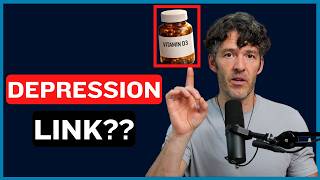

Vitamin D: A Natural Antidepressant?
44sTaps into the widespread concern about mental health and offers a natural, evidence-based solution that viewers can act on.
▶ Play Clip"Title promises a specific vitamin's effect on inflammation and depression, and the video delivers with research-backed evidence, though it includes some promotional content."
This video discusses the role of vitamin D in reducing inflammation and improving symptoms of depression, particularly during winter months. The speaker reviews a narrative review titled 'Nutritional interventions in depression, the role of vitamin D and omega-3 fatty acids in neuropsychiatric health' and highlights key research findings, mechanisms, and practical recommendations for supplementation.
Vitamin D is effective for improving cognition and symptoms linked to depression and seasonal affective disorder during winter.
Vitamin D affects inflammation in the body, reducing symptoms of depression, anxiety, and overall malaise.
A cross-sectional study found vitamin D levels are lower in winter and depression is linked with insufficient vitamin D levels.
Vitamin D is linked with frailty and sarcopenia; low levels correlate with higher frailty scores and reduced muscle protein synthesis.
Multiple RCTs (720 to 25,000 participants) show that 2,000-4,000 IU/day of vitamin D reduces inflammatory markers like TNF-alpha, IL-6, and C-reactive protein.
Five RCTs comparing vitamin D to placebo found vitamin D is associated with a reduction in depression.
During winter in the US, the sun's zenith angle is insufficient for cutaneous vitamin D synthesis, making supplements necessary.
Vitamin K helps matrix GLA proteins move calcium from blood to hard tissues; insufficient K can lead to arterial calcification, especially in those on warfarin.
Pair vitamin D with vitamin K2, especially if not eating fermented foods or liver. Mentioned a vitamin K2 product from Italian company Noosis fermented from Bacillus coagulans.
The narrative review recommends 1,500 to 4,000 IU of vitamin D as monotherapy for depression, even for children.
Increase vitamin D supplementation during winter, especially in high latitudes like Seattle, where sun exposure is insufficient from October to March.
What is the recommended daily dosage of vitamin D for depression according to the narrative review?
1,500 to 4,000 international units (IU) as monotherapy.
05:25
Which inflammatory markers are reduced by vitamin D supplementation?
TNF-alpha, interleukin-6, and C-reactive protein.
02:32
Why is vitamin K important when taking vitamin D?
Vitamin K helps matrix GLA proteins move calcium from blood to hard tissues, preventing arterial calcification.
03:38
What is the effect of the sun's zenith angle during winter in the US?
It is insufficient to induce cutaneous vitamin D synthesis.
03:26
What is the source of the vitamin K2 product mentioned in the video?
An Italian company called Noosis, fermented from Bacillus coagulans.
04:44
Large-scale RCT evidence
Provides robust evidence from cohorts up to 25,000 people that vitamin D reduces inflammation.
02:05Vitamin K pairing rationale
Explains a critical interaction that prevents arterial calcification, a key safety consideration.
03:38Specific dosage recommendation
Gives a clear, actionable dosage range for depression, useful for clinical or personal application.
05:25[00:01] These are common things that afflict a lot of people during the winter months. data to suggest that good old fashioned vitamin D is very effective for improving cognition as well as symptoms linked to depression and seasonal
[00:15] we're going to break down that research and dive into a recently published narrative review titled nutritional interventions in depression, the role of vitamin D and omega-3 fatty acids in neuropsychiatric health. Now, I think
[00:29] know about you, but I see on the media all the time about, you know, depression and the mental health here in America and throughout the world. We hear a lot about gun violence and and and violence
[00:41] in general and criminality and uh people taking their lives and suicidal ideation important that we talk about natural solutions that can improve the functioning of people's moods. And today we're going to talk about vitamin D.
[00:54] Now, this is really important because we actually have a lot of good evidence to suggest that vitamin D is really important for affecting inflammation in the body and thereby reducing symptoms of depression, anxiety, and overall
[01:09] malaise. So, we have This is table one from the study that I'm referring to. One observational cross-sectional study finding that vitamin D levels are lower in the winter for all individuals in this particular study
[01:23] uh and depression is linked with insufficient vitamin D levels. So, I think that's really important to focus on. We have data showing that vitamin D is actually linked with frailty and so we know that vitamin D is indirectly
[01:36] anabolic of sorts. It does affect muscle protein synthesis. Now, it's not like leucine in in so far as or it's not like testosterone in so far as how it affects growth or anabolism, but we know that protein uh muscle protein synthesis and
[01:51] vitamin D, there is some mechanistic correlations here. So, uh people with low vitamin D levels actually have higher frailty scores and increased sarcopenia. So, I think that's uh important to understand. And
[02:05] specifically in the context of inflammation linked with depression and characteristic of having a flu and and and being more susceptible to influenza-like illness, multiple randomized controlled trials in
[02:17] involving large cohorts of individuals ranging from 720 people all the way up to 25,000 people find that guess what, taking vitamin D on the uh on the low end, 2,000 IU's per day up to 4,000 IU's per day, guess what, reduce inflammatory
[02:32] uh objective markers of inflammation like TNF alpha and interleukin-6. Uh also uh C-reactive protein is known to decrease with vitamin D supplementation. during the winter to talk about depression. Uh vitamin D and omega-3s
[02:46] were linked with lower indices of depression and mental challenges along depression and mental challenges along those lines, but we have five studies randomized controlled trials finding
[02:58] comparing vitamin D to placebo, vitamin D is associated with a reduction in depression. So, you know, if we're serious about improving the mental health of Americans and the world, we should be at the minimum recommending
[03:13] outdoor full body outdoor exposure during the summer months, but the challenge here as many of you know is the zenith angle of the sun during the Georgia here in the US more specifically, the zenith angle of the
[03:26] sun is insufficient to induce cutaneous vitamin D synthesis. So, this is where supplements come in. Now, it's important to recognize that when you take vitamin D, you should also be taking it with vitamin K. Vitamin K
[03:38] affects these so-called matrix GLA proteins in the body and help take calcium from the blood and put it into hard tissues, not soft tissues like your your bone and uh you know, it help with bone
[03:51] remineralization and and so forth. And so, vitamin K is really important for that and insufficient vitamin K levels do lead to aberrations in these so-called matrix GLA proteins which can uh inadvertently when they're
[04:03] suboptimally functioning because of vitamin K insufficiency can lead to increased arterial calcification. And and we know this in people who take uh vitamin K antagonists like warfarin and blood thinners, you know, they tend to
[04:15] have higher levels independent uh you know, and along with treatment, the longer they're on these uh anticoagulant medications, they tend to increase their arterial calcification because these are directly inhibiting vitamin K
[04:30] So, I think that's really important. So, you know, if you don't eat, you know, fermented foods or liver uh things like that, you probably are diet. And so, I do recommend supplements uh pairing vitamin D and vitamin K. I'll
[04:44] put links in the description below uh for some of those ideas that you good vitamin K raw material from a Italian company called Noosis and they ferment this from Bacillus coagulans. And so, this is a fermentation of of
[04:59] mentioned, if you don't eat fermented foods, you may not be getting enough uh vitamin K, particularly vitamin K2. So, I think that's really important. So, again, in summary, we have really good evidence to suggest that vitamin D is
[05:12] anti-inflammatory and probably due to its anti-inflammatory effects, that's how it's affecting the brain. That's how it's affecting mood and affect and things of that sort. So, the recommendation according to this uh
[05:25] narrative review is a minimum of 1,500 international units up to 4,000 international units as a monotherapy for depression and depression-like illness. So, I think that's something that we should be considering for most people,
[05:38] even children. Uh also, I talked to, you know, a lot of vets and and various uh are recommending vitamin D for their dogs. Um [snorts] so, that I think that's something that we should consider. So, again, during this cold
[05:52] may want to consider increasing your vitamin D supplementation, especially if you don't get out in the sun. If you don't travel, if you don't go to say Hawaii or Mexico or live in South Florida in the during the winter.
[06:05] latitudes, you know, I'm here in Seattle, Washington. We don't get a lot of sun. Even if we did get a sunny day, you know, as I mentioned, the zenith angle between the months of October and March is insufficient to induce
[06:17] cutaneous synthesis of vitamin D. That's it for today's show, my friends. Hopefully you get out there and get some vitamin D. I appreciate you tuning all hitting that like button and we'll check you on a future video down the road.


⚡ Saved you 0h 06m reading this? Transcribe any YouTube video for free — no signup needed.