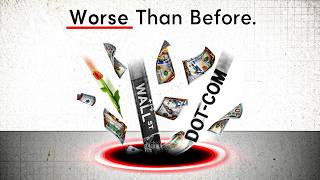

The 5 Warning Signs Before Every Crash
45sThis opening segment sets up a high-stakes, educational promise that hooks viewers with the idea of spotting the next financial bubble, a topic with broad appeal.
▶ Play Clip"Delivers a solid historical overview with clear parallels to modern markets, though it's more educational than a crash prediction guide."
This video explores the history of major financial bubbles and crashes, from the Dutch tulip mania to the 2008 housing crisis, and draws parallels to modern phenomena like crypto and AI. It highlights the common warning signs shared by these events, such as scarcity, leverage, and speculative mania, and encourages viewers to recognize these patterns in current markets.
Bubbles begin with real opportunities that attract money, leading to rising prices, speculation, leverage, and eventually collapse when everyone believes prices will only rise.
In the 1600s, tulips became a luxury item, and prices soared due to limited supply and growing demand. Investors speculated on contracts for bulbs still underground, leading to a crash when buyers disappeared.
These 1720 bubbles involved companies with political backing and grand promises of overseas riches, but actual trading prospects were poor. Share prices rose on official support and hype, then collapsed when confidence faded.
In the 1840s, railways were revolutionary, but overbuilding and optimistic projections led to a crash. Many companies failed, yet the railway network remained and transformed Britain's economy.
Margin borrowing fueled a speculative boom in the late 1920s. When prices fell, margin calls forced selling, leading to a domino effect that caused the Great Depression.
In the 1980s, cheap credit and rising land prices created a loop of borrowing and speculation. The Nikkei peaked at nearly 39,000 in 1989, then crashed, and it took over 34 years to recover.
In the late 1990s, internet companies attracted massive investment despite lacking profits. The NASDAQ peaked in March 2000, and many companies collapsed, but the internet itself thrived.
Low rates and easy mortgages led to a housing bubble. Banks bundled risky mortgages into securities, and when prices fell, it triggered a global banking crisis.
Crypto and AI exhibit patterns similar to past bubbles: meme coins resemble tulips, leveraged trading mirrors 1929, and AI valuations echo the dot-com era. The video questions whether we are in a bubble now.
The video emphasizes that financial bubbles share common warning signs, and recognizing them is crucial. It challenges viewers to consider whether current markets, especially crypto and AI, are repeating history.
What are the common ingredients of historical bubbles?
Scarcity, incredible promises, respected backers, and rising prices that make skepticism look foolish.
03:22
What was the tulip mania?
A 1600s bubble in the Dutch Republic where tulip bulb prices soared due to speculation, then crashed.
01:04
What role did margin borrowing play in the 1929 crash?
Investors borrowed to buy shares, multiplying gains and losses. When prices fell, margin calls forced selling, worsening the crash.
06:25
How long did it take the Nikkei to recover its 1989 peak?
Over 34 years, not exceeding the record until 2024.
09:23
What was the key lesson from the 2008 housing crisis?
Securitization did not remove mortgage risk; it spread it, and heavy borrowing made losses worse globally.
13:39
How does crypto leverage resemble the 1929 margin call?
Perpetual futures and margin trading automate liquidations, pushing prices down further, similar to margin calls in 1929.
15:26
Common Bubble Ingredients
Identifies the recurring pattern of scarcity, promises, backers, and rising prices that define bubbles.
03:22Railway Plot Twist
Shows that even failed investments can leave lasting infrastructure, a key nuance in bubble narratives.
05:11Crypto and AI Parallels
Directly compares modern assets to historical bubbles, prompting critical thinking about current markets.
13:54This Time is Different
Highlights the recurring false belief that current conditions are unique, a core lesson from history.
17:17[00:00] Market bubbles and their crashes always begin with an opportunity. Some of history's worst investments began with ideas that changed the world. Railways transform transport. The internet built during the com bubble transformed well pretty much everything. So real opportunity
[00:15] attracts money and we get rising prices. Rising prices attract speculation. Speculation attracts leverage. And eventually when everyone becomes so convinced that the prices will only rise, the whole thing starts falling apart right in front of their eyes. So, in this video,
[00:30] we're going to take a look at some of the biggest bubbles and financial crashes in history. Explain how some of the smartest people in the world got caught up in them and the warning signs they all shared so you can spot the next financial bubble, possibly even this one, before it's too late. My
[00:46] name is DC and you're watching the Coin Bureau. Let's start by traveling back in time to the 1600s and look at one of the earliest well-known bubbles in the Dutch Republic. Back then, the must-h have luxury item wasn't a sports car or a designer watch. It was a flower. Tulips arrived in Europe
[01:04] from the Ottoman Empire and rapidly became symbols of wealth and sophistication. Some rare varieties of the flower had unusual streaks and patterns which were considered even more valuable. So, prices started rising quickly because supplying was limited and demand was growing. And boom,
[01:20] the beautiful flower caught the eye of investors. Now, of course, they never cared about gardening. They were focused on one thing and one thing alone, making money. Thus, the tulip mania was born and finance discovered its favorite hobby. Turning something simple into something nobody
[01:35] can explain at dinner. It started with traders buying and selling contracts for bulbs that were still underground. And people started effectively speculating on flowers they had not seen and in some cases would never personally receive. To be fair, it's not like it destroyed the entire Dutch
[01:51] economy. People weren't trading their homes for one bulb. When prices reached absurd levels, the market ran out of greater fools and then buyers suddenly disappeared. A lot of crazy stories
[02:03] circulate about the tulip mania and most of them are exaggerated for a dramatic effect, but there's no mistaking that people went crazy for nothing more than a flower. Now, let's head west and fast forward to 1720. The South Sea Company helped manage government debt and held trading privileges
[02:19] which were connected to South America. This was a loaded operation with political backing, royal connections, and a story which involves access to distant markets supposedly filled with riches. But the actual trading prospects didn't turn out to be as impressive as the promotional
[02:35] story suggested. Nevertheless, the share price still increased because official support made the company look safe, and its overseas ambitions made it sound enormously profitable. At around the same time back in Europe, France was going through something similar with the Mississippi Company.
[02:51] John Law created a financial system which involved paper money, government debt, and shares tied to grand promises about France's territories in North America. Rising prices seemed to prove the scheme was working as more money entered circulation and share prices just kept going up. And eventually,
[03:07] confidence collapsed once the investors questioned whether the profits that were promised could ever justify those prices. This brought the whole scheme crashing. Now, despite relying on these different stories, tulips, the South Sea Company, and the Mississippi Company had ingredients that
[03:22] were remarkably similar. Scarcity, incredible promises, respected backers, and rising prices that made skepticism look foolish. And that is what makes bubbles dangerous. From the outside,
[03:34] they often look absurd, but from the inside, they feel like rare opportunities that everyone else has finally learned to recognize. A century after the South Sea bubble, Britain encountered an opportunity that was far more tangible. Steam railways. Railways were revolutionary around the
[03:51] mid 19th century. They could move people and goods faster than horses or canels. It could connect industrial cities and completely reshape trade. The network in Britain was rapidly expanded after the Liverpool and Manchester Railway proved that passenger travel could be commercially viable.
[04:08] So by the early 1840s, established railway companies were producing respectable returns and naturally investors concluded that if some railways were successful, then almost any railway proposal must be worth funding. So the parliament authorized thousands of miles of railway tracks,
[04:24] mostly on the basis of extremely optimistic projections. And now, as we all know, constructing a railway track isn't cheap. It requires an enormous enormous amount of iron, labor, land, and capital. So initially investors had to pay only a part of the cost of their shares. But
[04:40] little did they know railway companies could later demand the rest of the cost as well. And once those calls arrived, many investors realized that enthusiasm was much cheaper than actually building a railway track. Mounting construction costs and tighter credit brought this boom to an
[04:55] end by 1847. Railway shares fell heavily after many proposed lines were abandoned and weaker companies failed to deliver. Even routes that were complete sometimes struggled because several companies built competing lines to serve the same journeys. But there's a plot twist. Britain's
[05:11] economy transformed for the better because during all this chaos, they now had a railway network. Even though many of the investments failed, the technology ultimately succeeded. You see, there is no shortage of strange bubbles, spectacular crashes, and expensive lessons to explore. So,
[05:27] if you enjoy this kind of deeper look at markets and the forces moving the global financial system, then head over to our Finance Bureau channel and subscribe. That's where we unpack all manner of economic stories and dive deep into current macro trends so you're always informed on the
[05:41] stuff that matters most for your portfolio. You can find Finance Bureau using the link in the description or by scanning the QR code on screen. Okay, let's move on from the railway mania and drive into the 20th century. By the late 1920s, the United States was enjoying what appeared to
[05:58] be a new age of permanent prosperity. The stock market seemed to offer ordinary Americans a front row seat to the future. Corporate profits were rising and consumer credit was expanding. But the
[06:10] excitement turned to greed real fast and blurred the vision of most investors who thought that share prices would rise forever. A major source of fuel during this time was margin borrowing, which means that instead of paying the full price for shares, investors could put down a relatively
[06:25] small amount and borrow the rest from a broker. When prices rose, this multiplied the profits. When prices fell, it performed the same trick, but in reverse, which was considerably less fun. So,
[06:37] rising prices encouraged more borrowing and more borrowed money pushed prices even higher. And it all became a vicious cycle in which the market's success appeared to justify the behavior which made it increasingly fragile. But then came Black Thursday, the day when confidence broke. On the
[06:53] 24th October 1929, a wave of selling overwhelmed the market. Bankers briefly restored calm by organizing large share purchases, but this relief did not last long. The following week, prices collapsed again because investors rushed to sell in large numbers and trading
[07:09] systems struggled to keep up. and leverage made everything even worse. As share prices fell, brokers demanded additional money from investors whose collateral started to disappear. Those who could not pay were simply forced to sell. This was like a domino effect that pushed prices
[07:24] down further and triggered more margin calls and more force selling. And of course, it ultimately dragged down the entire American economy. Banks, farms, property markets, and heavily inepted businesses were all vulnerable, which led to what we call the Great Depression. The stock market
[07:39] crash damaged confidence and exposed economic weakness that would plague people for generations. 50 years later, this time in East Asia, Japan looked unstoppable. By the 1980s, Japanese manufacturers dominated industries ranging from cars to electronics, helping the country's economy
[07:56] grow rapidly. Investors even started to believe that Japanese companies might have discovered some superior way of doing business. Suddenly, confidence bloomed in both the stock and property markets. Cheap credit and aggressive lending made it easier for businesses and investors to borrow,
[08:12] while the rising land prices gave banks increasingly valuable collateral against, which they could make even larger loans. And so, a powerful loop was created because now owners could borrow more against their property as land prices rose. And at the height of this boom, Japanese
[08:27] property attracted almost mythical valuations. The NIK climbed from below 7,000 at the beginning of the decade to nearly 39,000 by the end of 1989. Quite the performance. Now, if you think about it,
[08:40] this boom was entirely dependent on continually rising asset prices and plentiful credit. And so, this financial party was disrupted because stocks began falling in 1980 after the Bank of Japan tightened its monetary policy. This also caused the property market to fall soon after inevitably.
[08:57] disappointed shareholders, bad debt for lenders, and the falling property market weakened the collateral which supported the bank loans. So instead of investing, hiring or expanding, companies that borrowed heavily during the boom then had to spend years paying off what they
[09:11] owed. Pure chaos. The crash in Japan happened relatively quickly, but repairing the balance sheets underneath it took far longer. The Nikkay would not exceed its bubble era record again until
[09:23] 2024, over 34 years later. And as it happens, just a couple of years after this fiasco came the internet. By the mid 1990s, the internet was moving from universities and government
[09:35] offices into ordinary homes. Suddenly, there was a way for people to communicate, to shop, read the news, and even build businesses online. This technology was going to transform society as we know it. Obviously, without waiting for this technology to evolve, investors
[09:51] again became slightly overexited. And just as expected, money started pouring into internet companies. Startups discovered that adding the.com to their names would attract investors even more,
[10:03] even if they had no defined path to profitability. Revenue was good and profits were a bonus. But despite what history taught us, rapid growth was again treated as the most important number. Often with limited operating histories and enormous projected markets, a lot of companies rushed to
[10:20] list on the stock market. Everyone ran for the internet spotlight. Traditional measures such as earnings were considered a thing of the past. Suddenly, investors started valuing businesses that were using website visits. Customer numbers or simply the possibility that they
[10:34] might dominate a completely new industry. It was all to play for. Now, this excitement also led to the funding of something real. During this time, telecommunications companies laid fiber optic cables and businesses developed online services which made consumers increasingly
[10:50] comfortable using the internet. However, this infrastructure did not mean every company deserved a billion dollar valuation, right? But this was only the time when things were starting to get interesting. AOL's agreement to acquire Time Warner in January 2000 captured the height of
[11:06] euphoria at that time perfectly. Who could have thought that an internet company was going to swallow one of the world's largest traditional media groups? Nobody. Of course, in hindsight, this was a clear warning that the bubble was about to burst. And just a couple of months later,
[11:21] in March 2000, NASDAQ peaked. Funding dried up once investors began demanding profits rather than promises. And many companies discovered that there was a difference between attracting users and building a sustainable business. Most of the era celebrated.com names disappeared as
[11:36] share prices collapsed and startups ran out of cash. Now despite all of this, the internet itself did not disappear just like the railways stand to this day. Both serving humanity. Companies such as Amazon managed to survive and new consumer habits for the internet
[11:51] developed during this boom. Businesses decided to build enormous industries on the networks. The investors were right about the technology, of course, but predicting the financial future correctly is never straightforward. There are way too many variables and a heap of economic
[12:06] and technological evolution that can take everyone by surprise. Now, another one most of you probably lived through is the housing bubble. Before 2008, rates were low, mortgages were easy to get, and home prices had been climbing for years. Naturally, buyers believed that property would
[12:22] simply keep going up forever. Lenders assumed that even struggling borrowers could just refinance or sell at a profit. So, banks started handing out loans to people who actually couldn't afford them. Some of these loans started with a low rate that jumped higher a couple of years in,
[12:36] and that was fine as long as prices kept rising. But once prices stopped climbing, the free trial ended, so to speak, and the subscription was extremely expensive. Banks took thousands of these mortgages, bundled them all together, and sold them off to investors as
[12:51] securities. Some labeled safe, some labeled risky, which basically meant the bank that made the loan didn't have to care anymore whether it ever got paid back because it wasn't their problem. And that bundle got repackaged again into something even more complicated and some still got stamped
[13:07] as safe. Now, on top of that, banks borrowed huge amounts of money to bet even bigger using very little of their own cash. And for a while, it worked. Payments kept coming in. Everyone made money. Everyone got rich. But eventually home prices started falling. People couldn't refinance
[13:23] anymore. Monthly payments jumped and more and more people just stopped paying. So banks stopped trusting each other. Be sterns went under. Fanny May and Freddy Mack needed a government bailout. And in September 2008, Lehman Brothers collapsed. Credit froze. Stocks crashed. And governments
[13:39] had to step in because a housing problem had ultimately turned into a full-blown banking crisis. This crisis showed that securitization did not remove mortgage risk. Instead, it only hit and spread it while heavy borrowing made the losses much worse around the world. Okay,
[13:54] let's bring all of these lessons into the now. And here's where it gets truly interesting. Because if you were paying attention to every story of a bubble I just covered, you probably noticed something. Crypto and AI might feel like a highlight reel of every single bubble playing out
[14:09] at once. Starting with tulips. Remember the deal? People buying contracts on bulbs still underground priced on nothing but the belief that someone else would pay more tomorrow. Are these meme coins? Are these NFTts? A token with a dog on it backed by no revenue, no product, no cash flow,
[14:25] just a chart in the hope that somebody else shows up after you did. But when the buyer stop coming, there is no flower left to sell. Just a ticker or an image of an animal. Remember the South Sea Company? a venture that looked safe because it had powerful backers in an official story,
[14:40] even though the actual numbers never justified the price. Crypto has had plenty of these projects that rallied hard the moment a big exchange listed them or a well-known name backed them or a government hinted at approval. The backing made people stop asking whether the fundamentals
[14:55] were ever there to begin with. And do you remember the railways? Real technology wildly overbuilt. Most of the companies that built it went broke and the tracks got used for a century anyway. That's the blockchain infrastructure argument. Thousands of tokens and chains have launched.
[15:10] Most of them will disappear completely, but the ones still running through every crash so far, the mining, the settlement, the actual rails keep getting used regardless of what the price is doing that week. Remember 1929, leverage that multiplies your gains on the way up and then forces you to
[15:26] sell on the way down. Crypto didn't just inherit that lesson, it automated it. Perpetual futures, margin trading, leverage tokens. When prices drop, exchanges liquidate positions automatically, which pushes prices down further, which triggers more liquidations. The 1929 margin call became a
[15:43] piece of code that runs itself 24 hours a day. And do you remember Japan? Rising collateral values, letting people borrow more, which pushed prices higher, which let them borrow even more. That loop has shown up inside crypto directly. people borrowing against their coins to buy more coins,
[16:00] using the new coins as collateral for the next coins. It works exactly as well as it worked in Tokyo in 1989, right up until the collateral stopped rising. And the securitization lesson, the one that took down the banking system in 2008, wrapping risk into products so complex
[16:17] that almost nobody holding them fully understands what's underneath. DeFi might have built its own version of this. yield products stacked on other yield products, tokens that represent other tokens collateral borrowed against collateral. It spreads the risk the same way mortgage bonds did,
[16:32] which means it may or may not hide the risk the same way mortgage bonds did. And now to AI, genuinely transformative. Nobody's arguing otherwise, exactly like the internet in 1999. But the same pattern, is it not? Companies get funded on user growth and total addressable market
[16:48] instead of profit. Anything with the letters AI attached gets a premium. the same way anything with.com attached once did. Some of what's being built right now will become this cycle's Amazon, but most of it will disappear the way pets.com did. And right now, nobody can tell you with
[17:04] certainty which is which. So, is Bitcoin the railway? Are memecoins the tulips? Is.ai the new.com? And is DeFi rebuilding 2008 with better branding? Maybe all of it. Maybe none of it.
[17:17] Every asset in this list has true believers who will tell you this time is different. But history has a long undefeated record of proving that phrase wrong. And that's the point of this video, to give you perspective. The most important question isn't which category
[17:32] any of this falls into. It's whether you'd actually recognize the warning signs from everything I just walked you through while you're standing inside of it. But what do you think? Are financial bubbles just an unavoidable part of markets? Are we experiencing one today? Please
[17:47] get highly opinionated in the comments and let us know what you think. And if you want to see more videos on financial history, market crashes, and the forces shaping the global economy, then head over to the Finance Bureau channel and check out our latest video right over here.
[18:02] As always, thanks so much for watching and I'll see you again very soon. This is DC signing off.




⚡ Saved you 0h 18m reading this? Transcribe any YouTube video for free — no signup needed.