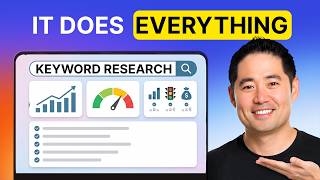

One Word Keyword Research
45sThe promise of doing all keyword research with just one word is a powerful hook that appeals to marketers and content creators looking to save time.
▶ Play Clip"Title is accurate: the tool does perform keyword research from one word, but the video focuses more on the build process than a ready-to-use tool."
The video demonstrates how to build an AI-powered keyword research tool using Agent A that automates the entire process from seed keyword generation to content briefs and internal linking maps, all from a single input word.
The tool generates a complete keyword roadmap for any niche in about 20 minutes, including clusters, content briefs, and internal linking maps.
The creator used a single prompt: 'Build an automated keyword research tool using Opus 4.7. User inputs a niche, tool generates seed keywords, clusters them, and produces a comprehensive report with action plan.'
Over $200 in API tokens were spent fine-tuning the tool over several days.
The tool is built on Agent A, an AI agent with unrestricted access to Ahrefs data, enabling real SEO and marketing data retrieval.
Steps: find seed keywords, generate keyword ideas, filter by questions/modifiers, assess SERP competition and search intent, cluster topics, and plan internal linking.
Initial seeds like 'golf shoe reviews' yielded only 90 keywords. Solution: use broader seeds like 'golf' and mine competitor keywords via Ahrefs top pages report.
The tool initially flagged branded navigational SERs (e.g., Topgolf) as winnable. Fixes: added branded SER detector, publisher dominance rule, and free tool identifier.
AI filters out homonyms like 'mini driver' (golf vs. car) automatically, removing 2,456 off-topic keywords in one run.
Generates briefs with target keyword, SER analysis, competitor weaknesses, title suggestions, outline, key entities, and FAQ mined from Reddit.
Visual internal linking map showing pillar and spoke pages with anchor text suggestions and rationale.
For 'house plants', the tool found 6,000+ queries, identified top opportunities (e.g., Monstera varieties and care), and generated a full action plan.
The AI keyword research tool automates hours of manual work into 20 minutes, but requires human oversight for intent and strategic decisions. It is available for one-click install on Agent A.
What is the first step in the keyword research process described in the video?
Finding seed keywords.
05:13
What problem occurred with initial seed keywords like 'golf shoe reviews'?
They were too specific and yielded only 90 keywords with no demand.
08:14
How did the creator fix the overly specific seed keyword problem?
By using broader seeds (e.g., 'golf') and mining competitor keywords via Ahrefs top pages report.
09:47
What is a branded SER detector?
A rule that identifies when a brand dominates the top results (e.g., Topgolf) and skips that keyword.
13:16
How many off-topic keywords did the AI filter out for the golf niche?
2,456.
15:58
What does the hub and spoke diagram represent?
A pillar content in the center with supporting spoke pages around it, showing internal linking structure.
04:06
What is the purpose of the prioritization score per cluster?
To score clusters based on volume, intent, and difficulty to identify quick wins.
03:37
What data sources did the tool use?
Keywords Explorer and Ahrefs Site Explorer.
03:11
How does the content brief feature gather FAQ questions?
It mines them from Reddit threads in the SER.
19:20
What is the 'publisher dominance rule'?
A rule that skips keywords if the SER is dominated by mega sites like Forbes or USA Today.
13:31
One-Word Keyword Research Tool
Demonstrates a fully automated keyword research process from a single input, saving hundreds of hours.
Seed Keyword Pitfall
Highlights a common mistake in keyword research: using overly specific seeds that yield no demand.
08:14Intent Misclassification Fixes
Shows practical AI training techniques to avoid ranking for branded navigational SERs.
13:00AI's Strength in Filtering Homonyms
AI automatically removes irrelevant keywords like 'mini driver' (movie) from golf niche, saving manual effort.
15:20Automated Content Briefs with SER Analysis
Generates detailed briefs including competitor weaknesses, title suggestions, and FAQ from Reddit.
16:46[00:00] What if you could type just one word and have all of your keyword research done for you? And I mean everything. You can see the keywords that you should go for. You can see them organized into clusters. You can generate content briefs at the click of a button. And while those briefs
[00:16] are generating, visually see exactly how these clusters should be internally linked throughout your site. There's no tool that does this well and fast until about 2 days ago. I built an AI
[00:28] tool that can do all of this, hand you the entire keyword road map for any niche, hundreds of hours of work packed into about 20 minutes. And today, I'm going to show you how to build it yourself.
[00:40] All you have to do is just type in one word. So, I'll do house plants and run the research. And right now, it's looking for seed keywords. It's going to go in and expand those keywords. And now, it's filtering the keywords. And this is where the bulk of the time goes because AI is actually
[00:56] processing every single keyword as it goes through to make sure that they're relevant first and then it's running different at calls right here. It's at 19% and it's going to keep going to make sure that we're getting the exact keywords that would be relevant to in this case the niche of house
[01:12] plants. And after this happens, the clusters are going to form. It's going to generate an executive summary and tell you exactly what happened. So while this is happening, let me show you the prompt that I used to build this. So I started off this chat session by saying, "Build an automated
[01:27] keyword research tool using Opus 4.7. The user inputs a niche. The tool generates seed keywords, clusters them into groups, and produces a comprehensive report with an action plan. In terms of output, all I wanted was keyword clusters with search intent classification. Super important. A
[01:43] competitor gap analysis and a visual map showing internal linking structures between clusters. And this part is usually the part that takes a really long time. So I said I also said that I'm
[01:56] open to additional suggestions during planning and that's the only prompt that I used. Now this tool didn't come from one hero prompt. I spent days fine-tuning this and over $200 in API tokens,
[02:09] which is really small in the grand scheme of things considering what it's able to do. Uh, so rather than just reading my entire agent a chat to you as a really bad bedtime story, I'm going to highlight some of the biggest problems and I'll explain exactly how I fix them
[02:25] so you can build it, too. If you run into the same problems, some of them you might, you can build it with the exact same specs that I did here. Now, the way that I built this tool is with agent A. And if you don't know what Agent A is, it's an AI agent with unrestricted access to HF's data. So,
[02:40] it can actually pull real SEO, Google, and marketing data, which is obviously super powerful for any marketer. And you'll see why that the unrestricted access part matters so much, especially for things like SER data as we go through the build. So, it starts by asking me
[02:56] where I want this tool to live. And so, I wanted it as a console app. And so you can see that I built it here. Um, and we can access this. I can access the keyword research tool just like that. And then it asks where we want to source the data. So I said keywords explorer as well as HRF site
[03:11] explorer. So we can actually find uh keywords that aren't necessarily so obvious but competitors are ranking for. Then it asked me about the competitor gap analysis like how should the competitors be picked? We're basically just taking data from the organic competitors report in hrefs and
[03:25] how big should it be? Uh, not that important. um beyond what you listed which of these are useful. So it kind of gave me this checklist of different things and I told it the prioritization score per
[03:37] cluster is important and the way it's scoring it is based on volume intent and difficulty. Quick wins is always good because especially when you're starting a new site, you don't want to compete for things that are out of your league. And so getting a few quick wins is always a good thing to do. So
[03:52] uh low difficulty is one that I flagged. And then I want to be able to export this as PDF and CSV. What style for the cluster link map? And I chose the hub and spoke diagram. And this is something
[04:06] that was popularized by HubSpot many years ago where we have, you know, a pillar content in the center and then supporting pages around it. So that's basically this one. Yeah. So this is the
[04:18] whole idea of clustering. So, we have something like this where we have a pillar page about putters and then we have spokes that come from it. So, you know, best putter, hockey stick putter,
[04:30] Tiger Woods putter, Scotty Sheffler putter, some different ideas that we can go after there. All right. And then it takes the plan, it goes, it tells you everything that it's doing. It's basically like somebody who's thinking out loud. And it'll go, it'll build the UI. It has more
[04:45] questions as it's going because it's processing as it goes. I want us data. I want uh competitors to be from the top five and then we're going to cue it and notify when ready. Then it goes it builds
[04:58] me the first version of the tool and then that's when we run into real problems. So before we get into the problems I need to explain the keyword research process to you because everyone does it slightly differently but there are certain pillars that need to be done. So the first step is finding
[05:13] seed keywords. So for a niche like golf that might be something like golf, putter, irons, driver and we can run a search. So this is what happens. Now from this search we need to go and
[05:26] generate a whole bunch of keywords. So a keyword research tool will give you a whole bunch. But the thing is these are not going to be the queries that you're actually going for. So you need to actually filter these down. There's 4 million keywords in here. That's crazy, right? So you
[05:39] might do that by looking at questions related to these queries. So, like what is a golf handicap? How do I That's irrelevant because of driver, a golf driver versus Door Dash driver. We'll questions or you might actually use modifiers. So, a modifier is just an add-on to a base keyword.
[06:00] So, if we have driver golf irons, if we type in best as a modifier and we click show results, then we'll have things like best golf balls, best golf courses near me, you know, queries that
[06:13] people are actually searching for. So, once we've filtered this down, we've taken all the different um queries like from the questions, different modifiers, manually searching through some, we're going to end up with a huge list of keywords. Now, after you've taken these four
[06:28] million keywords and and narrowed it down to a few hundred or a few thousand, you have to actually look at the search results for all of these queries because you need to figure out if you have a chance at competing against these competitors in the search results. And B, you have to assess
[06:44] search intent. And search intent represents the reason behind a searchers query. So, can you actually match the reason for the intent? So, if we're looking at best golf balls, we're looking at the search results here. Okay, Reddit's ranking here. Today's golfer is is pretty authoritative,
[06:59] too. Uh, Outbound Golf, this is a DR36, so it's not that authoritative of a website. DR is not the be all end all of things, but we see Amazon here. And we can see that the intent overall is
[07:12] is quite commercial, but we can see that blog posts are ranking here. So, for a content site, of course, you can rank with with a blog post. So, we would decide, yeah, you know what? we will go for best golf balls and target that. Now imagine doing that hundreds or thousands of times, right?
[07:28] Super long process and we're not done here. Then you have to figure out how these topics all kind of blend and mesh together like which posts should be linked to and from and we create this internal web structure so that search engine crawlers can come and access all those sites easily
[07:45] understand which ones should be connected to each other. So keyword research is just a much bigger process than just finding keywords. And as I was building this, I ran into problems pretty much at
[07:57] every stage. And so I'm going to highlight some of those for you and how I was able to fix them. The solutions that that uh AI and I were able to come together to solve those problems. Okay. So the first thing that AI did was it had to come up with seed keywords. And it's super important
[08:14] that you get your seed keywords right because everything else in keyword research that comes after are built around the seed keywords. And so the first run at this, it came up with seeds like golf shoe reviews or striicks on versus titleless golf ball. Like this is super specific. And the
[08:31] and the problem with this when you use these as seeds is when you go to generate keyword ideas, you're not going to come up with any. So in this case, these two seeds only have 90 keywords. And if you look at the keyword list, like there's no volume behind it. There's no demand. So,
[08:46] it's not about going for like these high ultra high search volume keywords, but there just isn't any demand around these. And sure, you can create content around these, but is it worth the time and effort? Probably not, right? So, I had to tell it specifically to go much broader. So instead of
[09:04] using golf shoe reviews, golf ball reviews, golf hat reviews, just go with golf and we'll figure that stuff out later. And then go with instead of strixon versus titalist golf ball. Like that
[09:18] is one query that we might actually target, not a seed. Let's go with titleist different manufacturers and then go and expand from there. Now, the problem with this approach though is that if you're only going for the usual suspects like golf and putter and putters, everyone else is
[09:35] doing keyword research that same way. And so, it's tough to find lowhanging fruit that people aren't necessarily targeting, but there is still a lot of demand around those topics. And so, what I had the
[09:47] AI do is to actually mine competitors keywords using the HF's top pages report. So it would find the competitors. It would mine those queries to see what they're ranking for where there might
[09:59] be a pattern with certain seed keywords. And so was able to actually find stuff that you normally wouldn't be able to find or that wouldn't be super obvious to find especially in a first round of keyword research. And so agent A was able to get the seeds down perfectly and it was able to
[10:16] go through to the next stage. So to show you an example, I'm looking at the cluster right now for golf apparel and shoes. And it was able to group all of this stuff together. So like golf shoes, golf shorts. Why is it telling us to go for the head term? Well, it's because there's a listical
[10:30] that's ranking there in the top five, right? So it's actually looking at the search results here and it's able to determine that. It's able to look at all these different apparel type stuff, all these apparel type queries, best golf sunglasses, and telling us, yeah,
[10:45] this is probably something that you should go for as well. And there's so many different things in here. And obviously, you don't have to create content around every single topic in the cluster, but it's meant to be here where you get everything shortlisted for you. Now the next problem that
[10:58] actually came is related to this and you can't see it here but the first round of creating this keyword research tool. There were some serious issues with understanding intent. So the way that AI made this system is based on like a verdict engine. So it decides whether you should go for
[11:15] them. So these are queries that fit a golf content site. There are a group of may where it's like you could go for it, you don't have to. Um, but yeah, these are things that you can look up manually
[11:27] if you want to expand your keyword list further. There's ones that lack data. So, those ones I just skip over because we have plenty to go with. These ones are definitely skips. And so, for example, Topgolf, you're not going to rank for it. And even if you do, people probably aren't going to
[11:42] click it because it's a very much a navigational search, which it shows right there. And so, in the first run, this keyword research tool was very, very bad at identifying intent. It told me that I
[11:54] should try and rank for Topgolf. Can you rank for it? Yes, this person does because of an editorial site. And this is where human overlook is actually quite important. And so I was able to train the
[12:06] AI to almost think and act like a human as it goes through this and make that decision like, hey, probably not going to make sense to go for Topgolf or golf or golf courses near me. So yeah,
[12:18] it was it was waving through branded SERs like Topgolf or Scotty Cameron and they're saying that these are winnable content opportunities when in fact they weren't. The first example that I actually went with was related to the coffee niche. So it's like um it was basically waving
[12:32] through things like espresso machine brands. It was telling me to go in and rank for like brevel and I had to correct it and teach it. So look, it's telling me that the pillar keyword here was Breville espresso machine. Like with a content site, you're probably not going to rank for that
[12:46] one there. it's probably not worth the effort in that immediate moment. So I was saying, shouldn't it be something like best espresso machine? So the thing with AI is that if you ask it to do something broad, it's going to do something broad and it's not going to be very good. So that's why
[13:00] we had to go through this entire process, but I will tell you the main things that I changed here. So there were a few major adjustments that I used to fix this. So first, I added a branded SER detector. So, if there was a brand that was just constantly listed in like the top three results,
[13:16] like if it was telling me to rank for Topgolf, you know, you would see Topgolf, their homepage, you'd see their Twitter, their Instagram, and just a whole bunch of things related to Topgolf. You know that it's a branded navigational SER, and so it would know to tell me, let's skip over this one.
[13:31] Okay. Okay. So, the second thing that I made was a publisher dominance rule where it would look for all these mega sites like like Forbes, USA Today, and if the SERs were completely dominated by them, it would just kind of skip over it or add it to the maybe pile. Um, the next thing was able to
[13:47] identify free tools. So, when it's looking for keywords, it's actually looking not just for content keywords like blog posts, but it's also looking for video topics and it's also looking for free tool opportunities. And so identifying which ones are free tools was not as straightforward as
[14:05] it might seem. And so I had to train the tool to actually identify which ones were free tools. So if we look here, I can go to recommended type and it's has a classification here called free
[14:18] tool landing page. Let me just go for the goes. So there are 342 free tool landing pages. Right? Look at all this. The golf handicap calculator. We can see that these are all golf handicap
[14:33] calculators. A golf club length calculator. These are all tools. Golf swing analyzer. These are all different tools. Basically, I was going through this loop of looking through data. So, it would
[14:46] basically do, you know, the more technical stuff of coming up with ideas and the logic to make this work. And I would use kind of my SEO brain to be like, "This one doesn't seem right because of X, Y, and Z." And then we were able to come up with ideas to come to a pretty good solution. So,
[15:03] and AI will actually go and grade the keywords one by one. So, yes, there are still some that we have to filter through, but in my experience, it's very, very little across three different niches that I tested. Now, the biggest problem I ran into was identifying irrelevant keywords,
[15:20] especially with homonyms. So, this is where AI is absolute money. So if we go to the overview report, we look at the executive summary. You can see here that these are the seed keywords that
[15:32] were used. So like golf, callaway, tailor made, these are all brand names, by the way. Puttern, irons, driver. So you can see like iron can mean many different things. Driver can also mean many
[15:46] different things. So, it actually tells us here every single time it runs through this process, when it goes through that filtering stage, the part that I said takes the longest, it's actually
[15:58] making sure that all the keywords are relevant. So, it's actually filtering out here 2,456 off-topic keywords. That's crazy. So, for example, Spark driver, Door Dash driver, Mini driver, the
[16:13] actress, Baby Driver, the movie. It's constantly looking at these these keywords and making sure that you don't have to actually filter them out. And I think that was the best part is that AI has all this knowledge already. So as it goes through it, it's able to say mini driver, nah, not nothing
[16:30] to do with that. And it'll just take out anything that's related to that. So every single keyword runs through AI and it removes the keywords that are irrelevant to the niche of golf. Now, not everything was bad. There were some things that were actually great uh out of the box. And so
[16:46] here, one of those things was content briefs. So if we look at like I don't know, best golf pants, this is one that I generated. Um when I click those buttons to to generate content briefs, it'll do things like this. It'll show you the target keyword. It'll tell you about the SER.
[17:01] So you know, your content writer can go in there with, you know, some basic knowledge and know who they're competing against, the types of pages. It actually goes and it reads the different pages that are ranking in the top 10 and it's able to identify weaknesses, areas that you can capitalize
[17:15] on to create better content. So, it says here that for best golf pants there's a weak editorial that there's a weak editorial landscape and only one true listical which is kind of interesting to me.
[17:28] And we can see here that the KD is one the keyword difficulty that there's weak top results that the single editorial content is a DR51. It's doing the analysis for you kind of of what you would do when you look through everything, but you don't have to look through all these SERs at once. You just go
[17:43] through them one by one and it's all listed here. It'll give you suggestions for titles. So, this is telling about intent. It's telling you to create a listical here clearly. Uh the metad description, metad description is not so important anymore. It'll tell you the URL slug to use a word count
[17:58] an exact word count here. Um, but it's, you know, giving you the median for the people who do care about word counts or people who are paying other writers to hit certain word counts. And then it'll
[18:11] do the entire outline for you. And the outline is actually decent. So, it's already looked at the different listicles that are ranking and it's providing suggestions to you based on that. So, it'll tell you, you know, we've seen affiliate sites do this before is they always have this
[18:26] thing of like how I tested these golf pins or whatever it is. I think that's actually quite good for the reader as well to know that you have actually reviewed these, you've touched them, you've worn them and tested them. So, we want to give people things at a glance because especially
[18:41] with blog readers today, everyone is skimming. So, make sure that it's skimable. We provide all that info for them. Do you have to label them like this? No. You can give your honest
[18:53] reviews like that, but if you're truly going for like content site type thing, you know, you at least have seeds and suggestions of what you might want to do. This part is pretty cool. It tells you key entities and topics to cover basically to have, you know, full relevance
[19:08] and topical coverage here. So, you know, Lulle Lemon, um, Travis Matthew, Bonobos, Nike, Adidas, etc. gives you an FAQ and says that it's mine from Reddit threads in the SER. I did not know this,
[19:20] but I think that is pretty cool is that it's picking up things like people also ask questions and it's bringing all of this together. And this is where the money is, right? The in the internal linking part is it's telling you that from the target page, so the golf apparel shoes,
[19:35] which the bigger part of the hub, it's telling you to link from that page, it says this is a spoke page. So this is one of those branches, right? It links up to the pillar and across to relevant siblings. So, it's telling you to link from this page. Uh, tells you the anchor text. It
[19:51] tells you why you should do this. And so, all this stuff is super super important. And I think that, uh, you know, most content tools are are missing these kinds of features. Again, you need to have some kind of SEO knowledge to be able to make good decisions in this. Take things
[20:10] with a grain of salt. Now, another thing that it did well out of the box is the hub and spoke map. So right now I'm just looking at, you know, the go keywords here and there are there is a lot of stuff going on here. So let's say that I wanted to just look at the quick ones. Then we can actually
[20:24] see the clusters. So we can see the different pages here. Um like what makes a golf cart street legal, how to test golf cart batteries. You can tell that these are going to be low competition,
[20:37] but these are meant to be quick wins. You basically have options is my point here. So the final result, you know, we went from entering a niche. I entered just golf. It came up with a seeds and went through over 10,000 keywords, probably closer to like 400,000, and it would
[20:53] bring it down to like 10K. It would go through a relevance filter. It would cluster stuff. It would pull all the live SERs. It would provide all the classifications and do the competitor gap,
[21:05] create the hub and spoke map. It would do per keyword briefs which is on demand because we're not going to generate all of them obviously because that's a waste of API tokens. And you have the option for CSV PDF exports. Now let's go back and see if our house plans thing is done. Oh,
[21:22] it's done. Literally done right then and there. So gez, it went through. In fact, 11,800 keywords. And this is on house plants. And for the record, I know nothing about house plants. So leave in the comments if this did a terrible job. We'll go look through some of the keywords
[21:37] and see how well it did. So, the overview here, it found over 6,000 queries related to house plants that we could potentially go after. And this is going to be a real test because with house plants, I would assume that the majority of queries are going to be commercial where, you know, you have
[21:52] to go and there's going to be e-commerce product category pages, service pages. Um, but yeah, so we can see here these are the seeds that it came up with like a monstera paos. I don't know how
[22:04] to say that. orchid, snake plant, peace lily. So, it went out and it found the seeds that are like popular house plants. I don't know about that. I've heard of I've heard of these some of these,
[22:16] but that's it. Top content opportunities, Mona, varieties, and care. Okay, that's cool and helpful to know. Share a voice. This is interesting. the share of voice in this niche. The majority for house plant care advice and it's giving us a recommended action plan. So ship the Mona pillar
[22:37] first. It has the highest opportunity score and supports a deep cluster of variety of listicles, care how-tos, and problems solving guides. Cool. Let's take a look. So we're just looking at go keywords here and let's look at the clusters. So, it's said to look at the Mona varieties in care
[22:54] uh or Monstera toxic to cats. This is considered a quick win and a go. So, let's let's generate a brief on that for now. So, basically, we have all the clusters here. We have the competitor gap and we can see the the websites that are getting the most traffic for these queries. So, the spruce
[23:12] that makes sense. Lively root sounds like it makes sense. Uh and the hub and spoke map. This one I'm a little nervous to see. I'm not looking yet. But yeah, that's crazy. Oh man, like these these hubs and spokes. You know what? Because it's limited to I limited to I think 15 to 20 for medium searches,
[23:29] it's actually quite reasonable to look at. And being someone who knows almost nothing about house plants. I can come here and I can see how some of these should be connected. Saying that there should be reciprocal links here because this one links to here. So this one on alocasia varieties
[23:46] and care should link to airplane care and vice versa. We can see the different ones that content that we should create. We can see the supporting content here. This is all go content. But this is all done for me and I think that it's done a very very good job. Uh the content briefs they're all
[24:03] done uh generating now too. So let's look at the one for cats. We have the title. So are monstera plants toxic to cats? What every owner needs to know. Vet reviewed. Okay. Well, that's not true. But, you know, we could get a vet to do that. I'm sure it's done the competitor analysis for you.
[24:19] Like, I like I'm actually genuinely impressed with this as I'm as I'm going through this. I don't know how accurate this stuff is and how how factual it is. I'm not a vet either, but you can see here what to do if your cat shoot a monster leaf step by step. It's telling you everything to
[24:36] do. Call your vet or ASPCA poison control. Will my cat is just answering questions really of someone who's searching for this. But from what I'm seeing here, I can see that it does a lot of really
[24:52] really good work for us. And all I did was type in one word, house plants, and it came up with all of this, which is super cool. Now, the the crazy thing about this all is in agent A, if I wanted
[25:06] to make a different change to this, let's like I don't like the way that let's go back to our house plans. Let's say that I wanted to have I didn't want to have that limit of like 15 to 20 clusters, but I wanted to have as many clusters as as needed. It would go and do potentially an infinite
[25:22] number of those, right? Um the hub and spoke map. Let's say I don't like the colors or when I click on one of these, let's say I want there to be like a little box that pops up and I can generate the content brief directly from the hub and spoke map. All I have to do is go in here, type that up,
[25:37] enter it, and it'll make those changes. Now, if you want this exact keyword research tool, you can build it yourself using the steps that I walk through. You know how to solve the problems, too. Or if you've got an agent a workspace, you can oneclick install it from the app
[25:51] store. Technically two clicks uh and have it installed directly into your workspace. And if there's anything that you want me to build for you, tell me in the comments below.
⚡ Saved you 0h 26m reading this? Transcribe any YouTube video for free — no signup needed.