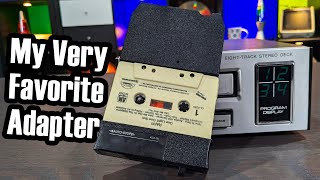
What is this weird cassette-8-track adapter?
45sThe hook introduces a bizarre, clever device that combines two obsolete formats, sparking curiosity and nostalgia.
▶ Play Clip
[00:00] Hello and welcome to No Effort November,
[00:03] a series of videos for the month of
[00:08] Have you heard of these newfangled compact cassettes?
[00:12] Everybody's got them these days and tons of new music is being released on these little things all the time!
[00:19] But what if all you've got is an 8-track player?
[00:24] Well, have no fear of being left behind because Kraco's got you covered with this.
[00:30] Just pop the tape you'd like to play into this thing,
[00:33] then shove it into your 8-track player and blammo!
[00:36] You're listening to the latest hits like one of the cool kids.
[00:39] I love a good adapter and this may be
[00:46] It uses one of the weirdest and arguably worst
[00:52] to create a surprisingly competent cassette player
[00:58] directly into the playback heads of an 8-track player so you can listen to the cassette.
[01:04] I don't remember when I first learned about these things,
[01:06] but back in the day I was given an old Zenith console radio set with a record changer, AM/FM tuner,
[01:13] and of course an 8-track player.
[01:15] And probably while perusing eBay for 8-track-related nonsense to play in that thing, I found one of these for sale.
[01:22] This is not the one I had back then - it broke and I threw it away.
[01:26] But I've tracked down another one for this video.
[01:28] And this is that!
[01:30] To explain what's so clever about this, first
[01:36] The 8-track was the first
[01:41] It was based on an endless loop cartridge format developed for radio,
[01:45] but for success in the consumer market, it was cost cut to oblivion.
[01:50] A design of Richard Krauss,
[01:52] the Stereo 8 cartridge hit the scene in 1964
[01:59] But it split the fundamental elements
[02:03] between the playback device and the cartridge itself.
[02:08] See, magnetic tape is really just
[02:13] When you drag that rusty tape
[02:18] you can store information
[02:24] A sound signal which is fed to the head modulates the strength of the magnetic field it produces.
[02:29] And since the tape is moving past as this happens, the powdered rust becomes magnetized in the same pattern as the original signal.
[02:38] In other words, a recording
[02:44] And when you move this newly magnetized tape past the head again,
[02:48] but this time without sending signals into the head,
[02:51] the varying magnetization on the tape will create an electrical signal inside the tape head
[02:57] which can be sent to an amplifier to recover the
[03:02] That's the basics of recording audio onto magnetic tape.
[03:05] But to do it well, you need a mechanism which can smoothly pull the tape past the head at a very steady speed.
[03:13] That's accomplished with a capstan and pinch roller.
[03:16] The metal capstan is spun by a motor at a constant and precise RPM,
[03:21] and the rubber pinch roller jams itself up against the spinning capstan.
[03:26] Stick some tape between the two spinny bits,
[03:32] If you give the capstan a bit of heft with the help of a flywheel, you can make this happen incredibly smoothly,
[03:38] which is good for keeping the audio
[03:43] In a reel-to-reel tape recorder, you have a supply reel of tape,
[03:47] the tape transport with the tape heads, capstan, and pinch roller,
[03:50] and then you have a take-up reel, which uh takes up the tape after it's gone through the transport.
[03:56] But this whole contraption is pretty bulky and inconvenient.
[04:01] Now, you could put the two reels into some sort of box and then create a tape transport which interacts with that box...
[04:09] which is what a cassette is.
[04:11] But those tape transports are somewhat mechanically intricate, which makes them fairly expensive to produce.
[04:18] I mean, you gotta have parts that move the pinch roller into the capstan,
[04:22] you gotta have some way to move the tape in both directions so you can rewind it...
[04:26] I mean, it's just a whole ordeal.
[04:28] The 8-track format, on the other hand,
[04:31] took everything out of the tape transport except for the spinning capstan and the playback heads.
[04:38] The pinch roller became part of the cartridge itself with the tape riding along its outer circumference.
[04:44] And with the help of this notch here and a little spring tension,
[04:48] the 8-track player simply jams the cartridge and thus the pinch roller right into the capstan inside the machine.
[04:55] Since the tape is now sandwiched between
[05:01] this simple arrangement was all that
[05:06] And to make it even simpler, 8-tracks contain
[05:13] Tape is pulled from the center of that loop,
[05:18] then back down the pinch roller
[05:23] This somewhat odd arrangement forces the tape to sort of slide past
[05:29] but since the tape is pulled out from the center of the loop where the diameter is smallest,
[05:34] the tape is naturally kept in tension.
[05:37] The... rather large catch is that this form of loop
[05:44] No rewinding is possible with an 8-track:
[05:47] you just have to keep going forward
[05:51] No rewinding is possible with an
[05:54] you just have to keep going forward until you're back at the start of the loop.
[05:57] That's not the end of the world,
[06:01] (which also explains why it's called the 8-track).
[06:04] The tape holds eight parallel
[06:09] They're interleaved as four programs of stereo sound,
[06:13] and the 8-track player used a mechanism
[06:19] to realign them with each of the four programs.
[06:23] This extra complexity belied some of the cost savings,
[06:26] but it meant that a hypothetical album with 12 songs on it would be recorded onto an 8-track as four loops with three songs each.
[06:35] And with a button on the 8-track player which lets you step through the four programs,
[06:40] you could kind of skip around and get to a specific song.
[06:44] [Music plays]
[06:47] [song playing abruptly changes]
[06:55] [another change - each change occurred mid-song]
[07:00] And while it was physically impossible for the tape to move backwards without the loop getting very badly undone,
[07:07] many players such as this offered a fast forward option to make queuing up a specific song at least a little bit easier.
[07:15] [very high-pitched squeaky fast music plays]
[07:18] And of course, 8-track players could
[07:24] This was accomplished with a piece of foil on the splice point of the tape loop.
[07:29] Electrical contacts inside the 8-track player were pressed against the tape and they had a modest voltage placed across them.
[07:36] When the foil splice bridged those two contacts,
[07:39] that voltage was fed to a small solenoid that pulls down on this lever which steps the heads to the next program
[07:46] with the help of this spinning cam thing.
[07:49] This was a pretty clever trick,
[07:51] but splitting up a loop of tape into four programs
[08:00] So albums released on 8-track would tend to have
[08:06] or they might have weirdly long gaps between certain songs.
[08:10] Or - much worse - they might
[08:16] which leads to a small gap in the sound in the middle of a song in addition to some audible clicks and pops.
[08:23] Not ideal.
[08:25] However, the format was stupid simple.
[08:28] Just shove the thing in and it starts playing without a fuss.
[08:32] And for its time, they were quite robust.
[08:35] Tape doesn't care about vibrations like conventional records do.
[08:39] And that made tape formats a great choice for cars.
[08:43] In fact, that's where 8-tracks first became popular.
[08:47] These days, 8-tracks are generally not well appreciated.
[08:51] For one, many of them now have issues with
[08:57] which keep the tape pressed up against the heads.
[08:59] And so they often need repair - just ask Techmoan.
[09:04] And they were never made all that well.
[09:06] I tried to demonstrate how they handled albums which split tracks across the program change with this cartridge,
[09:13] but the moment the splice made its way
[09:17] the tape broke.
[09:19] It broke! Right on camera.
[09:22] Even if they weren't prone to these issues with their rather restrictive playback limitations,
[09:28] they're a little annoying to use.
[09:31] However, 8-tracks sound better than you might realize
[09:34] in large part because the tape
[09:39] twice the linear speed of a compact cassette.
[09:42] And that allows it to record higher
[09:48] It's definitely not great by today's standards,
[09:54] Here are a few examples - and I'll note that
[10:00] It's pretty basic and it has that delightfully 1970s
[10:04] "we are really trying to make this look like a digital device with seven segment displays,
[10:07] but this is really a piece of plastic in front of
[10:11] But hopefully it gives
[10:17] [STAR WARS]
[10:23] [a much quieter and more obscure part of the soundtrack]
[10:28] [Get Together by The Youngbloods]
[10:29] [ope, now it's some instrumental thing]
[10:34] [The chorus of Aretha Franklin's I Say A Little Prayer]
[10:37] [You Don't Have To Say You Love Me]
[10:41] [instrumental section of Get Together]
[10:46] [and now it's the Mills Brothers]
[10:54] [and now some quieter classical music
[11:02] Now, if you're wondering why there's so much noise,
[11:08] but also the track width is identical to a compact cassette.
[11:13] And since eight tracks peaked before tape formulations got very good and noise reduction technologies like Dolby B took hold,
[11:20] they tend to have more tape noise than you'd want.
[11:23] Not exactly high fidelity, but far from terrible.
[11:27] Still, by the late 1970s,
[11:32] For one, the cartridges were quite
[11:38] The compact cassette was quite a lot smaller and thinner.
[11:42] And here's a fun twist:
[11:47] This came out in 1963
[11:49] and this came out in 1964.
[11:52] You might think it odd that the 8-track even happened then,
[11:55] but the compact cassette's very slow 1 and 7/8 inches per
[12:02] which made it awful for music.
[12:05] At first, this was mainly sold as a format for dictation
[12:10] But before long, with the benefit of innovations in tape
[12:16] cassettes could sound just as good as an 8-track
[12:19] and indeed much better once features like
[12:24] And all without any of the 8-track's weirdness.
[12:27] But there were plenty of people out there who had,
[12:35] As new music releases on 8-tracks started to dwindle, those folks would be left behind unless they upgraded their radios.
[12:43] That was annoying, especially since the radio part still worked fine for traffic reports and Casey Kasem's Top 40.
[12:51] Rudolf Van Kreuningen simply would not stand for
[12:58] Now, I will note that this is not the first product which worked like this.
[13:02] Tom T. Tsuji patented a similar device in 1969,
[13:09] However, this one features plenty of refinements
[13:12] and its clever arrangement of parts makes it much less bulky than those other designs.
[13:18] Here's what's so clever about these things:
[13:21] Since 8-track players all have that spinning capstan,
[13:25] if you can transfer that rotational movement
[13:30] you could use the motor of an 8-track player
[13:36] And that's exactly what this does.
[13:38] What was a pinch roller in an actual 8-track
[13:44] And with the help of some belts
[13:47] it can use the motor inside an
[13:53] As luck would have it, the compact cassette and
[13:59] And with the cassette slotted in like this, the adapter is just a tiny bit longer than a standard 8-track cartridge.
[14:07] When this control lever is slid over to the play position,
[14:15] A flat belt made of some kind of
[14:19] transfers that movement over to the
[14:24] That is a little strange.
[14:28] Ideally, it should be driving the capstan
[14:34] This design is exactly backwards,
[14:37] probably because it wouldn't be possible to
[14:42] but the capstan does at least have a substantial
[14:47] so it works well enough.
[14:50] At least... when these were new.
[14:52] This one's playing pretty warbly these days,
[14:55] though it's clear it got lots of use
[15:00] Now, I was a little worried this would be the case.
[15:03] The original one I had had the same weird belt in it,
[15:09] I could never get it to work properly again,
[15:14] But through the magic of buying two of them,
[15:19] And this one's new in box!
[15:21] Look, it's perfect for use in home 8-track players,
[15:24] car 8-track players,
[15:26] and patent pending!
[15:28] This one is a later revision
[15:33] When I tried it out, it played fine for approximately two seconds and then started slowing down.
[15:39] And then came to a stop.
[15:41] [sigh]
[15:45] And inside here, I found a surprise.
[15:47] This revision uses a standard
[15:53] The original belt had simply stretched
[15:59] But after a quick run through my
[16:05] It's not right, but it'll do well enough for this video.
[16:08] And after buttoning it back together, I gave it a test run.
[16:12] Great news, this one isn't warbly at all!
[16:15] Some less great news,
[16:18] it's running a little too slow and it's really
[16:23] I can't quite figure out why as everything in here seems to
[16:43] [various music samples, with surprisingly good quality!]
[16:55] [doin' some testing here]
[17:06] [a slow, poppy/jazzy theme reveals how the speed isn't quite steady, especially in the horns]
[17:29] [8-bit/electronic music again belies how the speed is drifting, but it sounds decent otherwise]
[17:38] [ooh it's particularly bad here]
[17:46] Aside from its issues with speed,
[17:52] It doesn't sound bad at all!
[17:54] Other than the high noise floor of this particular 8-track player, it sounds just as you would expect a cassette to.
[18:01] So, there's really nothing to complain about here!
[18:04] This is a very basic tape transport -
[18:06] it can only move the tape forward, which was common in some of the cheapest cassette players out there,
[18:11] but it does at least offer a fast forward option.
[18:15] Interestingly, the patent suggests a rewind option was in the cards, but that was apparently dropped before production.
[18:23] You could, of course,
[18:28] which is what you'd have to do
[18:32] this is amazing for what it is.
[18:35] But here's the even amazinger part.
[18:37] You might have wondered how the heck it's getting the signals from the cassette tape into the 8-track player.
[18:44] If you've seen those cassette adapters before,
[18:46] you'll know that you can actually just run a sound signal through a second tape head acting as a transducer
[18:52] and then shove it into a cassette shell such that it'll point at the playback heads of a cassette player.
[18:58] The magnetic field produced by the transducer
[19:05] That's essentially what's going on here,
[19:10] You'll see why shortly.
[19:12] But hold on.
[19:13] Those cassette adapters rely on
[19:19] to produce the power required for coupling the signal
[19:24] There's no way an actual tape head detecting
[19:30] can produce enough power for that coupling to work.
[19:34] And indeed,
[19:36] that wouldn't work.
[19:37] So, the adapter contains an amplifier which boosts the strength of the signal coming from the play head before sending it to the
[19:46] While that amplifier could be powered by some sort of battery,
[19:50] you could instead get a little power
[19:55] which detects the foil strip to advance it to the next program.
[20:00] That's why the adapter has these spring-loaded metal fingers.
[20:03] These will come into contact with the contacts inside the 8-track player and scavenge a tiny bit of current from them
[20:11] which is delivered to a small amplifier board.
[20:14] And that meant this thing could work without any batteries.
[20:18] I love this solution!
[20:20] Why bother with a battery when every 8-track player out there has a couple of electrical contacts that are always powered?
[20:28] So long as the amplifier circuit consumes a small enough amount of current
[20:32] that there's no risk of the step solenoid engaging
[20:38] And it's not like this introduced
[20:42] If somehow one of these feelers managed to short the contacts together when inserting the adapter,
[20:47] all that would happen is the advanced solenoid would fire.
[20:51] I suppose it's possible that if alignment went very wrong,
[20:55] these could keep those contacts bridged together and thus the solenoid would become locked on.
[21:00] But the way that these pivot away
[21:05] Now, something that I was hoping
[21:09] was the range of voltages
[21:14] I can't imagine every 8-track player design out there used the same voltage for the step solenoid circuit.
[21:21] For one thing, those in cars are definitely going to
[21:26] but those in the home, as far as I know, might
[21:32] As it turns out, this one does put DC voltage
[21:39] but I can't imagine that was certain to be the case.
[21:42] The amplifier board does have a few zener diodes on there
[21:45] which are probably clamping the voltage down for the little amp chip in there in addition to providing rectification.
[21:51] And with so many capacitors on that board,
[21:54] I think it's likely some of them are smoothing out an AC input
[21:59] So, I suspect this was designed to work
[22:05] And though I only have a sample size of two, so far it's worked in every 8-track player I've tried it with!
[22:11] Regardless, while there might be some 8-track players out there which won't be able to use this thing, I still love the idea.
[22:19] It's taking the weird decisions of the 8-track
[22:23] (placing the pinch roller inside the cartridge
[22:28] and putting them to an entirely new use.
[22:31] A use which just so happens to make
[22:38] And in doing so making them useful
[22:44] Oh, and remember that thing I mentioned about the transducer?
[22:48] So this is in fact a stereo coupler
[22:53] So it reproduces stereo sound from a cassette just fine.
[22:57] But because on an 8-track the two channels
[23:03] and the play head physically moves up and down,
[23:06] the coupler needs to produce
[23:12] I suppose it didn't strictly need to - they could have simply told users to set the 8-track player to a specific program,
[23:18] but this adapter works
[23:23] Actually, I was surprised to discover
[23:30] I fully expected programs
[23:35] since either the left or right channel head is close to the border between the two channels on the transducer.
[23:40] But nope!
[23:41] The middle programs do seem to sound a little better,
[23:47] it doesn't seem to matter which one you pick.
[23:50] Lastly - you know I had to -
[23:52] I wanted to see what would happen if I put my
[23:59] I had to fight with it a little bit as this roller thing
[24:04] but once I got it to cooperate...
[24:06] [music plays] heck yes.
[24:08] This is a ridiculous signal chain:
[24:11] Bluetooth audio to a DAC in this thing,
[24:13] amplified and output to a cassette tape head
[24:16] and then coupled into a second cassette tape head
[24:19] after which it is amplified again in the adapter
[24:21] and sent through the 8-track adapter's transducer
[24:24] before finally getting into the 8-track player's heads
[24:30] But hey, it works!
[24:33] And if you've got a classic car with an 8-track player
[24:38] this is a viable, if quite weird,
[24:44] I did discover though that for whatever reason, the signal is attenuated quite a lot when the control lever is fully engaged.
[24:52] This happens with both of these adapters.
[24:55] I'm not sure if it's an alignment issue or what,
[25:01] if I were to actually use this as a convoluted Bluetooth adapter,
[25:05] I would probably find or make something of just the right size
[25:09] which could be jammed in there to
[25:14] And hey, using this cassette adapter it won't matter how warbly the belts in the cassette mechanism of the 8-track adapter are,
[25:21] so that's a plus.
[25:23] Heck, the belts could be broken and it would still work.
[25:27] Though, of course, uh there are more conventional 8-track adapter solutions out there,
[25:32] and realistically, you should just use one of those.
[25:36] But man, there's just something
[25:41] It's just so clever!
[25:44] And even though there's really not much to it,
[25:50] For your sake, I truly wish
[25:53] It's a bummer that neither one of these is playing quite right,
[25:56] but I know they would have back
[26:00] Oh, and I should note, specifically for cars,
[26:07] Plenty of cars with eight track players only had AM radios,
[26:11] but with one of those, you could bring your car into the future!
[26:14] At least... a bit.
[26:18] Oh, oops. Sorry.
[26:20] ♫ inconsistently smooth jazz ♫
[26:24] Have no fear because Kraco's got you....
[26:27] Oh.
[26:29] farts!
[26:30] ...with the tape riding along its outer circumference.
[26:33] I keep screwing this line up.
[26:34] ...travels up and over the pinch roller and then across the top of -
[26:39] Oh, I didn't fact check that.
[26:42] Hold on.
[26:43] Yep, that's backwaaards.
[26:45] What was a pinch roller ind an actual 8-track....
[26:50] Did I say "ind an?"
[26:52] We'll restart. That'll fix it.
[26:54] ...and then shove it into a cashette sell.
[26:56] [dissapointed, but humorously]
[26:59] Well, sometimes roonerspisms happen.
[27:02] ...and if I put my Bluetooth
[27:07] [plasticky struggling]
[27:09] it's not workin'
[27:11] ooh boy the end music is really making a rubber-band-like push and pull with the speed change.
[27:16] It's interesting how it's way more noticeable in some instruments than others.
[27:21] I guess you'd call that...
[27:24] wow factor.
⚡ Saved you 0h 27m reading this? Transcribe any YouTube video for free — no signup needed.