
From $6K Intern to $7K/Month Faceless YouTube
60sThe dramatic income transformation from a $6K internship to $7K/month is an inspiring hook that promises a step-by-step roadmap.
▶ Play Clip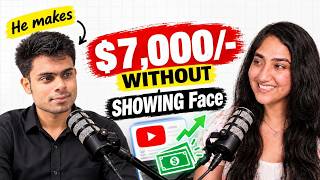
"Delivers exactly what the title promises: a realistic, detailed roadmap for building a faceless YouTube channel, backed by concrete numbers and failures."
In this podcast, Anas interviews Adosh, a former content writer who now earns $7,000 per month from multiple faceless YouTube channels while working only one hour a day. The episode breaks down his journey, his YouTube SEO and niche selection systems, his transparent revenue breakdown, and a detailed 90-day roadmap for beginners.
Adosh started as a blog writer, earning 6,000 rupees from his first internship, and eventually built his own websites. He pivoted to YouTube after a partner suggested converting articles into faceless videos, and a subsequent update wiped out website traffic.
Adosh's YouTube SEO system: 1) Use VidIQ to find keywords with high search volume and low competition. 2) Check the top 3-4 ranking videos—if small channels (2K-3K subs) are ranking with many views, the topic is easy to rank for; if big channels dominate, avoid it.
The biggest mistake small channels make is not having a micro niche. For example, in music, start with just guitar, then niche down to either chords or tabs, and only expand after gaining traction. For channels that already have broad content, start a playlist on the best-performing topics to organize.
Faceless niche selection criteria: 1) Competition should be low or moderate. 2) Product price should be high-ticket (e.g., $100+ products) to earn meaningful commissions. Avoid low-priced products like headphones (max $10 commission).
Adosh's monthly revenue breakdown: AdSense ($1K-$1.2K), affiliate marketing (~$4K-$5K), and sponsorships ($1.5K-$2K). Affiliate is the primary income, not AdSense.
Production process: keyword research → content outline → writer scripts → review → editing (screen record if needed) → AI voiceover (11labs) → thumbnail design → on-page SEO (title, description, affiliate links).
One-click AI-generated videos won't work; YouTube's update targets them. Success requires a real process, not shortcuts. Adosh's team uses AI only for the voiceover and brainstorming, not for full script generation.
It took 1 to 1.5 years to hit 1,000 subscribers and 4,000 watch hours for the first channel, but Adosh earned via affiliate long before monetization. 90% of his views come from search.
Adosh's biggest failure was a stickman video channel, costing 10k per video (15 videos = over 100k rupees lost) because it relied only on AdSense and virality. He now avoids niches where collaboration and high-ticket products aren't available.
AI is useful for brainstorming and simplifying, but not for producing deep, hyper-specific content. Human writers are still essential and must be vetted to avoid those who just use AI.
With a tight budget, the key is to substitute time for money—do editing and thumbnails yourself (e.g., Canva). Start with 2-3 videos per month, maintain consistency, and don’t expect fast results.
90-day roadmap: 1) Niche research. 2) Content calendar with 2-3 videos/month. 3) Consistency and systems; goal is to not stop. Affiliates can start on day one; sponsorships usually come after 5K subscribers.
Micro-Niche is the #1 Success Factor
Offers a concrete, actionable rule for beginners: start extremely small and expand only after gaining traction, avoiding a common fatal mistake.
06:57Leverage Competitor Size to Gauge Difficulty
A clever, practical SEO hack: if small channels rank top-3, the topic is easier to win; if big channels dominate, avoid it.
05:33Affiliate Revenue Dominates AdSense
Transparently breaks a common myth: YouTube monetization is not just about AdSense; affiliate income (from high-ticket products) is the real money-maker.
14:10AI Voice Needs Human Polish
Highlights that even premium AI tools require manual punctuation and expression tuning to sound natural, debunking the 'one-click AI' shortcut.
17:54Failure as a Data Point
Adosh's candid story of losing $10K+ on a failed stickman channel teaches that experimenting and accepting losses is essential for growth.
24:09[00:02] his podcast and 3 years later today he's sitting as a guest on mine and a [music] lot has happened since then. He started exactly where you are right now as [music] a content writer. Then he built and scaled his own blog websites and
[00:17] eventually started offering SEO [music] as a service to others. and today he owns multiple US-based faceless [music] YouTube channels and makes $7,000 per month from it by only working for 1 hour a day managing them. If you are a writer
[00:32] worrying about AI replacing you or not getting clients or starting off with something new, then this episode is for you. In this episode, Adosh breaks down how he goes about picking the most profitable niches, [music] what mistakes
[00:46] he has made that costed him money, his entire 7,000 per month revenue breakdown, and all the systems that [music] actually work for him. Make sure to stay till the end because he has shared the entire 90-day road map that
[00:58] you should consider if you want to begin with your first faceless YouTube channel. But before that, hi guys, my name is Aasta. I'm a freelance content channel, I talk all things freelancing. So if you don't want to miss out on any
[01:11] So if you don't want to miss out on any such video, make sure to subscribe now. Hi Adash, it's great to have you here on my podcast today. I mean the last we met was when I was your guest, right? And your journey since then has been crazy
[01:24] the way you have grown since then. So you moved from content writing to owning your own websites and then providing SEO as a service to others and now owning multiple channels of your own on YouTube making passive income with it. And you
[01:38] making passive income with it. And you make up to $7,000 a month. Honestly, more about your journey so you could also help other writers who are looking to switch to something and you know understand how to begin with that. So
[01:51] shall we begin? >> Yes, definitely. It's finally great to see you after such a long time and I'm very happy to be here. >> Yeah. Great. So, let's talk a bit about your original or how things got started,
[02:03] right? You started as a blog writer just like most of my audience. So, what was that phase like and what did you earn back then? writing because writing was like my
[02:16] superpower. Okay. I was interested in it. I was good at it and slowly I stumbled onto SEO because SEO if there is no SEO then you can't get your content out there. Coming to how much I earned I remember around 6,000 rupees
[02:30] from my first internship. That's where it began. So yeah that was the starting >> Okay. And when did you decide blogs alone won't scale and like how did you make the jump to building and scaling your own websites?
[02:44] >> Yeah. So uh actually it was something I decided on the first day that I want to build something of my own like having 100% ownership box the blog but I did not knew how to do it just like most beginners so I chose the internship
[02:58] route uh soon after that uh like once I had the money and a little bit of experience after 3 months I started my own website my own blog and we were just college students for you know fresh fresh freshman year and that's when the
[03:13] learning mainly happened. Uh but eventually like it it took so so much long time because building your own thing it always takes a lot of time even back then even before AI that is why I switched to freelancing again but yes
[03:28] the goal was always to build my own thing have my own projects. Oh, and I think that's another reason why you ended up also having your own channels on YouTube, right? But like how did you go from that blog websites to offering
[03:40] YouTube SEO and growth services? Because before your channel, I think you were offering YouTube services to others. So what gave your professional start with no prior experience in this? >> Yeah. So it had happened uh with a
[03:52] coincidence actually. Uh so uh this was around like after 2 years of starting all this, the blogs were going well. It was going good. But my partner said that uh you know let's convert these articles into videos. And I said who will shoot
[04:07] American uh audience, American accent, we target US. He said uh we will just you know use pictures and convert the article into faceless videos. Um I said okay do it. So he was the one who was doing it on the side as an experiment
[04:22] and slowly it started getting some traction and then I was like okay this is working. Let's see. uh and eventually a point came where another mobile update hit came and the website traffic completely got wiped off and we realized
[04:38] okay let's shift completely to YouTube. the only after we had social proof that yes we have success with YouTube only then I could provide services in that hire me >> right so just like we say if you want to
[04:52] offer SEO services have your own website get results there and then put that as a case study in front of the prospects to convert them similarly you did that by owning your own YouTube channel getting results and then putting that as a case
[05:06] study to your prospects and ultimately offering that as a service >> exactly That's how it starts. >> Great. And what is the exact YouTube SEO system that you use to get views from search plus that suggested on YouTube?
[05:19] There's just two things you need to remember. One is something that you do yourself using Vid IQ to do keyword research to find the high demand search volume keywords uh keywords which already have search volume. The second
[05:33] already have search volume. The second is a strategy that I personally use and it's already out there but people don't focus on it so diligently what you need to do is let's say you have a topic uh like how to start freelancing it's a
[05:46] very good topic but if you go to YouTube you have to search that topic okay and you will you have to see which videos are ranking in the top three four results uh let's say a channel with 1 million subscribers is get uh is ranking
[06:00] and the video has gotten 100k give views. Uh in short like big channels are ranking that is that means it it's very hard to rank. You can't beat those channels with millions of subscribers. But again in on another topic you might
[06:15] find that the channel has only 2K 3K subscribers small scale channel but uh it is getting 40k views 30k views on a particular topic and maybe multiple channels like that uh are ranking. So that means the topic is very likely to
[06:29] be you know easy for you to rank as well. Yeah, I think that absolutely volume and not just that but also seeing whether you can actually rank for that as a small channel or not considering the actual results you see on YouTube.
[06:43] short. >> Great. And what is that biggest mistake that small channels make that actually kills them in the first 30 videos they put out? I think the biggest mistake that uh many of us do I have also done I
[06:57] think you have also done is uh not having a micro niche. Uh so when we start on uh YouTube it's very important to start small. So for example if you want to start with musical instruments uh channel on music uh you might know
[07:12] guitar you might know synthesizer but it's recommended you start just with guitar. And in guitar there are like two categories. One is playing the song which is called chords and another is tab which is like the tune of the music.
[07:25] So you go even further you know niche down into just one category and once you are getting traction then you slowly branch to other categories. All of my business channels that have successfully became profitable have started like
[07:39] that. We moved from like very small place and we expanded. I feel caught. I think I'm still making this mistake and I need to fix that at the soon as possible. Right? But like if somebody has already done this that they have
[07:52] covered a lot of videos. I'm asking this for myself. Right? I've covered videos around different stuff. So how do you want me to go about it now? Should I delete those videos in other niches and just focus on that one subniche or
[08:04] should I just create more videos around that one thing and let everything else be as it is or is there any other way? >> Okay. So don't worry there is still hope for you. Uh to be honest it will be a little more easier to start a new
[08:18] channel that would be like be a fresh start but there is a strategy to not completely reboot your channel but at least to make some improvisation that is uh firstly what you can do is you look at what your existing audience is more
[08:31] interested in uh which are the best performing videos which are the topics they are more inclined towards and then you start a playlist on that. Let's say you your social media videos are getting more popularity. So you double down on
[08:45] that. So you can take the help of playlist uh to categorize your content. YouTube has that feature. That will be a better way to go about. >> Yeah, I think I'm doing that and I hope that things work out well. [laughter]
[08:57] >> Great. Okay. So now you don't offer these SEO services to others, right? And because you started out with your own channels since you always had this thing that you want to build something on your own. So basically I want to know why do
[09:12] you only own faceless channels and not channel with your face even when you started out with your face on YouTube. I remember when I was a part of your podcast it was all with your face. Now it's all faceless. So why exactly?
[09:26] >> Yeah. So the story about how it started uh I just shared that we converted the articles into videos and since we were targeting American audience because that's where the money is. Uh we knew that uh so faceless was the only option
[09:38] right because I don't look like American and neither do I have the asset. >> Yeah I think if you actually want to target that audience the best way is to be able to connect with them at the same level right and not make them look down
[09:51] upon you which is a fact which is a reality today. if you are an Indian and you are talking to them about something they won't care right so yeah I think that's a great perspective and you are pretty honest at putting it out great uh
[10:04] now how many faceless channels do you own right now and what are their niches and sizes like >> yeah so currently we have around three faceless channels uh one of them is the oldest one it is generating around 100k
[10:17] views uh in a month and it's a again a very micro niche so it's not like a channel like Zarati which is like for everybody. It's a very micro niche with very selected premium products and high ticket products. So even 100k views is
[10:31] ticket products. So even 100k views is good enough to generate good revenue. Uh which is the latest one actually it's about software tutorials. It is it hit around 100 uh 10k views and 130 10k subscribers and 135k views per month. Uh
[10:47] and this channel has a mixture of US and Indian audience also because AI is well popular everywhere. Uh but it has recently turned profitable for us up to almost one year. And the third channel that we have it is lying around 50k
[11:01] views per month. Again like it's also paceless targeted towards um US audience and it's in the cleanliness and hygiene. We have parked that channel because uh we want to invest in other projects for now. Yeah, that's about it. Wow. I think
[11:17] the niches you have picked for yourself are pretty u you know specific. So how does one go about picking their faceless niche in 2020 uh7 let's say and give us would consider before you actually start your own channel a new one.
[11:33] >> Yeah it's pretty simple actually there are only two things that you need to uh check out. Uh the first would be the competition. So if I am entering a niche where the competition is very high which happened to me in the very you know
[11:47] first uh day when I stumbled onto this model it was back in 2020. I looked at everyone buys it. So I said yeah let's make a website on this or a channel on make a website on this or a channel on this. Uh but what happened is uh the
[12:02] popularity is there obviously everyone uses headphones but the competition is also very high. uh eventually after putting a lot of effort I could not you know generate a lot of revenue. So that is the first thing you need to check out
[12:14] the competition the competition should be less or at least moderate. Second comes the is the uh price of the product. So if uh for example again headphones uh a headphone is like what uh in the even in the US it's $100 $200
[12:29] uh in the even in the US it's $100 $200 at max. Uh so even if you sell off a headphones, you will get a commission of $6, $10 depending on the commission rate, but it's not very good enough to sustain you long term. So yeah, the
[12:43] second thing comes as a ticket price. If it's not high ticket, then you are bought, which is what what is happening in our latest project, the AI one. So uh we have software tutorials and reviewing SAS products but the subscription is
[12:56] like $50, $100 max and we get out of that maybe $10 or $20. That's why we have to rely on other revenue sources like sponsorships or affiliate AdSense. Uh so yeah that is uh those are the two things that you need to check out
[13:11] depend on the ad revenue that YouTube offers and because of that you need to rely on also affiliate marketing which actually gets you the commission and how much you get it depends on the size of that product and hence choosing that
[13:25] niche is super important considering that but like walk me through your $7,000 monthly stack like how much of that or like how much percentage of that comes in the form of AdSense versus affiliate versus any paid collabs or
[13:40] other sources you have. >> Definitely. So, uh the way it goes like you already know the traffic that I'm generating is from the search based traffic. So, the ad revenue is pretty uh I would say stable not like those
[13:53] channels where it goes like that. >> Uh so the ad revenue gives around $1,000 to $1,200 a month combining all the channels like all the three channels. Uh then comes the affiliate part uh which is like my specialtity and that is uh
[14:10] that that that is something that applies to both of our oldest channels uh because they are product based. So getting a commission of around $4 to $5,000 just from affiliate the AdSense is actually a small part of the total
[14:23] figure. And lastly we have the sponsorship which is again depending on the niche. uh you might have sponsorship on some niches uh you might not have it in other niches like in the hygiene cleaniness space we don't have
[14:35] sponsorships we just have affiliate and ad revenue but in the AI software because there are so many AI companies they want us to review their product review their software make a step-by-step tutorial so u I charge
[14:49] around $500 to $600 for one single video um to review them so sponsorship is not coming as a new model for me yeah Cyber said $2,000 $1,500 to $2,000 for
[15:01] that mark. >> Wow. Amazing. I think this is something that most people don't know about. They think YouTube is all about AdSense and everything else is like secondary. But the fact is that everything else is
[15:15] primary and ad revenue from YouTube is secondary. Right. It's not as much as operating in the US niche or you are targeting that audience. >> Absolutely. like the ad revenue in India is even lesser. Uh the fact that I'm
[15:30] is because majority of the traffic is coming from you guys channel. >> Exactly. So it's not like you know I can't go to Dubai with that many. >> I'm glad you shared that transparently.
[15:44] Okay. But since you create faceless videos, do you like use any AI based many more in the market. So do you use any of them or like if not then what does that process from idea to production or editing look like?
[15:59] >> Yeah. So I do use AI tool in one step. I will reveal the software. Uh but let me take you through the full step. So the ideation part starts with the keyword research. We pick out a topic which has high chances of getting views. Uh the
[16:14] demand is high and the competition is low. So the keyword research process and checking the subscriber to beer ratio which I shared with you and uh just make a note of this that even following this process does not ensure a 100% run rate.
[16:27] Uh it's not like every video will go viral. Uh it's a safe uh strategy to increase your chances but uh that's where you start. Then comes the content outline. So this is the part that you know where research comes in. U let's
[16:42] what are the aspects? What are the things to cover? So it's it's a uh manual for the writer. So it's like prewriting stage. That's what we call the outline. Then it goes to the writer. Now the writer has all the references,
[16:56] the resources and he or she can just put put their focus on writing the script naturally keeping in mind the audience because the audience is maybe lay man right? Then after the script is ready, we review it. Me and my partner we u
[17:10] supervise everything. So we review it. Then we go to the next part which is uh your editing part and that's where the editor's job is to convert that script into a live video. We have our brand guidelines because these standards are
[17:25] old. So we have specific typography backgrounds but none of the that is made backgrounds but none of the that is made by AI. It's completely humanmade. Uh one do is screen report some of the tutorials because it depends on the
[17:39] niche. If I'm doing software tutorials, I need to screen report. So the writer does that job sometimes for this project at least. Uh then comes the AI part, the part where we use an AI tool and that is to generate the voice. Uh but don't be
[17:54] mistaken, you can't do this with free AI tools. We use use 11 laps which is a premium tool. Uh but it does the job really well. It makes it sound completely human and you still have to use punctuation, spaces properly to add
[18:09] those expressions and naturalness in the voice. And then we finally have the final output ready that is the video and after that it goes to the thumbnail designer and that is also someone he's actually a friend of mine who has been
[18:23] working on this project from the start. So he knows what to do here and he comes up with a thumbnail. uh again brand guidelines has to be followed and then we have the complete video ready and then we do something which you might be
[18:36] familiar with on page SEO. So equivalent to that we have to optimize the title description put that affiliate link give the discount coupons or maybe add the link in the comment section as well and some and then you finally have the
[18:49] video. I think that's quite a system because when we hear faceless we just think oh let's use an AI tool give a prompt and we are done right so what do you think about those videos do you think even those work well on YouTube or
[19:03] a process like yours is actually needed to succeed on YouTube >> no uh that process with oneclick AI generation that won't work and even YouTube uh said that in their last update AI generated videos won't work
[19:16] four of my team members uh you know co-workers because they like texted me like bro what will happen to us and I said real bro we don't do that thing anyway we just use the voice over and even that is like you know natural so
[19:33] YouTube was already has it cards against that those one click a generated videos it won't go anywhere and you can even watch some experiments done by some popular YouTubers who tried these uh tactics and they saw that even if there
[19:45] was a short-term beef uh it eventually got got nowhere I think that's a reality check that if you actually need to reach a level even YouTube you actually need to do that hard work right there are no shortcuts
[20:02] >> you said that okay and how many videos and like how much time did it actually take you to monetize your first faceless YouTube channel to hit that monetization on YouTube >> yeah that's a a little tricky and
[20:14] technical question because uh what happened is when I talk about SEO based YouTube strategy. It's very different from um what you see normally normal YouTubers doing. Normal YouTuber can go viral in one day and be monetized you
[20:29] know in a week. But that's not what happens with uh SEO driven YouTube channels. Uh we for us the main power is accumulation of views over a course of time because people are coming and searching. Uh 90% of my views are from
[20:43] search, Google search, YouTube search. So it takes some time to get monetized because people often don't subscribe. They just consume. They buy the product. So there was a point I did not even care about uh the monetization because I knew
[20:56] okay I have a $1,000 product. If I make five sales uh even at 10% revenue I I will end up making what like $500. Uh so that was the focus. But eventually as the channels grew older, we hit that mark of 1,000 subscribers and 4,000
[21:10] watch hours, which is soon going to be pumped to 8,000 watch hours. Um, and realized, okay, now we are getting uh some extra money. That's not bad. But it was never the priority. The timeline for that would be almost 1 year, 1.5 years,
[21:25] somewhere in that range. >> So the fact is the monetization, the but you were already making money from YouTube even way before that, right? So it hardly makes uh it get actual monetization.
[21:38] >> Great. And what is that one faceless niche that you would never touch today and like why? >> Uh a faceless niche that I won't touch uh right now. Um well I keep on you know
[21:54] like experimenting a lot. So a lot of what I have built today it's by hit and dice and sometimes it happens that it looks beautiful from the surface but when you put your hands into it well it's not that uh beautiful it's not
[22:07] going to give the ROI so one of the niches that I always thought is going to work is VPN niches uh like because VPN is something that everyone uses it's a you know SAS technically uh you don't need a physical product and the revenue
[22:22] is also good uh but unfortunately We tried a project in that niche and only later on we realized there are some road bumps. For example, the companies don't want to collaborate with small channels.
[22:34] So this is something every uh person starting a Facebook channel will face and you need to confirm this prior. Are companies in that niche ready to collaborate or even if they have a collaboration going on because some
[22:46] brands just don't have collaborations going on. So that did not work out and secondly the audience mindset. the audience was like they want free VPN that uh so eventually that project depart sustain it it was one of the
[23:01] depart sustain it it was one of the projects we you know uh kept it down just the name of this niche but also the fact that you need to also look into this aspect whether companies in this niche are actually looking to
[23:14] collaborate with creators and they have the budget to do that or not especially with small creators >> exactly and it's something that you just uh have the have the guts to face like not you will not get a manual to do it.
[23:28] Uh so for example I mentioned $500 I I charge $500 for one video. Uh now that is something which took curse because a lot of brands came and they were like we will give you $100 we will give you $50. But I said no I know my word I have
[23:41] audience quality is this high. So I'm going to accept maybe just one sponsor but it has to be $500. I don't need five sponsors paying less money. Uh and I stand by that rule. So that helps. >> Totally makes sense. Okay, we have
[23:56] talked enough about your success and what all you have built, how huge your audience is and the money you make. But now let's talk about the money, the reality and like the mistakes that you have made till now. So what was your
[24:09] biggest flop channel and how much money did you actually lose on it? >> Yeah, so the biggest flop channel is uh something and you might have seen channels like those. It was a channel on stickman videos. So, it's one of those
[24:23] cute, you know, stickman like uh made up of drawing and it's like the video is history and you have just those animations playing out. It's very
[24:35] engaging to watch and easy to follow actually. It's very much occupied and uh different from what we usually do. uh the SEO strategy and everything we have been talking about it it is not applicable in that niche because niches
[24:49] like this they thrive on virality uh they have to go viral and AdSense is the only mode of revenue in that niche. So we we saw a lot of channels doing good uh in that category and we thought okay we can also do but those videos they
[25:03] were very expensive to make because uh I outsourced the entire thing and it was costing me even at a discounted rate it was 10k per video just for editing the video and we made around 15 videos on that but the channel did not go
[25:18] anywhere. Uh eventually we had to pull it back so that was yeah one of the >> so like you lost over a l on it at least. Absolutely. Last year. >> Yeah. That's sad. But you are making way more than that by actually experimenting
[25:32] failures, right? try otherwise we'll regret that we did not even give it a try. >> Right. Okay. And now coming back to this. So writers fear that AI will
[25:46] replace them or it's already replacing them. And you use AI in faceless workflows too. So where does AI actually help and where does it fall short? Yeah. So, uh the problem with AI is that when you go very hyper specific in a
[26:02] channels are very hyper specific. of a particular industry, uh troubleshooting that particular product. Uh it takes a human intervention to go that deep and you can obviously use AI
[26:17] to simplify things even at that deep level. But you can't expect AI to make the entire article with one click. That won't happen. And that's where human writers are, you know, useful for me. And I have I have a team of writers and
[26:31] I I've been retaining them for years because nowadays it's very hard to find new writers also. And some people are just using AI and pretending which is very easy to spot for us. So yeah, that is the main distinction. Um but I have
[26:46] seen that on social media whether you're writing a LinkedIn post or sometimes I'm making uh you know like shortlisting hooks for social media that's where AI is very good in brainstorming. So yeah I think AI is going to change the space.
[27:00] >> Got it. And I think I agree with everything you said. Okay. So let's say if somebody just has a budget of 10,000 rupees like that's their total savings not a monthly budget and they have no team they're starting from absolutely
[27:13] scratch. So what is that realistic first faceless channel they should start? >> Yeah. So I think the first thing that they should start is uh they have to do the niche research. Okay. Uh and I have already given you the parameters to pick
[27:27] a good niche. I can't give you the niche because these days uh it's very hard to find a good niche even uh I have been asked to keep my niches as confidential but I have given you several hints. Uh so what happens is yeah first is the
[27:40] research based the exploratory base. Uh since you are low on money uh see YouTube does not take any money to get started. Uh so the only downside will be that you have to put in time you have to make up uh the shortage of money with
[27:54] time. Uh we have outsourced everything in our team because we have the incoming cash flow. So we save our time using money. You don't have money so you put money. You don't have money so you put your time and save your money. Uh so
[28:07] when it comes to editing or you know uh thumbnail you have to do it by yourself and there will be a learning curve to that it's easy like one of our channels we edit the videos using Canva. We have been doing that from the start and that
[28:20] uh that design and uh layout has is accustomed to our audience. So we are fine with that. Even the thumbnails are very simple. We do it on Canva. So you have to experiment it by yourself. There will be no expert, no editor, no writer
[28:33] to help you out. That is the only downside which takes more time. >> Got it. That makes sense. Okay. And before we actually end it, I have like two final questions. One of them is 3 years ago you invited me to your
[28:46] podcast, right? And now you are here on mine. >> Now you are that one person with multiple channels across the internet. So what changed in you as an operator when you were handling your channel
[29:00] versus when you were handling your channel but like faceless channels. >> Yeah. So uh it has been like quite a journey from there to here. Uh and I think the one thing I was doing back then is experimenting uh more. So I was
[29:14] experimenting with one of my face channelers where I asked you to come as a guest. Uh and it did not end well because compared to faceless it was not profitable. So I decided to uh like shut it down because uh it was like giving
[29:27] gan but uh I was not up for selling courses or you know going down that road. Uh but the faceless channels that I have today two of them I also had back then but they were not this much grown or not generating that much revenue then
[29:41] I will make a podcast like I'm doing right now. So I kept it under the wraps. Uh now yes uh choosing those Facebook channels they have grown. So it's you know about like compounding effect. uh one thing changed is like I stuck with
[29:54] one thing changed is like I stuck with them and it it has grown. Uh but I I I still keep on experimenting. Back then I was experimenting with podcasts. Now I'm experimenting with something else. So nothing much has changed but yeah
[30:06] results. >> Great. And if a freelancer watching this wants to build their first uh faceless income stream in the next 90 days, then what would be your exact month by month road map for the next 3 months?
[30:22] >> Yeah. So what I would say is uh for a freelancer the entry uh is even easier freelancer would already have those skills required in this game uh like writing or maybe editing or just research work right. uh for 90 days what
[30:38] I would say is uh firstly finding the niche that's that's one thing he or she has to be clear with and once they're cleared with that linking a content calendar you don't have to start very with a high frequency just three videos
[30:52] a month or even two videos a month is good but get your process clear the that's only possible when you have a realistic target like one video a week or one video every 1.5C and consistency is needed. Like if you
[31:08] look at my channels, we have over 100 200 videos, but we don't post like 10 videos in a month, okay? We we posted maybe four videos a month or five videos, six videos a month. Even now, we do that. I I can scale that up. I have
[31:21] the team, but I don't need that because end of the day it's like accumulating compounding effect. So, it has taken years to be here and after spending years, I I guess I'm not regretting it. So, start slow. Don't be like oh I have
[31:35] to upload five videos six videos from the first month. It doesn't work like that. Have your systems in place. Uh and obviously you have your clients to attend to maybe other commitments. So set a realistic time 2 hours a day or
[31:47] you know like 3 hours a day if you're doing everything by yourself because it's going to take time. It's going to be slow before it gives you any results. So the goal is not to make money goal is to not stop.
[31:59] H and like when do you suggest people to start reaching out to companies or brands for paid collabs or like referral like affiliates or something? >> Mhm. So affiliate is something that brands are automatically offering you.
[32:12] If you just go to their website uh they will usually have this uh form and fill that up and they will give you unless it's a very specific niche like VPN totally against no we will not take small channels. Most niches will
[32:26] actually take the channels. So you can start that by day one itself even when you're growing the channel. Uh and coming to sponsorships for sponsorships bit more before you get quality sponsorships. So again depending on your
[32:39] niche but in my software tutorial channel I got sponsorships after channel I got sponsorships after crossing 5K subscribers uh and I think I >> Mhm. >> Monthly. And I think this is relatively
[32:52] easier with channels with face because I personally got my first paid collaboration on YouTube and I had like 1.5k subscribers only. So even that was 10,000 rupees. So I think it is relatively easier or like faster to get
[33:07] brand paying you when you have a face on the channel right opposed to when you trust faster. >> Totally agreed. Like so there's one face channels that is your credibility so everyone can recognize you using your
[33:23] face and we have spotted that difference uh early on we try to cover that up. So in my latest channel we added up avatar we have a cute panda face who is like speaking just to give you give that illusion. Uh but yeah uh subscribers do
[33:36] increase much faster in face channels because of that credibility part ultimately depends on your niche and your strategy but sticking to one niche that will it go a long way. >> I love that. driving loved every insight
[33:48] you shared and the reality check that you gave is just because you spend one hour today in a day handling all your three channels because you have built a team alongside it doesn't mean that people can do the same or make $7,000 a
[34:02] month in their first month or even anytime soon right it's a whole long process that requires a lot of consistency a lot of effort and no >> true it takes a it takes its time but it's a journey that will transform you
[34:17] do it right. >> Absolutely >> amazing Thank you so much for being here. I truly hope my audience learned a lot and we would speak soon again.
[34:29] here and your audience might have a lot of questions. So I would suggest here. >> Sure thing. Please feel free to drop answer them. >> That's it guys. I hope Adosh insights
[34:44] and the entire journey, the mistakes, the breakdowns, everything helps you start your own faceless YouTube channel. But if you've got any questions, and I would be happy to answer them in the comments. Just drop them and make
[34:57] sure to subscribe to my channel so you don't miss out on any such videos. I'll don't miss out on any such videos. I'll see you in the next one. Bye.
Starts with a narrative arc—3 years ago he was a guest, now he's the host—creating curiosity about his transformation, which hooks viewers who want to replicate that success.
Three years ago I was [YOUR POSITION]. Today, I'm [ACHIEVED RESULT]. Here's exactly [STEP-BY-STEP ROADMAP] to get from [START] to [RESULT] — including the [MISTAKES] I made along the way.
AI-generated clip ideas for Shorts based on the transcript
The dramatic income transformation from a $6K internship to $7K/month is an inspiring hook that promises a step-by-step roadmap.
▶ Play ClipReveals a common, costly mistake (not niching down) that resonates with struggling creators, offering a clear fix.
▶ Play ClipTransparent income breakdowns are highly shareable and satisfy curiosity about realistic YouTube earnings.
▶ Play ClipAddresses the hot AI vs. human debate with a contrarian take that reassures writers and sparks discussion.
▶ Play ClipActionable 90-day plan with a motivating 'start slow' message that appeals to beginners seeking a clear path.
▶ Play ClipSnapshot 2026-11-17
Every observation TubeSum recorded, plotted as measured.
Based on 7 observations · last observed Nov 17, 2026 · solid lines connect consecutive measurements (≤2 days apart); dashed lines span days TubeSum did not measure. · vertical axis from zero
Exact daily observations; gaps mean no observation was taken that day.
| Date | Views | Avg views / hour | Channel median |
|---|---|---|---|
| 2026-11-17 | 2,725 | 16.0 | — |
| 2026-11-16 | 2,662 | 16.5 | — |
| 2026-11-15 | 2,129 | 16.3 | — |
| 2026-11-14 | 1,694 | 15.4 | — |
| 2026-11-13 | 1,125 | 14.8 | — |
| 2026-11-12 | 812 | 13.3 | — |
| 2026-11-11 | 205 | 9.8 | — |
Audience reaction — separate from the performance metrics above.