
No Best Trading Strategy?
45sChallenges the common belief that one strategy is superior, sparking curiosity and debate.
▶ Play Clip"Title accurately promises a tier list for beginners, and the video delivers exactly that with clear rankings and explanations."
This video provides a comprehensive tier list of trading strategies for beginners, explaining what makes a strategy profitable and ranking approaches from best to worst. The presenter, an experienced trader, emphasizes that no single strategy is inherently superior; rather, strategies perform differently across market phases. Key factors for profitability include pattern recognition, specific rule sets, frequency of trades, risk-reward ratio, and win rate.
There is no inherently best trading strategy; strategies perform better in certain market phases. Some are easier to learn, require less emotional involvement, or are more automated.
Two steps: 1) Find a pattern that repeats over time (e.g., breakouts, moving average crossovers, liquidity grabs). 2) Add specific rules to that pattern (entry, stop loss, take profit, position management).
To evaluate a strategy, consider: 1) Number of times you can execute it, 2) How much you win when you win vs. lose when you lose, 3) Win rate. These determine if a strategy is profitable.
Input your strategy's data (frequency, win/loss amounts, win rate) into ChatGPT to calculate projected profit over a period (e.g., 10 years).
Scalping involves very short timeframes (minutes/seconds), high volatility, and can cause anxiety and bad habits. It's the worst strategy for beginners.
Price action focuses on raw candlestick data without indicators, capturing human emotions (greed/fear). It's the best strategy for both beginners and advanced traders.
Swing trading uses long timeframes (weekly charts) for calm, measured learning. It's slower but allows combining with work. Better than scalping but not the best.
Indicators provide delayed, visual information but don't teach real trading knowledge. They are the worst strategies for beginners.
Day trading balances swing trading and scalping, using hourly charts for minute-level trades. It allows setting alerts and is the perfect way to learn.
Elliott Wave Theory is subjective, explains past moves but not future ones, and can lead to adjusting calculations. It's a poor choice for beginners.
Trading solely with candlesticks is like playing basketball with one arm. It's complex and requires many additional elements. The worst strategy.
ICT (Inner Circle Trading) is a philosophy, not a holy grail. Many traders are profitable, but many overtrade and have large losing streaks. It's a normal strategy.
Technical patterns are basic and popular; big players exploit them. Trading solely with patterns lacks tools to determine direction. A poor choice.
SMC focuses on liquidity and manipulation by large players. It's generic and can be confusing. Often overhyped on social media with misleading profit captures. Normal strategy.
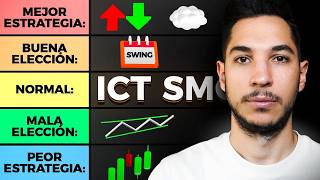
Best: Price action and day trading. Good: Swing trading. Normal: Smart Money and ICT. Bad: Elliott Wave and patterns. Worst: Candlestick scalping and indicators.
The best trading strategies for beginners are price action and day trading, while scalping and indicator-based strategies are the worst. Understanding patterns, adding specific rules, and evaluating frequency, risk-reward, and win rate are essential for profitability.
What are the two steps to determine if a trading strategy is profitable?
1) Find a pattern that repeats over time. 2) Add specific rules to that pattern (entry, stop loss, take profit, position management).
01:32
What three elements determine if a trading strategy is profitable?
Number of times you can execute the strategy, how much you win vs. lose, and win rate.
05:11
Why is scalping considered the worst strategy for beginners?
It involves very short timeframes, high volatility, and can cause anxiety and bad habits.
06:54
What is price action trading?
Trading based on raw candlestick data without indicators, capturing human emotions of greed and fear.
07:47
What is a key negative of trading with indicators?
Indicators provide delayed information and don't teach real trading knowledge.
10:47
Why is day trading considered the best way to learn?
It balances swing trading and scalping, allows setting alerts, and provides a perfect learning environment.
12:01
What is a major problem with Elliott Wave Theory?
It is subjective; traders can adjust calculations to fit different outcomes, which is detrimental for beginners.
13:31
Why is trading solely with Japanese candlesticks considered the worst strategy?
It is complex and requires many additional elements; it's like playing basketball with one arm.
14:37
What is the main criticism of ICT (Inner Circle Trading)?
It is overrated as a holy grail; many traders overtrade and have large losing streaks despite occasional big wins.
16:51
Why is pattern trading considered a poor choice?
Patterns are basic and popular, so big players exploit them, and trading solely with patterns lacks tools to determine direction.
19:13
What is the focus of Smart Money Concepts (SMC)?
Liquidity, imbalances, and structures to identify manipulations and traps by large players.
21:02
According to the final tier list, which strategies are best for beginners?
Price action and day trading.
23:23
No Single Best Strategy
Establishes the core premise that strategy effectiveness depends on market phases, not inherent superiority.
00:02Three Key Profitability Elements
Provides a simple, actionable framework (frequency, risk-reward, win rate) to evaluate any strategy.
05:11Price Action as Best Strategy
Highlights that trading raw candlestick data captures human emotions, making it foundational for all traders.
07:47Day Trading as Ideal Learning Method
Positions day trading as the perfect balance between speed and calm, suitable for beginners.
12:01Final Tier List Summary
Provides a clear, actionable ranking of strategies from best to worst, guiding beginners' choices.
23:23[00:02] professionally in the field, having worked on the trading desk of an investment bank, and having mentored hundreds of traders, I can say with 100% certainty that there is no single trading strategy that is inherently better than
[00:16] another. There are only strategies that perform better in certain market phases and strategies that perform better in others. However, there are trading strategies that are easier to learn, that can be used in different
[00:31] market phases, that require less emotional involvement from the trader, or that are more automated. So, in this video, in addition to explaining what a
[00:45] explaining what a profitable trading strategy is and how you can tell if you will make money trading, I'll present a tier list of the best beginners. I'll separate the main strategies and ways of
[01:00] trading into different categories from best to worst. This video will be useful whether you are a beginner or an advanced trader. However, if you would like me to do the same but with more advanced trading strategies for traders with
[01:16] a bit more experience, let me know in the comments and I'll get right to it. let me know in the comments and I'll get right to it. Before anything else, I want you to understand, in a very summarized and simplified way, what
[01:32] you can know if a trading strategy is profitable or not. There are two very simple steps you have to follow to reach these conclusions. The first step is to find a pattern that repeats over
[01:47] time. But what does a pattern that repeats over time mean? Well, the reality is that there are many patterns that constantly repeat. One of the patterns would be breakouts of support or resistance levels. You have a
[02:00] resistance level, and a very common pattern is both the breakout and the subsequent pullback for a continuation or even rejection of that
[02:12] resistance level. In this case, there are other types of patterns: moving average crossovers. When you have a much shorter moving average and a longer moving average, and there is a crossover in this sense, when the shorter one crosses from above to
[02:28] below, the longer one doesn't. We don't usually sell. On the other hand, when you have a long moving average and a short one comes along and crosses it from below to above, we normally buy. But there are also other ways to trade, such as
[02:42] taking... Liquidity, where the price comes to find liquidity levels below and reverses. Normal impulses, pullbacks, and continuations—these are not trading strategies; these
[02:56] are simply patterns to which, and here we move on to point two, you will have to add specific rules. That is to say, the pattern itself is not the strategy. The strategy is composed of the pattern that repeats over time,
[03:11] giving you the certainty that you are trading something that repeats. But then it is composed of the rule or set of rules that you apply to that pattern. For example, let's imagine the typical example of the impulse, the pullback,
[03:27] and the continuation. This is a pattern that repeats itself over and over again in each and every timeframe. Perfect. Here you can add different types of rules. Trading strategy number one: execute a limit order at a
[03:42] Fibonacci level: 1/3, the half, 2/3. You execute a limit here, you place a stop You execute a limit here, you place a stop loss below the 2/3 level or below the half level and a take profit at the previous high,
[03:57] managing the position, for example, with a moving average. a moving average. 50-period moving average and also taking partial trades in the middle part. This is a trading strategy. Why? Because
[04:10] you have a pattern and you add very specific rules, but nevertheless, within the same pattern, there are different ways to trade it. We have evaluated trading strategy number one. Trading strategy number two: We execute at the
[04:25] moment the price reaches at least half of the Fibonacci level and reverses. We execute at the middle of the impulse. We put a stop loss below the 2.3% Fibonacci level and a take profit at the previous high. We don't
[04:41] manage the position or do anything. Here we are seeing how, within the same trading strategy, or rather, within the same impulse, pullback, and continuation pattern, there are different ways to wrap that pattern with
[04:56] specific rules. Which is the most profitable? Which strategy will be more profitable of these two? Well, for that, you need to know the following: You need to take into account three very specific aspects. If you want to know if
[05:11] specific aspects. If you want to know if trading strategy number one is better than number two, you have to consider three different elements: first, the number of times you can execute that strategy; second, how much you
[05:26] earn when... You win and how much you lose when you lose. You need to know how much profit you're making each time you win and how much profit or loss you 're making when you lose. The third aspect is the
[05:43] win rate. These three elements will applied to a specific trading strategy or pattern are
[05:57] profitable or not. The reality is that there could be infinite variables; that is, there could be strategies with a higher win rate, with a lower one, more executable strategies, less executable strategies, strategies where you win more, where you lose more, where you win less, where you lose
[06:12] less. There are infinite variables. So I recommend that with the data of the pattern and the rules of the trading strategy you're using, you go, for example, to ChatGPT and say, "Hey, calculate my profit over a
[06:26] 10-year period if I have this trading strategy in which I execute this number of times, I win this amount when I win, and I lose this amount when I lose, and I have this win rate." ChatGPT will automatically give you the
[06:38] numbers to see if your trading strategy is profitable or not. Let's start with the first way to trade. Scalping, regardless of the specific scalping strategy you 're using, involves
[06:54] determining the price direction in a matter of minutes and executing a position within seconds. Trading is fractal, meaning that the same strategy, pattern, or set of rules you use on a
[07:08] 4-hour timeframe can also be used on a 1- lower the timeframe, the greater the volatility, and with greater volatility
[07:20] comes greater potential for profit and also greater potential for loss. If you're starting out in trading, it's normal to lose more than you win initially. Therefore, scalping can generate anxiety, bad habits, and even the
[07:35] urge to quit. Considering all of this, scalping would be the worst trading strategy for beginners.
[07:47] analysis of what's happening on the chart without using any elements or tools other than the candlesticks themselves. If we reduce what a chart is to its simplest form—that is, the price of any asset, regardless of
[08:03] the timeframe—we realize... Both upward and downward price movements are caused by human beings themselves. The chart is simply the struggle between bulls and bears, preceded by the emotions of
[08:16] greed and fear. So, trading while taking price action into account allows you to trade the essence of chart movements, that is, human emotions.
[08:31] candlesticks or Japanese charts. Candlesticks are simply one of the many elements that make up price action. In fact, we will talk about them later, but a candlestick is an element. A set of
[08:44] candlesticks can form a pattern. A set of patterns can form a trend. A set of trends can form support and resistance levels. And so on. We could go on indicating and developing
[08:58] the many elements that make up and form part of price action analysis. Whether you trade for life or not, these concepts of price action will be the only ones
[09:10] that, firstly, allow you to trade the essence of what happens in the market, and secondly, allow you to understand each and every concept much more clearly. Or ways of doing trading that we will see below, the
[09:25] reverse doesn't happen. So, taking into account everything I've mentioned, trading with price action is the best trading strategy whether you're a beginner or even advanced. Swing trading is based on trading
[09:39] with long timeframes, looking for the main direction of the weekly chart to then execute profitable long-term trading strategies. One of the strengths of swing trading is that you'll be able to
[09:53] familiarize yourself with the broker, the strategy, position management, money management, the routine, the habits, the watchlist— everything—in a calm and measured way, even being able to combine it with your
[10:06] even being able to combine it with your work or personal life. One of the real negative points is that everything happens very slowly, and obviously, it will take you longer to learn all the concepts, and from there,
[10:18] other consequences can arise, such as rushing to learn and making hasty decisions, acquiring bad habits, and that generates significant frustration. habits, and that generates significant frustration.
[10:32] a good choice when starting to trade and apply profitable strategies, clearly better than scalping, but by no means the best. Best choice: Indicators are external elements
[10:47] superimposed on the chart. Through mathematical formulas, they provide information in a more visual way. The very definition of what an indicator is already denotes its strengths and
[11:03] weaknesses. Positive aspects include making the chart more visual, allowing for emotional involvement, and automating many decisions we would otherwise have to make when trading.
[11:17] Negative aspects include providing information already represented on the chart, whether we recognize it or not. The information they provide is delayed because they require the candle's closing price to complete the formula and provide the information.
[11:32] indicators used, they can be quite confusing. Adding indicators to the chart doesn't provide real trading knowledge. While it can be profitable to trade with indicators, you won't actually be
[11:47] learning anything tangible. Obviously, we can add certain indicators to take advantage of their positive aspects, but we would first need to have a more mastered understanding of price action analysis.
[12:01] Therefore, indicator-based strategies are the worst strategies to follow if you are starting out in day trading. It analyzes the trend and direction of hourly charts to then apply
[12:16] strategies in a matter of minutes. The reality is that it represents a perfect balance between swing trading and scalping, since you won't be stuck with the slowness of swing trading or the slowness of scalping itself. You can choose whether to trade in the
[12:32] morning or afternoon, which session to trade, what type of assets, and what type of strategies to use. You can even set alerts so you don't have to be constantly in front of the screen. So you go about your day setting
[12:45] alerts, whether it's morning or afternoon, and the moment that alert sounds, you go to the chart because the price will be in a position that interests you to execute the strategy, manage the
[12:59] position, or whatever. So, taking all these elements into account, taking all these elements into account, day trading makes it the perfect way to learn to trade and is therefore the best
[13:12] strategy or way to trade to start with, or even to be already trading
[13:31] a way, organize what is happening, give shape and direction, understand if there is an impulse, a pullback, or what the... The current market situation, however, with
[13:44] Elliott Wave Theory alone, we won't be able to understand what will happen next and trade profitably. An
[13:56] Elliott Wave Theory will be able to explain very well why the price has gone in one direction or another, or why the pullback is one way or another, but it will be much more difficult for them to determine how to
[14:10] capitalize on the upcoming move. Furthermore, all trading strategies or methods are subjective to some extent, but Elliott Wave Theory is even more subjective. If the calculations don't work out
[14:24] with one type of wave, you can adjust the numbers, impulses, and prices to get different results. This is extremely detrimental at the very beginning, when we are starting out. For these reasons,
[14:37] Elliott Wave Theory is one of the ways to start that represents a poor choice. Japanese candlesticks are an analysis technique brought from the East not many years ago. In fact, if you go to TradingView and click...
[14:53] In this moment, you'll realize that this is simply one of the many ways we have to receive information from the chart. But we have many other ways that are also quite attractive;
[15:08] however, candlesticks or Japanese candlesticks are the most used due to how complete the information they provide is.
[15:20] as we mentioned earlier, that are part of price action. Therefore, applying trading strategies based on the prior analysis of these Japanese candlesticks is like playing basketball with one arm.
[15:34] Trading with Japanese candlesticks can be profitable, yes, it can be profitable, but keep in mind that it is much more complex than if you take other elements into account. There are also two ways to use Japanese candlesticks. Number one, you
[15:50] approach them from a scientific perspective, which is how many traders do it; that is, you measure the body and the shadow exactly, compare the previous shadow with the subsequent body, measure percentages, pips, etc., etc., as if it
[16:04] were literally a pie chart. And trading isn't like that, so it's a somewhat fair way to use them, in my opinion. Point number two, you approach them in terms of... Regarding the nature of these candles, you know there are different shapes,
[16:20] different candles, different patterns, but you don't demand perfection because imperfect and that the market is moved by human beings themselves. The first approach is extremely far removed from reality; the second approach requires the support of
[16:36] many more elements. Knowing all this, trading exclusively with candlesticks or Japanese candlesticks is the worst strategy you can apply. ICT, which stands for Inner Circle Trading, is run by someone who currently seems like the
[16:51] God of trading, who calls himself superior to the rest of the traders, and who, we will discuss in the next few seconds, seems to be the only person in the world who operates profitable trading strategies. ICT is
[17:06] Money; in a few minutes we will talk about Smart Money itself. It has positioned itself as the holy grail of trading, as the way of operating that will allow so many traders who have not been profitable until now to start making a living
[17:21] from trading. But this is precisely where the trap lies. Obviously, I'm not saying it's not possible to be profitable trading by applying ICT concepts; quite the contrary. I know many people who have been
[17:34] profitable using these strategies; however, this way of trading has been overrated because so many millions of people have tried so many different methods that marketing has somehow convinced them otherwise. ICT
[17:48] has somehow convinced them otherwise. ICT a trading philosophy. And although there are
[18:03] many traders who are profitable using ICT—in fact, as I mentioned, I know several—there are millions of traders who are constantly overtrading, generating large profits of
[18:17] 5%, for example, in a single trade, but then subsequently losing and entering subsequently losing and entering a losing streak of 10% in just two and a half days. Is it possible to be profitable using ICT? Yes, obviously,
[18:30] but as with every trading method, you have to master the concepts they teach you very well. Therefore, it's not the holy grail of anything. Furthermore, the fact that it's a somewhat generic philosophy, in my opinion,
[18:45] makes it much more complex to be able to apply the concepts profitably, especially if you 're starting from scratch. So, for this main reason, and also because... My opinion is that it's more sensible to go
[18:59] directly for Smart Money. It's a normal way to be profitable trading. Technical patterns are also one of the many elements that make up the price action we discussed at the beginning.
[19:13] Those who trade with technical patterns look for structures that constantly repeat in the market, and by measuring and analyzing them, you can determine the best time to enter, the best
[19:27] time to exit at a loss, and where you should place the take profit. The main problem is that it's a very basic and popular way of trading. So, the big players already know that when, for example,
[19:40] like the one you're seeing on the screen, millions of traders will execute buy positions at that precise moment, placing a very tight stop loss. By measuring the
[19:54] length of the double bottom, they'll place a take profit at this point. So, all they have to do is raise the price a little to make it seem like the double bottom is working, send the price directly down,
[20:08] send the price directly down, trigger the stop losses, and generate liquidity. The sales strategy involves leveraging that liquidity to accumulate long positions, and when there are no more sellers willing to sell, causing the price to
[20:22] explode sharply in the main direction. The issue is that trading solely with patterns doesn't provide the necessary tools to determine with a high probability which direction the
[20:35] price will take or if something unusual is happening. Therefore, considering everything I've mentioned, pattern trading is one of the worst
[20:47] ways to start and clearly represents a poor choice. clearly represents a poor choice. Smart Money Concepts (SMC) is a slightly more generic and user- friendly way of applying certain concepts
[21:02] also taught in ICT. Through Smart Money concepts, traders focus on liquidity, looking for imbalances and structures that allow them to identify manipulations and traps created by
[21:17] large players in order to predict the future price action. The direction of the next move and joining the trend with those big hands— the general theme is the philosophy and what Smart Money attempts to encompass, which is very good, in fact, it
[21:32] 's transcendental. Mastering liquidity to be able to trade, regardless of the strategy or trading method used, is key. However, they talk about many very broad and generic concepts that are all determined and directed towards the
[21:46] same thing: liquidity. This can be confusing and prevents one from becoming profitable quickly. Another problem is that, like ICT, it's received
[21:58] as the solution to the problems of so many traders who haven't been able to be profitable and who now, thanks to Smart Money, will be able to be. Furthermore, it 's the main source of profit captures you'll see on Twitter. The
[22:12] kind of aura has formed around Smart Money where traders who use Smart Money label those of us who don't use these concepts as beginners, as traders who don't
[22:25] be profitable with our strategies. They use Instagram, YouTube, and other social networks to promote their profit captures. But these same traders who They show returns of 5 or 6% in a single
[22:40] trade, but I have to warn you that these are the same people who need to lose 10 or 12 same people who need to lose 10 or 12 consecutive trades of 1% each to generate that capture that, from the outside, seems so positive. This
[22:54] means that Smart Money isn't the solution to anything and often becomes the problem. So, Smart Money falls under the category of normal trading strategies. However, I would start with Smart Money before
[23:07] ICT so that we can organize everything I've been discussing in this video and also categorize within the categories which approach is better and which is worse. Let's review everything.
[23:23] As the best strategies, we place price action and day trading, in that order. As a good choice, we would find swing trading. As a normal way to be profitable, we would include Smart Money concepts and ICT. As for bad
[23:40] choices, we find Elliott Wave Theory and patterns, and finally, as the worst strategies for trading, we would include candlestick scalping and indicators, in that order. So, the best strategy among all those I've
[23:56] mentioned would be price action and... The worst strategy would be trading with only indicators. Remember that below, in the first pinned comment and in the description of this video, you'll find other links of interest, such as
[24:09] tutorial courses, other complete and profitable trading strategies—all 100% free content so you can continue learning as a trader without investing your own money. Also, if you're interested in me making this video a
[24:23] bit more complex for more advanced traders, even with much more defined trading strategies, just let me know in the comments. I'll leave this video here. I hope you liked it and that it was helpful, which is
[24:37] the important thing. If so, like, subscribe, and share it with friends and family. See you in the next video! Goodbye!
⚡ Saved you 0h 24m reading this? Transcribe any YouTube video for free — no signup needed.