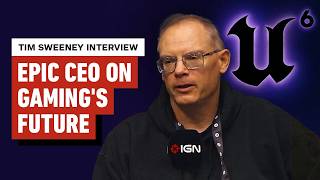

Tim Sweeney on UE6, AI, and Industry Struggles
45sDirectly addresses the controversial use of AI in game development and the current industry crisis, sparking debate among gamers and developers.
▶ Play Clip
[00:00] IGN caught up with founder and CEO of
[00:02] Epic Games, Tim Sweeney, and EVP of
[00:04] development, Marcus Wasmer, at Unreal
[00:06] Fest 2026. We talked about performance
[00:08] optimization with the upcoming UE6 and
[00:10] how it could change game development, as
[00:12] well as the increasing cost of hardware
[00:13] and the current struggles across the
[00:15] games industry with studio closures and
[00:17] game shuttering. We also discussed the
[00:19] controversial use of AI in game
[00:21] development when it comes to artistic
[00:22] value and its real world impact in light
[00:24] of Unreal Engine's updated AI tools. So
[00:27] many of the biggest games are built on
[00:29] Unreal, so check out our recaps of the
[00:31] state of Unreal keynote to see where
[00:32] games are going in the future as you
[00:34] stick with IGN. Now, here's our
[00:36] interview.
[00:46] I think it's two things like one as you
[00:48] say just like efficiency of of
[00:50] development like games are getting
[00:52] bigger, games are you know getting more
[00:54] difficult. So like all the architectural
[00:56] work we're doing on the engine should
[00:58] just smooth things out. Not to mention
[01:01] um you know like AI creation flows. We
[01:03] showed some demos today. Uh you know
[01:06] really should take a lot of the tedium
[01:07] out of of game creation. Let people just
[01:09] actually focus on the creative part
[01:11] which which would be really nice. Uh,
[01:13] and then the really cool thing will be
[01:14] the uh I think we're kind of inventing a
[01:16] new kind of economy here hopefully with
[01:18] the interconnected interoperable assets
[01:21] like between games which I think is uh I
[01:24] don't know if it's never been done but I
[01:26] haven't I haven't seen it done at scale
[01:27] at least anyway but
[01:29] yeah I'm really looking forward to the
[01:31] increased simplicity. Yeah, I wrote the
[01:33] first generation Unreal Engine and with
[01:34] every generation out of necessity of
[01:37] taking advantage of new features of
[01:39] hardware and um expanding the engine's
[01:42] capabilities, we we've made the engine
[01:44] progressively more and more complicated
[01:46] with every generation to the point where
[01:48] it's like somewhat daunting to open up
[01:49] Unreal Engine 5 and look at the you know
[01:52] five level manested uh menus in some
[01:55] cases. Um, and the C++ programming model
[01:58] really requires expert level programming
[02:01] that the great cleanup in Unreal Engine
[02:04] 6 is to adopt diverse scripting language
[02:07] that we've been pioneering in Fortnite
[02:09] um with the Fortnite creator community
[02:11] and bring that into UE6 as the primary
[02:13] way to develop game gameplay code. So it
[02:16] brings the ease of uh development of you
[02:19] know an ease of programming that you
[02:20] have in an engine like Unity or God um
[02:24] together with the full power of of UE6
[02:27] um you know all the high-end AAA feature
[02:30] sets and to tame um you know complexity
[02:32] of the engine the ability to prompt a
[02:35] lot of different systems and you know
[02:37] have it help you create a particle
[02:39] system and tweak it um enable you to
[02:41] focus on on the the details that really
[02:43] matter rather than the boiler plate of
[02:45] creating and you know you redoing the
[02:48] same road actions over and over is going
[02:50] to be really freeing. Um yeah, I think
[02:53] it'll bring back some of the magic that
[02:54] we had in earlier days and some of the
[02:56] magic that each engine had in its like
[02:58] first few years before each engine grew
[03:00] more complex is that it just of making
[03:03] it really easy to create stuff and you
[03:04] know giving the the user an immense
[03:06] amount of creative freedom and the
[03:07] feeling that they can exercise it pretty
[03:10] easily without going off and spending
[03:12] you know hours or or days on tutorials
[03:15] and learning.
[03:21] I mean, I think we've I think we've
[03:23] actually been addressing it through 57
[03:25] and 5'8 even. Uh, and I think the trend
[03:27] will continue through six, you know,
[03:29] like we're a game developer, too. Um,
[03:31] you know, Fortnite players have the same
[03:32] issues as anyone else. And, you know, we
[03:35] try to scale uh, you know, from mobile
[03:37] all the way into high-end PC. So you see
[03:38] initiatives we have like uh you saw
[03:40] lumen light on stage uh you know as an
[03:42] effort to like kind of bring the cost of
[03:44] of of lumen down to be accessible to
[03:46] more people for global dynamic
[03:48] illumination. Uh we were showing off you
[03:50] know mesh terrain where you can see
[03:52] where new features we're building. Uh
[03:54] you know that thing is built inherently
[03:56] to scale from nanite to non-nanite
[03:58] platform. So like when it when it cooks
[04:00] down for a non-an platform, it it just
[04:02] cooks down to regular meshes uh that
[04:04] should run, you know, really efficiently
[04:05] and more efficiently than the old uh
[04:07] landscape system in in most cases. Uh so
[04:09] it's really on our mind. I think you can
[04:11] see, you know, games lag a little bit in
[04:13] in shipping on engine releases, but as
[04:16] more games kind of hit that 57 and 58
[04:18] mark, I think you'll already see a trend
[04:20] uh toward toward um efficiency and then
[04:24] just like I don't know, we have a ton of
[04:26] stuff in the pipe uh as we progress
[04:28] towards UE6 and that's going to land in
[04:30] the engine as well.
[04:31] >> Yeah, it's the cumulative set of
[04:32] optimizations that have been done. Um,
[04:34] we've, you know, Fortnite back on
[04:36] mobile, we're putting a lot of effort
[04:38] into optimizing, um, the engine for, you
[04:40] know, so that a developer can ship a
[04:42] game and run on everything from the
[04:44] highest end hardware all the way down
[04:45] to, you know, low-end Android and
[04:48] several year old iPhones. And we we've
[04:50] also come to an increasing appreciation
[04:52] over time of the need to make the engine
[04:54] automatically scale uh much more of the
[04:56] content in the game. Um, you know, it's
[04:58] always been the case that with enough
[05:00] effort and um, you know, trickery a
[05:02] developer could make their game run well
[05:03] on on low-end devices, um, but the more
[05:06] our systems like Nanite can
[05:07] automatically scale, the better. Um, and
[05:09] that's going to be a source of ongoing
[05:10] attention.
[05:12] >> Yeah. And I think on top of that, just
[05:13] even more directly, like I think we're
[05:15] going to continue to see um, just like
[05:18] small teams being able to punch above
[05:19] their weight. you take a look at like,
[05:21] you know, Clare Obscure and and just a
[05:23] day um you know, no law getting shown
[05:26] off like really small teams doing really
[05:27] really impressive stuff. I I think
[05:29] you're only going to see that that trend
[05:31] kind of accelerate as we go towards the
[05:32] the U6 era.
[05:40] Well, it's an unfortunate and completely
[05:42] unexpected event um that AI would surge
[05:46] so much and to uh place so much
[05:49] competitive pressure on memory prices
[05:50] and everything. Um to the point where
[05:52] it's you know affecting significantly
[05:54] affecting cost of gaming hardware. Um I
[05:57] think it's a temporary effect but it is
[05:59] like temporary over the next 2 or 3
[06:01] years. Um, I'm sure throughout Asia
[06:04] there are massive fabs being built to
[06:06] manufacture memory at scales that will
[06:08] eventually relieve the supply pressure.
[06:10] In the meantime, we're going to have to
[06:12] be judicious um, and, you know, spend
[06:15] more time optimizing and less uh,
[06:18] knowing that we can count less on
[06:19] Moore's law to uh, solve our problems
[06:21] for us as, uh, the game industry uh,
[06:24] like has always done um, with or without
[06:27] an intention.
[06:33] I I think its role is as as a helper
[06:35] where it's useful, right? Like you go
[06:39] look back at codegen tools back in last
[06:40] November, they kind of weren't that
[06:42] great. Like now they're pretty good,
[06:44] right? So you can you can pretty easily
[06:46] um put them into engineering pipelines,
[06:49] right? I I think the main thing is uh
[06:51] you know you want to make sure to
[06:54] use AI to reduce all of the tedium all
[06:57] the tedious tasks like I I don't know
[06:59] like you don't need an engineer to go
[07:02] and spend half a day doing root cause
[07:04] analysis on a crash if you can you know
[07:06] h have a thing do that for you for 20
[07:09] minutes uh and then tell them what's
[07:10] going on and they can spend that time
[07:12] optimizing the engine instead or like
[07:14] helping a content creator or whatever.
[07:16] So I think it's it's horses for courses
[07:19] and um there'll be places where it's not
[07:22] useful, there'll be places where it
[07:23] won't.
[07:24] >> Yeah. You know, the whole space is
[07:25] moving so fast. Uh we early on
[07:27] recognized that like Epic should just
[07:30] broadly enable everybody to use the
[07:32] tools they prefer and to plug them into
[07:34] Unreal Engine in any way they want. Um
[07:37] and so we didn't go out to build like
[07:40] the Unreal Engine coding model. or
[07:41] rather we uh we built an MCP server so
[07:44] that people could run Claude code or
[07:46] Gemini or whatever tool they prefer
[07:48] connected in and um you know every week
[07:51] or two there's going to be new new
[07:53] capabilities coming out lots of
[07:54] different companies competing and we
[07:56] want to you know be able to support them
[07:58] all um and really put the put each game
[08:02] developer in charge of how they how they
[08:03] want to integrate um you know the AI
[08:06] tools into their pipelines um to get
[08:08] maximum usefulness out of it and figure
[08:10] out Um, you know, what what really does
[08:13] it what really gets acceleration, you
[08:16] know maximized?
[08:24] >> Sure. I mean, we're building all the
[08:25] pipelines in Unreal to maximally
[08:28] preserve artistic intent. You can see, I
[08:30] mean, we gave the demos. There was like
[08:31] a video we did this morning. Like you
[08:33] can see every step of the way, our
[08:34] intention is um whatever gets built is
[08:38] is a real Unreal scene that people can
[08:41] tweak and make exactly the way they
[08:43] wanted it to be. Uh rather than just
[08:45] like, you know, typing into the prompt
[08:46] and trying a million times to to get a,
[08:48] you know, like whatever pops out, right?
[08:50] It's, you know, it's really meant to
[08:51] help people explore creatively more
[08:54] quickly and then settle in on the
[08:56] details of what they actually want and
[08:57] then do the tweaks they need by hand,
[08:59] like right in the in the engine. So uh
[09:02] for us it's it's it's human control all
[09:05] the way through the pipeline.
[09:08] >> Yeah. Yeah. Exactly that. And you know
[09:12] the gaming has always been driven by
[09:14] great games built by great development
[09:16] teams and that will continue to be the
[09:18] case. You know every every generation
[09:19] has had its way. You know it's
[09:22] stereotypical lowquality games. um you
[09:26] know from like just plain old bad games
[09:29] to asset flips and now you know we'll
[09:31] have AI slap but like you know the in
[09:33] the hands of awesome you know
[09:36] professional creators and you serious
[09:38] indies
[09:40] uh building a game uh these tools are
[09:42] just an accelerant and uh you know just
[09:45] as the industry moved from pixel art um
[09:47] to Photoshop and then from 2D to 3D
[09:50] these are just going to be ways of
[09:51] making content more efficiently and um
[09:53] avoiding the drudgery of, you know,
[09:56] handwiring a giant blueprint um and
[09:58] debugging really complicated problems in
[10:00] a program.
[10:07] I think that's for the you know model
[10:08] providers to to sort out. Um a lot of
[10:12] some of them are operating a loss such
[10:14] that there's actually a higher cost than
[10:16] they're charging um you know to try to
[10:18] grow their businesses. Um then there are
[10:20] trade-offs between local AI um and um
[10:23] you know server based hosted AI. Um you
[10:26] know I think the whole industry is going
[10:28] to have to sort that out as a whole and
[10:31] um you know our project Epic doesn't
[10:33] have billions of dollars to invest in
[10:35] building a leading edge model um to
[10:36] compete with these things. So what we
[10:38] what we can do is build you know an
[10:40] awesome MCP interface so that uh every
[10:43] one of them can talk to our engine and
[10:45] uh so on and you know I think developers
[10:47] and you know the market and um you know
[10:52] are going to ultimately sort that out.
[10:53] Um and that I think there's plenty of
[10:55] incentive for everybody to do these
[10:57] things efficiently. Um co cost is is
[11:00] going to be formidable when you're using
[11:02] a leading edge model at its maximum
[11:04] capability. Um and you know optimizing
[11:07] that is going to be a first class
[11:09] objective for everybody.
[11:16] You can't say that this is the first uh
[11:18] time the industry has gone through a
[11:19] shakeout because there have been many
[11:20] before. I was a young gamer in the 1980s
[11:23] when you know the Atari crash happened
[11:25] and then uh I was a game developer and
[11:29] um
[11:30] uh you know in the transition from 2D
[11:32] gaming to 3D um when suddenly a lot of
[11:35] the games at the time that were being
[11:37] built you know ended up not finding a
[11:39] market for them and then um you know Bit
[11:42] Torrent hit the industry pretty hard
[11:43] too. Um there was a time when uh you
[11:46] know the rumor industry rumor was that
[11:48] crisis had sold 100,000 copies and that
[11:51] 10 million people had played it. Um uh
[11:54] yeah and the solution to that was you
[11:56] know was multifaceted. um every you know
[11:59] technology generation whether it's seven
[12:02] or 10 years um you know changes
[12:05] accumulate um such so much that um the
[12:07] way people build games and play games
[12:09] changes um and the answer can't be that
[12:12] every generation we just spend you know
[12:14] exponentially more on game development
[12:17] um uh because you know the the market
[12:19] doesn't always support that um and you
[12:22] know I I think we've seen some very
[12:24] specific problems with specific games
[12:26] you know sometimes was a really big
[12:27] budget game. Shiftton wasn't very good
[12:30] um and didn't sell but much much more
[12:32] often and we've seen here with a bunch
[12:34] of the big multiplayer games um and
[12:36] about a good game um uh but the market
[12:39] dynamics prevented players from coming
[12:43] in simultaneously with enough scale um
[12:46] to make it viable you know and that
[12:48] that's why I was really talking about in
[12:50] you know Unreal fastest talks we we
[12:52] should set aside like flukes where you
[12:54] know a game didn't meet expectations of
[12:56] gamers and just look at the more of the
[12:58] structural changes and those are really
[12:59] appreciable. The fact that games are
[13:02] becoming increasingly multiplayer uh and
[13:04] not just multiplayer but social where
[13:06] you're getting together with your
[13:07] friends and then you're deciding what to
[13:09] do, what to play, h how to play it. Um
[13:12] and you know the trend of you know the
[13:14] gaming economy shifting more and more
[13:16] like some people like it and some don't
[13:18] but more and more towards um buying
[13:20] things in games rather than buying in
[13:22] buying games and in-game economy is
[13:24] driving driving gaming especially at
[13:26] scale and especially over long
[13:28] durations. You know as you see with
[13:29] these longlasting multiplayer games you
[13:31] have much more of a winner take all
[13:33] phenomena. It's really really hard for
[13:35] any new entrant to compete with an
[13:36] established game. um even if it is
[13:38] incrementally better and then you know
[13:40] after years of established games
[13:42] continually reinvesting and making you
[13:44] know their games better and better. It's
[13:45] hard for a new entrant to compete with a
[13:47] game that's had you know many years of
[13:49] development and potentially billions of
[13:51] dollars of development investment going
[13:53] into it over time um you know with a
[13:55] small team building a small game. Those
[13:57] are the huge challenges and those are
[13:58] generational and they're in a different
[14:00] sort of challenges than we've seen in
[14:02] the past. Each of them was kind of an
[14:03] isolated problem that had a solution.
[14:05] Um, and here the answer has got to be
[14:07] pretty broad change in the way that
[14:09] everybody goes about developing games.
[14:11] We've got to develop, you know, better
[14:12] games more consistently and we've got to
[14:14] develop them a lot more efficiently. You
[14:15] know, the only way that we can hope for
[14:17] new games coming onto the market um to
[14:19] be able to succeed when there's so much
[14:22] metastases
[14:26] and the really big games, you know,
[14:27] Fortnite and Roblox and PUBG Mobile and
[14:30] um, you know, a few other really huge
[14:32] ones. Um, it's got to be that those
[14:34] games get momentum by connecting to the
[14:36] economies and other games. Um, I think
[14:39] that can really reinvigorate the market
[14:40] if people are constantly um looking to
[14:43] new games as sources of new items that
[14:45] they can own everywhere um and able to
[14:48] really easily move together with their
[14:50] friends. And you know, I I think we we
[14:52] it shouldn't be understated how badly
[14:54] broken the social ecosystem is in gaming
[14:57] as a whole. Most games now are broadly
[15:00] multiplatform.
[15:02] uh you have a lot of games that are
[15:03] across mobile, you have a lot of games
[15:05] that are across PC and console, and then
[15:07] you have games that are across all
[15:08] platforms like Fortnite is um and Roblox
[15:11] is where literally the game is on every
[15:13] platform everywhere in the world for
[15:16] those to compete against that sort of uh
[15:19] sort of thing. You've got to build games
[15:20] that run everywhere and you've got to be
[15:22] able to um have social connections that
[15:25] work everywhere. You know, like if you
[15:27] look at Epic and a number of other
[15:28] independent multiplatform game
[15:30] developers, we built social ecosystems
[15:32] for that. Your Fortnite friends, your
[15:34] friends across all platforms. You can
[15:36] connect with them. Uh, you know, an iOS
[15:38] player, an Android player, an Xbox,
[15:40] PlayStation, and Switch player, and a PC
[15:42] player. We bled for that. We had a
[15:44] pretty big confrontation with Sony and
[15:46] which we ultimately got crossplatform
[15:48] play across consoles sorted out um in
[15:51] 2018 and we're grateful for that and the
[15:53] industry is better off for it. But still
[15:56] most game developers are you know locked
[15:59] into these single platform ecosystems.
[16:02] Xbox voice chat doesn't chat with
[16:04] PlayStation voice chat and Nintendo is a
[16:06] separate thing still. All these players
[16:08] in Steam can't talk to their friends on
[16:10] Xbox and PlayStation unless they're
[16:12] playing a big game that's developed at
[16:13] Bespoke uh as a custom system. And so,
[16:16] you know, one of the one of the
[16:18] solutions to this has to be making
[16:19] social work across all platforms
[16:21] natively and naturally and getting all
[16:23] the platform makers uh and all the big
[16:25] game makerers to work together to make
[16:27] that happen. Um, let's talk about an
[16:28] unreal fest. I think it's in everybody's
[16:31] interest to do so and like massively so.
[16:34] I think every platform would have a lot
[16:37] more engagement um and every game acting
[16:39] ecosystem would have a lot more
[16:40] engagement um if we connected things
[16:42] like literally I think Xbox not not just
[16:45] Epic and you name all the top game
[16:46] developers uh Epic and Roblox um you
[16:50] know and Riot um Tencent and uh EA um
[16:54] you know all the different studios
[16:56] within Microsoft we'd all be better off
[16:58] if we connected our stuff um and we'd
[17:00] all be making more money and our gamers
[17:01] would be happier so it'll be just a
[17:03] great outcome for the




⚡ Saved you 0h 17m reading this? Transcribe any YouTube video for free — no signup needed.