
What is Kubernetes?
40sExplains Kubernetes in a simple, clear way, perfect for beginners and tech enthusiasts.
▶ Play Clip"Title accurately reflects content; video delivers a clear, concise introduction to Kubernetes."
Kubernetes is an open-source container orchestration platform that automates deployment, scaling, and management of containerized applications. It originated from Google's internal Borg system and was open-sourced in 2014. The name 'K8s' abbreviates 'Kubernetes' by replacing the eight letters between 'K' and 's' with the number 8.
Kubernetes is an open-source container orchestration platform that automates deployment, scaling, and management of containerized applications.
Kubernetes traces back to Google's internal system Borg, which managed thousands of applications. Google open-sourced a version in 2014.
K8s is a numeronym where '8' represents the eight letters between 'K' and 's' in 'Kubernetes', similar to i18n for internationalization.
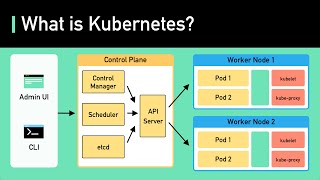
A cluster consists of a control plane (manages state) and worker nodes (run containerized applications in pods).
The control plane includes API server (interface), etcd (key-value store), scheduler (places pods), and controller manager (runs controllers like Replication Controller).
Worker nodes run kubelet (communicates with control plane), container runtime (manages containers), and kube-proxy (networking and load balancing).
Kubernetes offers scalability, high availability, self-healing, and portability but has complexity and cost drawbacks. Managed services like EKS, GKE, AKS reduce operational burden.
Kubernetes is powerful for large-scale container orchestration but comes with significant complexity and cost. For smaller organizations, simpler solutions or managed Kubernetes services are recommended.
What does Kubernetes automate?
Deployment, scaling, and management of containerized applications.
00:12
What internal system at Google led to Kubernetes?
Borg.
00:24
Why is Kubernetes abbreviated as K8s?
The number 8 represents the eight letters between K and s in 'Kubernetes'.
00:40
What are the two core parts of a Kubernetes cluster?
Control plane and worker nodes.
01:08
What is the smallest deployable unit in Kubernetes?
A pod.
01:25
Name four components of the control plane.
API server, etcd, scheduler, controller manager.
01:59
What is the role of etcd in Kubernetes?
It is a distributed key-value store that stores the cluster's persistent state.
02:12
What does the scheduler do?
Schedules pods onto worker nodes based on resource requirements and available resources.
02:24
What is the function of kubelet?
It runs on each worker node, communicates with the control plane, and ensures pods are running as desired.
03:21
What does kube-proxy do?
It routes traffic to the correct pods and provides load balancing.
03:51
List two benefits of Kubernetes.
Scalability and portability.
04:07
What is a major drawback of Kubernetes?
Complexity.
04:57
Name three managed Kubernetes services.
Amazon EKS, Google GKE, Azure AKS.
05:40
Why K8s?
The numeronym explanation is a fun, nerdy insight into the abbreviation.
00:40Trade-offs of Kubernetes
The honest discussion of pros and cons provides a balanced perspective.
04:07YAGNI Recommendation
The pragmatic advice for smaller organizations to avoid over-engineering is a key takeaway.
06:12[00:00] What is Kubernetes? Why is it called KAS? What makes it so popular?
[00:12] Let's take a look. Kubernetes is an open-source container orchestration platform. It automates the deployment, scaling, and management of containerized applications.
[00:24] Kubernetes can be traced back to Google's internal container orchestration system, Borg, which managed the deployment of thousands of applications within Google. In 2014, Google open-sourced a version of work that is Kubernetes.
[00:40] Now, why is it called K-A-S? This is a somewhat nerdy way of abbreviating long words. The number 8 in K-A-S refer to the eight letters between the first letter K and the last letter S in the word Kubernetes.
[00:54] Other examples are I18n for internationalization and L10n for localization. A Kubernetes cluster is a set of machines called nodes that are used to run containerized applications.
[01:08] There are two core pieces in a Kubernetes cluster. The first is the control plane. It is responsible for managing the state of the cluster. In production environments, the control plane usually runs on multiple nodes that span across several data center zones.
[01:25] The second is a set of worker nodes. These nodes run the containerized application workloads. The containerized applications run in a pod Pods are the smallest deployable units in Kubernetes A pod hosts one or more containers and provides shared storage and networking for those containers
[01:45] Pods are created and managed by Kubernetes control plane. They are the basic building blocks of Kubernetes applications. Now let's dive a bit deeper into the control plane. It consists of a number of core components.
[01:59] They are the API server, SCD, scheduler, and the controller manager. The API server is the primary interface between the control plane and the rest of the cluster.
[02:12] It exposes a RESTful API that allows clients to interact with the control plane and submit requests to manage the cluster. SCD is a distributed key value store.
[02:24] It stores the cluster's persistent state. It is used by the API server and other components of the control plane to store and retrieve information about the cluster. The scheduler is responsible for scheduling pods onto the worker nodes in the cluster.
[02:41] It uses information about the resources required by the pods and the available resources on the worker nodes to make placement decisions. The controller manager is responsible for running controllers that manage the state of the cluster.
[02:57] Some examples include the Replication Controller, which ensures that the desired number of replicas of a pod are running, and the Deployment Controller which manages the rolling updates and rollbacks of deployments Next let dive deeper into the worker nodes The core components of Kubernetes that run on the worker nodes include KubeNet Container Runtime and KubeProxy
[03:21] The KubeNet is a daemon that runs on each worker node. It is responsible for communicating with the control plane. It receives instruction come from the control plane about which pods to run on the node
[03:33] and ensures that the desired state of the pods is maintained. The container runtime runs the containers on the worker nodes. It is responsible for pulling the container images from a registry, starting and stopping the containers, and managing the container's resources.
[03:51] The Q-proxy is a networking proxy that runs on each worker node. It is responsible for routing traffic to the correct pods. It also provides load balancing for the pods and ensures that the traffic is distributed evenly across the pods.
[04:07] So when should we use Kubernetes? As with many things in software engineering, this is all about trade-offs. Let's look at the upsides first. Kubernetes is scalable and highly available. It provides features like self-healing,
[04:22] automatic rollbacks, and horizontal scaling. It makes it easy to scale our application up and down as needed, allowing us to respond to changes in demand quickly. Kubernetes is portable. It helps us deploy and manage applications in a consistent and reliable
[04:39] way, regardless of the underlying infrastructure. It runs on-premise, in a public cloud, or in a hybrid environment It provides a uniform way to package deploy and manage applications Now how about the downsides The number one drawback is complexity
[04:57] Kubernetes is complex to set up and operate. The upfront cost is high, especially for organizations new to container orchestration. It requires a high level of expertise and resources to set up and manage a production Kubernetes environment.
[05:14] The second drawback is cost. Kubernetes requires a certain minimum level of resources to run in order to support all the features we mentioned above. It is likely an overkill for many smaller organizations.
[05:28] One popular option that strikes a reasonable balance is to offload the management of the control plane to a managed Kubernetes service. Managed Kubernetes services are provided by cloud providers.
[05:40] Some popular ones are Amazon EKS, GKE on Google Cloud, and AKS on Azure. These services allow organizations to run Kubernetes applications without having to worry about the underlying infrastructure.
[05:55] They take care of tasks that require deep expertise, like setting up and configuring the control plane, scaling the cluster, and providing ongoing maintenance and support. This is a reasonable option for a mid-sized organization to test out Kubernetes.
[06:12] For a smaller organization, Yagni is our recommendation. If you would like to learn more about system design, check out our books and weekly newsletter. Please subscribe if you learn something new.
[06:25] Thank you so much and we'll see you next time.

⚡ Saved you 0h 06m reading this? Transcribe any YouTube video for free — no signup needed.