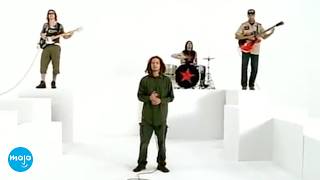

Bands That Never Changed Their Lineup
45sThe intro sets up a classic listicle format that hooks viewers with a compelling promise.
▶ Play Clip"The title promises a countdown of bands with unchanged lineups, and the video delivers exactly that, but the content is padded with repetitive commentary and a lengthy livestream promotion."
This video from WatchMojo counts down the top 10 music groups that have maintained their original lineups, highlighting bands like Coldplay, Muse, Rammstein, and Radiohead. It explores how these groups have avoided personnel changes despite fame, hiatuses, and internal tensions, emphasizing the rarity and significance of such stability in the music industry.
Coldplay, formed in 1997, has kept its founding members (Chris Martin, Johnny Buckland, Guy Berryman, Will Champion) through all albums and tours. Phil Harvey, the creative director, is considered the most important member but never performs, so the performing lineup remains unchanged.
Muse, formed in 1994, has had the same three members (Matt Bellamy, Chris Wolstenholme, Dominic Howard). Wolstenholme switched from drums to bass to accommodate Bellamy as frontman. Morgan Nichols has been a touring keyboardist since 2006 but is not an official member.
Rammstein, formed in Berlin in 1994, has never had a lineup change. The band won a contest for a recording booth, which solidified their formation. Despite controversy and hiatuses, no member has been replaced.
Phoenix, formed in 1995, kept the same core lineup (Thomas Mars, Deck d'Arcy, Christian Mazzalai, Laurent Brancowitz). They gained global fame with 'Wolfgang Amadeus Phoenix' in 2009, which won a Grammy, after over a decade together.
Yeah Yeah Yeahs, formed in 2000, has maintained a three-piece core (Karen O, Nick Zinner, Brian Chase). They started as an acoustic duo, then added Chase for a harder sound. Touring guitarist David Pajo joined live shows but was not an official member.
The Strokes, formed in 1998, have kept all five members (Julian Casablancas, Nick Valensi, Albert Hammond Jr., Nikolai Fraiture, Fabrizio Moretti). Despite breaks and tensions, they reunited for 'The New Abnormal' in 2020, considered some of their best work.
Blur, formed in 1988, had Graham Coxon leave in 2002 due to substance issues and creative differences. He was never replaced; the band paused and reunited in 2009, releasing 'The Magic Whip' in 2015 with the original quartet.
Rage Against the Machine, formed in 1991, had Zack de la Rocha quit in 2000, but he was not replaced. The band reunited in 2007 and 2022, but dissolved again in 2024. No member was ever swapped out.
U2, formed in 1976, has kept Bono, The Edge, Adam Clayton, and Larry Mullen Jr. together. In 2023, Mullen had surgery and was temporarily replaced by Bram van den Berg for a residency, but Mullen retained membership and later recorded 'Atomic City'.
Radiohead, formed in 1985, has maintained the same five members (Thom Yorke, Jonny Greenwood, Colin Greenwood, Ed O'Brien, Philip Selway). They delivered iconic albums like 'OK Computer' and 'Kid A' without lineup changes, even reuniting for a 2025 tour.
The video underscores that lineup stability is a rare and valuable trait in the music industry, often contributing to a band's cohesion and creative evolution. It highlights that even through breakups and hiatuses, these groups chose to reunite rather than replace members, preserving their original identity.
Which band formed in 1997 and has kept its founding quartet intact?
Coldplay
00:23
Who is the creative director of Coldplay who never performs on stage?
Phil Harvey
00:55
What instrument did Chris Wolstenholme originally play before joining Muse?
Drums
01:40
Which band won a contest for a professional recording booth, leading to their formation?
Rammstein
03:01
What was the name of the album that gave Phoenix their global breakthrough in 2009?
Wolfgang Amadeus Phoenix
04:12
Which band started as an acoustic duo called Unitarz?
Yeah Yeah Yeahs
05:08
Which band's debut album was 'Is This It?'?
The Strokes
06:18
Who left Blur in 2002 but was never replaced?
Graham Coxon
07:29
Which band dissolved for the third time in 2024?
Rage Against the Machine
08:42
Who temporarily replaced Larry Mullen Jr. during U2's Las Vegas residency?
Bram van den Berg
09:38
Which band formed at Abingdon School in 1985?
Radiohead
10:17
Coldplay's Intact Quartet
Highlights how a band can achieve massive success without changing its core lineup, emphasizing the importance of internal chemistry.
00:23Muse's Unchanged Trio
Shows how a band can adapt roles (Wolstenholme switching instruments) to maintain lineup stability.
01:26Rammstein's Consistent Lineup
Demonstrates that even in a volatile genre like industrial metal, lineup consistency is possible.
02:31Blur's Restoration
Illustrates that a band can pause and reunite with the original lineup, rather than replacing members.
07:06Radiohead's Near-Perfect Stability
Shows that a band can reinvent its sound multiple times while keeping the same members, a rare feat.
10:17[00:00] Welcome to WatchMojo, and today we're counting down our picks of the top 10 music groups who essentially didn't change their primary lineups in formation or even amid breakup.
[00:23] Number 10, Coldplay. Since forming in 1997, Coldplay stands among the few major acts of the streaming era to keep their founding quartet intact.
[00:40] Chris Martin, Johnny Buckland, Guy Berryman, and Will Champion have released every studio album and undertaken every world tour together. Their trajectory, from parachutes to music of the spheres, is one of the most dramatic evolutions in modern rock,
[00:55] achieved without a single personnel disruption. The fifth name in the room is Phil Harvey, who helped to manage the band, and is officially credited as the band's creative director.
[01:08] Though Martin has called Harvey the most important member of Coldplay, he never performs on stage. This is precisely why the performing team has remained untouched. There was never a vacancy to Phil. Number 9. Muse.
[01:26] Three cool friends, Matt Bellamy, Chris Wolstenholme, and Dominic Howard formed Muse and have been the sole official lineup since 1994. You can start a music, it's a special.
[01:40] Their origin story is more unusual than most. Wolstenholme originally played drums for another group, not bass. When Bellamy joined Howard's group, they asked Wolstenholme to join, but on bass so Bellamy could front the band as singer and guitarist.
[01:54] He agreed, took lessons, and they've been the same three people ever since. Over nearly three decades, they turned that chemistry into one of the most ambitious rock careers of the 21st century.
[02:11] Since 2006, keyboardist Morgan Nicholas has augmented live performances, but only as a touring member. What do we expect from a band that started as a teenage friendship? Music exemplifies rare steadfastness in modern rock.
[02:31] Number 8, Rammstein. In the volatile realm of industrial metal, Rammstein's consistency is exceptional. Since merging in Berlin in 1994,
[02:47] Kir Lindemann Richard Krupa Paul Landers Oliver Riddell Christoph Schneider and Christian Lorenz have operated without a single substitution The band had been loosely working together but began in earnest under specific circumstances
[03:01] A contest offered the winner access to a professional recording booth. Krupa, Schneider, Riddell, and Linda Mon entered, won, and the chorus set. Landers and Lorenz joined shortly after, completing the lineup that has never changed.
[03:21] Their pyrotechnic spectacle and confrontational lyricism have courted controversy across continents, but through all of it, hiatuses, scrutiny, and intense touring schedules, not one member was replaced or removed.
[03:33] It's almost impossible to believe Ramstein could pull it off. Number 7. Phoenix
[03:45] Some bands evolved through members. Phoenix charted a different course. In French indie pop, they maintained steadfast unity from the outset.
[03:59] Puma Mars, Dex Darcy, Krishnamazalai, and Loha Brankovic had formed the core line-up since 1995. The group were patient in development, but about five years of releases before anyone outside France really noticed.
[04:12] Their real global breakthrough came in 2009, following the drop of Wolfgang Amadeus Phoenix. The album won the Grammy for Best Alternative Music Album in January 2010.
[04:26] By then, the four had already logged over a decade together without changing a single seat. That shared history is audible in the music's cohesion. Four people who stay together, making one of indie pop's most refined sounds? How fitting.
[04:44] Number six, Yeah Yeah Yeahs. With three members, Yeah Yeah Yeahs built their art punk identity on deliberate minimalism.
[04:56] Since forming in New York in 2000, 2000, Karen O, Nick Zinner, and Brian Chase have maintained an unaltered three-piece core. The band began as an acoustic duo, Karen O and Zinner, under the name Unitarz.
[05:08] Then, they shifted to a harder, trashy sound, and added Chase on drums. Their chemistry fueled visceral releases, like Fever to Tell and It's Blitz. They survived extended hiatuses, and individual side projects without dilution.
[05:21] A touring guitarist, David Paho, joined live performances from 2009, but as with muses Morgan
[05:33] Nichols, he wasn't an official member. By resisting expansion the band preserved the raw immediacy that makes a Yeah Yeah Yeah record instantly identifiable identifiable Number 5 The Strokes
[05:52] When the Strokes captured the early 2000s rock revival, they did so with an intact foundation. Julian Casablanca, Nick Valenzi, Albert Hammond Jr.,
[06:05] Nikolai Freicher, and Fabrizio Moretti have comprised the lineup since 1998. Three of them, Casablanca's Valencia Amoretti, began playing together as teenagers, before Frazier and Hammond Jr. completed the quintet.
[06:18] Their debut, Is This It?, landed like a flare in a dormant rock scene, and all five were named on the cover.
[06:30] The remarkable part is what came after fame. Early success is precisely when bands fracture, yet the stroking during a decade of breaks and openly discuss tensions without a single departure. All five return for The New Abnormal in 2020, widely regarded as some of their best work.
[06:46] You're welcome to, if you want me to, if you want me to do, thank you. Number 4, Blur. From the outside, they don't look perfectly stable, but look closely. Blur's story reflects steadiness through restoration,
[07:06] him, rather than unbroken continuity. Damon Albarn, Graham Coxon, Alex Jane, and Dave Roundtree formed the band in 1988. In 2002, Coxon, battling with substance use disorder and deepening creative risk with Albarn, effectively left the group. For a while, it looked permanent.
[07:29] It was later then disbanded after the Think Tank tour in 2003, but Coxon was never replaced. Blur simply took a pause and the door stayed open. In December 2008, Albarn confirmed Cox in the sack. The full original quartet reunited in 2009 for a headlining Glastonbury slot
[07:45] and went on to release The Magic Whip in 2015. Blur chose The Harder Road and came back intact.
[07:57] Number 3, Rage Against the Machine. With an unusually complicated history, Rage Against the Machine demonstrates the ideological intensity and line of consistency can coexist.
[08:12] Zach Della Rocha, Tom Morello, Tim Cumberford, and Brad Wilk formed the band in Los Angeles in 1991. In 2000, after growing creative differences, Zach quit. The remaining three went on to form audio plays with Chris Cornell.
[08:25] He didn't replace Zach. When he was ready to return the Ming Corps reconnected at Coachella in 2007 as if nothing ever happened They disbanded a second time in 2011 and reunited again in 2022
[08:42] In January 2024, Will confirmed via Instagram that the band had dissolved for the third and presumably final time. Through three breakups and one member quitting, no one was ever swapped out.
[08:56] Number 2, U2. Few bands achieve U2's scale while preserving their original configuration.
[09:09] Bono, The Edge, Adam Clayton, and Larry Mullen Jr. have operated as a quartet since September 25, 1976. From The Joshua Tree selling over 20 million copies to Ashton Baby redefining rock music,
[09:21] the four Dubliners have maintained their central identity through every transformation. In 2023, Mullen underwent neck surgery and was unable to play the band's landmark Las Vegas beer residency.
[09:38] Dutch drummer, Graham Vonderberg, filled the live seat, but Mullen retained full membership. It was the first time U2 had played with Adam since 1978. He later continued recording and played on the single Atomic City that same year.
[09:50] Through the fame and pressure, U2 remained intact. Before we continue, be sure to check out WatchMojo's 24-hour livestream.
[10:02] All of your favorite videos in one place, 24-7. Always on, always live. Please don't entertain! Number one, Radiohead. Tom York, Johnny Greenwood, Colin Greenwood, Ed O'Brien, and Philip Selway
[10:17] met at Abingdon School in Oxfordshire and formed a band in 1985. They renamed themselves Radiohead in late 1991 upon signing with EMI.
[10:33] From then, they have redefined alternative music multiple times while maintaining near-perfect lineup stability. The same five people delivered OK Computer, Kid A, and In Rainbows. The three albums were routinely placed among the greatest ever made across three entirely different soundscapes.
[10:55] When the band went on hiatus in 2018, O'Brien focused primarily on solo work, but no replacement was ever introduced, and the band remains officially complete, even reuniting for a 2025 tour. Wondering how they kept their lineup while consistently reinventing their sound?
[11:09] Well, you are not alone. Which other bands still have their original lineup?
[11:21] Let us know in the comments section. Thank you.



⚡ Saved you 0h 11m reading this? Transcribe any YouTube video for free — no signup needed.