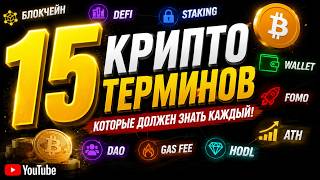

Crypto Terms Sound Like Harry Potter Spells?
44sRelatable humor about confusing crypto jargon hooks beginners and invites clicks.
▶ Play Clip"Delivers on the promise of explaining 15 key crypto terms for beginners, though some explanations are brief and the video includes filler content."
This video explains 15 essential cryptocurrency terms for beginners, covering blockchain, cryptocurrency, Bitcoin, altcoins, Ethereum, smart contracts, DeFi, tokens, NFTs, wallets, exchanges, mining, Proof of Work, Proof of Stake, and HODLing. The host aims to demystify crypto jargon and provide a foundational understanding of the crypto ecosystem.
A decentralized, tamper-resistant digital ledger where data is stored in blocks linked by cryptographic hashes. Each block contains a hash of the previous block, ensuring integrity. Copies are held by all network participants, making it resistant to censorship and fraud.
Digital money created using blockchain technology. It is decentralized, not issued by governments or banks, and allows peer-to-peer transfers without intermediaries. Transactions are pseudonymous and recorded on the blockchain.
The first cryptocurrency, launched in 2009 by pseudonymous Satoshi Nakamoto. It has a capped supply of 21 million coins, is often called 'digital gold,' and is used for payments, trading, and as a store of value.
All cryptocurrencies other than Bitcoin. They offer alternative features like higher speed, privacy, or smart contracts. Many are speculative, but some have real utility.
The second-largest cryptocurrency, launched in 2015 by Vitalik Buterin. It is a platform for decentralized applications (dApps) and smart contracts, supporting NFTs, DeFi, and DAOs.
A self-executing program stored on the blockchain that automatically enforces agreements when conditions are met. No intermediaries are needed, and the code is immutable.
An ecosystem of financial services on blockchain using smart contracts, replacing traditional intermediaries like banks. Includes decentralized exchanges (DEXs), lending, borrowing, and yield farming. Open and transparent but carries risks like bugs and scams.
A digital asset issued on an existing blockchain (e.g., Ethereum) via smart contracts. Tokens can represent currency, voting rights, shares, or unique items (NFTs). Two main types: fungible (identical) and non-fungible (unique).
A unique digital token proving ownership of a specific digital item (art, music, game item). Created via smart contracts, each NFT has a distinct ID and metadata. Cannot be exchanged one-to-one like fungible tokens.
An app or device that stores private keys to access and manage cryptocurrencies on the blockchain. Public address is shared for receiving funds; private key/seed phrase is secret. Types: hot (online) and cold (offline, e.g., hardware wallets).
A platform for buying, selling, and trading cryptocurrencies. Centralized exchanges (CEXs) like Binance act as intermediaries; decentralized exchanges (DEXs) like Uniswap use smart contracts for peer-to-peer trading.
Process of creating new blocks and confirming transactions by solving complex computational problems. Miners compete to find a valid hash; the first to succeed gets a reward. Requires specialized hardware (GPUs, ASICs) and high energy consumption.
Consensus mechanism where miners solve cryptographic puzzles to add blocks. Secure but energy-intensive. Used by Bitcoin.
Consensus mechanism where validators are chosen to create blocks based on the amount of cryptocurrency they stake. Energy-efficient, faster, and more accessible than PoW. Used by Ethereum after its transition.
A long-term investment strategy where investors buy and hold cryptocurrency despite price volatility, based on the belief that value will increase over time. Originated from a typo in a 2013 Bitcoin forum post.
Understanding these 15 terms provides a solid foundation for navigating the cryptocurrency space, from blockchain basics to investment strategies like HODLing. The video encourages further learning and cautions about risks in DeFi and the importance of securing private keys.
What is blockchain?
A decentralized, tamper-resistant digital ledger where data is stored in blocks linked by cryptographic hashes.
01:04
What is cryptocurrency?
Digital money created using blockchain technology, decentralized and not controlled by governments or banks.
02:34
Who created Bitcoin?
Satoshi Nakamoto, a pseudonym for a person or group.
03:47
What is the maximum supply of Bitcoin?
21 million coins.
04:15
What are altcoins?
All cryptocurrencies except Bitcoin, offering alternative features or improvements.
04:58
What is Ethereum?
A decentralized platform for creating applications and smart contracts, second-largest cryptocurrency.
05:43
What is a smart contract?
A self-executing program stored on the blockchain that automatically enforces agreements when conditions are met.
06:44
What does DeFi stand for?
Decentralized Finance, an ecosystem of financial services on blockchain using smart contracts.
07:25
What is the difference between fungible and non-fungible tokens?
Fungible tokens are identical and interchangeable (e.g., USDT); non-fungible tokens (NFTs) are unique with distinct IDs.
09:54
What is a cryptocurrency wallet?
An app or device that stores private keys to access and manage cryptocurrencies on the blockchain.
11:03
What is the difference between hot and cold wallets?
Hot wallets are online (e.g., Metamask); cold wallets are offline (e.g., Ledger hardware wallet).
12:03
What is mining?
The process of creating new blocks and confirming transactions by solving complex computational problems.
14:01
What is Proof of Work?
A consensus mechanism where miners compete to solve cryptographic puzzles to add blocks, used by Bitcoin.
15:39
What is Proof of Stake?
A consensus mechanism where validators are chosen based on the amount of cryptocurrency they stake, used by Ethereum.
16:48
What does HODL mean?
A long-term investment strategy of holding cryptocurrency despite price volatility, originating from a typo.
18:02
Blockchain Explained
Clear analogy of blockchain as a journal of records linked by hashes, emphasizing immutability and decentralization.
01:04Bitcoin's Origin
Highlights the mystery of Satoshi Nakamoto and Bitcoin's capped supply as key to its value.
03:47Smart Contract Automation
Illustrates how smart contracts eliminate intermediaries by automatically executing conditions.
06:44DeFi vs Traditional Finance
Contrasts DeFi's open, code-based system with traditional intermediaries, noting risks like bugs and lack of support.
07:25HODL Philosophy
Explains the origin and strategy of HODLing as a meme and investment approach.
18:02[00:05] Invest channel. In today's video, I'll be going over crypto lexicon. The good thing about this video is that you can watch it or set it as a background if you're busy with something else, for example. If you're finding that many words
[00:19] in the cryptocurrency world sound like Harry Potter spells, you definitely need to watch this video at least once. In this video, we'll break down 15 of the most important terms that any
[00:34] street urchin should know, especially newbies who don't even know how cryptocurrency works. And in the next videos I will analyze the following concepts. Thank God, we have about a hundred of them. Well then, let's get started already.
[00:49] Just don't forget to like the video and subscribe to the channel. This can be done right now. If you did, thank you.
[01:04] Blockchain is a technology for storing and transmitting data that is structured as a chain of blocks. Each block contains certain information, such as a list of transactions. and is linked to previous blocks using a
[01:17] cryptographic hash. This is what it looks like . The block chain is a journal where records are entered not by one page, but by entire blocks of records. Each new block contains a link, called a hash, to the previous one. So
[01:33] if someone tries to change an old block, the chain will be broken. All records in the blockchain are protected by cryptography, and copies of the chain are stored simultaneously by many network participants. This makes the blockchain resistant to counterfeiting and
[01:49] censorship. Another advantage of blockchain is that it has no central server or database owner, because every participant in the network stores a complete copy of the blockchain and can verify its correctness. And once a block is added to the
[02:04] chain, it will be extremely difficult to change it . And this gives a high degree of confidence in the data. Blockchain is used in the same cryptocurrency as Bitcoin, Ethereum and others. For example, if you want to transfer cryptocurrency to a friend
[02:20] , this operation will be recorded in a block, which is added to the chain and becomes part of the overall blockchain history. This information can no longer be faked; it will remain online forever. Let's move
[02:34] online forever. Let's move on. Cryptocurrency. Cryptocurrency is a digital form of money created using blockchain technology. It does not have and cannot have a physical medium. These are not coins or pieces of paper, but
[02:49] simply lines of code. As critics say, it's just zeros and ones in a computer. The main difference of conventional money is its decentralization. Cryptocurrency is not issued by governments and is not controlled by banks. The main
[03:04] feature of cryptocurrency is the ability to transfer it to anyone, anywhere in the world, without any intermediaries. It turns out that crypto is inherently anonymous, but this is n't just for the good and righteous, as
[03:19] you can imagine. And the issue of anonymity is also debatable, because some intelligence agencies might still try to track you. Well, if you're some kind of Vasya Pupkin from the village, then you can safely pay for whatever you buy there with cryptocurrency
[03:35] . Nobody will look for you . Next on the list is the famous and unique Bitcoin. Bitcoin is the first and most famous cryptocurrency, which
[03:47] appeared back in 2009. It seemed to be a response to the financial crisis and distrust of traditional banks. It was created by Satoshi Nakomota. It is a pseudonym for a person or group of people about whom nothing is known. There is even a popular
[04:03] opinion that it was created by the same intelligence agencies or the same banks or investment funds. Well, let's not build funds. Well, let's not build conspiracy theories. In general, this Sasha
[04:15] created a decentralized system where every participant is equal and there is no single manager. One of the main features of Bitcoin is that it has a limited number of coins, only 21 million pieces. And, as we know,
[04:30] everything that is limited has value, which is why it is often called digital gold. It has never been hacked and is used all over the world. He buys real estate, he buys cars, and you can even buy beer at the supermarket with it
[04:46] . It is also frequently traded by traders and stored in investors' wallets, because this coin has been constantly growing since its launch.
[04:58] Next come altcoins. Altcoins, in simple terms, are all cryptocurrencies except Bitcoin. Altcoins are simply created as an alternative with improved features or completely different purposes than Bitcoin. That is, altcoins are a
[05:14] whole class of different projects that compete with Bitcoin or simply expand on its ideas. I offer my users new features, higher speed, privacy, smart contracts, and much more.
[05:28] Eltcoins can also represent an entire ecosystem where one can, for example, issue tokens, launch applications, and much more. The main thing you need to understand is that there are thousands of altcoins. Most of them are, of course, useful in some way
[05:43] , but the majority are created purely for speculative purposes. Just to line the creator's pockets. Next on the list is Ethereum. Ethereum is the second-largest cryptocurrency in the world, but unlike Bitcoin, it is not
[05:58] just a means of payment, but a fully-fledged decentralized platform for creating applications and running smart contracts. For example, you could create a token or launch a decentralized exchange. or make an
[06:12] NFT. It's all based on EFIUM. It also supports programmable contracts, smart contracts, and is a base for NFTs, DFIs, DAOs, and other technologies. In general, Ethereum is a center of innovation in the world of cryptocurrency.
[06:28] Incidentally, an interesting fact is that Ethereum was launched in 2015 by nineteen-year-old Vitalik Buterin, who is originally from Russia. Well, I said this just to make you feel ashamed to still be sitting on the couch with a beer. Let's move on
[06:44] . Smart contract. A smart contract is a program that is stored and executed directly on the blockchain. If, for example, a regular contract is a piece of paper with conditions that people must fulfill, then a
[06:57] smart contract is code that automatically fulfills the prescribed conditions as soon as they occur. For example, you create a smart contract on the Ethereum network that says: "If user Artem transfers one
[07:11] Ethereum, then user Boris will automatically receive the project's tokens." As soon as Artem sends the ether, the code checks the conditions and immediately executes the actions, transferring the tokens to Boris. As you understand, intermediaries are not
[07:25] needed here. No one can change your mind, change the rules or simply cheat. This is because the code and its state are stored in the aforementioned blockchain. Our next term is the famous DeFI. DeFI is an entire ecosystem of
[07:41] financial services that operate not through banks or other intermediaries, but on the blockchain using smart contracts. While our traditional financial systems are banks, brokers, and payment systems, in DeFI, their role is taken over by code. It has
[07:57] pre-defined rules and operations are carried out automatically on the network. Most often, this is, of course, on Ethereum or other smart contract blockchains. DeFi also allows you to exchange cryptocurrencies directly through
[08:12] decentralized exchanges. They are also called Dex, for example, the UNISWAB exchange. You can also borrow and lend without a bank, earn interest like you would at a bank by providing liquidity, stake, farm, and use many other functions
[08:25] stake, farm, and use many other functions and terms you may not understand. Define's main features are openness, transparency, and the absence of censorship. Anyone with internet access and a crypto wallet can use the services, and the data and code are accessible to
[08:39] everyone. But there are also risks, such as bugs in smart contracts and various fraudulent schemes. volatility, as well as user errors. After all, there is no support service if something goes
[08:52] wrong. While, for example, on the BYBIT exchange, everyone knows everything about you—who you are, where you are, and can still help you in some way , in DeFi you're just symbols, nothing more. There is no support. Let's move on. And
[09:09] our next concept is token. A token is a digital asset that is issued on an existing blockchain, such as Ethereum, BNB Chain, Sana, and others. And this is done using the same smart contract. Tokens do not have
[09:25] their own network, like Bitcoin or Ethereum. They live within the platform and obey only its rules. Simply put, a blockchain is like an operating system, and a token is the software inside it. A token can be used to
[09:40] represent anything: the project's internal currency, voting rights, shares, discounts, and unique items like NFTs. Therefore, there are two main types of tokens: Fungible Tokens and NFTs. Fungible tokens are fungible. They are all
[09:54] the same, like coins. For example, USDT or your favorite Shiba Inu. NFT tokens are not interchangeable; they are unique, and each has its own ID. These could be
[10:06] paintings, game items or tickets. Now let's take a closer look at the concept of NFT. NFT, as I already said, is a non-fungible token, each of which is different from the other. It proves ownership of a
[10:20] digital object, such as a picture, song, video, game item, or ticket. While regular tokens and cryptocurrencies are fungible— say, one Shibainu token is equivalent to another Shibau token—an
[10:35] NFT is unique in this regard, as each has its own ID and metadata. Such a token cannot be simply replaced with another, like identical coins. A technical NFT is created using a smart contract on the blockchain. Most often, of course, Ethereum. It
[10:51] also stores information about the owner and a link to the file. The file itself the owner and a link to the file. The file itself can be stored in IPFS or another storage, and the NFT serves as proof of ownership. Basically, an NFT is like a
[11:03] movie ticket with a specific row and seat, and no one else can have that ticket. Next comes the cryptocurrency wallet. A cryptocurrency wallet is an application or device in the form of a memory card that allows you to
[11:18] store and manage your cryptocurrencies. and tokens. It does not store coins physically, like paper, but simply provides access to them through private keys. that show that you are the owner of the funds at a
[11:33] specific address on the blockchain. It works like this . Each wallet has a public address. It can be shown to others to receive funds. There is also a private key or sit-phrase, which consists of several words. This is the secret that
[11:48] gives access to coins. It is strictly forbidden to show it. The coins themselves, as I said, are not stored in the wallet, they are stored in the blockchain, and the wallet simply manages the keys and transactions. There are two
[12:03] types of wallets: hot and cold. Hot online wallets are mobile or web applications, such as Metamask, Trust Wallet, and others. They are convenient and can be downloaded, but they depend on the Internet. And there are cold offline wallets. It is a
[12:19] hardware device like Ledger or Tesr, similar to a memory card. There may even be paper wallets. Yes, it will just be letters and symbols on some piece of paper. They're also very convenient for long-term storage of cryptocurrency, but
[12:33] only if your mom doesn't throw the paper in the trash . Therefore, there is a main rule: do not lose your private key or, even worse, your SIT phrase. Without them, it is impossible to restore access to the cryptocurrency. Let me repeat, there is no support service in the blockchain. there is
[12:49] nowhere to write. The next concept is the exchange. An exchange is an organized platform that brings together buyers and sellers and exchange assets. In the case of cryptocurrencies, the exchange allows you
[13:04] to register an account, deposit fiat money or crypto assets, and use them for trading. You can exchange cryptocurrency, buy and sell coins , trade with leverage, enter into futures and options
[13:18] contracts, use staking, and much more. It is also important to note that there are two types of exchanges. The first is a centralized exchange, such as Bhaance or Bybit, where all transactions take place through an intermediary company
[13:31] that stores user funds and manages orders. Such an exchange has a director and staff, while there are decentralized exchanges, such as Uniswap or Pancake Swap, where transactions occur directly between users
[13:47] through smart contracts, and the management and storage of funds remains with the wallet owners. Such an exchange has neither a director nor employees. Thus, in the crypto world, an exchange is a digital marketplace that not only brings together
[14:01] buyers and sellers but also provides tools for more complex trading and earning. Let's move on. Mining. Mining is the process by which new blocks are created in the blockchain and transactions are confirmed
[14:16] . You can think of it as a big lottery. Millions of computers around the world perform many identical calculations trying to find the correct hash number. which complies with the network rules. The one who finds the
[14:29] desired result first wins and receives a reward. This is a pre-set amount of new coins plus a mission for transactions. To participate in mining, you need special equipment. Often these are farms made of
[14:41] video cards. It is the video cards that perform the calculations. There is also special equipment such as ASICs. They are a little more powerful than video cards. And with the help of such devices, calculations are carried out around the clock. Well, it’s logical that
[14:57] the more powerful your farm, the greater your chances of earning. But you might ask: "What about that person with just one video card? Will he mine for months and still not get anything? Absolutely right. But a
[15:11] solution was found for this, such as a mining pool, where all the miners in the world receive a profit proportional to the power invested. This made it possible for even made it possible for even miners with just one video card to earn money. But
[15:25] mining has its downsides. Firstly, the price of video cards worldwide skyrocketed with the start of mining. Plus, it's extra noise if the farm is in your apartment. It also creates extra heat and, most importantly, high electricity consumption. Now there are a
[15:39] lot of miners, even entire data centers have appeared, which means the profit from all this is not as great as before. Our next spell is Proof of Work. Proof of Work is a way to secure
[15:54] and operate a blockchain, in which new blocks are added by those network participants who are the first to complete a complex computing task. Miners try millions of combinations to find the correct block hash.
[16:07] This process, as I said Previously, it required a lot of effort, so forging or rewriting a blockchain becomes extremely expensive. It works like this. Miners take the block data and select a number of nonces so that the block hash is below a
[16:21] specified threshold. It's similar to searching for a key using brute force. The more power, the higher the chance of finding the correct hash. The first to find the solution gets the right to mine the block and takes the reward in the form of new coins and
[16:35] fees. This mechanism makes the network decentralized and resistant to attacks, and also controls the issuance of new coins. But, as I said, it requires significant energy consumption and powerful equipment.
[16:48] The next similar spell is called Proof of Stake. Proof of stake is a blockchain operating mechanism that has become an alternative to the energy-intensive Proof of Work. In it, new blocks are created not using computing power, but through
[17:04] staking, freezing one's cryptocurrency. It works like this. Network participants block a certain number of coins, and the system randomly, but taking into account the size of the time and the stake, chooses A validator who
[17:18] mines the next block. The more coins a validator stakes, the higher their chance of being selected. They receive a reward for honest work, and if they try to cheat the network, they lose part of their stake. This approach is advantageous
[17:33] because it requires almost no electricity, allows for faster and cheaper operation, and makes participation accessible to a large number of users without the need for expensive equipment. Blockchains such
[17:47] as Ethereum after the transition, as well as Cardana, Selana, and Polcat, operate on Proof of Stake today. In general, proof of stake is more economical than proof of work or proof of work, but it also has some downsides, as large coin holders are constantly increasing their
[18:02] influence. Plus, network security is more difficult to verify, and at launch, control may end up in the hands of a small circle of people. And finally, for today, there's holding. Holding is a strategy in which an investor buys cryptocurrency and
[18:18] holds it for a long time without selling, even if the price falls or fluctuates significantly. Buy and forget. The idea is that in the long term, the price may rise, so Constant exchange rate fluctuations shouldn't scare you. This approach is the opposite of
[18:34] active trading. Instead of multiple trades, you simply buy and hold for several months or even several years. The word "hod" appeared as a typo of the word "hold" on a Bitcoin forum in 2013 and became a meme, even an
[18:50] entire philosophy, that says, "Don't panic and don't sell during an attack." Thanks for sticking it out until the end. And how you liked this video and whether I should go over the next terms. Or
[19:05] say you're just an investor doing some nonsense, and no one needs it, because the next terms will be less popular, but it's still important to know. Also, please support the video with a like and subscribe
[19:21] to the channel so you don't miss the next video. There are links to crypto exchanges in the description below the video . By following and registering through my links, you are guaranteed to receive discounts on trading fees and guaranteed
[19:34] guaranteed registration bonuses. Once again Thanks everyone for watching. Happy trading everyone. Bye everyone . . [music]
⚡ Saved you 0h 19m reading this? Transcribe any YouTube video for free — no signup needed.