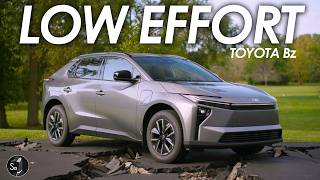

Toyota's $30K EV is a Compliance Car
45sThe shocking claim that Toyota's EV is a compliance car and a total disappointment will provoke strong reactions and debates in the comments.
▶ Play Clip"The title promises a review of the bZ4X, and the video delivers that, but it's padded with lengthy banter and repetitive points, making it feel longer than necessary."
The video is a critical review of the 2026 Toyota bZ4X, focusing on its improvements over the previous model while questioning its overall competitiveness and value. The hosts discuss its efficiency, pricing, driving dynamics, and the strategic reasons behind its existence, ultimately concluding it remains a lackluster offering in the EV market.
The hosts introduce the video, noting that Toyota has made significant improvements to the bZ4X, but it still trails the competition. They plan to test drive it and discuss whether it's worth buying.
The previous bZ4X was described as 'horrifically bad' and won 'worst car of the year' from the hosts. They emphasize that no one could recommend it in good conscience.
Toyota listened to feedback and made improvements across the board. The hosts note that this is the car that should have been released initially, but it's still not perfect.
The car achieves over 5 miles per kilowatt-hour, which is impressive. The battery size has been increased to around 70-74 kWh, but it's still considered small. There are different trims: a front-wheel drive 'NERF' version with a 50 kWh battery and 160 horsepower, and a more powerful front-wheel drive plus version.
The car now has a heat pump, pre-conditioning (manual or automatic), and an 11 kW home charger (up from 7 kW). These updates bring it up to industry standards, but the hosts note this is what should have been available five years ago.
The 2026 front-wheel drive plus model is around $40,000. The base front-wheel drive is about $36,000, and the all-wheel drive is about $45,000. However, lease deals can bring the price down to the low-to-mid $30s for the tested model, and even lower for the base version.
At $30,000, the car might be considered, but the hosts worry about depreciation. They predict it will be worth around $15,000 in three years due to lack of desirability and prestige. They compare it to a 'rent-a-center' car that should be offered at a very low monthly rate.
The hosts label the bZ4X as a 'compliance machine' built to meet emissions regulations, not to be a compelling product. They contrast this with Tesla, which has brand baggage, while Toyota has damaged the EV market by releasing a poor product.
The car has significant handling problems. It steers unexpectedly, has poor lateral stability, and the stability control is overly intrusive to compensate. The understeer is described as 'horrendous.'
The car is comfortable on straight roads but suffers from 'head toss' and 'head bob,' and there's a low-frequency boom in the cabin. The only thing it does well is go straight on a perfect road.
The hosts compare the bZ4X to the Tesla Model 3 and Hyundai Ioniq 5, both of which are better cars. They suggest that the only reason to choose the bZ4X is if the lease is extremely cheap (e.g., $140/month) and you only drive in the city at low speeds.
The car could become an interesting option in a few years when it hits the low $20,000s on the used market, especially with its efficiency and home charging capability. But at current prices, it's not worth the risk.
The hosts discuss that most Toyota EVs are purchased, not leased, which is unusual for the brand. They wonder if the bZ4X's poor depreciation will change this trend.
The hosts express disappointment that Toyota, known for innovation, would release such a lackluster EV. They suggest the money would be better spent improving existing models like the Corolla.
The car exists primarily to lower Toyota's corporate average fuel economy (CAFE) average. Toyota is planning for future emissions regulations, unlike some American brands, and this car helps them meet those goals globally.
The hosts ask whether brands should reduce their model lineup and focus on making existing cars great, rather than releasing marginal products like the bZ4X.
The hosts see the bZ4X as a 'tax write-off' for Toyota, but it's also brand devaluation. They question whether the cost of developing this car with Subaru is worth the benefit of lowering emissions averages.
The car is 'heartless' and 'soulless.' It's quiet and efficient, thanks to high rolling resistance tires, but that's about it. The only compelling argument is buying it used when its value has flatlined. The hosts advise brands to 'do it right' if they enter a segment.
The 2026 Toyota bZ4X is a significant improvement over its predecessor, but it remains a compliance-focused vehicle that lacks the driving dynamics, desirability, and value to compete with rivals. It's only worth considering at deeply discounted lease prices or on the used market after significant depreciation.
What was the previous Toyota bZ4X described as by the hosts?
Horrifically bad and the worst car of the year.
00:46
What is the efficiency of the 2026 bZ4X in miles per kilowatt-hour?
Over 5 miles per kilowatt-hour.
01:41
What is the battery size of the 2026 bZ4X?
Around 70-74 kWh.
01:59
What is the price range for the 2026 bZ4X trims?
Base front-wheel drive is around $36,000, front-wheel drive plus is around $40,000, and all-wheel drive is about $45,000.
02:53
What is the main reason the bZ4X exists according to the hosts?
To lower Toyota's corporate average fuel economy (CAFE) average and meet emissions regulations.
09:35
What are the two main positives of the 2026 bZ4X?
It's quiet and efficient, thanks to high rolling resistance tires.
12:30
What is the predicted depreciation of the bZ4X after three years?
It will be worth around $15,000, down from $30,000.
03:40
What charging improvements were made to the 2026 bZ4X?
It now has a heat pump, pre-conditioning, and an 11 kW home charger (up from 7 kW).
02:25
Impressive Efficiency
The car achieves over 5 miles per kWh, which is a key selling point and a significant improvement.
01:41Depreciation Warning
The hosts predict the car will lose half its value in three years, a crucial consideration for buyers.
03:40Compliance Vehicle Label
The hosts argue the car exists solely to meet emissions regulations, not to be a compelling product.
04:23Poor Driving Dynamics
The car's handling is described as 'horrendous,' with intrusive stability control, which is a major drawback.
05:03Corporate Strategy Insight
The explanation of why Toyota releases such a car provides valuable context for understanding automaker behavior.
09:35[00:00] What do you do when your car is ****? You take a couple letters off the name, change it a bit,
[00:15] give it a bigger screen, tougher looks. You got a winner on your hands, right? Not exactly. Well, they made some pretty significant improvements to this car to keep it up to date. Still trailing behind this competition, but there's a reason why. We're going to take this for a drive. We're going
[00:29] talk about the updates to the Toyota BZ and why you may or may not want to buy one of these or just forget about it altogether.
[00:46] Derek, you've been treating me with BMWs, Porsches, Ferraris. Now it's time for you to get the real treat. I'm playing you in this video, Mark. I know nothing about this thing.
[00:58] The last time I drove a BZ4X, it was horrifically bad. This won our worst car of the year. Yes, it did. The previous BZ4X, it was abysmal.
[01:11] In no good conscience could you recommend anybody buy that car unless they were transplanted aliens from another planet and you threw them and they're like, here's a car. That's it. It's a car. So Toyota listened, to be fair, and they made improvements across the board on this thing.
[01:29] This is kind of the car that should have been released before when they just shit out the other one. So it's not bad. Well, let's talk about that, Jack, because the improvements they made are the real things that you wanted.
[01:41] So it seems like a good efficiency, 4.2. It was over 5. I've had it whittling for like an hour or two. Oh, that's very impressive. It's been over 5 the whole time. So that's five miles per kilowatt hour. And it's showing a 69% range, or 170, sorry, 69% full capacity, and then 173 miles per
[01:59] kilowatt-hour. So they've bumped up the battery size to around like 70, 74 kilowatt-hour. So it's still a small battery. Small battery, but you can get the NERF one, the front wheel. This is front wheel drive plus. So this gets the bigger battery, more power.
[02:13] But there's an even more NERF one that has like a 50 kilowatt battery, front wheel drive only. and that car makes like 160 horsepower. It's the value model, which this is where I'm going to hit you.
[02:25] This is going to be the fundamental question about this car. They've improved charging. It now has heat pump. It has a heat pump. It has pre-conditioning that you can manually do or automatically do. It has an 11 kilowatt charger at home.
[02:39] It's only limited to seven, so you couldn't even use the home charger to charge it fast. So now it's at 11 or up to date with the industry. So this is the car that you released five years ago? Yeah, 100%. So as it stands right now, the 2026 model year,
[02:53] this front-wheel drive plus car is around $40,000, right at $40,000 all in. You can get the Nerf front-wheel drive one for around like $36,000, and then if you go to the all-wheel drive one, it's about $45,000.
[03:06] What are the lease rates? Well, here's the special part about this. You can get a 26 with like 2,000 miles on it for the low 30s because the dealerships just they probably use them as their service alone They 20 pieces of the same deal Yes yes You can get it for the mid to low 30s this exact car that we in and even an all drive version for the upper 30s
[03:28] and you can probably even negotiate that farther down. At $30,000-ish, would you even consider this? Because, like, max limited around our farm road? Yeah.
[03:40] I mean, it's not... It's so hard. The problem is if you buy this for $30,000, you know in like three years it's going to be worth like $15,000. So like it's going to be worthless because there's no desirability on the new side.
[03:57] There's no prestige to this car. To me, there's two things I thought of. This is Toyota's rental center car, right? They should be giving you this way. This is shit that you like you can't afford
[04:09] and they should be like at $150 a month for somebody that needs a car. on top of that, this is the car that Toyota released as a compliance vehicle, to be honest. It's a total compliance machine.
[04:23] It's a total compliance machine. Get out. We talked about how Tesla might be the de facto electric car, but that brand has created so much baggage for itself that people swear off Tesla
[04:35] because of their leadership and some of the decisions they made. This is the polar opposite where Toyota has literally damage the EV market by releasing the biggest piece of shit on the planet, right? Like, just the polar opposite mentality here is so crazy to me.
[04:51] Now, they have, again, they have improved this. This is, like, to your point, this is what they should have done five years ago. Extinctly Sweet is, like, it steered me today. It steered me, like, just out of nowhere to the left side for no reason.
[05:03] You know, like, the tech is, like, Toyota connected the original stuff that we talked about five years ago. They just put a bigger spring in here. Dynamically, as I just experienced back there, it's pretty terrible.
[05:16] Dynamically, here's the thing about this, too. It's very comfortable, though. This car definitely has a problem with head tops and head bobs. It's really, really bad. At least the initial. Yeah. The up and down.
[05:28] It's the lateral. The lateral is horrendous. You can play some good music, man. You can blow up a dude. No, seriously. It got really annoying in soft training. Yeah. The second thing is, this car cannot handle.
[05:42] It, like, does not handle. It's always on its stability control. I turned it off earlier. I turned it off earlier and it just, like, turned down. You should leave it on. Actually, turn left up here and leave it on. And just see, you don't even have to turn the wheel.
[05:55] The stability control completely. Turn left here. Yeah, just turn left here. You'll see what I'm talking about. Like, this car dynamically is so bad that they've had to overdo the stability control to keep it in check. The understeer is horrendous. I mean, because they're on a compliance layer, how do you think they're getting five miles per kilowatt?
[06:10] A hundred percent. I'm just saying, like, this car is... It's got a problem with low frequency boom. It's really booming in here.
[06:23] Despite its electric architecture being very rigid and it's a mostly quiet experience, The only thing this car does well is goes down a road straight on a perfect
[06:35] Well why would you want a turn back? That an inefficiency It crazy Toyota is a brand that we really really recommend to people because they make great commander vehicles But our previous video we talked about this
[06:49] brand is so big that they can turn up shit like this like it's nothing. This car should not exist. It's just, it's not competitive. They tried to price cut it into making it relevant. But other than going straight and having good efficiency, are you happy?
[07:04] Say they were for a lease. Say they were the same price. Say you're somebody for, to be honest, political reasons, you're not going to get a Model 3. Right? You hate Elon.
[07:16] He's the horrible person. Whatever reason you don't want to buy a Tesla, you don't want a base Model 3, which to me is sort of the cheap space, the cheapest EV I can think of other than like a used Acura ZDX,
[07:28] is probably a lease. A new lease. Yeah. I mean, to be fair, in the used market too, you're looking at the IONIQ 5, which is a better car than this. I mean, it does have a share of problems.
[07:40] I just feel like this classic car in this country is just... I know everybody's like, just buy a Tesla. But this is an exact reason why people say always buy a Tesla. This is just not compelling. Like, I'd rather have a RAV4.
[07:53] I don't disagree with you remotely. To me, the only reason you would buy this is if the lease was like 500 EU levels. That's what I'm saying. Like, rent a center shit. Yeah, like if this was like $140 a month, you lived in the city, you're driving at below 40 miles an hour, and the headcots you got was going 20 miles an hour bumper to bumper, that's where this car could shine.
[08:12] I think if you wait a couple years and you start hitting the market in the low 20s, it becomes a far more interesting discussion. You know, if you get the longer range battery on this thing and you're truly getting this type of efficiency and you have charging at home, it would probably be a really killer $20,000 car as a box.
[08:32] But I mean, until it gets down to those price points, I just don't see why you would risk spending your money on this new. Especially what they just did to the BZ4X owners. Imagine buying a BZ4X and getting s*** on that thing, how bad the depreciation is on that.
[08:47] I mean, obviously, I'm sure most people lease that thing, but still. No, I'm sure. Like, you and I, when we talked to some of these brands, it was they only leased it. You know, I found out the vast majority of Tanya and EVs, at least now, are all purchased.
[08:59] It's a different price point, but I'm sure, I'd be curious if this test club would ever actually release how they break down between lease versus purchase. I would not be surprised if more people bought them than leased them. Yeah, and this is a brand that typically people don't lease Toyota.
[09:11] Yeah, they don't. There's no incentive to lease a Toyota. It's a worse deal than just financing or buying it. It's better, but it's the ultimate disappointment from this brand because you know how much technology and how much innovation they can do
[09:23] and then just to shit this thing out. Like, I would rather see them update the Corolla. Something that's more, like, put the money into something else that's just better. That's the only reason the car exists.
[09:35] Yeah. If anyone at Toyota is going to be honest with us from a corporate perspective, that's the only reason this car even made it to the U.S. is to lower their overall cafe average. And Toyota, unlike GM or Stellantis or any of the American brands,
[09:50] the emissions regulations have been flagged. They're not a reactionary brand. They never have been. They never will be. That is not who they are. So despite whatever our current administration has been doing with emissions they probably planning for the future and they continue to plan for the future where they can claim that they moving whatever goalposts forward
[10:10] towards the lower emissions across the entire car line. This is a question for the viewers as we close this out. This is a discussion I've had with you endlessly. Would you prefer to see a brand like this
[10:22] just reduce the amount of models and focus their engineering and budget into making the cars that they have really good versus just shitting about a bunch of marginal cars like this. Because I just don't see the,
[10:34] I really don't see why you would invest your money, and they split this type of engineering out to other cars, so it's not just this, it's just share it out. But, I mean, how do you compete with the real, like, EV companies when you're doing something like this?
[10:47] I don't see why you would even want to do that. No, you don't. To me, this is like almost like a tax write-off for them. It must be. They're the biggest car maker in the world, so they can afford to have some duds, that this is just, like, this is brand devaluation.
[11:00] This is, like, I'd be curious if whatever potential harm from a business side of things that this car does to them, like, cost it in terms for them to split development with Subaru on this car, versus the cost for them taking an alternate route to lower cap.
[11:17] They have, like, emissions averages. Don't forget, they sell this thing not just in the U.S., they sell this thing globally. Right. So in China and in Europe, more importantly, where Toyota still wants people to sell cars in very, very large numbers,
[11:30] they need a way to lower their overall emissions average, and this is a good way to do it. I guess I just have higher expectations from them. I do, I mean, this is a bad car. Yeah, I mean, I thank God it's better than it was, but it's just like, you know, it's like handing in a paper that you phoned in
[11:44] and the teacher's like, here's a D grade, go rewrite it, and you rewrite it to get a C. You know, it's like, it's just... This is a passing grade. Yeah, like, an A's in a... Yeah, absolutely.
[12:01] Now, understand this is low-hanging fruit. It's easy to attack a car that was never good to begin with. This was never designed with any heart or soul. It was just there to be there. And we talk about this with other brands. While Toyota can float some duds like this, you know, long-term with a competition,
[12:17] what it is, namely in the EV space, this shouldn't exist like this. It really shouldn't. and there's very few redeeming things about it. It's quiet, which is pretty much everything. It's a pretty good box on wheels when you're going straight down the road
[12:30] and it's efficient and it's really efficient for an EV and that's a large part thanks to the high rolling resistance tires on here. But other than that, it's heartless. It's soulless. It's something that you completely forget about.
[12:42] It does feel like that rent-a-center car where, you know, literally should be paying nothing for this thing and I think the only compelling argument for this if buying it on the used market when it is absolutely flatlined in value. This is not like a RAV4 that people are going to be waiting for or fighting for.
[12:56] It's something that's going to appear on the lot, and you're like, oh, I have to have a Toyota. That's a pretty sad reason to buy this. And this is just an example to many brands that feel like they have to have a product in each segment. If you're going to do it, do it right.
[13:09] And that's where I'm going to leave it. Thanks for watching. I'll see you next video. you
⚡ Saved you 0h 13m reading this? Transcribe any YouTube video for free — no signup needed.