
Every Car Engine Part Explained in 60 Seconds
53sImmediately clarifies the role of key engine components, making it perfect for beginners and curious viewers.
▶ Play Clip"The title accurately describes the educational content about engine operation."
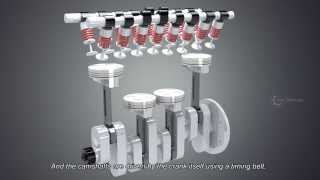
The video explains the internal combustion engine's components and the four-stroke cycle (intake, compression, power, exhaust) that generates power. It details how the crankshaft, pistons, valves, and camshafts work together, and how a multi-cylinder engine ensures continuous operation.
The crankshaft converts linear piston motion to rotational force; pistons are pushed down by expanding air; valves control air/fuel flow driven by camshafts via timing belt.
Four strokes: intake (piston down, inlet valve open), compression (both valves closed), power (spark ignites mixture, piston pushed down), exhaust (outlet valve open, piston pushes out gas).
Crank-to-camshaft ratio is 2:1; camshafts open/close valves based on stroke.
Flywheel and crank counterweights provide momentum to keep the engine turning; in a four-cylinder engine, one cylinder is always in power stroke for smoother operation.
What are the four strokes of a four-stroke engine?
Intake, compression, power, exhaust.
01:19
What is the crank-to-camshaft ratio?
2:1 (two crank revolutions per one camshaft revolution).
01:33
What is the function of the crankshaft?
It converts linear motion of the piston to rotational force.
00:15
How is the air-fuel mixture ignited in a gasoline engine?
A spark plug ignites the compressed air-fuel mixture with an electrical spark.
01:45
What keeps the engine turning continuously between power strokes?
The flywheel and crank counterweights provide momentum to keep the crankshaft turning.
03:22
Four-Stroke Cycle
Explains the fundamental cycle of an internal combustion engine.
01:19Crank-to-Camshaft Ratio
Provides a key mechanical ratio essential for engine timing.
01:33Engine Continuity via Flywheel
Clarifies how momentum keeps the engine running between power strokes.
03:22[00:00] A car engine generates power from the expansion of compressed air in a contained cylinder with the help of fuel. That is why it's called as an internal
[00:15] combustion engine. Before getting into the working, let's see the main parts involved in the working of an engine. First, the crankshaft. This is the part
[00:27] which converts the linear motion of the piston to a rotational force. Next, the pistons and the piston rods. The pistons will be pushed down by the expansion of compressed air,
[00:40] and turns the crank shaft, and the valves, which controls the flow of air and fuel into the cylinders. These valves are driven by the intake camshaft, and the exhaust camshaft,
[00:53] and the camshafts are driven by the crank itself using a timing belt There will be idle pulleys and a tensioner pulley to hold the belt tight in place This here is the internal
[01:07] structure of a four-stroke inline four-cylinder DOHC engine which is commonly found in most hatchback and sedan cars. A four-stroke engine should
[01:19] pass through four different strokes to complete one cycle to produce power. They They are intake, compression, power, and exhaust stroke. The crank to camshaft ratio is 2 is to 1.
[01:33] Which means it will take 2 crank revolutions, to complete 1 camshaft revolution. And the camshafts are designed in a responsive manner, to open or close based on the corresponding
[01:45] strokes, of each cylinder. Let take a look at a single cylinder and see how a four engine works in detail In order to ignite the air mixture a spark plug is used This will ignite the compressed air mixture with the help of an electrical spark
[02:06] We will take it down by each stroke. The intake stroke. The inlet valve opens and the downward movement of the piston creates a suction. This pulls the air-fuel mixture into the cylinder.
[02:20] Once the air-fuel mixture is in the cylinder, compression stroke begins compressing the mixture. At this time both inlet and outlet valves stays closed.
[02:32] At the end of compression stroke, the air-fuel mixture is ignited by the spark plug. The explosion exerts pressure and pushes the piston down. This is the power stroke which produces power to the crank.
[02:45] At the exhaust stroke, the outlet valves opens and the piston pushes out the burned gas. The cycle starts again from intake stroke keeping the engine running and produces power For a carburetor engine the air and fuel are mixed inside the carburetor assembly and fed to the cylinders In the case
[03:09] of a fuel-injected engine, the fuel is injected into the intake manifold, or directly into the cylinders. Since only a power stroke produces power, you may wonder how the engine turns
[03:22] continuously? Well, the answer is in the crank itself. The flywheel and the crank counterweights provides momentum, which keeps the crankshaft from stopping immediately. For a four-cylinder engine,
[03:37] considering any time instance, one cylinder is always in power stroke, which produces more power and less vibrations comparing to a single-cylinder engine. And that is how a car engine produces power
[03:51] and simple. Thanks for watching, and stay tuned for more presentations from Auto Tech Labs.
⚡ Saved you 0h 04m reading this? Transcribe any YouTube video for free — no signup needed.