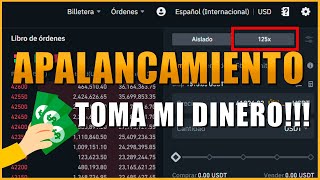

Leverage Explained: The Truth About 100% Gains
54sDebunks common misconceptions about leverage and fake trading results, sparking curiosity and debate among traders.
▶ Play Clip"The title accurately reflects the video's core topic of explaining leverage with practical examples."
This video explains how leverage works in trading, warning against misleading profit percentages shown in trading groups. It demonstrates that high percentage gains can be misleading, as they are often based on small account sizes or high leverage, and the actual movement in the market may be minimal.
Many people post fake or misleading results, showing high percentages but with tiny capital, making the actual profit insignificant.
With $100 and no leverage, a 1% move yields $1 profit.
Using $1 with 100x leverage is identical to using $100 without leverage: both control $100. A 1% move yields $1 profit, but the percentage shown is 100% for the leveraged trade.
With $100 leveraged 100x, you control $10,000. A 1% adverse move wipes out your entire $100 capital.
To see the actual price movement, divide the reported profit percentage by the leverage used (e.g., 200% reported with 100x leverage means only 2% real move).
Leverage amplifies both gains and losses, and many posted profit percentages are inflated by small capital or high leverage. Always verify real movement by dividing the percentage by the leverage.
If you have $100 with no leverage, what is your profit if the asset moves 1%?
$1
01:14
Using $1 with 100x leverage is equivalent to having how much capital?
$100
01:43
What is the real price movement if someone reports 200% profit with 100x leverage?
2%
10:05
What happens to your $100 capital if you leverage it 100x and the market moves 1% against you?
You lose all $100.
08:07
Misleading profit posts
Reveals that many posted high percentages come from tiny capital, not large profits.
00:18Danger of 100x leverage
Illustrates how a 1% adverse move can liquidate the entire capital.
03:35Formula to detect real move
Provides a simple calculation to verify actual price movement from reported percentage.
09:04[00:05] is a short video to explain how leverage works how leverage works many people don't really understand how leverage works. Some over-
[00:18] leverage, others simply get carried away by the super mega percentages they see in NLP. In other groups, or in some groups, everyone starts posting NLP of 100, 200, 300, 400,000 percent. So,
[00:33] some people don't understand how over-leveraging works. And remember that many people simply post fake results, or results that, well, let's not say they're fake, but it's not the same to have 100 percent of
[00:46] not the same to have 100 percent of $0.10 as it is to have 100 percent of $1,000. Do you understand? So, there are people who, with 1%, are with 100 percent, are barely making a dollar or less. So, keep that in
[00:59] mind. I'm going to explain it here quickly, and I can also show it to you directly in other ways. So, let's see what happens. Here you have $100. You
[01:14] can leverage $100 to x. This will be the same as $100. So our take profit (TP) and stop loss will be at 1%, just as an example. So if the currency goes up in our favor, what would our net profit be?
[01:29] 11 percent. Because we're not leveraged, we'd be at x. And what would the profit be? One dollar. This is what you would also gain here: not even one dollar. So now let's do it another way, with
[01:43] leverage. We can use one dollar. Look, look at the difference here. Here we have $100 without leverage. Here we have one dollar leverage. Here we have one dollar leveraged to 100x, which means
[01:57] 1%. We would be talking about $100, which is the same as here. So this is identical. Now what's the difference? If it goes up 1%, you'll
[02:09] gain here, but the difference is the net profit. Why? The difference is the net profit because, look, one dollar $100 is 1%, but one
[02:22] dollar of one dollar uses the profit of one dollar, and one dollar is 100%. So, look, it's the same thing, only here they used leverage to show a
[02:34] arrive, send them through groups 2, 3, or applaud. Look how they made a lot of audio, I want to be like you, give me a child, that's what you're going to say. But it turns out that if you see what happens here, it
[02:49] turns out that this 1% is identical to this, only here you're going to see it and you'll say congratulations, applause, that's all you're going to do. So, the idea is that you understand how leverage works. So, look, the same thing:
[03:04] going to give you one dollar, and the same thing between you: $1 with one dollar at 100 x 1000 will give you one dollar. Now, what's the difference? This is what happens when you don't know how to handle leverage.
[03:19] know how to handle leverage. Someone comes into the group and sends a 100, 200 percent... You say, " Wow, I want to be like him." As I was saying My son, when I grow up, I want to be like him." But now what's going to happen?
[03:35] You're going to take your 100 dollars—look, they're the same ones that were here— and now what's going to be the difference? It turns out out that what you're doing right now is
[03:48] leveraging 100 dollars to 100x, and that's equal to 10,000 dollars. Now, what 's the minimum difference for you? The currency goes 1% in your favor. The
[04:00] currency goes 1% in your favor. The NLP is 100% minimum since it's identical to NLP is 100% minimum since it's identical to this. Up to this point, we're good. But now what's the difference between you? You're going to earn 100 dollars
[04:13] you? You're going to earn 100 dollars because 1% of 10,000 dollars is 100 dollars. So, wow, super cool! Wow, that 's real NLP! Wow, yes. But it turns out that if it goes against you
[04:27] goes against you —-1%—that's also less than 100 dollars.
[04:39] happens with leverage. This up here is n't bad, look, this is good, this is good. n't bad, look, this is good, this is good. This here is bad, but I'm emphasizing this one
[04:52] because this is what most people use to send NLP messages. They're huge and say, "Look how I earned 50 or 70, 80, that's 200," but when you see, it's the same as if you had invested this capital.
[05:07] So keep this in mind, don't be fooled, don't get confused. And now I'm going to show you in the practical part, directly in terms of things. In terms of things, you're going to do absolutely the same thing. Let's
[05:22] take the example of 100 dollars. Let's pretend that here we don't have 1500 dollars, but rather, let's show you that here I'm leveraged to 100x. So let's put it at x. We have this at x. Now what are we going to
[05:35] do? Let's put 100 dollars. We have 100 dollars, which is equal to 0.0220. Sosa isn't saying that $100 wouldn't be enough for that. So if we look down here at the cost, it tells us it would be 85.70, meaning
[05:52] look, the bid in this theme is at this price, so it's not enough because of a third, because of course we don't have more capital. So look, 0.02 bitcoin is equal to this value. We're already at x, that's why it's
[06:08] not enough. So that's how this leverage works. Now, what's the other way? Look, you come in and say, 'Or how to other way? Look, you come in and say, 'Or how to leverage?' I don't know, is it better to use 10x?' So
[06:22] let's put 10x here. Now look at the difference. We still have the same $100, but look what happens here but look what happens here [Music].
[06:40] to have the same $100. The difference is that you're going to difference is that you're going to enter simply with $10. We don't want to do this; we're going to use super mega leverage, like in the
[06:54] example we had. Now you have to put it in the... put what was in one hundred. Look, in 100x, when I put in $100, 1000 is still $100, which is what the position will enter. But it actually takes almost
[07:09] a dollar here for another reason. This is something that I need to explain, But look, it's the same; it's practically a dollar. And look, we're going to
[07:21] we're taking one dollar and not multiplying it by 100. And here we have our $100 doubled. So far, we have the normal example. The difference is that this one will show us a higher percentage, and the difference with x
[07:36] is that it will only show us 1%, and if we put it like this, x will show us 100 percent. But it's exactly the same; using it doesn't alter the result or the loss at all. Now, the one I was telling you about that
[07:52] is dangerous. Well, they take these $ 100 and say, "No, I want my $100 leveraged to when, like this, x," then those $10,000,
[08:07] to when, like this, x," then those $10,000, here we have 10,000, that's enough for this. I started, okay, look how much we're investing here, 100 real dollars of our own, and we're not leveraging by
[08:21] 100 to enter with 10,000. That's where the danger lies because if the danger lies because if we lose just 1%, that's equal to 100 dollars, since we would lose the entire 100 dollars. This is the dangerous part.
[08:35] The other one isn't. The other one you can use to increase profits and the millions I'm making." Obviously, they never show how much to earn; they always show the percentages directly. In the end, what I was
[08:49] telling you doesn't matter because you don't know how they actually have real money. So, with this, I think you understand leverage well, and when you want to know if someone
[09:04] really made a good trade, I'm going to show you here quickly, in a few minutes. Let's to show you here quickly, in a few minutes. Let's say I have, I don't know, leverage of 20x, this is what I have, and it turns out that
[09:19] the person showed me a profit percentage of 200 %. This is what we're talking about. How do I do it? To really understand the the leverage, or what you're reading here, the percentage
[09:35] the person gained, and you divide it by the leverage. So, by the leverage. So, when you look at this, you 'll say, "Oh, okay, it went 200 percent." But what if it was a
[09:48] good trade, or is it just to show me things that are useless? So, a 20x... when you look here, you take 200 divided by 20, which gives you 10. This is what we do. The coin actually moved 10
[10:05] percent from the entry point. Now, let's do another example. Someone comes along and shows us this same 200 percent. They showed it here. Okay, let's delete...
[10:23] applauded them! Give me a son, superstar, I want to follow you! Okay, but now, strangely enough, we see they have a 100x. So, when we see this, if we take this 200 and divide it by 100, it shows us it
[10:40] [Music] This was only... What I did [Music] is that sometimes they show what the look is that I did, I don't know, sometimes they show what the look is that I did, I don't know,
[10:56] absurd school, no, but obviously when they actually see the movement, it's practically nothing. Anything with 100 divided by 100, they'll realize that the movements are small. This is a big movement
[11:09] small. This is a big movement for them, and many will show you for them, and many will show you 70%. Well, when you take it and divide it, look, take 70% and divide by 100. How much did it really move me? 0.7 and 2. Wade
[11:23] Superstar, let's divide the initial, okay? He had a movement in favor of 0.7 percent. That was the real thing he did. So, well, I don't want to delay this video any longer.
[11:35] Remember to like the video if you liked the information. If you are the description you can find the link to the Telegraaf group. There you will find absolutely all the information, totally free, because
[11:47] we don't sell courses, we don't sell anything at all, so don't get scammed. So, thank you very much, see you later. Also, please hit the bell icon and obviously give the video link lots of likes. Thank you so much!
[12:01] the video link lots of likes. Thank you so much!
⚡ Saved you 0h 12m reading this? Transcribe any YouTube video for free — no signup needed.