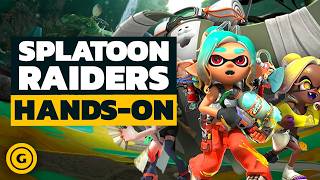

Splatoon Finally Gets a Real Single-Player
45sHighlights a major shift in focus for a beloved franchise, sparking debate among fans who prefer multiplayer.
▶ Play Clip"Title is generic, but content delivers on impressions and gameplay details. Not misleading, but lacks a specific promise."
Splatoon Raiders shifts the series' focus from competitive multiplayer to a PvE single-player and co-op experience, emphasizing gadget-based builds and horde combat. The game introduces a loot loop, gadget modifiers, and relics, aiming to create a more dedicated single-player campaign while retaining the core paint mechanics.
Unlike previous Splatoon games, Raiders prioritizes single-player and co-op PvE over competitive multiplayer. Multiplayer is co-op only and de-emphasized.
Regular weapons include paint blasters, rollers, and swashers. Rollers are less useful in PvE because covering ground is less critical; combat zones are small.
Gadgets are divided into Power, Speed, and Tactical categories. You pick one category per stage and can equip two gadgets from that category. Cooldowns are quick, encouraging liberal use.
Leveling up allows upgrading health, damage, and gadget modifier capacity. Loot found in stages includes modifiers to enhance gadgets, enabling powerful combos.
Relics are equippable items with big effects like double jump. A crewmate pilots a protective machine and provides an ultimate attack for boss fights.
Missions are battle arenas with light platforming and horde battles against Salmonids, including new 'seasoned' variants that are tougher.
Different enemy types (tower, brute, sniper) require strategic prioritization. Stages combine them in varied ways to create chaos.
The game reuses Splatoon assets but also draws inspiration from Donkey Kong Bonanza in crystal mining and drilling mechanics.
Multiplayer is more frantic with more enemies. Players can synergize builds; e.g., a power build gets close while teammates provide support.
The campaign loop seems sustainable, but the co-op multiplayer's longevity is uncertain. Unlike previous Splatoon games, it may not have infinite replayability.
Splatoon Raiders offers a fresh, build-focused PvE experience that finally prioritizes single-player, but its long-term appeal hinges on whether co-op raids provide lasting engagement beyond the campaign.
What are the three gadget categories in Splatoon Raiders?
Power, Speed, and Tactical.
01:45
Why are rollers less useful in Splatoon Raiders compared to traditional Splatoon?
Combat zones are small so covering ground isn't as important; focus is on taking down enemies.
01:13
What is the purpose of relics in Splatoon Raiders?
Equippable items with larger effects like double jump.
03:29
What does the crewmate do in gameplay?
It pilots a protective machine and provides an ultimate attack for bosses and choppers.
03:41
How does the loot system work?
Loot consists of modifiers for gadgets that enhance damage or effects; capacity for modifiers increases with level.
03:15
What are 'seasoned' Salmonids?
New variants covered in salt, tougher than regular Salmonids.
04:26
What concern does the author raise about Splatoon Raiders' longevity?
Co-op multiplayer may not have infinite replayability like competitive Splatoon; players might finish the campaign and stop.
07:03
Gadget Build Potential
Illustrates the core loop of creating 'broken' builds by reducing cooldown and extending effect time, reflecting the game's Vampire Survivors inspiration.
02:48Nintendo's Asset Reuse
Points out how Nintendo reuses existing IP and mechanics from Donkey Kong Bonanza, showing design philosophy.
05:20Longevity Uncertainty
Central tension between campaign depth and multiplayer replayability, key for fans evaluating the game.
06:48[00:00] Splatoon has always featured single player campaigns, but they've never been the focus. Often they're glorified tutorials, and even when they venture into more clever puzzle
[00:12] platformer territory, it's been a relatively short side dish to the competitive multiplayer main course. Raiders look to address this by putting the single player focus front and center.
[00:25] is here, but it's de-emphasized and co-op only. In some ways, that makes Raiders the mirror image of Splatoon games. I recently tried out Splatoon Raiders, sampling some of the early game progression along with a later co-op raid in multiplayer. While this
[00:41] is still undeniably a Splatoon game, it's a very different one with particular emphasis on making a build that feels downright broken as you take down increasingly tough hordes the salmon is. To start, you have your regular arsenal that is largely recognizable from
[00:57] previous Splatoon games, your regular paint blasters that fire like traditional guns, along with more inventive paint-slashing weaponry like rollers and swashers, which cover the ground and paint more quickly. I stuck mostly with the traditional weapons, mostly because
[01:13] I was just learning the ropes, but also because weapons like rollers just seemed less useful in this contest. Those are great for a team composition in multiplayer Splatoon where your goal is to cover as much ground with paint as possible, but their utility is less
[01:29] obvious in a PvE game that's focused on taking down enemies. You do still need to cover the ground and paint to quickly move around the battlefields, but the combat zones are relatively small, so covering them completely isn't as important. There may be use cases I just didn't
[01:45] fine in my limited time, however. Aside from your regular weapons you also have gadgets which are sorted into three tank types Power Speed and Tactical You have to pick just one of those categories to use but you can swap between stages All of
[02:02] your gadgets fall under one of those three buckets, and you can equip two of them at a time within that category, mapping them to the shoulder buttons. The Tactical kit has an auto turret, for example, while the Power set lets you
[02:18] generate a spinning array of ink blobs that circle around you and deal damage to enemies. At first I was cautious about my gadget use, saving them for bigger engagements, but the cooldown is quick and the stamina aids are ferocious.
[02:31] It's clear that Splatoon Raiders wants you to use them liberally, so after getting warmed up a bit, I was hitting my spinning power attack at every opportunity, acting like a passive damage dealing shield to complement my shooting.
[02:48] I knew then and there that my ultimate goal would be to reduce the cooldown and extend the effect time as much as possible, to make it, if not infinite, at least as close as possible. It's not really Vampire Survivors, but it's not not Vampire Survivors.
[03:03] Upgrading and supporting your gadget loadout is a major driver in the loot loop of Splatoon Raiders. As you level up your character, you can upgrade their health or damage, but also their capacity for gadget modifiers.
[03:15] Most of the loot you find in the stages are different modifiers for your gadgets, to let you upgrade damage or tweak its effects. It is a very flexible system, and even in my limited time, I could see the potential for building out a combo of traditional weapons
[03:29] and powered-up gadgets that feels OP, at least until you hit the next challenge milestone. Rounding out your combat options are relics, equippable items with even bigger effects like enabling a double jump.
[03:41] Finally you can bring one of your deep cut crew with you to pilot the protective machine that accompanies you into each mission and which when you pick determines a charge ultimate showstopper attack that you actually should save for boss and chopper
[03:59] All these options come together to make your perfect little inkling-killing machine, venturing out into an array of islands that unlock across new islands as you complete story missions on the world map. These missions function like battle arenas with some light-platforming elements.
[04:14] You might need to call over your cohort to give you a boost, but for the most part, these seem to be traveling between skirmishes. Those play out like horde battles with massive numbers of Saminids attacking you, along with
[04:26] new season Saminids that are visibly covered with salt and are much tougher than their regular counterpart. From the little that I played, Splatoon Raiders gets mileage out of even just a handful of
[04:38] Saminids I encountered, by both increasing the numbers of the horde and rearranging its pieces. One Samunid occupies a giant tower that has to be cut down to size before you can defeat it, another is a giant lumbering brute, and so on. One stage may require you
[04:55] to take on just one of each, while another strategically positions the sniper tower so it's difficult to reach one without being exposed to the other. Another wrinkle might add a bigger, slower boss to deal with, forcing tense decision-making about which threat to
[05:08] eliminate first. It can get chaotic, but that's what makes it so satisfying to use all the combat options at your disposal to mop up the battlefield. There is a general sense that Splatoon Raiders is
[05:20] an example of Nintendo using every part of the buffalo, as the saying goes. The character design, some enemies, weapons, and the world of Splatoon are well established, of course, but I was surprised to be reminded of the recent Donkey Kong Bonanza. This game doesn't have Bonanza's
[05:36] destructibility but you end stages by mining crystals and the clink clink of collecting them very much reminded me of Donkey Kong latest as did the concept of drilling into the ground to progress into a deeper cave in some stages We also tried a multiplayer skirmish which was as you might expect a lot more frantic
[05:54] with more enemies to match the increased player count. Though, as with single-player missions, you're moving around the map a good deal more to find different engagements, and your prize is new gadget modifiers for loot.
[06:06] The real treat here was seeing how players could start to synergize with each other. My power-focused build was good for getting in close to enemies and dealing heavy damage, but I wasn't especially hardy, so I could rely on my teammates to take some of the heat off
[06:21] while venturing into the thick of the enemy horde. Combined with the wealth of options for your gadgets and gear, multiplayer seemed like a fertile ground for high-level raids against tough opponents, which would then cash out with appropriately better loot.
[06:36] Splatoon Raiders has a nice combat loop built around grinding for loot to get stronger and then using that to experiment with new builds and take on even tougher foes.
[06:48] That seems like more than enough to sustain it through a story campaign. The lingering question in my mind is how much longevity the co-op multiplayer will have to sustain continued raids with your friends after you've wrapped up most of the challenges.
[07:03] Previous Splatoon games were built with long-term competitive multiplayer in mind, with all the infinite replayability that comes with it. The switch to a single-player focus may mean that Splatoon Raiders is content
[07:15] to let you finish the campaign and be done with it. So it remains to be seen if co-op raids for ever-increasing builds will give it similarly long legs. That makes it a big chance for a series built on multiplayer,
[07:27] but as someone who has always wanted a more focused single-player Splatoon experience, I'm excited to see it finally deliver.



⚡ Saved you 0h 07m reading this? Transcribe any YouTube video for free — no signup needed.