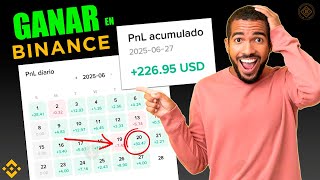

Scalping de $100 a $326 en Binance
34sMuestra un crecimiento real de cuenta pequeña, generando curiosidad y credibilidad.
▶ Play Clip
[00:02] puedes ganar dinero haciendo scalping de criptomonedas en Binance. Esta es una estrategia real que llevo ya años realizando. Te mostraré cómo funciona la estrategia sin humo. Y esta estrategia es especial para subir cuentas muy
[00:20] pequeñas. Por ejemplo, yo inicié una cuenta recientemente de $100. Como vemos, mi cuenta ya se encuentra en el día de hoy en $326.
[00:36] vemos acá, $1,27 83os,
[00:52] Como vemos, también hay pérdidas y acá vemos una pérdida bastante grande que recuerdan. Nuestra gestión de riesgo es el 10%
[01:06] de nuestra cuenta. Entonces, como vemos acá, eh la operación se protegió con cobertura, pero eh salió negativa. Si restamos 103 - 73 nos darían $30 de
[01:21] pérdida, que es el 10% de nuestra cuenta. Y más sin embargo, nuestra cuenta. Y más sin embargo, nuestra cuenta sigue subiendo ya, porque el cuenta sigue subiendo ya, porque el trading es así. Subimos, retrocedemos y
[01:34] lo importante es seguir subiendo. El trading no es lineal, sino que también tiene su retroceso. Bueno, mi gente, sin nada más que decir, vamos al video y vamos a explicar en qué consiste la estrategia. La estrategia que estamos
[01:49] utilizando es scalping a una temporalidad de 5 minutos. Para los que no saben, el scalping es una estrategia de trading que consiste en abrir y
[02:02] cerrar operaciones rápidamente. Eh, por lo general se usa en temporalidades muy bajas y nosotros aprovechamos impulsos, ya sea alcistas o aprovechamos impulsos, ya sea alcistas o bajistas del mercado, entramos y nos
[02:17] llevamos nuestra ganancia. Hacemos muchas operaciones en el día en un periodo muy corto de tiempo. Por lo general las operaciones demoran 1 2 minutos, 5 minutos. Si la operación se complica, ya demoraría 10, 15 minutos.
[02:34] Todo depende, no hay nada escrito, como siempre les digo. También depende mucho de la volatilidad del mercado, si las monedas se están moviendo, si el mercado está congelado, influye en muchos factores. Entonces, nosotros hacemos
[02:49] varias operaciones al día rápidamente y nos llevamos un 2, un 3% de nuestra cuenta. Por ejemplo, si tenemos una cuenta de 300, como es el
[03:01] tenemos una cuenta de 300, como es el caso ahora, nos llevamos 10, 12. Hay ocasiones que nos llevamos hasta 15 ya respetando al 100% nuestra gestión de riesgo, que esa es la clave. Entonces, adicionalmente, como les
[03:17] comenté, yo pero a 5 minutos y utilizo dos indicadores. Indicador número uno, que son las bandas de Bollinger, como lo vemos aquí.
[03:29] Estas son las bandas de Bollinger y también utilizo el RCI. Entonces, nosotros, ¿cómo identificamos entradas utilizando esta estrategia a 5
[03:41] mencioné? Entonces, en primer lugar, cuando hay un impulso hacia la alza, por ejemplo, en este caso, y la vela rompe la banda superior de Bollinger y el RCI está
[03:56] sobrecomprado por acá más o menos a los 70, a los 80, nosotros abrimos un short aquí. Obviamente nosotros nunca nos vamos a el punto exacto. Hay ocasiones en que sí. Entonces nosotros ahí abrimos un short y buscamos el 1% de
[04:15] movimiento, por ejemplo, aquí y buscamos el 1%. Bien. Y ahí nos vamos en ganancia. Ya. En este caso, acá hay otro escenario. Perfecto. Acá impulso hacia la alza. Rompió la
[04:31] banda de Bollinger. RCI está acá sobrecomprado y ya busco el 1% de movimiento. Ahí está. Ya. Y así
[04:43] sucesivamente en el escenario contrario. Acá rompió la banda hacia la baja Acá rompió la banda hacia la baja y busco el 1% de movimiento. Si la moneda se va en contra, yo hago recompra. Por ejemplo, acá las últimas
[04:59] operaciones. Vamos a buscar esta que fue en la moneda H. Y aquí vemos la entrada. Miren, se cumplió la estrategia. Impulso hacia la baja. Yo le entré al aquí.
[05:18] Miren, bajó cuánto bajó desde mi desde mi entrada bajó un 3%. Y aquí abrí una recompra. Después la moneda de este impulso se
[05:31] recuperó y acá logré salir. Si nos si nos damos cuenta, nos llevamos $,27 y ni siquiera teníamos el 100% de nuestro capital. Entonces nosotros haciendo estas entradas así va sumando
[05:49] 70entavos y cuando cuando nos damos cuenta ya nuestra cuenta va subiendo siempre y cuando respetemos la gestión. Entonces vamos a buscar una entrada para que quede la explicación un poco más fina.
[06:05] Acá nosotros vemos una posible entrada. Esta moneda se está moviendo bien. Si Esta moneda se está moviendo bien. Si nosotros medimos se está moviendo un 1% que es lo que nosotros buscamos y nos podemos ayudar también con soportes y
[06:20] resistencia. Yo esto muy poco lo marco, pero es superútil. Entonces acá nosotros vemos la entrada. Entonces, ¿qué hacemos? el 1%
[06:36] ¿qué hacemos? el 1% apalancado por 10. Voy a rodar acá mi entradita ahí y ahí esperamos. Como vemos, ya entró la operación. Entramos relativamente con poco capital,
[06:51] Entramos relativamente con poco capital, 32 dolaritos, que es el 1% de nuestro 32 dolaritos, que es el 1% de nuestro capital apalancado por 10. capital apalancado por 10. Entonces acá nosotros podemos colocar
[07:03] nuestra próxima recompra igualando el número de monedas. 1620. Medimos más o menos por aquí a un 2,74%.
[07:19] preparado. Entonces, las recompra uno las coloca de acuerdo a la volatilidad del mercado. Si la moneda se está moviendo full fuerte en un 3%, 4%, tú no
[07:31] puedes colocar las recompras a un 1%, un 2% porque si la moneda se mueve en 2% porque si la moneda se mueve en contra un 10 12% ya tocaría gestorlo. Entonces nosotros colocamos la recompra de acuerdo a la volatilidad de cada
[07:47] de acuerdo a la volatilidad de cada moneda. Acá también configuro lo que es la toma de ganancias. Uno busca más o menos un 1% y lo coloca en zonas estratégicas, por ejemplo, allí. O lo podemos colocar
[08:01] aquí en la última mechita. Ya estaríamos buscando un 1% y nos Ya estaríamos buscando un 1% y nos estaríamos ganando 34avos. Superb. Entonces, muchos los ven poco, ¿no? Que son 33 centavos. ¿Qué pasa si
[08:16] ¿no? Que son 33 centavos. ¿Qué pasa si la operación se va cargando, es decir, va tomando recompra? Nuestro profit va aumentando. Por ejemplo, si ya nos si nos toma una recompra, ya no tendríamos 32 en la operación, si no tendríamos $60
[08:34] 32 en la operación, si no tendríamos $60 en la operación y el 1% de 60 es 6. Si nos toca otra recompra, ya tendríamos $10 en la operación y el 1% de 120 es
[08:50] 1,2 y así sucesivamente. Pero obviamente a nosotros no nos interesa que nos tome la recompra porque nuestro storlo va a quedar cada vez más cerca.
[09:04] Como vemos acá, yo tengo mi estorlo, miren, dispuesto a perder $30, que es el 10% de mi cuenta, y lo tengo a un 92% de Es decir, que la moneda tiene que moverse un 92% en contra para yo tocar
[09:23] Storlo. Pero, ¿qué pasa si yo si esta moneda toca la recompra? Ya mi estorlo moneda toca la recompra? Ya mi estorlo no va a estar un 90% sino a un 45%. Y así sucesivamente hasta que mi estorno lo tenga literalmente en la nuca. Bueno,
[09:39] en este caso, mi gente, eh ya toca esperar que se desarrolle la operación esperar que se desarrolle la operación y estar aquí gestionándola.
[10:19] B [Música]
[10:32] operación ya nos dio nuestra salida. Se quedó ahí rangueando, por eso demoró un poquito. Si nos vamos acá, vemos 32 centavos de Si nos vamos acá, vemos 32 centavos de dólares y miramos el análisis de esta
[10:45] operación. Entramos aquí, una zona bastante buena. No se cumplió la estrategia el 100%, pero vemos que esta moneda había bajado bastante, entonces lo más probable es que hiciera un pequeño una pequeña corrección. Vemos
[11:01] que entramos aquí y se mantuvo en el rango. Miren, por eso les digo que hay monedas que hay operaciones que pueden demorar, otras que se ejecutan enseguida. Ya eso depende de la volatilidad. Vemos,
[11:16] depende de la volatilidad. Vemos, entramos aquí, pasaron 1 2 3 cu cco velas para que nos dieran nuestra salida. ¿Por qué? Porque se quedó en salida. ¿Por qué? Porque se quedó en rango. Mire aquí un casi 2%
[11:29] rango. Mire aquí un casi 2% bajó y subió un punto y pico. Es decir, bajó y subió un punto y pico. Es decir, que ya sí se nos dio nuestra operación. Entonces podemos hacer 15, 20 operaciones al día, buscar un 3, un 2%
[11:45] de nuestra cuenta y así la cuenta va subiendo poco a poco como lo hemos hecho con esta cuenta reto que inició en $100 y ya va en 326.
[12:04] de la estrategia. Si tienen cualquier duda, inquietud, la pueden dejar en los comentarios. Si quieres que suba video más seguido operando esta cuenta reto, házmelo saber en los comentarios para yo tenerlo en
[12:19] cuenta. Sin nada más que decir, nos vemos en una próxima ocasión. Adiós.
⚡ Saved you 0h 12m reading this? Transcribe any YouTube video for free — no signup needed.