
Escape Analysis Paralysis for Muscle Growth
45sDirectly addresses the common feeling of overwhelm and provides a clear solution, making it highly relatable and actionable.
▶ Play Clip"The title promises a muscle-building checklist, and the video delivers exactly that with actionable steps."
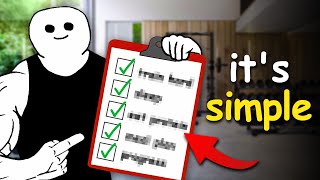
This video provides a comprehensive muscle-building checklist to help viewers overcome analysis paralysis and build muscle effectively. It covers essential training principles like progressive overload, movement patterns, and training frequency, along with key nutrition and lifestyle factors.
Too much information leads to overwhelm and analysis paralysis. This checklist provides a structured approach to building muscle.
Aim to increase weight or reps each workout. Progress slows over time, but consistent effort is key for muscle growth.
Use a tracking app, notepad, or paper to log exercises, reps, and weights. This allows you to beat your previous performance.
Each body part has key movement patterns (e.g., chest: horizontal press, incline press, isolation). Covering these ensures complete development.
Training a muscle twice per week is the sweet spot for growth, as it allows for recovery and more frequent stimulation.
Mental focus and effort during sets are crucial. Distracted sets are ineffective.
A structured plan is essential for consistent progress. Random exercises yield poor results.
Aim for 1 gram of protein per pound of body weight. Prioritize quality sources like meat, eggs, and dairy.
Distribute protein across 3-6 meals per day for optimal utilization. For example, 160g protein over 4 meals = ~40g per meal.
Fuel before workouts and refuel after. The anabolic window is not as urgent as often claimed; a pre-workout meal covers you for an hour or more.
Focus on daily protein and calorie intake. Use a TDEE calculator to find maintenance calories, then add/subtract 500 for bulk/cut.
Cardio aids muscle building by improving recovery and overall health. Any movement is beneficial.
Sleep is critical for muscle recovery and growth. Prioritize it over procrastination.
Muscle building takes time. Consistency with the checklist guarantees success.
Following this comprehensive checklist—covering progressive overload, training frequency, nutrition, cardio, sleep, and patience—will guarantee muscle growth over time.
What is progressive overload?
Aiming to increase weight or reps each workout to stimulate muscle growth.
00:38
How should you track your workouts?
Log the exercise, reps per set, and weight used in a notebook, app, or paper.
01:15
What are the three movement patterns for chest?
Horizontal press, incline press, and an isolation exercise.
01:55
How many times per week should you train each body part for optimal growth?
Twice per week.
02:32
What is the recommended daily protein intake?
1 gram per pound of body weight.
05:02
How should you distribute protein intake throughout the day?
Spread it evenly across 3-6 meals per day.
05:40
What is the anabolic window myth?
The idea that you must eat immediately after a workout; in reality, if you had a pre-workout meal, waiting an hour or more is fine.
06:08
How do you calculate calorie intake for a bulk or cut?
Find maintenance calories using a TDEE calculator, then add 500 for a bulk or subtract 500 for a cut.
07:01
Why is cardio included in a muscle-building checklist?
It helps build more muscle by improving recovery and overall health.
07:44
What is the key to success according to the video?
Consistency and patience; following all checklist points guarantees success over time.
08:50
Progressive Overload is Key
It is the primary driver of muscle growth, without which you will plateau.
00:38Tracking Progress is Non-Negotiable
Memory is unreliable; tracking allows you to systematically apply progressive overload.
01:15Twice Per Week Training Frequency
This is the sweet spot for maximizing growth while allowing adequate recovery.
02:32Protein Quality Matters
Beyond quantity, the source of protein (meat, eggs, dairy) impacts utilization.
05:02Sleep is a Muscle Builder
Often neglected, sleep is critical for recovery and growth, and is a simple, free tool.
08:09[00:00] In this day and age, there is just so much information available everywhere. In fact, there is so much information that you get super overwhelmed and anxious, which gives you this unsettling feeling that keeps your brain running all day and all night.
[00:13] And you get into the state of analysis paralysis, where you just keep on overcomplicating without actually achieving anything, which eventually just makes you want to give up on your goal. That's why I created this muscle building checklist.
[00:25] We will go over all the important things that you need to do in order to build muscle. So just write all of these things down and as we go along, check them off of your list. And after you finish watching this video, you will know exactly what parts of the puzzle
[00:38] you are still missing and you will be finally able to escape analysis paralysis. First up on the list we have progressive overload. Progressive overload is one of the most important things on this list, because without it you
[00:50] will keep on looking the same year after year. You should go into every workout with the goal of either progressing in weight or in reps. are still new to the gym, you will be progressing very fast, but as the time will go on, it
[01:02] will slow down by a lot. And you simply won't be able to progress from workout to workout, because that is just impossible. Sometimes it will take multiple workouts to progress by at least one rep, but you should always try your best to progress forward. That is
[01:15] what is going to guarantee that you will build a ton of muscle. Of course, in order to progress with the overload, you need to know what you did in the last workout, and you might think that you can remember exactly what you did in the last workout, but you simply will not
[01:28] be able to do that accurately. That's why you need to track your progress. It doesn't matter how you do it. If you choose to use a tracking app, a notepad in your phone, or just a paper notebook, just write down the exercise, the reps in each set, and the weight you used, and do that
[01:42] with every single exercise in your routine. When you then come to the gym to do the next workout, you can look at what you did last time exactly, and try to beat it by at least one rep. I can't even put into words how important it is to do this.
[01:55] What is also incredibly important is that you use all the necessary movement patterns. Don't worry, this is not some kind of science-based nonsense. Every body part has a couple of movement patterns that you should use to get the best overall development.
[02:08] So for example, for the chest, you want to be doing a horizontal press, an incline press and an isolation exercise. If you use all of these movement patterns, you will be completely covered and you won need to stress about missing out on some weird exercise you saw on TikTok If you want to look at all the movement patterns for all the body parts you can grab the simplified cheat sheet that I made that also includes recommended amount of sets per week and also rep ranges
[02:32] The link to the cheat sheet will be down in the description below. And by the way, it's completely free. Well, now you know that you should do all the movement patterns. But that's not all. If you really want to make sure that you are doing everything that you can to build the most muscle possible, you should hit each body part twice per week.
[02:48] twice per week. Simply because if you hit your chest on Monday for example, then it's probably going to be fully recovered by Wednesday. Just the only time you train your chest is on Monday, then you are basically wasting a half a week of growth. That's why hitting each body part twice
[03:02] per week is the sweet spot. There are of course some exceptions, where the number can be higher than twice per week, but also lower. To give you an example of that, smaller body parts that recover very quickly can be hit for example three times per week without any issues. So for example calves,
[03:17] But there are also situations where training some body parts once per week will be ok. Most commonly this applies to leg training. Some people just don't care about having super massive legs, but they don't want to have chicken legs, so they just train legs once per week and that's completely fine.
[03:32] Or you are just like me and your legs are already way too big and you don't want them to look even bigger, because if they got any bigger, you would look like reverse Johnny Bravo, and let's be honest, that looks absolutely terrible. But really, for most of you guys, training each body part twice per week will be exactly what you are looking for.
[03:49] So, now you are training each body part twice per week, that's great. But when you are actually training in a gym, you need to make sure that you are doing hard and that you are focusing on what you are doing. If you start a set of bench press and instead of mentally focusing on performing the bench press,
[04:04] you are thinking about how you are gonna play video games with the boys tonight, then I can guarantee you that set was basically worthless. That's for two reasons. You didn't put hard enough to reach failure and you did not concentrate on what your muscles are doing.
[04:17] It might seem like a minor detail, but I assure you that it's not. It is incredibly important, so don't underestimate it, because that's how the best physics are built, by going hard and thinking about how your muscles are working.
[04:30] Everything we went over so far was super impactful, but we are still missing a very important thing when it comes to training, and that is having a structured training plan. This is an absolute must, because if you just do random exercises in each workout, you simply
[04:44] can't expect great results. That's just how it is. You can create a very simple training plan All that matters is that you have some structure that you can follow and that you don get lost I would of course recommend you to get one of my training plans if you want to have a great structure that you can follow and that is very easy to understand
[05:02] No matter what you decide to do, it's super important that you have a training plan that you can follow. Now let's take a look at all the nutrition related necessities. I of course have to mention that you should consume enough protein. Go for roughly 1 gram
[05:14] of protein per pound of body weight. This information is pretty well known, but what is not really that well known is the importance of quality of protein. To absolutely simplify it, make sure that most of your protein sources are foods like green meat, eggs, different
[05:28] types of dairy, and occasionally some protein supplements if needed. The amount of protein per day that you should consume is pretty easy to understand, but that's not the whole story. To utilize that protein in the best way possible, it's very important that you
[05:40] spread it out evenly throughout the day. The number of meals you should have can be anywhere between 3 to 6 meals per day. And based on the amount of meals you chose to eat per day, you will try to distribute your daily protein intake between them. So for example, if your
[05:54] daily protein intake is 160 grams and you want to eat 4 meals per day, then each one of your meals should contain roughly 40 grams of protein. You don't need to spread it out so precisely, that would just stress you out. Just make sure that you are roughly around that number in each
[06:08] and that you're getting all of your protein at the end of the day. And when you get that done, also make sure that you are properly feeding and also hydrating yourself before and after workout. Because you need the energy to push through the workout, but you also need to reach through
[06:21] your body afterwards, so you can build more muscle. But you don't have to go sprinting home right after your workout to eat your post-workout meal as fast as possible. The anabolic window really isn't that dramatic. Yes, you should eat after your workout, but if you had a decently sized pre-workout meal,
[06:37] then there is no problem with waiting an hour or more after your workout to eat your post-workout meal, because the nutrients from your pre-workout meal are still in your system, so it's completely fine if you eat the post-workout meal a little later.
[06:50] Of course, as with the training plan, you should also have a meal plan set up. Then you will know exactly what you need to do in order to achieve your goal. I will once again recommend you one of my nutrition plans, but you already know that. If you are going to build a meal plan by yourself, and you are less experienced in the realm of nutrition,
[07:06] I would recommend you to focus on just two things. Your daily protein intake and your daily calorie intake. That's it. Don't worry about anything else. Because if you don know what you doing you would just get super confused and overwhelmed And you would have no meal plan whatsoever as a result of that To figure out your daily calorie intake you will first need to go to this website where you fill in all the info and then as a result it will show you your
[07:29] maintenance calories. From that point, you will either add 500 calories on top of that number, if you want to go on a bulk, or you subtract 500 calories if you want to go on a cut. And that's basically the simplest way of building a meal plan. But if even that sounds too complicated to you,
[07:44] you can just get one of my nutrition plans. Well, that was everything training and nutrition related. But we are still not done. The next thing we have on our list is cardio. And you might be like, why is cardio on a muscle building checklist?
[07:57] Well, that's very simple, my friend. It's because it will help you build more muscle. I know, shocking. Most of the people just hate cardio. But it's basically free muscle mass that is just waiting for you to pick it up off the floor.
[08:09] So stop avoiding it like the plague and start moving. Any movement will greatly benefit you, it doesn't matter what you choose to do. As long as you remain active, you will be all good. There is one other thing that often gets neglected, and that is getting in enough sleep.
[08:23] It is truly the simplest thing that you can do. It's one thing if your schedule is legitimately full and you are struggling with getting in enough sleep, but if you are just procrastinating instead of going to sleep, and then missing out on all the muscle building and health benefits,
[08:37] then you really need to rethink your priorities. As one of you commented on one of my recent videos, Don't stay up late for something that you wouldn't wake up for. I think that this sums it up perfectly. Which brings us to the last point on our checklist.
[08:50] And that is patience. Whether you like it or not, there is no building muscle fast or any quick fixes. It all takes time. And if you are able to go over all the points I showed you in this checklist and say Yes, I'm doing all of that.
[09:03] Then you will succeed. That is not a maybe. That is guaranteed. If you made it this far in the video, thank you for watching. And also big thanks to all the supporters on Patreon.
[09:37] Did you like this video? Then you will for sure like this one too. Thank you.
⚡ Saved you 0h 09m reading this? Transcribe any YouTube video for free — no signup needed.