
Why even pros get scared of sheet music
48sRelatable fear of complex sheet music creates curiosity and engagement.
▶ Play Clip"The title promises a quick overview and the video delivers exactly that—a beginner-friendly explanation of the basics of reading sheet music."
This video provides a beginner-friendly overview of how to read sheet music. It covers the staff, clefs, key signatures, time signatures, note values, and rests, with practical examples and tips for memorization.
The staff consists of five horizontal lines and four spaces, each representing a different note. Notes can be placed on lines or spaces, and can extend above or below the staff using ledger lines.
A good trick is to memorize the middle line as B, the top line as F, and the bottom line as E. Then count up or down from these anchor points to find other notes.
The treble clef (G clef) curls around the G line. The bass clef (F clef) has two dots marking the F line. The C clef is used by violas and cellos.
Key signatures are written after the clef and indicate which notes are sharp or flat throughout the piece. For example, one sharp (F#) means all Fs are sharp. The order of sharps and flats is fixed.
A natural sign cancels a sharp or flat for the remainder of the measure. After the measure, the original key signature applies again.
Time signatures consist of two numbers: the top tells how many beats per measure, the bottom tells which note value gets one beat. Common examples: 4/4 (four quarter notes), 3/4 (three quarter notes), 6/8 (six eighth notes).
Note values include whole, half, quarter, eighth, and sixteenth notes. Rests have corresponding durations. Notes can be beamed together for easier reading.
The video ends by analyzing a real piece (Ode to Joy) to demonstrate how all elements work together. The first measure may be incomplete (anacrusis).
What is the staff in sheet music?
The five horizontal lines on which notes are placed.
01:04
What note is on the middle line of the treble clef staff?
The middle line of the staff is B.
02:07
What notes are on the top and bottom lines of the treble clef staff?
The top line is F and the bottom line is E.
02:22
What is the sequence of notes in a C major scale?
The sequence C, D, E, F, G, A, B, C.
04:34
Why is the treble clef also called the G clef?
The treble clef is also called the G clef because it curls around the G line.
05:46
Which clef is used for low-pitched notes?
The bass clef (F clef) is used for low notes.
06:02
Which instruments commonly use the C clef?
The C clef is used by violas and sometimes cellos.
06:32
Where are key signatures written on sheet music?
Key signatures are written right after the clef symbol and indicate which notes are sharp or flat throughout the piece.
08:46
What does a natural sign do in sheet music?
A natural sign cancels a sharp or flat for the remainder of the measure.
13:52
What do the two numbers in a time signature represent?
The top number indicates how many beats per measure; the bottom number indicates which note value gets one beat.
16:05
What does 4/4 time signature mean?
4/4 time means four quarter notes per measure.
16:34
How long does a quarter rest last?
A quarter rest lasts the same duration as a quarter note.
18:37
What does 6/8 time signature indicate?
6/8 time means six eighth notes per measure, often played faster and used for arpeggios.
24:00
Memorize the middle line as B
Provides a simple anchor point for beginners to start identifying notes on the staff.
02:07Treble clef is a stylized G
Explains the origin of the treble clef symbol, making it easier to remember which line it marks.
05:46Key signature affects all notes of that pitch
Clarifies a fundamental rule: sharps/flats in the key signature apply throughout the piece unless canceled.
10:14Natural sign cancels accidental for one measure
Explains how accidentals work within a measure, a common point of confusion for beginners.
13:52Most modern music uses 4/4 time
Highlights the prevalence of 4/4, giving learners a practical starting point for rhythm.
16:34[00:00] and welcome to how to read music very quick yet hopefully helpful overview the uh it won't i can't promise you that you will be sight reading after watching this video but i can promise you that
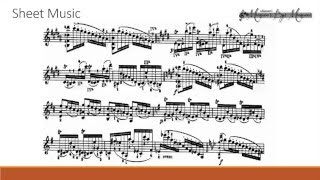
[00:17] you will understand uh music sheet much better after this so let's begin and let me show you example of Music Sheet right here. This is a highly complicated Music Sheet and even
[00:33] I if I see this I get scared, but I do understand everything in it because all Music Sheet is essentially the same. So let's jump to something more simple like this. This is more along
[00:48] along the lines of what you will be seeing in my videos. It doesn't necessarily mean that the song is easy, but it's definitely easier than on the last music sheet. So, again, my goal is for you to
[01:04] understand what music sheet is about. So, let's get started. The basic of the basics is the staff. The staff are those five horizontal lines, and each line represents a note.
[01:21] It has spaces in between, and between those spaces, those are notes as well. So a note can be on a space or on a line. For example, let's play four random notes.
[01:39] There we go. and those are placed on spaces. You can see the first note goes underneath the staff. You can go way below the staff or you can go way above the staff.
[01:52] We'll look into that a little bit later. So let's continue. And a good trick if you have never read music before is you need to memorize what each note is.
[02:07] A good way to do that is if you know that the middle line on the staff is the B note. And any note that's placed on the middle line is going to be a B.
[02:22] So memorize that. Remember that. And then also remember the top line and the bottom. The top will be an F and the bottom will be an E. So with that you have three notes and you can find notes in between.
[02:39] And let me give you an example. We start with a note B. And now we're going to climb up all the way to that F that we have marked.
[02:52] So we count up. After the B comes a C. Then a D. Then an E. And we get to the F. and we can do the same thing counting down.
[03:08] Let's go back to our trusty B. So we count down. The next note down is an A. Then we have a G, an F, and we get to the E.
[03:23] And this technique of counting is the way you're going to have to start with. I had to go through with everybody and I'm sure Mozart did too. So you can't be born knowing this. So you're going to have to count up and down and then with time you will memorize every single note.
[03:45] So, let me give you a C scale. This is the most typical scale, always played, it's just played on a white keys on a piano keyboard. And it's a series of 8 notes and we start with a C right here.
[04:04] You can see that C has an auxiliary line because it goes below the staff. Then we have a D, E, F, G, A, B, and we go back to C.
[04:21] This C sounds the same as this one, note-wise, but it's an octave higher. We can do that with all Cs are the same note, only different octave.
[04:34] Oh, well, that was an E. Sorry. Anyway, I think the point is clear, and what you need to memorize is this sequence right here. C, D, E, S, G, A, B, C.
[04:48] and this will allow you to see any note let's say you have a note on the B and what comes below the B well let's look BA okay what's above the B a C hmm
[05:05] what's this next line and after the C comes a D again so this loops over and over and over so it's a nice sequence to memorize and then use when you're trying
[05:17] to find a note on a music sheet and let's move on to the clef we're back to the basic we have our staff and then and on every music sheet or sheet music
[05:31] rather and you're gonna have a clef that this symbol here is a clef symbol it's the assemble of G and you can see it ends right there and it should be
[05:46] If properly done, then it'll end on this line, and this line is a G. That's why it's called the G clef. The G clef is also known as a treble clef, because it's used for high-pitched notes.
[06:02] There are different kinds of clefs, and you have an F clef. This is used for low notes. It's a low register clef, and it's also more commonly known as the bass clef.
[06:17] And then there is this clef. This is a C clef, and this is something in between. Very few instruments use this. The ones I know of for sure is violas use the C clef.
[06:32] Cellos sometimes jump to the C clef. and it has different positions, but we don't worry about it. We just use the G-class
[06:45] and that's one of the big advantages of playing violin. There's only one class, one staff you have to worry about. I mean, look, this is an example for a piano player.
[06:58] Look at this poor guy. He needs to side-tweet two staffs at the same time and they're different class. and the difference in the clefs, they're not exactly the same
[07:10] for example, this F, as you can see the two dots, that marks the F line but on the treble clef, that would be a D, the same line so each clef is different and a piano player has to memorize both clefs
[07:27] and be completely comfortable reading them So just be glad that we are sticking to the RG no matter what. And that's enough about Cliffs.
[07:40] It's just background information and for you to know why it's there. The next step is going to be keys. Keys is what makes a song a certain pitch.
[07:53] Like for example let play this song I playing it in A major Let go to C major
[08:09] I'm sure you heard the difference. It's the same song, but it's played in different keys. And keys are important because there are certain instruments that play better with certain keys. and maybe if you're a singer you want to tune that song up or you want to tune it down to
[08:28] adjust better to your voice so that's why keys exist and also it gives a little bit of a different flavor to to each song keys are written right after the clef symbol and it can be either
[08:46] starts like this or it can be flat like this and each sharp or each flat added or even if there is no sharp and no flat this is a key in itself the key of C major and on the piano again just to give
[09:06] you a visual example C major just uses the white keys on the piano each key also has a relative minor scale which the C major relative minor is A minor why because it uses the same keys
[09:27] it just uses the white keys let's hear a minor scale It sounds darker, doesn't it? But it's the same keys as the C major scale.
[09:40] The only difference is that instead of starting it on a C, I'm starting it on an A. So, again, this, the sharps or the flats in the beginning determine the key the song is going to be played in.
[09:56] Now, if keys don't make sense to you yet, don't worry about it. It's not important. You will understand it with time as we go along. The important thing to remember with these is that the key signature is written right next to the cliff.
[10:14] And these symbols mean that, let's say, this one is written on an F. See, it's right on the line. And then this one is on the space where the C should be.
[10:30] So we have an F and a C, and these are sharps. And this means that all our Fs and all our Cs will be sharps throughout the entire sheet music,
[10:44] unless otherwise indicated, which we'll get to that later. But that is the important thing. That's what you need to remember. Not so much which sharp is which p, e, and the relative minor.
[10:58] you'll understand that on your own it will come to you later you you need to worry about that but what is very important is to know that whatever is marked in the beginning for example here this
[11:11] is above the staff this wasn't remember f that's right and the note right above the f is a g so this is a G sharp and this means that all our G sharps no matter where they are
[11:26] even if it's down here or way below here it's still going to be sharp okay and the order of these sharps is always the same so if you want to memorize the key
[11:42] signatures you can it's the same with the flats they have a specific order they always are added the same way. It starts with a B-flat, then an E-flat, then an A-flat,
[11:56] then a D-flat, then a G-flat. Okay? And here is a little graph for you to have a visual cue of the major and minor scales. Like we talked about the one that has no key signature, which is a key
[12:14] signature in itself, and that's a C major scale or the relative A minor scale. Then, if we look at the next one, it has just an F sharp, and that means that we will play all our F sharp. So,
[12:31] So on the G major scale, it's G, A, B, C, D, E, F sharp, G. See?
[12:43] Because the only note that's marked as sharp is the F. And now the relative minor would be E minor. And that's the scale we started on, E.
[12:55] And again, it's the same rule. It's just the F that we play sharp. So an E minor scale is E, F, G, A, B, C, D, and C.
[13:12] See, that scale sounds darker. And the same applies to all of these. The flats is exactly the same principle. It's not hard to understand, but it does get confusing.
[13:26] Now, we have our signatures right here, the keys, and let's stick to the F sharp as an example.
[13:39] And this means all our Fs are sharp, but then maybe the composer, or if you're playing a song, you don't want the F sharp. You want to play it natural. That's where this guy comes in.
[13:52] This is the symbol for a natural note, and this goes right in front of a specific note, and what this does is it cancels out the initial setup, but it only works for this measure, only for the measure it's in.
[14:13] so we have a D and F it's supposed to be sharp but the natural symbols here so we play it natural and by sharp I mean a half a tone higher up right flat is half
[14:26] a tone lower and natural is the exact tone so an F on the piano the white key is this an F sharp is half a tone higher so in the beginning this timing
[14:43] to play this song, but it's been naturalized. So, we play the F natural. Then we have an E right here, and then an F again. Since this F is still within the first measure,
[15:00] we know that we have to play it natural again. So, we go natural. Now, here we begin a new measure. This line divides via measures. And every time we have a new measure, we default back to the ground rule.
[15:17] So all our S's are sharp again. So here we have a random B. Here we have an F. And this F is sharp. Because this natural only works for this measure.
[15:29] And only for whatever comes after that note. And then we have a D and an A. We don't really care about those. I hope that's clear and that is important to understand.
[15:41] So if you had trouble understanding that then go back, revisit and see it again. I hope I explained myself clearly there. And the next thing we going to talk about is the time signature So we know what this is the class we know what this is it the key signature and now we get to the time signature
[16:05] and those are those funny numbers that are in the very beginning of every score. Sometimes you will see a C or a C with a line through it.
[16:17] Those are special markings, but not really that special. I mean, a C means exactly the same as four-fourths, but let's not worry about that. Let's just try to understand these numbers. Usually, most songs are four-fourths, especially in today's music,
[16:34] And that means that on each measure, like we talked about before, measure one, measure two, measure three, on each measure, it wants to have four quarter notes or equivalents of quarter notes.
[16:54] So an example would be easy enough right here. One, two, three, four. and what do I mean with equivalence?
[17:09] if we look at this graph we can see the quarter notes right here one quarter note is the same length as two 8th notes so if this is one quarter note
[17:21] this would be the 8th notes and this would be the 16th notes ok, I hope that makes sense So, one quarter note is four sixteenth notes.
[17:36] And then we got this is our basic, because it's four fourths. But we can also write one of these, because one of these is the same length as two quarter notes.
[17:52] And then has two quarter notes. That will give us four fourths. We have this note and then this in one measure. Since this is the same as two quarter notes, we can play this.
[18:04] One, two, three, four. See? I hope that makes sense. And then, just so you know, each note also has a value in silences.
[18:16] This is the same graph. These are the quarter notes, but these are rests. So this means that you're not playing the note. It doesn't have an actual pitch, it's just a marking on the sheet music. But it means to shut up, don't play.
[18:37] Okay? And each rest has a certain value. This is a quarter note rest, so you just silence for the duration of a quarter note.
[18:49] So, let's say we have a measure with one quarter rest and then three quarter notes. It would be like this. One, two, three, four.
[19:04] Does that make sense? hopefully. And these are eighth notes rests and these are sixteenths and so forth. Half notes and whole notes. Now let's go back to our rhythmical example. So here we have one, two, three, four.
[19:27] And that would be the same as this This is still 4 fourths Because here is 1, 2 Then there are 2 eighth notes
[19:39] 2 eighth notes equals 1 fourth note So that's 3 And then here we have a 4th, 4th note What? Yeah Well, I think that makes sense
[19:51] So on the piano, this would sound like this 1, 2, 3, 4. Okay? It's still 4 beats.
[20:03] An even more complicated example would be this. It's still 4 fourths. We've got 1 fourth here. These 4 count as 1 fourth, because these are 16th notes.
[20:18] These 2 8th notes are the same as 1 fourth. And then here we have, again, 1 fourth. So it's 1, 2, 3, 4. On the piano, it will be 1, 2, 3, 4.
[20:35] And then, as a last example, let's make the notes longer than a fourth. We got the half notes. So, even though there are only two notes in this measure, it's still four fourths,
[20:51] because each one of these has a value of two. see we're we're basing ourselves with the fourth note because that's what this base number is that's actually a good way to remember it base number is the
[21:05] basic so let's count these this will be one two three four I hope that makes sense and and this will make it much easier to for you to play a rhythmically
[21:21] Now, I don't know if you noticed, but seeing these two notes looks kind of messy, watching these sixteenth notes makes everything a little bit more confusing, so there is an alternate
[21:37] way of writing these notes and make it easier on the eyes, and that would be right here. Here are the eighth notes, they're joined by a horizontal line, and the sixteenth notes
[21:54] are joined, all four of them are joined with two horizontal lines. Why? Because the eighth note has only one stem right there, and the sixteenth has two. And then here we have eighth notes again.
[22:09] So you will see music written this way. Let's go back to the time to control. We talked about 4 fourths, but it could pretty much be anything. And let's see, 3 fourths. 3 fourths is a, what would that be? It would be 3, what's the base,
[22:32] is the basic, so quarter, 4. So we need 3 quarter notes on each measure. An example, right here. and this is usually used with Minuet, you know Bach Minuet and Mozart and
[22:51] that's three fourths then a valve those are usually three fourths and that's why I'm using this example because it sounds a lot like a like a valve rhythm so the you can see that it's three beats three beats of quarter
[23:11] notes. One, two, three. There is more than one note right here, but that just means that the notes are played at the same time. It does not change the length of the note, the beat. It doesn't
[23:25] change the beat. It's still three beats. And this example would sound something like this. Can you hear it?
[23:39] Dun, dun, dun, dun, dun, dun. 1, 2, 3. 1, 2, 3. 1, 2, 3. And that the 3 fourths Then we got 6 eighths is another example And let see if you can figure this one out I not talking through it anyway
[24:00] And you know it. The eighth right here is the bass. That's right. So our bass is eighth notes. This time not fourth notes.
[24:12] Like the last time, not quarter notes. and what we want is we want six of an eighth notes on each measure and that would look something like
[24:25] this and usually when it's like this the eighth notes are joined right there and then right here to make it visually more clean but i'm doing a powerpoint presentation and i got too complicated
[24:42] to change that whole thing. So this is it's kind of like a 3-4 you know 3-4 is actually equivalent to 6-8 and but it's usually played a little faster there are more notes in a measure and
[25:01] and this is generally used to play arpeggio style an arpeggio is a chord that's being played note note. Like for example, there's the chord and I'm going to play those notes.
[25:19] Does that make sense? 1 2 3 4 5 6 1 2 3 4 5 6 Okay? And again we're basing on the eighth note, not on the fourth note. But
[25:35] The most common ones are... Well, these are the three more common ones. Then you can go crazy with the time signatures. But we will be working with these mainly, especially in the beginning.
[25:51] Now, I hope this sheet music right now makes more sense to you. Hopefully, you can figure it out. And let's take a quick gander at it.
[26:04] So we know what this is. It's the treble clef, so that's not going to change for us. Then we need to pay attention to the key signature. Since there's nothing there, we know it's probably C major or A minor, but it's C major. I mean, look at the first note here. It's a C. So that's usually a giveaway.
[26:28] Then we've got the numbers This is our time signature And it's telling us it wants three quarter notes on each measure
[26:41] And sure enough, it has one, two, three And then here, one, two, three These two eighth notes count as one quarter note
[26:54] Here, just straight quarter notes one, two, three, a half note, so that's one, two, three, and so on. And I'm sure you have noticed, if you haven't, you're not paying attention,
[27:12] but I'm sure you noticed that this first measure does not have three beats in it. And that's very observant of you and very true as well, but this is a very common thing in music.
[27:26] It's kind of like a jumping into the melody, like a little start, a little push to start the song. And I'm sure you'll recognize this song.
[27:40] This is... I misplayed that one, I'm sorry.
[27:53] but I'm holding a microphone too so it's not easy I'm not being patronotic here it's a recognizable melody
[28:06] and it's very nicely spread and one can very clearly see what's going on here is the interesting instance like we talked before
[28:18] there is no key signature here yet it wants us to play this F sharp goes from right and that is because of what we talked before
[28:31] the composer needs that F sharp it doesn't sound right if it were natural so he put that in front of the note to change just that note and any note that would follow it
[28:43] as long as it's within the measure this is the last note of that measure we're starting a new one here so new measure goes back to the ground rules like we talked before so if there is another
[28:58] f now coming up here are a couple there is one this one is natural because it's a it's a new measure and it goes back to the ground rules if f were to be sharp then it would say here and it
[29:15] would be marked on each line and the time signature is only marked once unless it changes and let's see here's another F it's natural another F it's
[29:28] natural another F it's natural so this part would sound like I'm sure you recognize that part.
[29:46] And then right here it plays the main melody again. No it doesn't. Yes it does.
[30:01] it wants to sharpen this F again. Okay? And that's pretty much it for now. There are more details to be explained, like what the hell is this,
[30:14] what is this, what does this dot mean, what does this line mean, and we're gonna get into those kind of things when we play violin together. I'll be reviewing each sheet music,
[30:27] and I'll be explaining every new thing that appears. But at least right now, you have a basic concept to start playing. Get your own music sheet or sheet music
[30:41] and try as an exercise to write down which note you see on each individual note. It's a great practice and you will learn,
[30:54] you will memorize the notes on a staff very quickly. That's how I had to learn and it went fast. I think after two weeks, I was pretty much fluent in knowing exactly which note was what.
[31:08] So do that when you're bored, you know, when you're in history class or math. No, I like math.
[31:20] Do it in history class. No, no, I don't like condoning that kind of behavior, but do it whenever you're bored and you have a second, or it's actually therapeutic and relaxing. So this will give you a good start to start playing the violin,
[31:37] and hopefully I'll see you on the video. Let's make some music together. Thank you very much for watching. I hope this helped, and until next time.
⚡ Saved you 0h 31m reading this? Transcribe any YouTube video for free — no signup needed.