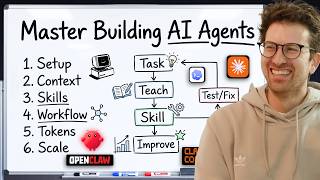

Models Are Good Now – Context Still Matters
39sChallenges common AI skepticism by stating models are finally good, but context is the real differentiator.
▶ Play Clip"Provides actionable steps for building agent skills, but the generic title undersells the content."
Ross Mike explains how to effectively use AI agents by building custom skills through iterative workflow development. He argues that pre-made skills and excessive agent configuration files are often unnecessary, and that the key to productivity lies in teaching agents your specific processes step-by-step.
Current models like Opus and GPT-4 are exceptionally capable, but context and user steering determine output quality.
Agent context includes system prompt, agent.md files, skills, tools, codebase, and user conversation. Progressive disclosure via skills saves tokens.
95% of users don't need an agent.md file unless they have proprietary information. Most general instructions waste tokens and degrade performance.
Skills use progressive disclosure: only name and description are in context until needed, avoiding token waste.
Do not jump to creating a skill immediately. First, walk through the workflow with the agent step-by-step, then convert the successful run into a skill.
Ross taught his agent to research sponsors by guiding it through each step (check Twitter, Trustpilot, funding) and only created a skill after several iterations.
LLMs do not think or understand; they predict tokens. Provide step-by-step instructions tailored to your workflow.
It takes about two weeks of investment to get an agent working well. Expect failures and iterate by identifying errors and updating skills.
Your specific workflow, taste, and strategy are what the model lacks. Skills capture that uniqueness.
As context fills, model performance degrades. Use skills to keep context minimal and rely on model strengths.
Building effective AI agents requires investing time to teach them your specific workflows through iterative skill creation, rather than relying on pre-made configurations.
What is progressive disclosure in skills?
Only the skill's name and description are added to context; the full content is loaded only when the agent decides it needs the skill.
03:28
Why is an agent.md file often unnecessary?
It wastes tokens because it's added to every conversation turn, and general information is already known by the model.
02:03
What is the first step in creating a skill according to Ross?
Identify a workflow but do not create the skill immediately. Instead, walk through the workflow with the agent step by step.
08:30
Why do agents often fail initially?
Models are token predictors and do not truly understand; they need explicit step-by-step instructions for your specific workflow.
10:23
How should you respond when an agent makes a mistake?
Ask it why it failed, then instruct it to fix the error and update the skill file accordingly.
21:50
What is the recommended approach to using sub-agents?
Start with one main agent, build up skills, then add sub-agents only when they naturally fit your workflows.
25:53
Why should you avoid downloading skills from marketplaces?
They lack context of your specific workflow and can be a security risk.
12:54
Models Are Good, Context Matters
Sets up the core thesis that current models are capable, but user guidance determines success.
01:07Progressive Disclosure of Skills
Explains a key technical advantage of skills over monolithic prompt files.
03:28Build Your Own Skills, Don't Download
Emphasizes that custom skills tailored to your workflow are more effective.
12:28Expect Two Weeks of Investment
Manages expectations by explaining the upfront time needed to train an agent.
23:44Skills Capture Your Uniqueness
Highlights that your specific workflow is the competitive advantage the model lacks.
29:11[00:00] Ross, Mike, welcome back to the pod. By the end of this episode, what are people going to learn? I hope I'm going to share some wisdom on how you can use the agents better. There's a lot of information going on right now. I disagree with most of it.
[00:13] And that's what we're going to talk about. But at the end, when you're building something, using an agent for some sort of work, you have the best output possible. And is this going to be a technical dive or, you know, a non-technical person can...
[00:25] Anyone can watch this. There's going to be a lot of diagrams. That's all. You're going to make it clear to understand the concept, right? Easy. Okay. Basics. Let's go. So.
[00:42] The first thing that I want to announce, previous episodes, we probably disagreed with this point, but now what's true is the models are good. The models are exceptionally good. Opus 12.6 is amazing.
[00:54] TVD 5.4 is amazing. I know there's like two sets of campers, especially when it comes to programming. People are like, oh, Opus is the better UI designer, GDT 5.4 is the better backend. Generally speaking, we've reached the point, we're not at AGI yet,
[01:07] we've reached the point where the models are good. But context still matters. And you have the power to steer the models in a direction where you can get quality or you can get flop. And that's what I really want to talk about.
[01:21] But before we get into all that, feel free to cut me off because this topic excites me. we need to learn how context works and context is the model assembly information that it needs to execute an action and the way the context is
[01:36] assembled let's say in the coding agent but really in any sort of agent is there's this general system prompt usually by the model provider so for example cloud code leaked recently and one of the cool things that especially
[01:49] as a developer I got to do is I got to read the system prompt so they have this general system prompt that guides the model on how to act, what to do, what not to do. The system prompt is very important. And then you have, a lot of people have agent.md files or quad.md files.
[02:03] Now, I'm just going to say off rip, 95% of people don't need this. The reason being is, again, you have to assume that the models are already good, right? Now, imagine I told you, Greg, every time we're about to shoot a podcast,
[02:17] Greg, you need a microphone. You know you need a microphone, right? You've done this plenty of times, right? So if I'm building, like, let's say a website with cloud code, and I'm telling cloud code, this code base uses React.
[02:31] I don't need to because it has the code base in context. It can check the code, right? So there is this disparity where a lot of people are putting a lot of onus on the hardness and the context building. And I'm low-key starting to strip things off.
[02:46] Like, I'm going super, super minimal because, again, not to sound like an anthropic or open AI show. Unfortunately, I have not been acquired. None of them are paying me. But the models are really, really good. Wait, so 95% of the time, I don't even need to bother with an agent MD file?
[03:02] You don't. Unless this is some sort of proprietary information. Yeah, what is the 5% of the time I should care about it? Proprietary information that may be specific to your company or some methodology that is specific to you
[03:14] that has to be referenced in every single conversation. Because the annoying part with an agent.md file is every time you go back and forth with the agent, it's added in the context, right? The cool thing about skills, and I'm going to talk about skills in a second,
[03:28] the way skills are designed, the skills are used in a way that's called progressive disclosure, meaning when you have a skill file, the entire thing is an added to context. It's just the title and the description.
[03:41] So the agent has the title and description in the context, and let's say you have a Notion report skill, right? and you tell your agent, hey, I want you to create a Notion report, it's then going to check its context and be like, oh, I have this skill.
[03:56] Let me check out the entire document. So it's not in the context. What's in the context is the name and the description, but that's enough for the agent to be like, oh, this is a skill I need. Let me go use it, which is fantastic.
[04:08] I'm a skills maxi, and I'm going to show later in the episode how you craft the perfect skills. But with agent.md and cloud.md files, it's context being added at every turn right so let's say you have like a thousand like line file
[04:23] quad.mp and let's say that's like 7 000 tokens you're spending 7 000 tokens on every run now do you need to most likely not it probably should be a skill but if you have some sort of
[04:35] company proprietary information or like there's something specific that you do that the model needs to run every single turn then you use it the thing is 95 percent of people don't have that right so I'm not a fan unless that's the case so and the reason being is we're
[04:52] wasting tokens right it's in every single turn but this is where the beauty of skills come I'll show my screen here the your skill again this is not like word-for-word how it looks but a skill basically looks like this there is a
[05:08] name there is a description and then underneath is a bunch of information I'm I'm going to put a bunch of info. When you create a skill.md file,
[05:20] what gets added into the context is actually just the name and the description, right? The bunch of info doesn't get added. So imagine you have two sentences versus an agent.md that has like a thousand lines
[05:33] that get added into the context. We're talking thousands of tokens compared to a couple hundred. And the agent only gets a bunch of info when it realizes it needs this skill. So, if I have, let's say, a certain way of generating a report, a certain way of structuring my code, why would I put that in the agent.nd file when I can have the agent call on it progressively when it needs it, right?
[05:57] So, this is why skills are, honestly, like I'm a shill, I'm a maxi, but people do it wrong, and I'm going to share the right way on how do we create skills. So, so far, we have the system prompt, the agent.nd, the skills, and then we have the tools, right?
[06:12] So if you're using cloud code, there's already built-in tools, a read tool, a write tool. There's many tools that it uses. This has to be added into the context because the model doesn't call the tools. It's the agent harnessed around it that allows it to call the tools.
[06:27] And then in this case, we also have our code base, right? Like whatever, if we're building a web app, a mobile app, I know most people here won't care for the specific framework. And honestly, we're getting to a point if you're not technical, you really shouldn't.
[06:39] And then we have the user conversation. So this is what the complete context window is filled with, right? And this can total up to, let's say, like, at the beginning, this could be like 20,000 tokens.
[06:51] And as the conversation continues to grow, you might reach your limit of 25,000, 250,000 tokens. And that's when you see both quad code and open AI codex, they'll compact, right? So beautiful so far, right?
[07:04] This is how context works. Why skills are important and how you should generate skills. let's say I have a specific workflow for example for my YouTube channel we're at a point right now
[07:16] Greg where we get sponsored now crazy when I first came to the pod not a thing it was just her so in love but now we get sponsored
[07:28] I get a lot of emails some are good some are bad and it's a lot of time I'm sure you're aware to comb through and to check so I have an open call agent that has its own email, right?
[07:40] I haven't given it access to my email because there's like attack vectors and I haven't hacked before, so I'm very careful with these things, but it has its own email. And every time I get an email from like a sponsor, I forward that email to the agent.
[07:54] Now, the first time I told my open call agent, I'm going to forward you emails, check every 15 minutes when you have an email, and when you check the email, do research on the sponsor and tell me they're worth it.
[08:06] That's all I told the agent. every sponsor email I sent it, it was like, legit, legit, legit, perfect, perfect, perfect. There was no, like, there was no rejection. There was no, this is bad, or these guys are a scam,
[08:18] or this product's not good. Like, there was no deep research being done by it. So then I realized, huh, okay, the model needs a step-by-step guide. This is when I create a skill.
[08:30] But here's the problem. A lot of people will, I'll just write it down here, will identify they have a workflow, you have some sort of workflow, and then they'll jump to create the skill right away.
[08:42] This is the let me click hide here this is the worst thing you can do I just going to draw arrows to signify that this is bad You don do these And the reason why you don do this is imagine you hire an employee or you mentoring somebody
[09:01] Correct me if I'm wrong. You're probably going to tell them what to do, and if they ask you questions on how to do it, you'll help them. You would ideally like them to fail, and then you want to then tell them,
[09:13] oh, this is how you do it. Like, there needs to be some sort of experiential learning. The way I've been creating skills, Greg, and I have like 100% hit right now when I tell my agent to do something specific, is I actually walk with it step by step on doing the workflow.
[09:28] So in the case of my YouTube analysis, I told the agent, okay, I just sent you an email. Tell me about the company. Company this, this, that, and that. Okay, check their Twitter. Check their YouTube. Check their Trustpilot.
[09:41] Check if they raised any money. if two of these are have not if two of these don't exist are not in good standing automatic rejection it checked it was like you're absolutely right i was using opus um these uh this is not a
[09:54] good company and then it would just we would we have a spreadsheet in google sheets it'd be like no contact it's so frustrating to you right because you're like you give it a task and it seems like so binary like right or wrong and then when you tell it hey like why didn't you look at
[10:11] a truck pilot. Why didn't you see if they raised money? You're absolutely right. You're absolutely right. What? And the thing is, the reason why this is the case is, the models actually don't think.
[10:23] They're predictors of tokens, right? So, when you give it English, when I give it English, it maps it on this vector graph and then it looks for the closest resemblance and it says, this is the response, right? So, when you say, what is the capital of
[10:35] France, it maps it again on this graph and it says, oh, Paris is pretty close, right? And it gives you Paris. It has no it doesn't think it doesn't understand it feels like it understands it feels like it thinks heck it even feels like it has emotion that's because it's been trained on so much data
[10:49] but it actually does not know how to think and this is where a lot of people be frustrated um with like why is it not understanding you have to walk with it so i told it okay this is how you research and it's like okay it researches and guess what this is part of the context and like
[11:05] okay now that you're done researching when it's a good company these are the qualities you look for And then when it's really good, send me an email. And then once we had a successful run and we did it again and again, then I converted it to a skill.
[11:19] The reason being is a lot of people create the skills themselves, or I mean, they'll use the AI to create the skill, but it doesn't have the context on what a successful run looks like. Because most of the time, especially if you use an open call, it's probably going to fail a daily API call.
[11:32] It's probably going to call the data wrong. There's so many places it's going to get wrong. And I see a lot of people saying, this is so frustrating. this is terrible technology why doesn't it work because you don't understand how an agent works right it will mimic you perfectly and you're giving it nothing to mimic right so i will do
[11:49] the workflow myself so the the updated version is identify the workflow go back and forth and teach it so like i'm doing it like i'll be like okay first do the research here's the result and i'm
[12:03] like what do you think about this oh these guys are terrible you're absolutely right okay what do You should go to the Google Sheet and mark this as that company. I've done that. Once I've had that back and forth, then I tell the AI,
[12:16] review what you did and then create the skill. So now it has actual context of how it worked and it's going to create the skill beautifully.
[12:28] I don't handwrite skills. I don't think you need to. You can use AI to do it. They even have a skill to create skills, skill section. but you should have the context of what a successful run looks like and this is why by the way Greg I
[12:40] don't install skills like I've seen people like oh this motion skill this social media skill whatever I'll review it I'll check it out I'll even give it to my aunt and be like oh what are some things you can learn from this but I don't download skills because your engine needs the context
[12:54] of a successful run which you then turn to skills right and this is the big thing I see you see skills marketplace as you see download this and that first of all it's an easy way to attack somebody so i would be very very careful with downloading some random person skills but second
[13:12] of all again it's all about context right it's all about and you know open claw has a memory layer and all these type of things you want it to do the right thing and the only way you can do the right thing is if you give it the proper context and to me the best way to create a skill is to work with
[13:30] in your specific workflow. Once you have a successful tele-book, you review what you just did, this is the skill you need to create. I'll pause here. I mean, it makes sense, right? Because if you hired an employee,
[13:42] you would do the same thing. Yeah. You wouldn't just be like, okay, go do this thing, good luck. Yeah. And by the way, this is how you're going to go do things forever. You would map out a workflow. You would identify what right and wrong is.
[13:57] You would do it iteratively. and then once you've gotten to that point, you would codify it, 100%. And I think that's the thing. We should treat models and these agents
[14:09] like very new employees versus these black magic boxes that know everything, right? They know everything because they've been trained on a lot of data, but they don't know your workflow, your steps, right?
[14:22] So I see a lot of people who have, you know, 15, like right off the bat, set up OpenClaw and 15 sub-agents, 30 skills, yet you haven't even set up your own workflows, right?
[14:36] And these things are cool right off the bat and there's a perfect time to use sub-agents. I use sub-agents a lot. But the way you build, like I call it scaling for productivity, not scaling for what looks cool, right?
[14:48] Like I've seen, for example, paper, paper cookbooks are awesome, cool. I use it, I love it, right? But I think people would be more productive if they built up from scratch their own version.
[15:00] Meaning like, okay, you have your own like, you know, like editor, right? Content creator. So you're asking people to do the work. 100%, 100%. Because the thing is, it's like, look, I'm in a position where like,
[15:13] people using like these beefed up things make a lot more sense for me. And the reason being is like, I can build a product like that. Like, I know what your audience wants. I know what my audience wants. Like, you know, heck, I can spin up agents
[15:25] and build this thing, right? But if I'm going to be completely honest, if you want to scale for productivity, it starts with one agent and you building up the skills. And then, okay, now you've built up some skills and now you add a sub-agent and your one agent manages multiple agents, right?
[15:38] Like, imagine this. Like, imagine I start a company and off rip, I have 10 employees. Never managed a team in my life. Heck, I don't even have a really big family. So, like, I'm a loan...
[15:50] You know what I mean? So, it's like, you have to sort of... Yeah, it's not sexy. and I apologize if this is not the cool thing people wanted to hear, but you sort of have to put in the work and build it up. And I personally believe you're building skills,
[16:04] like your personal human skills, not skill.md files, that when the models get better, when the agents get better, you will be more valuable. Because at the end of the day, as long as there's no new paradigm for models,
[16:16] LLM just predict tokens. They don't understand or know the way you and I do. Right? And this is why although like the job scene and all this stuff is scary, I genuinely believe anyone who knows how these tools work
[16:29] and knows how to build agents and craft skills and knows how to make them productive, we're in for a good run. So you're saying that if you know how to do this, you won't join the permanent underclass?
[16:41] The permanent underclass! Is the permanent underclass basically, like I've seen this on Twitter a lot, is that basically AI has replaced you, so now you're just...
[16:54] From what I understand, it's once AGI comes, all these white-collar workers are going to lose their jobs. And if you don't know how to build skills, use AI,
[17:09] people say you're joining the permanent underclass. That's the term. It's permanent underclass. I just have a little bit of time left. Yeah, by the way, it's ridiculous to call it a permanent underclass.
[17:22] Yeah, because that's their fight. I can understand underclass. But vermin, vermin, it's like, like you say, there's no hope. No. Yeah. I mean, we are in, like, knowledge that took 20 people, 20 years to acquire is now, like,
[17:37] 20 bucks a month right So there is like a huge shift right People who are non are I think I saw yesterday like some guy who had like million and he vibe the whole app
[17:49] I think it was him. $1.8 billion. Billion? Yeah. So you know what I mean? Like, it is the... There is a shift, right? And I think this idea of, like... I love how you're, like, billion.
[18:01] You're about to just leave this podcast and just be, like... No, you know what it is? I just realized, man, I overthink things. Like, I just need to drop the thing, release the thing. And there's, like, wisdom in that. Like, there needs to be this level of delusion, which I don't have.
[18:14] Like, I'm trying to work on. We're like, this is just going to work out. We're just going to launch the product. It's going to succeed. And if it doesn't, on to the next one. Because 1.8 billion. Yeah, dude. Like, B? B.
[18:26] USD? Yeah, we're not talking monopoly. It's a Canadian. it's we're not talking carny coins we're talking
[18:41] real benjamin yeah yeah that makes sense that makes sense but yeah like I hope this like understanding of like again I personally don't think you don't need an agent.md file unless you have something proprietary
[18:53] skills are valuable build your own though build build your own like you know like when you asked your mom when you were a kid oh can we have McDonald's and she's like we have food at home we have food at home build your own skills for
[19:06] coding perspective from coding wise um a lot of the companies model companies have realized that the agents are really good at writing code particularly typescript and this is why there's
[19:21] been like you see this advancement with like quad co-work and like even open claw really what they're doing under the hood is they're writing code right they're writing code calling apis and all this stuff. So when it comes to building a project, you actually don't need skills or like you don't
[19:39] need an agent MD file specific to the text that you use. Like I remember we used to, I'm using React and, you know, Convicts or I'm using Next.js and SuperBit. I'm using this and I'm using that. And you put that in the agent MD file. You have like all these lines. For the most part,
[19:54] unless again, you have a specific, specific workflow, unnecessary. And the reason being is Code itself has become context now. So the more important thing is starting with a solid foundation.
[20:06] Templates used to be big back in the day. People made lots of money with templates. I believe templates are going to have a renaissance because if you have a solid template, whether it be for a web app or a mobile app,
[20:19] because that becomes context for the agent, it's going to build on top of that. And again, I didn't need some large agent.md file. I didn't need any large cloud MD file. What I needed was, again, minimal context usage and skills.
[20:36] So if there's anything anyone can learn from me, is build your own skills. Build your own skills. And there's this methodology. I don't know if I've shared this with you, but personally building skills. So let's say you've built your skills, right?
[20:48] I have, I'll draw a diagram because why not? Let's say I have a workflow. and after setting up my workflow with an agent, I've decided, you know what,
[21:00] I'm going to turn this into a skill, right? So this is my skill.mp. Now, here's the thing. Even though you have the skill.mp, the agent at some point is still going to mess up
[21:14] because there's probably gas in the information it has in the skill. So when it messes up, I'm going to work with it again. How do I work with it? You messed up. try calling the API again try doing this again
[21:26] or even ask it when it tells you oh I failed I couldn't do this task believe it or not when you tell the agent why did you fail when you ask it like what's the error that you got it will tell you descriptively oh I got a 505 error
[21:38] you have insufficient credits like oh okay so it's a credit issue fine so I would tell it that and then I would pass that failure back to the agent
[21:50] so let's say it did something wrong we identified the failure, all I did was asking it. I will give that failure back to the agent, I'll be like, you failed here, this didn't work, fix this. It's going to fix it, it's going to
[22:03] write code, it's going to do whatever it does. Once it fixes it, and it's done it right, now you tell it, with the new fix, update the skill, so this doesn't happen again. I have, like for my YouTube channel, I have like a report generator, it calls motion,
[22:18] Dove analytics, YouTube analytics, Twitter analytics, it pulls from like eight data sources. There's no way you're going to one prompt and the agent's going to do it. But every time I tell it to do that work, and it takes like 10 minutes, it executes it flawlessly.
[22:33] Why? I went through five loops of this. Five iterations of recursively building this skill. And that skill is so good, I genuinely think if anyone's going to, if like skills marketplace is going to be a thing,
[22:46] there's going to be people who sell skills like really well defined like step-by-step skills because people are just creating them without having built out the workflow with the agent right so use the workflow by hand like telling it each step once it's done it completely
[23:03] print the skill out in default continue to use it it's going to mess up when he messes up you thank god you don't complain because a lot of people are angry no this is the moment where You identify the error, tell it, this is the error, fix it.
[23:17] It will fix it itself, and you tell it to update the skill file so that this doesn't happen again. So that's a little bit about shifting your expectation, right? Because people just assume it's going to work in the beginning.
[23:31] You're saying basically it's not going to work initially. There's going to be two, three, five, six hiccups. And over time, it should be good. So this is most people's expectations.
[23:44] right yeah and the way i've personally experienced is it's like this so there's like this early area of investment that you have to make that sucks that nobody will tell you especially agent harness
[24:00] this company because they wouldn't raise as much money as they did but like this maybe i would give it two weeks because it took me two weeks like open call when i first set up open claw i thought the same time like what what is this garbage and like it doesn't understand if he's confused and
[24:14] And then I realized, oh, let me go lower level. The models and the agents, they don't think like you and me. I could tell you, hey, Greg, we need a report on the financials and no shit.
[24:29] Because you probably were in the same business, we worked together, you would understand based on the context you have in the business what that means. But imagine a new guy joins, like, yeah, I need a report on the financials. You know what it reminds me?
[24:41] I wonder if we can put this clip in, but in the office... You watch The Office? I am not an office lecturer, unfortunately. There is a clip that there's a new boss, and the new boss goes to Jim, one of the main characters.
[24:57] Yeah, and he asks for a rundown. So go The Office, The Office, rundown. Oh, no. basically the whole
[25:11] episode is about Jim trying to ask around and be like what is a rundown like what is a rundown he's like calling his dad like what is a rundown you know what I mean he's just he didn't have the context
[25:25] he didn't have the context and it goes back to my initial point the models are really really good now but the context matters more than anything right so when you see like these large agent like companies and sub-agents and again I'm not saying those don't
[25:40] work but I'm saying probably won't work for you off rip because you haven't built it up to get to that point right so let's say like for me for example I started with um one agent let me draw
[25:53] this I started with one agent and this was like my main agent this did everything right this checked my spreadsheet this checked my sponsors email and all these types of things and once I have like predefined workflows, let's say for like working with sponsors, then I can actually have a
[26:10] sub-agent. What's the purpose of the sub-agent? The sub-agent does all the marketing stuff, right? But I'm not creating the sub-agent for the sake of creating it. It's going to have skills, it's going to have context, and it actually makes sense for me to have sub-agents, right? So I've built
[26:24] out my state to like now I have five sub I have one for marketing one for business one for personal and that it And I willing to bet if I want open call to open call with anyone my system is more productive because I didn scale for what looks cool
[26:41] I scaled for productivity. That was a bar. That was a huge bar. We got to quit that. I was just thinking that clip, that's going to rip. Yeah, that was a bar. What else do you want to leave people with?
[26:54] This is the main point. Yeah, we've got to put where the models are good. the models are really good, the context matters plus the hardness, right? So, for example, there was this benchmark, although I'm not 100% supporting it,
[27:09] that there was a difference between the quality of output that cursor generated versus cloud code versus codecs, right? So, what that tells me is that we've reached the point where the models are really, really good.
[27:24] They're probably going to get better. The next iteration is probably going to get better. but the harness and the tools that you surrounded the context that you give it is going to matter even more and just like in everything in life less is more right like building up step by step
[27:40] making it productive for you first before you add the shiny new thing like because i tried all these tools all the time like especially paper for paperclip blew up and a lot of people have been talking about and it's fantastic but i'm willing to bet if people took two weeks to build up to
[27:55] a version, because you can prompt OpenClock to do all that stuff. If they built up their own version of Pay Per Click in two, three weeks, where they're building things that they actually need, their productivity level will skyrocket through the roof.
[28:07] It's a hot take. It's a hot take. It might get me in trouble. No, it won't get you. Who's it going to get you in trouble with? Maybe Pay Per Click leaves a billion dollars and they go and acquire my podcast. I think, listen, you're out there, you're trying things, and you're just sharing what
[28:22] you're learning in real time. so if you're just things can change by the way like two weeks from now it could be like no the age and everything there's this new memory paper that Google released
[28:34] and like now like it has the ability to index information and stuff but as it pertains to real life less is more simple is better right if you can't explain it in a few sentences
[28:46] you probably don't really understand it right and I find that the models are trained on so much information especially when it comes the programming, building, and what do you call it, day-to-day work, like financial work
[28:58] or any sort of checking contracts and stuff, the model companies are focusing on that, like on white-collar work. The models are really, really good. What matters more is the harness and the tools you provide.
[29:11] And the one thing that you and I have that the models don't have is my specific workflow, my specific taste, my specific strategy of doing things, and those can be codified in skills, right? This is why skills make sense when you build them.
[29:26] If you download my skill, like I have this one skill. Don't download it. I'm telling you now, do not download it. Don't use it. I just put it so I can get some GitHub stars.
[29:39] I have this one skill, and it's literally a code structure skill, and I'll put the mark down so people can see it. It's 160 lines. It's basically after AI has generated a bunch of code.
[29:51] I like it structured in a certain way so it's easy for me to review it and like I mentioned earlier with skills the only thing that gets added into context is the name and description so when I look at the name it's called structure when I look at the description
[30:03] use when multiple workflows do the same operational logic when deciding that blah blah blah some nerd stuff so when I tell the agent I want to clean up the code structure it checks the skills it has
[30:15] it sees the name it reads the description it's like oh this makes sense then it progressively discloses meaning once it realizes it needs this skill then it adds the rest of this right versus if this was my agent.md file imagine every single time and we can actually
[30:31] check how many tokens this is let me check um what was it open ai token tokenizer if i go to this so this is 944 tokens so if this was an asian.md file every single time i have a chat i'm adding
[30:51] 944 tokens tokens being cheap now no but if i just have the name and the description says 53 that's not even cheap it's just like you're not trying to hit the limit quicker than you need to
[31:04] hit the limit because the model will get dumb as the context closes right so if you have like a context window and I can draw this out if this is your context window and like the optimal is
[31:18] you're between like there's always like maybe like 10% already filled with all the system prompt and all that stuff you want to be between like you know fresh to like 70% because the closer you get to 99 100% like 99 90 80% it starts to get dumb right and you can
[31:35] think of this like a human. Like imagine you throw a bunch of information again and again and again and again. And this is why like when I like was in school, like last minute study never worked for me. Because like I didn't pay attention the entire year. Now I have to learn about polynomials and I
[31:51] have to do these graphs and there's this weird notation. It's impossible for me to catch up, right? And it's the same way with the agents. You want to keep your context. You want to save your context because it saves you money but not only that it makes a more
[32:05] performant agent so less is more less is more rely more on the model strength and what the model needs is what's unique and special about you your work for your business not general knowledge don't tell the model use react it knows to use
[32:21] react don't tell the model you know things that like should already be known for the purpose or like you know traffic for example like let's say I'm doing a financial report and in the agency MD file I say to denote money use a dollar
[32:37] sign it's good to use a dollar sign right now if you have a specific currency then you like all use this currency this is it you know like for something that the agent won't do manually like won't know manually that's
[32:52] when you have like your agent on and these are done and these but honestly these are forced. You don't need them. Skills, skills, skills, skills, skills is what it's at. Thanks for keeping it real.
[33:04] I appreciate you, man. No, I appreciate it. Like always, I'll include links where you can follow Ross Mike on YouTube and X and other places in the show notes in the description.
[33:16] So go follow him there. Always clearly breaking down things. We, uh, I have to be real with you. You weren't going to come on the show today. I wasn't, and I'll be honest. I told Greg, and I'm just going to be frank,
[33:28] I'm like, I don't have that banger, you know, something new dropping, let's review it, because if we're going to be honest, there's not that many tools dropping nowadays. Like, unfortunately, the big dogs are running the show.
[33:40] Yeah. The quads and the orthotics and the opening act, especially when it comes to general purpose and coding, they sort of run the game. So they're releasing updates,
[33:52] and, like, all the stuff has already been covered. I don't know if I have anything valuable. And what did I say? You're like, the people, you know, you got to think about impact. You got to think about what, you know, this could apply to someone. And you showed me like a text.
[34:05] I sent a text to you. Yeah. I'm going to pull it up. I sent a text to you of someone who saw a video that we did together.
[34:17] And that video got him into coding. Now he's running a cake business. He's making $150,000 a year and growing. And he said, the Greg and Ross Mike episode in November last year is what got me into coding.
[34:32] I've recommended to everyone asking how to start out. And I just sent you that text and I said, it's not about the numbers. It's not about, you know, because you said in the text, you want to see some fives, right?
[34:44] I need everything we do to get to 200k views minimum. Yeah, yeah, yeah. And I'm just like, I hope this gets 200,000 views or more, so like and comment to juice those out. But if it gets 2,000 and two people end up taking this information
[34:59] and changes their business, their productivity, how they think about things, then, you know, I think that's why you and myself have been put on this planet Earth to inspire people to get their creative juices flowing.
[35:13] And so I thank you for coming on and taking time out of your day. And I appreciate the motivation and, yeah, I hope this helps somebody and can't wait to be back with more. Absolutely. All right. Catch you later, dude.
⚡ Saved you 0h 35m reading this? Transcribe any YouTube video for free — no signup needed.