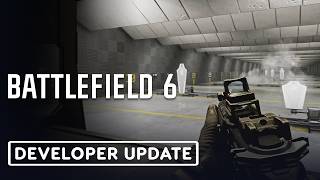

Battlefield's New Gunplay Philosophy
42sGamers love behind-the-scenes insights into game design, especially when it promises improved mechanics and depth.
▶ Play Clip"Title promises gunplay details and delivers specific mechanics and philosophy, though it's a developer update rather than pure gameplay showcase."
This video introduces the 'Battle Recombat' series, focusing on the evolution of gunplay in Battlefield. The developers discuss their philosophy of making each weapon feel unique and rewarding mastery through three core skills: aiming, recoil compensation, and weapon knowledge.
First installment of Battle Recombat series covering combat philosophy and upcoming gunplay changes.
Mastering gunplay requires aiming, recoil compensation, and weapon knowledge.
Recoil made more consistent; bullet deviation increased after first shot to reward controlled bursts at range while keeping full-auto viable in close quarters.
Muzzle velocity and bullet drag tuned to make anticipating distant targets more important.
Weapons placed into archetypes (e.g., LMG heavy, SMG snappy) to give each category distinct feel; players can customize within limits.
Close-range TTK kept fast for clutch plays; body damage multipliers adjusted to reward precision across all ranges.
Includes sole invisibility, body damage changes for long range, recoil adjustments, and a new network bandwidth priority system.
These gunplay improvements will go live next week, with future updates covering vehicles and gadgets. Player feedback is crucial for balancing.
What are the three skills required to master gunplay in Battlefield?
Aiming, recoil compensation, and weapon knowledge.
00:55
How does bullet deviation change after the first shot?
It is slightly increased to reward controlled burst or tap fire at longer distances.
01:09
What is the purpose of tuning muzzle velocity and bullet drag?
To make anticipating the movement of distant targets more important for long-range engagements.
01:36
What are weapon archetypes and why are they used?
Archetypes categorize weapons (e.g., LMG heavy, SMG snappy) to give each category a distinct feel in weight and handling.
02:04
Why is close-range TTK kept fast for automatic weapons?
To allow players a chance when outnumbered and enable clutch plays.
02:46
Depth and Character of Gunplay
Establishes the core philosophy that every weapon should have notable character and gunplay should have depth.
00:30Recoil Consistency and Burst Fire
Explains specific mechanical changes to reward skill and technique.
01:09Weapon Archetypes
Describes how archetypes define weapon feel and customization limits.
02:04TTK and Body Damage Tuning
Highlights player feedback integration and balancing for precision.
02:46[00:00] Welcome to the first installment of Battle Recombat. A series where we take you through our combat philosophy, showcase how it's improving and evolving, and give you a taste of what's
[00:12] coming very soon to the game. Today we're talking Gunplay. Every weapon should have notable character. Gunplay should have depth, and infantry combat pacing should create various types of engagements on every map and mode.
[00:30] Aiming and improving the depth, character, and pace of gunplay, every time we add new content to the game, is key. As usual, we always test the changes in labs first to make sure they're resulting in positive, consistent improvements before bringing them over to the live version
[00:42] of the game. Mastering Gunplay comes down to three skills. Aiming, recoil compensation, and weapon knowledge.
[00:55] Aiming is of course a foundational skill for battlefield, but to master automatic weapons, you need to embrace and master a deeper shooting technique. To reward proper technique, we slightly increase bullet deviation after the first shot. Making
[01:09] control burst or tap fire even more important for accuracy at longer distances, while keeping full-hour viable for close quarters encounters. We've also made recoil more consistent and predictable
[01:21] across all weapons, allowing skill players to better stay on target. Combined, these changes reward players with master their shooting technique. We also want long range engagements to be more interesting, which means ballistics should matter more the
[01:36] further away you are from your target. To this end, we've tuned muzzle velocity and bullet drag to make anticipating the movement of distance targets more important. The final skill required to master gunplay is weapon knowledge, knowing all its strengths
[01:51] and weaknesses so you can optimize its performance for every encounter. This includes understanding the weapon's ideal range and other attributes that give each weapon its own personality.
[02:04] We start by placing weapons in one of several archetypes. These archetypes ensure every weapon category has its own feel in terms of weight and handling. It's why a bell-filled machinegun feels heavy and powerful while an SMG feels snappy and reactive. Players can further customize
[02:21] each weapon to balance its strengths and weaknesses to fit their playstyle, but only within the limits of its archetypes. Mastering all three of these skills can push a weapon's performance beyond its baseline comfort zone and make it viable in most combat situations. This flexibility
[02:34] encourages players to be creative, to find the limits of each and every weapon. An infantry combat, pacing and weapon balance are heavily influenced by our type of kill,
[02:46] also known as TTK. A close range, TTK for automatic weapons is fast. This is key to allowing players to have a chance when they are upnumbered. Slowing down TTK in these situations would limit
[02:58] opportunities for clutch plays. That said, we've heard your feedback and we have tuned the amount of damage down to specific parts of the body to further reward precision across all engagement ranges. Your feedback is invaluable as we work to balance and improve features such
[03:17] as sole invisibility, body damage, multiplier changes specifically for long range fighting, recoil adjustments across a wide range of weapons, and a new network bandwidth priority system to manage critical enemy updates, fixed skip server inputs and better improved latency for
[03:32] incoming and outgoing damage. For even more details on these changes and our approach to gameplay, you can head on over to the Battlefield website to read an in-depth breakdown. All these changes will be making the leap from labs into the live game next week
[03:46] and we can't wait to hear your thoughts. The future state of combat updates will be taking a deeper look at vehicle play, gadgets and more, so stay tuned for that and we'll see you on the battlefield.



⚡ Saved you 0h 04m reading this? Transcribe any YouTube video for free — no signup needed.