
Built & Sold AI App in a Weekend (No Code)
45sHigh aspiration and disbelief factor: quitting corporate, building an AI app without coding, and making a sale in one weekend is inspiring and controversial.
▶ Play Clip"Title accurately reflects the video: the creator builds and sells an AI app in one weekend without coding."
The video documents the creator's journey of building and selling an AI app in a single weekend without writing any code. It outlines a four-step process covering ideation, building, launching, and marketing, emphasizing the use of AI tools and a problem-solving mindset.
The creator quit HSBC, got a master's from Imperial, and built an AI app in one weekend without coding, getting a sale.
Build an app that solves a deep, repetitive pain point, not just a cool app. Look for problems that people will pay for repeatedly via subscriptions.
The creator suffered from doom scrolling and built Kaizen to provide productive content with the same dopamine hit as social media.
Use Verlo to scan short-form data trends, and Reddit to find and validate problems in subreddits.
Used Anything AI's app builder (no-code) with built-in database and automatic App Store publishing. Also used Whisper Flow for voice prompting.
Applied the Pareto principle: focus on onboarding and a hard paywall. Used RevenueCat for subscription management.
The app was rejected three times; an appeal got it approved. Expect rejections and be prepared to resubmit.
Launch is a process, not a moment. Create authentic, low-effort content (e.g., using Meta Ray-Ban glasses) with 'TikTok shop energy'.
Short-form content on TikTok/Instagram, Reddit promotion (non-spammy), App Store search ads, and Meta ads (after 3-5K MRR). Used Mockingbird to clone competitor ads.
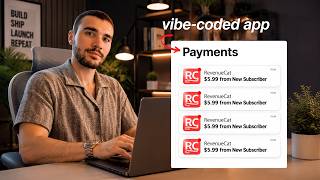
Got a weekly subscriber at $5.99/week. Validation that the app solves a real problem.
Building and selling an AI app in a weekend is achievable without coding by focusing on a real problem, using no-code tools, and executing a solid launch and marketing plan. The first sale validates the idea and paves the way for scaling.
What is the first step in building an AI app according to the video?
Nail the right idea by solving a deep, repetitive pain point that people will pay for via subscription.
00:52
What tool did the creator use to scan short-form data trends?
Verlo.
02:00
Which no-code app builder did the creator use?
Anything AI's app builder.
04:07
What is the Pareto principle in the context of building a consumer app?
Focus 80% of effort on the 20% of activities that drive 80% of revenue, such as onboarding.
05:26
What external service did the creator use for subscription management?
RevenueCat.
06:19
How many times was the app rejected before approval?
Three times.
06:31
What is the recommended approach to promote an app on Reddit?
Weave the app into genuine advice posts, not outright promotion, to avoid being banned.
10:01
At what MRR does the creator recommend starting Meta ads?
After 3 to 5K MRR.
11:04
What tool did the creator use to clone winning Meta ads from competitors?
Mockingbird.
11:16
What was the price of the first weekly subscription sold?
$5.99 per week.
11:42
No-Code App Building
Demonstrates that non-coders can build and sell apps using AI tools.
00:02Problem-First Ideation
Emphasizes solving a deep pain point rather than building a cool app.
00:52Pareto Principle for Apps
Applies the 80/20 rule to focus on onboarding as the key revenue driver.
05:26First Sale Validation
First sale proves the concept and provides a foundation for scaling.
11:42[00:02] months, I quit my corporate role at HSBC, got a master's degree in engineering from Imperial, founded and co-founded multiple businesses, and in one weekend, I built and got a sale in a brand new [music] AI app, completely
[00:14] from scratch without writing a single line of code. And in this video, I'm [music] four-step process I used to go from scratch to launching an app on the App Store and getting a sale. I'll share with you the ideation, building,
[00:28] you can do the same thing. Now, before we get into it, I want to stress something. I cannot code. Like genuinely, every single coding assignment I got with my engineering degree, I either failed or took someone
[00:40] there thinking, "Oh, this isn't for me." It literally is. Because the beautiful thing is that in 2026, you do not need to code to build an app. [music] You just need the right tools and a good idea. Speaking of which, step one in
[00:52] this four-step process is nailing the right idea. My biggest piece of advice here is don't try and build a cool app. Build an app that solves a deep, pain point and the more repetitious it is, the more likely someone will [music]
[01:06] that are going most viral right now, CalA.I., Puff Count, Lovely, they are all just monetizing a problem, [music] whether it's weight, vaping, secondary. It's just a vehicle to solve the problem. The actual pain point is
[01:21] why someone is buying a subscription [music] monthly or weekly. For my app because the main problem was doom scrolling. I was personally suffering from this, waking up and scrolling Instagram or TikTok for hours on end
[01:34] So, I knew there must be a more productive way to fix the doom scrolling issue. Having that same dopamine hit as an Instagram or TikTok, but with better, more productive content. And because this was a problem I was personally
[01:47] the only person in the world that also had this issue. So, I would first look within as to if you have any problems in your daily life and try and monetize that because you'll be the best person to consult for those problems. But if
[02:00] here's what I would do. Number one, you can use Verlo. It's a company that I co-founded which scans the whole of the short-form data market, so you can see reason I recommend this is because TikTok, Instagram, and YouTube Shorts
[02:14] will be a good indicator as to what is trending and what problems people have. So if you can utilize Verlo to spot those trends, then you're onto a winner. And secondly, consumer apps blow up through social media. So just like how
[02:26] next winning product, you can probably try and find the next winning consumer app idea through TikTok or Instagram. And if you can see problems people are talking about on social media and your app can genuinely solve those problems,
[02:38] can look is Reddit. Reddit is amazing because it has subreddits and subreddits are like communities of people bonding around a particular problem or topic. Now, I really like Reddit not only for finding problems but also validating
[02:51] your ideas. So for example, with my app that I built Kaizen, I went to a dopamine detox subreddit and I validated my idea there by asking questions like, scrolling? How have you fixed a doom scrolling problem?" Questions like this.
[03:04] My goal was not necessarily to sell my app Kaizen, it was more to do free market research and utilize those ideas when building my app. Because speaking paid me thousands of dollars to do market research when you can do this for
[03:17] free on Reddit, especially when starting out. And trust me, if someone is venting about a problem, that means it genuinely hurts them. And once again, the question at the forefront of your mind has to be, is this a deep and repetitive problem
[03:29] that someone would want to pay for again and again? Because the power of consumer apps is not the one-and-done purchase, it's the recurring subscription model, getting repeat purchases weekly, monthly, or yearly. That is how you get
[03:42] and how you can potentially exit apps for thousands if not millions of which was Kaizen, I moved on to step two, which is building the app. Now, this is the part where it gets fun because anyone can come up with an idea,
[03:55] but building apps were before reserved for only coders and developers. But nowadays, even people that can't code, like myself, are able to build apps and launch them on the App Store. Now, there's a bunch of AI app builders out
[04:07] there, Claude Code, Voic, Lovable, etc. But I used Anything AI's app builder. It felt like a good place to start. I'll link it down below so you can sign up you want to. I'll break down exactly what I did to build my app. So, number
[04:21] database, so I did not need to connect Supabase, for example. [music] I know this doesn't sound like a big deal, but imagine I was just starting out in this app building world, so any extra
[04:33] complexity was a massive pain for me. I wanted one place where it could just be all done in one hub with one software, and that was Anything. And then secondly, it automatically published the app onto the App Store for me. There was
[04:45] a button in the top right corner which said export and publish, and bang, it the App Store. So, what I did is I opened a brand new project and just prompted exactly what I wanted to build. [music] Now, to do this, typing out was
[04:58] Whisper Flow. It's got a free plan, as well. I'll link it down below, also. >> And it meant that I could hold the FN key on my MacBook and just speak, and [music] to prompt. This is just a personal thing that I prefer to speak
[05:12] obviously up to which method you want to go for. And as I was writing in the prompts, [music] the actual app was being built before my very eyes, split Now, these are the things I paid most close attention to when building my app.
[05:26] being built on a shoestring budget. We need to follow the Pareto principle, or the 80/20 rule, which basically means focus most of our attention on the 20% of to-do list activities which will get us the 80% of revenue and sales. And for
[05:40] a consumer app, that starts with onboarding. This is everything because I was running a hard paywall, meaning someone had to pay to use my app. There subscription. So, the first few plans did a lot of heavy lifting. I asked a
[05:53] really resonated [music] with my target audience. So, as they were going through This app is actually made for me." The user needs to really feel and the paywall, and they need to feel like
[06:06] problem. And if they don't feel enough of that pain or enough of the pain they won't pay for your app. Speaking of which, when it came to payments, the one external site I did link over to Anythink App Builder was RevenueCat.
[06:19] RevenueCat handled the paywall and the subscriptions for me, so I was able to track it in one internalized app on my phone. Plus, it's absolutely free until you hit 2 to 5K MRR, so it kind of pays for itself in that sense. Now, one thing
[06:31] the app to the App Store, I didn't get accepted right away. I would love to sit and rainbows, and as soon as I clicked submit, 24 hours later, my app was on the App Store, but it didn't quite end up like this. It took me three attempts
[06:45] were kind of confusing, and then the third one made absolutely no sense. So, just sent an appeal explanation saying, "Hey, have no idea why this isn't approved yet. This is everything I've got going on." And then, 24 hours later,
[06:59] you do get rejected from the App Store, it's not a complete denial. It just means they probably want more info and data from you. And I don't know a single person that got their app approved first time. So, you can pretty much guarantee
[07:12] you'll need to appeal and resubmit again. Oh, and you also need an Apple $100 a year, but it does give you the ability to make unlimited apps, so it's consumer app journey. Okay, so the app was built, and it was launched on the
[07:26] App Store within 24 hours. Now what? This is where we move on to step three, which is the launch plan. And honestly, this is where most people just drop the something decent that when it comes to launching, they just magically expect it
[07:38] to go viral on the App Store. You can't just post about your app once and hope it blows up because the launch process isn't a moment, it's a whole process. Now, when my app actually got approved, it coincided well with my business trip
[07:50] I was taking over to the USA. So, I was in San Francisco and Los Angeles during I kind of just used that as the perfect opportunity to make content. I was filming myself using the app recording through the Meta Ray-Ban glasses and I'm
[08:03] clips of me doing this. It was authentic, low effort, but high value content. The key thing with consumer apps is I treat it like the TikTok shop. I make the content feel like something I would send to a friend or a colleague,
[08:16] make. Because let's be honest, nobody wants to be sold to. I'd rather just pain point that I'm solving. [music] So, yeah, really think TikTok shop energy, everyday person, no corporate polish, just solving problems. Those real use
[08:31] cases are what actually converts. You can also run ads to your app if you want can also run ads to your app if you want to. Some of my competitors for Kaizen, and Headway run extensive marketing campaigns across paid media, so I know
[08:43] more in the marketing section, which is step four. Speaking of which, let's get this is genuinely make or break because launch week is cool, but if you want to ship into orbit, you need to have a strong marketing game plan. Now, I've
[08:57] multiple million and billion-dollar businesses on their marketing strategies, so I'm pretty clued in as to what to do to get sales online. And I will tell you this, there are some bad app ideas, make no mistake about it,
[09:09] [music] but there's far more bad marketing strategies. An average app with an incredible marketing strategy will make more money than an amazing app strategy. Unfortunately, that's just the reality. You've got to shout about your
[09:22] for Kaizen. Number one, short-form content. I mentioned [music] before TikTok and Instagram Reels being the lifeblood for consumer apps. I set up a content agent on Verlo around dopamine detox, quitting social media, and it was
[09:35] pulling [music] in the out live videos in this niche. I was using these out-lie videos as the frame and context for the sort of content that I create around really well is tease the result, show the problem, and then show the app. No
[09:48] were doing most of the legwork. So, that ties into the organic distribution marketing strategy, but there's also Reddit. I mentioned before how Reddit is really good for validating ideas. It's also good for promoting your ideas as
[10:01] well, as long as you do it in a clever way. If you just outwardly promote your banned from a lot of subreddits. So, you can still promote your apps, but you've got to do it in a very clever way. Make sure the content you create comes off as
[10:13] genuine advice and it's like you're weaving in your app to the post you make your app. There's a clear difference because if someone interprets it as an ad for the app, then they'll say, "Okay, cool. We're banning this person." or
[10:26] "Your post is getting deleted." Whereas if they see as actual advice and just weaving the app as, "Hey, I've tried this and it works well." then it may stay up on Reddit and then you'll get lots of upvotes potentially and
[10:38] conversions. You can also run App Store search ads. Just like you've got Google directly on the App Store. So, when someone searches something, for example, in my case, doomscrolling or even my competitors like Blinkist and Headway,
[10:51] then my app will rank top of the search items. I didn't personally do this for space that have done this and say it's really good especially during launch scalable factor, which is Meta ads.
[11:04] Pretty much every successful app uses Meta to scale. But cracking Meta ads for consumer apps is quite tricky. That's why I recommend doing it after around 3 to 5K MRR. One of the businesses I invested in is a software called
[11:16] Mockingbird and it clones winning Meta ads from your competitors into your branding in under 3 minutes. It works for e-com brands, softwares, and you guessed it, consumer apps. So, I made a few ads for Kaizen on Mockingbird,
[11:28] from my competitors. Once again, I'll link down below Mockingbird in the description and in the pinned comment. When you're making scalable static ads, >> [music] >> did it work? Yeah, it did. I got my
[11:42] first sale, a weekly subscriber from the US paying $5.99 every single week. Don't money, but it's validation. If one person can buy your app, you can get your first 100. And with your first 100, you can get your first 1,000 and so on.
[11:56] found the app, resonated with the paying [music] the money to fix that issue. And that was the whole point of this weekend challenge, not to retire, but to solve a problem and make some
[12:08] weekend. And a couple weeks later, I had a few more paying users as well, including one person which was paying weekly for months on end. I had another subscription, then a few days later upgraded to the yearly subscription
[12:21] much. So, to recap, building my app in one weekend took just four steps. The idea, building the app, launching, and then marketing. All in one weekend without writing a single line of code. If you want to work directly with me to
[12:35] build your own lifestyle business with AI, as mentioned, I run a bunch of online businesses both AI and non-AI related, and they cash flow me multiple that is of interest to build your own lifestyle business, I'll have a link at
[12:47] work with me, and then a link to click there, and you can book in a call with yet, but do want to know more about making money with AI, then check out the video right beside me as I started my own one-person solopreneur business with
[13:02] own one-person solopreneur business with AI, check out to see exactly what I did.
⚡ Saved you 0h 13m reading this? Transcribe any YouTube video for free — no signup needed.