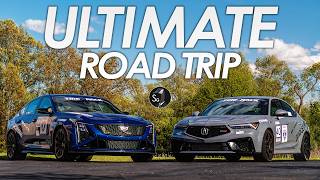

8 Days of Hell: 4000 Miles in a Week
53sReveals the grueling reality of the event, sparking curiosity and empathy.
▶ Play Clip"Title implies a crash, but the video is a detailed recount of the entire One Lap experience without any actual accident — a classic bait-and-switch."
This video recounts the grueling 4000-mile, 8-day One Lap of America competition, where the host and his team drive two cars (a Cadillac CT5-V Blackwing and an Acura Integra Type S) across multiple racetracks while testing Bridgestone's new RE71 RZ tires. The narrative covers the logistical challenges, team dynamics, and personal growth experienced during the event.
An event that runs for 42 years, involving a challenge of cars, tracks, and tires, visiting different racetracks across America. Participants drive their own cars on current Tire Rack branded tires.
Jack describes it as eight days of hurry up and wait, driving just under 4,000 miles (in their case over 4,000). Each day involves driving to a track, spending half the day there, then driving 5-12 hours to the next hotel, with minimal sleep.
You must start and finish the entire event on one set of tires. No swapping or changing except for a single spare in case of road hazard (nail, puncture). If you cord the tires, you're out.
Since transit time dominates (hours per day), a great street car is essential. Dual-purpose cars like the CT5-V Blackwing and Integra Type S offer comfort for long drives and capability on track.
Minimal prep: brake pads from Counterpace Garage, a standard alignment (max camber from stock bolts), and nothing else. The cars were essentially stock to ensure reliability.
After initial awkwardness, the team began talking during downtime, which completely changed the dynamic. The personalities and community became more interesting than the driving itself.
A terrible experience in the wet (spinning, poor laps) became a turning point. After that, the driver focused more on consistency and having fun, leading to better performances at subsequent tracks.
One Lap of America is a remarkable experience that tests patience, teamwork, and vehicle endurance. The ultimate takeaway is that the people and community make the event special, not the competition itself.
What is One Lap of America?
A 42-year-old event where participants drive their own cars across multiple racetracks in America over 8 days, covering nearly 4,000 miles.
00:50
What is the key tire rule in One Lap?
You must start and finish the entire event on one set of tires; no swapping except for a single spare in case of road hazard.
04:43
Why is car selection critical for One Lap?
Because transit time dominates (hours per day), so a comfortable and reliable street car that is also capable on track is essential.
07:10
What preparation did the team do to their cars?
They installed upgraded brake pads from Counterpace Garage, performed a maximum-camber alignment (no aftermarket parts), and left the cars otherwise stock.
11:54
How did the team dynamics evolve during the event?
After an initial period of awkwardness and not talking, they started conversing during downtime, which improved the dynamic and made the experience more enjoyable.
30:27
What was the turning point for the driver after the wet track session?
After a terrible performance in the wet, he shifted focus from setting fast laps to having fun and being consistent, which led to better results and a more positive mindset.
34:34
Dual-Purpose Car Necessity
Emphasizes the need for a car that is both comfortable for long drives and capable on track, a key insight for any participant.
07:10Community Over Competition
Highlights that the people and camaraderie are the true value of the event, not the lap times.
30:27Learning from Failure
Shows how a disastrous experience can become a valuable lesson that improves performance and mindset.
34:34Escapism and Car Culture
Captures the idea that One Lap offers complete immersion in car culture and a break from everyday life.
39:06[00:11] Lap of America with Bridgestone?" I said, "Well, what is that?" And the more he explained the format, the more I got this sinking feeling this is going to be another project we're going to be in well over our heads with. So, that's
[00:25] going to sum up this video. It's going to be explaining what it is, what it took to get this done, the planning, the execution, the driving, and so much more. So, get yourself nestled in because this is going to be quite the
[00:38] because this is going to be quite the story.
[00:50] ceremony, it's that time of year when everybody's medications run out and we everybody's medications run out and we make bad decisions. One lap is a an event that's been running for 42 years. Uh,
[01:04] and for reasons that I don't quite understand, we've assembled a group of people, some of the nicest people in racing that come play with us every year. It's a challenge of cars and tracks and tires and all the while
[01:19] visiting all of America and different racetracks every time. And it's it's a truly epic trip. >> We only really have one rule and that's to that you have to run current tire rack branded tires. Other that car has
[01:33] to be legal. It has to be insured. Um how legal is not not up to me. Uh run what you brung. Be as creative as you want. We have classes for virtually everything and we'll have virtually everything here from 1100 horsepower
[01:50] everything here from 1100 horsepower Corvettes down to oh maybe 100 horsepower Impalas. So it's a it's a it's a big mix of people, a big mix of it's a big mix of people, a big mix of of of of cars of of of talent. Uh and
[02:05] but the binding factor is the people. But um it's um it it's a completely different game than when it started off, but um I've kept the legacy alive. Um not for financial gain so much as I can't imagine like most of the others to
[02:20] do a month uh a month of May without one lap. of gave you uh the philosophical part of one lab. Now, we're going to talk about
[02:33] the fine print of what one lap is and why you would do it or definitely not do it. Jack, >> this is eight days of hurry up and wait, days and you drive just under 4,000
[02:46] miles, assuming you've teleported to Indiana. In our case, to your point, we've driven over 4,000 miles in that single week. And it is a long week. racetrack from whatever hotel you were sleeping at. You spend half the day at
[03:01] that track and then you drive to the next hotel which is anywhere between 5 to 12 hours away depending on how many times you stop and everything else in and you are learning a lot of these tracks assuming you're doing it what's
[03:13] called the honest way for the very very first time. So there's a high degree of as well like snow and rain like we did. >> Yeah. Yeah. It was interesting. We started off at like 60° and then we were in near Colorado where there was a
[03:26] winter storm advisory at like 30°ree weather. So again, there's diverse conditions, you're driving a lot and not a lot of sleep, and the events are not in and out.
[03:38] >> So you really are like when we first started this, it was well you guys were co-driver was trying to get out the door and be on the road by like 6:30 in the and then you're sitting around and waiting for hours, like hours and hours
[03:53] before you run. And the run groups are essentially you get three laps in the morning, three time laps, and then you get three time laps in the afternoon. going to either one driver is going to take the whole day or split it up. So if
[04:06] you haven't been at these tracks before, like we we we were only at two of the >> Yeah. So the rest we had never even seen before. So that doesn't give you a lot of time to learn these tracks or you basically have to go out your first time
[04:19] and be fast. So that's why it's very very tricky. The other issue is, you know, if you're going out the first time and you're on no sleep, not because you isn't structured for you to get in at a reasonable hour to get sleep, you're
[04:31] you're there late. You're getting up early. And so, it's very, very challenging. The other part is you have to do it on one set of tires. Whatever tires you start with, you have to end with. There's no swapping, no changing,
[04:43] no cheating. Like, you have to finish. If you have one spare that you can only use if you've destroyed one of your tires through, let's call it a road hazard, a nail on the sidewall, >> a weird puncture. If you cord your tires
[04:57] out for the rest of the event. >> Yep. And you have to carry that one >> So, you have to have the right car. You have to have the right mentality. You have to be with the right people. And you have to be prepared just enough, but
[05:10] >> The thing that hurts you is the transits. It's not your time on track. you're only doing like 70 80 laps during the entire week. It is the hours upon hours you spend in these vehicles. >> So, let's talk about the tire component.
[05:23] Uh, we were invited by Bridgestone to do this and when Bridgestone talked to Jack and as I started this video, the more I got into it, the more I realized this was going to be my own personal nightmare. Like 25-year-old Mark would
[05:36] like 70-year-old Mark is like, "This is a logistical nightmare." gear, making sure you have everything you're not stopping a lot, making sure you have the food, the tools, the
[05:48] equipment, the spares, the jacks. I mean, I literally had a spreadsheet that I had been working on for like three or four weeks gathering all these things that we need to do it. The boxes, the boxes had filled my house, my garage.
[06:01] just dumped all this in my garage, which is still sitting there. Like, this is a massive commitment. if you're doing this and you need to make sure you're prepared, it's it's very it was very stressful for me. This was something
[06:14] that was like not exciting for me to do. And when Bridgestone's like, "Hey, you excited about this?" I'm like, "No." I'm like, "No, it's it's stress for me. forward to was the driving part, which I'll get into that talk with Chris, but
[06:29] again, logistics, making tires last." Um, and we we were on Bridgestone's brand new tire, the RE71 RZ, which is an evolution of their RS tire jack. So, >> So, essentially, to your point, it is an evolution of an existing 200 track day
[06:43] tire. The RZ cliff notes, it has new construction, new chemistry, but it is faster in the dry, it is faster in the wet, and it lasts longer, which is really the stress test of this event. If you look at the entrance or the people
[06:57] who competed in this, it was vast vast majority of these cars were on the RE71RZ and the winners of this event were essentially all on the RZ. This is the perfect tire to do track days that also you want them to last long. The
[07:10] other thing to talk about is why we picked the cars we did. I'll let you go >> So, we originally talked about uh Porsche like Panamera something that was you're you were talking about we're in transit. It's not about three laps.
[07:23] minutes. >> You're you're on track for six minutes, but you're in the car for hours and hours and hours. So, great street car. So, the people that were at the top, like, of course, you're
[07:36] be flying on track, >> C8, You're going to be miserable on the street for sacrificing a win. I didn't event, but I didn't want to be miserable. So, there's not a lot of cars
[07:49] can fit a small house into it in terms of gear plus camera equipment. So, Jack what you were going to do. >> No, I'll make it easy. I am a a firm
[08:02] member of the Church of CT5V Blackwing and Blackwing in general. Um, prior to of the greatest vehicles I've ever driven. And at this point, if you even think that you want to buy a CT5V Blackwing, you should. It is probably in
[08:16] the top 10 cars I've ever driven. It is an amazing vehicle. I like that car car now after doing this event that I would buy my press car. I beat the piss it was my own car. There's a lot of strings attached to doing an event like
[08:31] didn't skip any beats. And more importantly, it's one of the few dual truly dualpurpose cars. It is a good luxury car. I had massaging seats unlike you. I had a reasonable audio system. It was reasonably quiet despite the tires.
[08:45] It was huge on the inside. So, I got the transit part well done, but on track, it has an over 600 horsepower supercharged V8 with a manual gearbox, carbon ceramic which meant better alignment, higher spring rates. It was a truly dualpurpose
[09:00] car. It is an incredible vehicle. I love the Blackwing, Mark. I love everything >> you change my name to Blackwing. >> You should change your middle name to >> You should change your middle name to Blackwing. Richard Blackwing. Uh both
[09:12] not. You know, you would think for something like this that wouldn't be requirement. Again, hard to find a dualpurpose car that can fit stuff, be a comfortable. So, there wasn't a lot left for me after you took that. There was
[09:27] to Lucid about, but Randy Popes decided he was going to do that car, and I'm glad he took the bullet for me. Nothing wrong with that, but you still have to like, like 5:00, >> 4 in the morning. Yeah, we saw because
[09:40] they had to do jump to different chargers to get enough speed to charge definitely on my mind because it's ultimate comfort, but logistically the way the Avent is is formatted, it it's not the best way to do it. So, that left
[09:53] me with like either an uh Civic Type R, which I really didn't want to use my own car. So, Acura donated their Integra Type S, which is essentially the same thing. And I think that was probably the best decision on the planet. a car that
[10:06] I didn't even really I literally didn't have to check anything on it. I checked the oil every event and it didn't even burn a drop. >> I there was literally no issues with that car. Super comfortable. I can We
[10:18] fit 80% of the gear in the Integra whereas the rest got offloaded to the Cadillac. So, you can store a ton of in there. It's still comfortable. Good audio system. Great manual gearbox. Alignment never went off on it. Like
[10:31] nothing like literally nothing went wrong with that car. on tires. >> Yeah. And it was super easy on tires. We didn't even rotate the tires. I I can't Like we got to the last event and the Bridgestone guys are like, "Are you
[10:43] like, "No." I'm like, "I don't even want to I don't want to lift the car up. I like, "Honestly, you're probably better off if you don't even rotate them." So, the same set of tires with minimal wear, which again, the RZ is way better than
[10:58] the RS. And that like l did not destroy the tires at all, at least on these cars. So, it it was it best case scenario was the Integra. Um, and I would again like the Blackwing if you're more in that budgety $50,000 range.
[11:13] Amazing car. Same thing with Type R, like no no second thoughts to it. >> This event I think further solidified our love of both of these cars. You think the Type R and Type S is a tremendous vehicle? I will go to my
[11:25] grave singing the praises of Cadillac, Blackwing, Tony Roma, the whole nine >> Both these cars have the same argument against them. Your car is super going to argue that the Integra is super expensive for what it is because it's
[11:39] $50,000 for a front-wheel drive car, but I'm telling you, like if it Yeah. How worry about it and know the reliability parts there when you're just beating the >> So, what do we do for prep? >> A lot. Yeah. I I I think, you know,
[11:54] >> let's start with the car first before all our stuff. So, we went to URW um and Limit Plus One, same sister shops, and they do all our prep work. They set up they do all our prep work. They set up all the GR cars, they do Corvettes, C8s,
[12:07] and of course, these cars, everything. >> So, I did Counterpace Garage pads on the Integra because I didn't trust the stock brake pads to do all these events. And development, driving, and formulations of brake pads, suspension, all of that.
[12:21] We've been working with them since really when I was doing the F FRS stuff >> 15 years ago. >> Yeah. So, they have this wealth of knowledge for these types of cars. So, we got pads from them. Amazing.
[12:33] >> Mike and David are great. The >> the these guys seriously like they're hardcore, way more hardcore than us, but I trust them implicitly. And then they did a straight like regular alignment. The best you could do out of a stock
[12:46] struts. Yep. One negative 1.8 eight degrees of camber, which is as much as you're going to get off of a stock car, and that was literally it. Like, they did nothing else. So, the car was basically as stock as you could make it.
[12:58] alignment that GM did at Milford because it had to drive another couple hundred made some tweaks because the alignment shifted probably due to horrible potholes through Michigan. What I'm going to say is we've undersold URW a
[13:11] performance shop we've ever worked with. If you are anal about safety, particularly when it comes to tracking your car, they do an tremendous job prepping them. They basically pen marker every or paint marker everything that
[13:24] they touch to make sure you know if it's shifted on track, which does happen if you were tracking your car for long sessions. They do car builds. Obviously, because they do very, very good work. >> Yeah, it's it's again to Jack's point,
[13:37] last thing I want to deal with is on a trip like this where you have the logistical nightmare of doing what we did and not knowing the tracks you're at and having to move all this gear, being tired. Like I don't want to be sitting
[13:50] tighten this bolt? Are is the Did they put the brake pads in right? Did they bleed? Did they cycle the ABS? All this stuff. Now it's out of my head and I can >> Yeah. trying to drive >> because you did not want to piss off
[14:04] Acura and I did not want Tony and Mike from Cadillac to break my kneecaps if I stuffed their $150,000 car into a wall. >> So, there's a there's a lot of people and you we're representing Bridgestone and their tires. Well,
[14:17] to go through this event and DNF, not finish. You don't want to crash. You want to be a dick, right? Like there's there's all these things. And to film a video and try to be nice to each other which was wound up being the
[14:31] >> So what does day one look like or really the day before the event? So we both had to drive from Illinois to Indiana to South Bend the Tyrack facility and it's David. >> We had talked to David in the past on a
[14:45] Karina and David on a conference call from Bridgestone and he was kind of that us and she was like David's going to be with you guys >> cuz I needed a co-driver. Yeah, we we realized we needed two people like and
[14:58] do it by yourself. You need two drivers. So David came in and we didn't know who were, but it was just awkward, right? Like it was an awkward situation. >> Dating for one week basically. >> Exactly. So after that conference call,
[15:12] as you can be. But on our way there, we started stickering up the cars with all the sponsors. things like URW, Grassroots Motorsports, Falcon Northwest, this computer behind me who's
[15:24] able to help me AI myself at night into a younger man who's a lot more a lot tolerant, you know, impossible. >> You know, like our our sponsors were there on the cars trying to represent like the best we could possibly do,
[15:39] >> plus the stickers that One Lab requires you to have on these cars. So, they end billboards, but you get to meet all the other participants in this event. And >> Yeah. >> All the people that are there are very
[15:52] have been doing this for decades. Yeah. douchiness when it comes to my car is more money than your car. It's just people who love this. There are tons and tons of national autocross champions.
[16:04] they will help one another, which is something that you're not expecting in a competition. They will lend you tools. They'll give you oil. They'll help you with food. They'll do everything they can to make sure that this event is a
[16:19] community-based event. While it is not necessarily the best organized time, >> that's a total separate story. >> It is a event that I think you will cool people. And I've met some people from that event that now weeks later I'm
[16:32] still talking to. Like they are a great group of human beings. >> I'm David Kleti. I'm president of consumer original equipment tires for Bridgestone. I knew a fair amount of about one lap because I've had friends
[16:47] do it for many years. I've followed the adventures. Knew kind of what to expect, but you never really know what to expect until you do it yourself. >> Hello, Jack. >> I'm going to push this out of the way as
[17:00] I don't knock this thing over. So, the very first time I met you for real was in the car and we set off on a 3,500 mile and some change road trip for let's call it 8 days. And I know you
[17:12] selling yourself short. You were not just tire man executive. You worked on basically every cool SRT product in the last like 20 years from 20 2004 2003 all
[17:25] >> Y >> which is a long time. And you did Viney and tires for all of them. >> I worked on tires for most all SRTs and kind of that generation. And then I was involved with vehicle dynamics for the
[17:40] caliber SRT4 when we developed that vehicle. So this was feels like a lifetime ago, but a lot of experience at SRT, SRT development, Viper, all the other vehicles, Jeep Grand Cherokee, the 300, the Magnum, the Caliber, all of
[17:56] those vehicles back in the day. >> The stuff that kept Stalantas back then, FCA Daimler, relevant for the time they were relevant. The golden era of of Dodge basically the last 20 years. Not only that, you live and breathe this
[18:10] You raced wheel to wheel and spec neon. You're a very, very prevalent wrench on all your all your stuff. And the reason I bring that up is he saved my ass this week because he's a better driver than I am. How did it go?
[18:25] driver than I am. How did it go? >> It went very well. Uh, the car performed very well. It got noticed by a lot of people regardless of the demographic >> Yes. I think we opened people's eyes because we were battling with Camaros on
[18:40] them >> in a completely stock Blackwing. >> Completely stock. We pushed it really hard at a lot of tracks. >> Tracks you and I had never driven. We had probably not smartly split every
[18:52] single track. So there's no chance to improve, but we went to what the only tracks you and I had driven were Blackhawk and in my case, Road America. on before. Correct. >> It was uh exciting. and one of them in
[19:07] snow and rain. >> Yes, that was that was the highlight of the week. You know, I said that a couple times, but um I wasn't nervous. >> A lot of people were nervous about the conditions and I wasn't. And I think
[19:23] that confidence helped. The tires performed way better than a lot of people thought. Um I wasn't overconfident. I didn't put the car off. and do something stupid, but I was confident and the tires performed.
[19:37] allseason tire cars were going to perform better than we did in the wet. That was not the case. What I will say as well on the personal side of this worst form of speed dating. You're stuck with another human being you've never
[19:51] met before for a week. The fact that you and I like the same music, had similar viewpoints of the world, I think made it a very pleasant experience. I think what's going to make or break this, other than your car not working and the
[20:03] with. >> Um, if you do this with a random you get unlucky, you're going to have a very, very bad week. >> Oh, no. That would that didn't hear about that happening at all at this
[20:18] and I are going to talk about this as well. Both of our first times ever doing this. We came second out of seven in luxury and we came 17th out of 70 overall, which for a completely stock CT5e Blackwing on RZ's that never
[20:35] recorded, we had not a minute's trouble with them this entire event, I couldn't >> U, I think when you come to the end of an adventure, the team clicked very well. It took a while to bond, I think, as a team and understand the
[20:50] personalities. Once we found a rhythm and we started knowing the strengths and weaknesses of the team of the vehicles, there was no tension, arguments, fighting, screaming, throwing, kicking, biting. None of that
[21:06] happened. And you can't say that about every team. There's definitely tension within teams. So that's a big part of the adventure is the team, the personalities, the cars, the tires, everything else is also part of it. But
[21:21] it together. You can't do it by yourself. So I I think it was very successful. Um and so successful that I would do it again. So it left a good impression that I actually would come back. I I wouldn't shy away from doing
[21:36] actually are like, "Wow, that was fun. I'll do it again." Not like, "Wow, I did it, but I never want to do it again." The pros of the kind of the overall I I really think the tires were a huge pro. I didn't really know what to expect cuz
[21:52] I hadn't driven on these tires and we haven't done a lot because it's a new tire. As the Bridgestone rep, it's very difficult if the product doesn't perform. I've been there before. It's very hard. So, that was a huge pro. The
[22:04] very hard. So, that was a huge pro. The con um was just the adapting to the event um and trying to learn, meet the people quickly, understand the strengths people quickly, understand the strengths and weaknesses and how people operate.
[22:19] That was kind of a took a couple days to figure out who did what, what needed to be done when. Things that I would do differently. I don't think it's a con, but we were maybe overprepared, but I think it's
[22:34] better than the the inverse of being unp underprepared. Not do so much preparation, not overthink everything, but because now we've done it. we kind of know the rhythm, what you need to bring, what you don't need to
[22:47] what you don't need to stress about. Um, that's what I would change going forward that's what I would change going forward is is bringing less stuff and not stressing about the details. But, uh, as a first timer, I think it
[23:02] underprepared. It would have been a horrible trip if we were underprepared. >> So, I'm here with Chris, my co-driver. Now, Jack and David had a brief conversation about what their experience was. We knew each other. Like, Chris
[23:18] does some of the backend work on every single video he's there. And this was his first time really going to a bunch of tracks he's never even driven on, let experience either. >> I mean, it's not like this is the first
[23:32] long drive that we've we've done. I mean, we've we've driven to Atlanta and back and Tennessee and back and but just not this much continuous time together >> One thing that would probably have been useful is uh the ability for Well, I had
[23:47] in a car, right? >> That is a problem, I think, for for this event. Yeah. There's just not enough time to uh get your get a full night of sleep, get set up in the morning and uh be ready like you know be like
[24:00] be ready like you know be like functional in the like at the track without getting a little bit like a little nap in at some point. >> I I think that's very hard and if you're somebody that cannot sleep in a car or
[24:12] has is a light sleeper um you're not going to be able to do well in this event. I I struggled with it the entire time. I I really did. I I had no problem doing the street drives like going from place to place except the one time, you
[24:24] >> that I had to have you take over. But >> it was just cumulative damage at that deprived. You were having uh having an eye infection issue. >> Yeah. We started the the event the first day we got to Nashville and my eye was
[24:36] cellulitis in my eyelid probably because I got some in it from the track a car filming. So that's how I started the event, not being able to see the first two tracks. So that that was honestly that didn't even bother me as
[24:49] just like, "Okay, I hope this isn't going to be how the rest of the event was, you know, started off that bad." We started in Nashville, you know, and um I went into that uh pretty pretty pretty good. I went into it with a very
[25:03] positive mindset, very open mind, and then at the first track, I immediately caught nerves. I was like, "Wow, man. And I've driven these in a simulator and this is not at all what it was like. And uh and then uh immediately
[25:19] downward spiral through the whole like track driving stuff. But even set even before that setting it up, we went into it like ready and like raring to go, not realizing how much waiting we were going to have to do even before the the uh the
[25:35] >> Yeah. And I think when you look at some of the footage in Nashville, we started at tire rack for the wet skid pad, which you did. And we instantly learned like this car just the Integra specifically needed to be pedal danced the entire
[25:48] where you can turn off stability control and the brake torque vectoring in the rear because it tends to destroy brake pads. It's really hard on brakes. So, it is not unmanageable. It's really easy to
[26:00] got to Nashville, I think there was a ton of nerves, not just from us, but Bridgestone was there, like a lot of the the the brand people from Bridgestone. And then David, this was his real first event with Jack. And I felt like there
[26:14] was a ton of anxiety on his end, Jack's end, like what we were supposed to do, like our roles. Like you and I was more clear, like we were just trying to be in the middle of the pack. Like you hadn't driven before. I had not driven more
[26:27] than 80% of these tracks. So my level of what I wanted to achieve was to compete with the the GR racing teams like the actual Toyota teams in terms of times meant nothing outside of that in my own brain. But for you I just wanted to get
[26:41] I wanted you to get through where you felt like you gained something some type of driver knowledge out of it. So again it wasn't so much about where we placed it was about just kind of being finishing the event where I think Jack
[26:53] establishing like who's the better driver? what if I don't do better than struggled with that in Nashville where Jack was faster than him there. They talk to them on the side and I think it really got in their heads. And I was
[27:08] even telling Jack, I'm like, "Well, if he's going to be slower than you, just take the lead, you know, and then it totally switched. Like David got way more comfortable." I think by like day three, he was in his groove of driving
[27:20] really well and consistently where Jack it got in his head then and he wasn't driving great. So, they struggled, I think, a lot more than we did. >> Dude, I left the spag bowl. >> Yeah. What is it? Um I I I would agree.
[27:32] I mean, we we kind of like um I mean, you were aiming for like a like a like a mid low30s finishing position. I was aiming for like a mid low like 40s. >> Um >> which is not necessarily like a bad
[27:46] fast cars, fast drivers. It's like And we're in what what like a stock Integra of whatever. I think a lot of the event we spent iced out, you know, just because of there was so much waiting. We ended up just like thinking about things
[28:00] like think about things that we wouldn't have normally thought of, ending up in we normally would have been because if you just show up and drive, like you just like, "All right, let's get it done." Right.
[28:12] >> Yeah. I think that that's a good point because my biggest issue and it and it's not really a problem, but when you don't expect it, like Nashville was a perfect example of like get on grid. They call all these cars to grid and then you're
[28:24] sitting in the car with your costume on like your race suit, your helmet, your like your race suit, your helmet, your Hans. We sat there for like two hours the run groups, they weren't calling the numbers out. So, you were literally just
[28:36] "What the hell is going on? Is this how it's going to be?" And quickly by like the fourth event were like you and I, we weren't there at 7 a.m. because we'd be know? So, like that wasn't explained. And then I think by the end they were
[28:50] finally calling out the car numbers like when it was time for your car to be pulled up so you're not just sitting there with your car running all day. Um but when you're trying to figure it out you're like okay when I'm going to run
[29:02] right now. And I think by the time we got we were on our way from Nashville I remember the order anymore but >> it it was like uh Colorado, Oklahoma, all of those tracks that we started running at next. There was a midway
[29:17] point where we stopped for food like by your uh your your uh pyramid. >> Memphis. We were >> the Bass Pro Shop Pyramid. >> So, we stopped there and I have this picture of Chris, Jack, and David at
[29:32] this like restaurant and it like summed up our our entire dynamic at that point. >> we're like this is like we're not clicking. Things are not going well. We're just kind of all like quiet. We didn't really know where we were
[29:46] couldn't sleep like the next two nights. I was like desperately trying to figure out like how do we write this? You know, Jack is with somebody he doesn't know. can, but we're not really talking to them. So, I really was trying to talk to
[30:00] David to to since we had so much dead time. Once you realized there was nothing going on, I think that really helped because it wasn't about the cars, started talking more and then it just completely changed.
[30:13] >> Like the dynamic changed, we all started to get along and I that's what really changed. >> I What is it? I felt really bad because the first two tracks I I don't think we talked to basically anybody,
[30:27] >> Like in like any meaningful sort of capacity. Yeah. just we were just uh kind of like all right we're we're here to like you know to drive but it's talking to people because there yeah as you said there is just so much downtime
[30:40] and the personalities are in some ways more interesting than the >> because you got you got three laps like you have enough time to you have enough >> then you're done >> and we split up the driving with the
[30:53] whole thing for Road America but we split up the driving and like to Chris's credit Like, you know, Jack was talking to me. He's like, "How do how do you "He's got to do it." Like, he's never done this before. The only way you go
[31:08] through some of the the learning and the seat time, like, not just the seat time, is is you have to go through these uncomfortable positions driving, even if you're putting yourself at a more of a risk. Like, because you did it, you're
[31:20] out there and drive. Like any track that it is, even if you don't know it, you're confident to do it. Um, and I think when we got to the wet track, you know, >> that's I think that was your your worst day and I could sense it and I'm just
[31:35] >> it was the worst by far. I What is it? That was the one I had run the least in a simulator, which is to say I ran like two laps in a simulator and >> Oh, and speaking of which, yeah, they they Jack and Chris decided to run the
[31:48] simulator here uh two days before the event and Jack was just doing donuts in a dirt track, like a dirt car. That that was his driver training. It's like, oh yeah, but I had never driven in the wet. And um everyone's like, oh, you know,
[32:02] like the object the objective obviously number one is always bring the car back in one piece. That's one. Two is have fun. Three is maybe set like a competitive time. I threw out the first two and was and uh was really stupid.
[32:17] And I also ignored every Well, I didn't ignore it. It just in the moment, you know, sitting on the grid for sitting on like in pits for like an over an hour, >> right? I I just got into my head and I just forgot everybody's uh wet driving
[32:31] sort of advice and like like you know man just put it in the middle just you grip is and I'm like I got to set a good lap. >> Immediately set horrible horrible lap times because I I rushed things and was
[32:44] times because I I rushed things and was stupid.
[33:25] bit of Chris's, you know, driving and I I've never seen you so frustrated. I horrible that, you know, like I felt kind of responsible. I should have been back to the place only you can experience this. You can go on a sim.
[33:41] people don't quite talk about with driving is you can practice, you can go on a sim, you can go do time trials, but nothing can really prepare you and going out there and doing it and getting in bad a bad situation like you were
[33:56] where you were not knowing the track, not knowing grip levels, how how to navigate a wet track. Like you just had to do it, right? So now it's done, still be nervous, >> but you wouldn't go through the same
[34:09] issues that you had before. >> Yeah. The band-aids ripped off. >> Um I I do think it was a very valuable learning experience that I'm glad I'm glad nothing permanent happened. >> Yeah. Yeah. I think that we we wind up
[34:21] there was an unbelievable amount of like concrete like mud. But yeah, the car was weren't even out of balance, you know, once we sprayed all the mud off. I mean, it was like back to business. And I think that also changed our driving. I
[34:34] think I changed definitely after that that event specifically. I was definitely more locked in because I knew like if we were going to be we wanted to be mid pack like 40th out of >> 70. I I dropped I dropped us down uh
[34:46] >> So I I took the driving a lot more serious and I think the the next two the cars for my drive. I just because I never get to drive a car anymore. Every time I drive there's some type of camera and it sucks like you can't
[35:00] about everything else. So, I I really drove the next two tracks not knowing them as best as I could. And I think those were times where I was really close to the the GR guys, their class, which was not our class. Um, and I was
[35:14] happy with that. And I I knew that there I could have done better, but I for me get is to compete against myself in that part. That's that's what really got me out of my slump. You know, it's like a glorified autocross on a track. So, the
[35:28] the abuse isn't there. The abuse really was the big concern once we got through the next couple tracks into Road America, which I did take over driving seat time. I did a WRL Enduro there. I have a lot of laps at that track and it
[35:41] is by far from my experience, I've seen people hospitalized for months from accidents at that track, going off, brake failures. It's not to be trifled that track and most people don't take
[35:54] that very seriously. Um, and in the morning session or afternoon session, I watched a guy in a Corvette who wasn't taking his soft brake pedal seriously. Watched him go straight into a wall at like 100 plus miles an hour. Um, several
[36:07] other offs or crashes, but yeah, I think our last stop was um, Blackhawk really before we stopped at Tyra again. And how did you feel like when you did your last track session? >> Uh, I felt great. I mean, I didn't put
[36:21] up a fast lap time, but I that was the most fun I had the whole time because we finally went in with the the right mindset or I went in with the right mindset. Um, I was just there to have like, you know,
[36:34] I figured like, you know, we're kind of on track for like a midpack finish. Just there to have fun. If I set a nice lap time, that would be cool. But I I just want to like learn the track. Um, learn like maximize the car. Just there to
[36:48] get why people want to win and I get the whole competition part, but at the end of the day that track and I think the culmination was everybody was getting along. Like we were just happy to be together like happy to be talking and
[37:00] what you did in the car. The car was like the amusement ride of the whole like the amusement ride of the whole like human experience. It just the car gave us an excuse to be there. And the heart guys told me early on when we were
[37:14] to look at this as an adult summer camp. That's all this is. It's a summer camp activities and you know you got to navigate through that and but it again it's about you spending time with other people and that's how I felt but really
[37:29] I mean I couldn't have asked for it to end better than it did you know I don't even care about the finishing position I mean this is like a consolation you know of particip participation award you know we we this is more for Acura you know
[37:44] really thank you Acura for allowing us to take the Integra Type S out and do what we did. And I think it's just proof that if you're on the fence about that car, um, or the Type R, you know, despite its price tag, it's it's really
[37:57] amazing for what you get and you don't have to worry about it. End of the road. I think we've talked people's ears off about what this event was. What's your takeaways? I think it is a remarkable experience that if you
[38:10] someone that you enjoy, you will have a good time. You just have to be someone with a lot of patience. And I think if I was doing this without the cameras, it would be a more enjoyable experience. But I think
[38:26] never forget doing this and is probably one of the more special things I've done with you professionally. How do you feel, Mark? >> I don't know. I really don't know. I mean, I I've reflected on it. I think
[38:40] it's just because of where I'm at in my life with the work schedule of not being able to get a break to do something like this. I was behind all week. I couldn't for my own personal life, my own work.
[38:54] all night. >> Oh, yeah. Soon as we got back, we car schedule. >> Yeah. So, I mean, if you're somebody trying to ek this out, it's going to be very difficult. But if you can set aside
[39:06] the time and focus on the people part of it, enjoy the driving part of it and the fact that you are completely removed and you're forced to be removed from your life. Like literally like if you want to escape, it's complete escapism from so
[39:21] >> Yeah. And that's what my takeaway was is if you can get yourself in that headsp the fact that you're connected with the country, the car, the car culture, cuz it's the best part of car culture for us. People who like driving cars.
[39:35] >> Yeah. They they these people, they like the driving part. Whether they make a life like behind the wheel. And this is like the ultimate expression of it. I think the people part, like everything we do, the machine is part of it, but
[39:48] >> And we got to meet people like James and Kevin and Brian and the variety of other we would never meet otherwise. >> And all the supporting people around it. look, we had to go through URW. We had to go through Bridgestone. We had to
[40:03] doesn't want to talk to us ever again after this. But, you know what I mean? that's just us. Imagine all these other teams that have like their own shops and work together to make this event happen. And I think
[40:17] and this is something that even remotely appeals to you, you will love this >> All right, sir. You ready to do it again?
⚡ Saved you 0h 40m reading this? Transcribe any YouTube video for free — no signup needed.