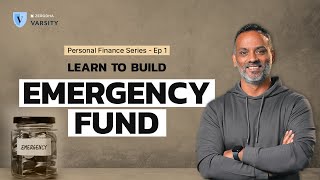

My 2020 Emergency Cost Me Lakhs
54sThis relatable story of unexpected expenses during COVID makes viewers realize the importance of an emergency fund.
▶ Play Clip"The title accurately promises a beginner's guide to emergency funds, and the video fully delivers – explaining what they are, how to estimate the size, how to build them, and where to park the money – very minimal exaggeration."
This video, part of a personal finance series for beginners hosted by Karthik Ralupa, stresses the critical need to establish an emergency fund before engaging in trading or investing. It covers why an emergency fund is essential, how to determine the right amount for your family, and how to build and preserve it using low-volatility financial products.
The speaker emphasizes that sorting out personal finance is the foundational step before any trading or investing, as proceeding without it starts your financial journey on the wrong note.
The very first step in personal finance is saving for emergencies. The speaker shares a personal story from 2020 about having to spend a lot on IT upgrades and then on parents' COVID treatment, highlighting the unpredictability of emergencies.
The fund's purpose is to handle emergencies without scrambling for funds last minute, preventing additional stress on top of the emergency.
The speaker disagrees with the common '6 months of expenses' rule, advising instead to sit with family and determine a number that gives peace of mind. For discussion, they assume 10 months or about 5 lakh rupees.
Two approaches: save little by little monthly, or allocate a lump sum. The goal is to hit the target in a few months.
A major mistake is investing the emergency fund in stocks, equity mutual funds, or any volatile asset. This introduces risk and defeats the purpose of having the money available fully when needed.
Low-volatility vehicles are recommended: simple fixed deposits (FDs), short‑term bond funds, or liquid funds. The key is quick access and capital protection. The speaker uses a mix of classic FD and an arbitrage fund.
Liquid funds take T+1 day to settle; for immediate needs, the speaker suggests using a credit card's free grace period (≈25 days) and repaying when the fund settles.
A common mistake is spending the emergency fund on non‑emergencies (e.g., a new iPhone, a European holiday). After using any part of it, the fund must be rebuilt.
Building an emergency fund before any investing is the first and most crucial step for a beginner's personal finance. Once built, preserve it in low‑risk, quickly accessible instruments, and always rebuild it after any use for genuine emergencies only.
What is the first step in your personal finance journey according to this video?
Saving money for an emergency situation (building an emergency fund).
01:12
Why is it a mistake to invest your emergency fund in stocks or equity mutual funds?
Because it introduces volatility, and the fund must be available in full when needed. In an emergency, volatile investments could be at a low point.
04:47
What are the recommended low‑volatility vehicles for parking an emergency fund?
Fixed deposits (FDs), short‑term bond funds, or liquid funds. The speaker also uses an arbitrage fund.
05:17
The speaker criticises the '6 months of expenses' rule. What does he advise instead?
He advises sitting with your family and determining a number (e.g., 10 months, 15 months) that gives you peace of mind and lets you sleep well at night.
03:27
What smart method does the speaker suggest to handle a 1‑2 day settlement delay of a liquid fund during an emergency?
Use a credit card for the immediate payment, utilise the free grace period (≈25 days), and repay the credit card as soon as the liquid fund settlement arrives.
06:10
What common mistake do people make after building an emergency fund?
Using it for non‑emergency lifestyle purposes (e.g., a new iPhone, a European holiday) and failing to rebuild it after use.
07:00
Emergency fund is the first step
It establishes a clear priority for financial beginners before any investing or trading.
01:12Customise fund size, not a fixed rule
Challenges the popular '6 months of expenses' rule and advocates a family‑specific, comfort‑based approach.
03:27Avoid volatility in emergency funds
Clearly explains why stocks or equity mutual funds are dangerous vehicles for an emergency fund.
04:47Use credit card grace period for liquidity
Provides a practical, smart workaround for the settlement delay of liquid funds in a real emergency.
06:10Rebuild after use – common mistake
Highlights a frequent behavioural mistake and reinforces the discipline needed to maintain the fund.
07:00[00:00] We spend a lot of time educating people on various topics related to stock markets. Be it simple stock investing or understanding complex derivative products. But the underlying assumption here is that you have your personal finance sorted out,
[00:14] even before you get into trading or investing in the markets. If your personal finance situation is not sorted, then I am afraid you are starting your financial journey on the wrong note. And it's time to fix that. Hi, this is Karthik Ralupa, and in the short video series, I will be talking to you about personal finance
[00:30] and the best practices that you need to have in place to start your personal finance journey. I would suggest you watch this video series as a very first step in your financial journey. By the way, many people ask me if we have a finance course for beginners without really specifying what they mean by a finance course.
[00:47] But my guess is people are looking for a personal finance Kickstarter course. If you are one of them looking for such a finance course, then I would suggest you watch these short videos.
[01:12] In this video, I will be talking to you about the very first step you need to take in your personal finance journey. That is saving money for an emergency situation. Let me share a personal story with you. It was the year 2020, and I guess we all know that it was a horrible year.
[01:27] Work from home was a norm, so was cooling from home. Suddenly, I had to upgrade the IT infrastructure in the house. I had to buy two laptops, a printer, a better router and a better broadband connection.
[01:39] If you remember, laptops were not easily available in 2020 because of the supply chain and COVID constraints. Whatever was available was available at the premium. We had no option but to shell out extra money to purchase these occupants.
[01:53] A few weeks later, both my parents contracted COVID. We were in the first wave of COVID and there was quite a bit of panic around. Finding a hospital bed was nearly impossible. But we got lucky, somehow found a hospital bed for both my parents.
[02:08] But the treatment costs were exorbitant, it was a few likes per head. And I wasn't even sure if my insurance would cover for COVID treatment. The reason why I'm sharing this with you all is to highlight the fact that within a few weeks
[02:21] all of a sudden I was faced with a situation where I had to spend a lot of money. I'm sure you two would have faced such a situation in life. Emergencies can come unannounced and when they do, it can be financially draining.
[02:35] While the emergency and the nature of emergency is not in our control, what is in our control is our preparedness to face such an emergency situation. Preparedness in terms of having an emergency coppers.
[02:47] Luckily, I was able to manage the situation because I had an emergency coppers in place. The purpose of an emergency coppers or an emergency fund is to help you deal with the emergency and not let you scramble for funds at the last minute.
[03:01] Imagine in an emergency situation you're already under significant stress because of the circumstance you are in. If you don't have the money to deal with the situation, then that will be an added additional stress.
[03:14] I hope by now I've convinced you enough as to why you need to have an emergency fund. Let us talk about how to build an emergency coppers and preserve the same. The very first step is to estimate the quantum of coppers you would need as an emergency fund.
[03:27] Some experts say that you need at least six months of expenses dashed away as an emergency coppers. Personally, I don't subscribe to this thought. Each family is different, each family's requirements are different. What would work for your family may not work for my family.
[03:41] Given this, it is best to sit with your family with your loved ones and figure out what would work as an emergency coppers for your family. It could be six months, ten months or even 15 months of expenses.
[03:53] There is no right or wrong number here. The right number is that number that gives you and your family peace of mind and lets you sleep well at night. For the sake of this discussion, let's assume that number is ten months expenses
[04:07] or maybe about five lakhs in rupee terms. Now that you've identified what is the coppers requirement, the next step is to figure out how you can accumulate this coppers. The most common approach is to save little by little every month
[04:20] till you hit the targeted emergency coppers number. Or if you have a large coppers, it makes sense to first carve out the emergency coppers and park it separately. If you take this approach in a few months, you can build your first emergency coppers.
[04:35] Now once you've accumulated the coppers, the next step is to figure out how to park those funds. When it comes to maintaining emergency funds, one of the most common mistakes that people do is that they invest this fund either in a stock
[04:47] or a portfolio of stock or even an equity mutual fund. This is one of the silliest financial mistakes that you can do. Remember, the reason why you've saved for an emergency fund is that it is available to you in full when you need it.
[05:01] Investing your emergency money in stocks or a equity mutual fund means that you're inducing volatility in your funds. And this can be a fatal mistake in times of emergency. I would suggest you invest your emergency funds in financial products that have low volatility.
[05:17] A simple fixed deposit will do the trick. Alternatively, you can even consider short term bond funds or even a liquid fund. The idea with emergency fund is to have quick access to the funds and also have full capital protection.
[05:31] A financial product that does not fit into this definition cannot be your vehicle to save your emergency coppers. Having said that, I've split my emergency coppers into two vehicles, a classic FD and an arbitrage fund.
[05:45] Arbitrage funds invest in arbitrage opportunities and equity markets and by definition arbitrage positions are hedged and bring in very little risk. If you're not familiar with arbitrage funds,
[05:58] then I would encourage you to read this chapter on varsity where I've explained arbitrage funds in detail. One last thing. Let's say you pick an instrument of your choice and park your emergency funds in it. Maybe a liquid fund.
[06:10] When an emergency strikes, you need access to the funds immediately. But a liquid fund, although very liquid, still needs steep plus one day for full settlement. Which means that you may not have access to your funds immediately
[06:22] and there could be a one or two day waiting period. How would you deal with this? Well, in such a situation, there is absolutely nothing wrong to use your credit card as a source of funds. Use it to pay for the emergency.
[06:35] Utilize a 25 day free credit your bank could give you. And repay the credit card bill as soon as you receive money from your liquid funds. This is one of the smarter ways to use a credit card
[06:47] and the free grace period that your bank could give you. I will talk more about credit cards in the third video in the series where I will be talking about borrowings. By the way, once you've tapped into your emergency coppers and utilized a portion of it,
[07:00] do not forget to rebuild that coppers. Another common mistake that I've seen people do is with great difficulty they will build their emergency coppers but they end up utilizing this fund for lifestyle purposes. Maybe buying that new iPhone or maybe going on that fancy European holiday.
[07:16] When you build an emergency coppers, you need to be completely aware of the reason why you've built this in the first place. Going on a European holiday is not an emergency situation. I hope you guys get started on your personal financial journey
[07:29] by building an emergency coppers. If you guys have already built an emergency coppers, then do comment below and let me know what is your preferred financial instrument to save these funds. In the next video, I'll talk to you about the second building block
[07:42] of personal financial journey that's insurance. I'll see you guys soon.
⚡ Saved you 0h 07m reading this? Transcribe any YouTube video for free — no signup needed.