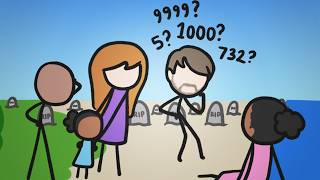

The Genetic Bottleneck Problem
56sExplains how recessive diseases increase with fewer survivors, making viewers question the minimum population.
▶ Play Clip"Delivers a thorough, science-backed answer to the title's question without sensationalism or fluff."
This video explores the minimum number of human survivors needed to repopulate Earth after an apocalypse, considering genetic diversity and the risk of recessive diseases. It discusses scientific estimates from space colonization research and historical breeding programs, ranging from 14,000 people down to as few as 98 with careful selection, or even one with a frozen embryo bank.
Recessive genes for deadly diseases become more likely to pair up in small populations, threatening long-term survival.
To maintain a healthy gene pool and preserve culture/technology, an off-world founding population needs at least 14,000 people.
If only concerned with species survival (not technology), 5,000 people might suffice.
800,000 years ago, primate ancestors survived with a breeding pool of about 1,300, likely due to high genetic diversity.
With exceptional genetic luck, as few as 150-500 survivors (e.g., a full commercial flight) could repopulate.
A genetically diverse, reproductive-age group of 98, managed with strict mating rules (like zoo breeding programs), could work.
A lone survivor could repopulate using a pre-apocalypse bank of frozen fertilized embryos, reaching current population in ~420 years.
Theoretically, humanity could restart with as few as 98 carefully selected individuals, or even one with advanced planning, but larger populations drastically improve genetic health and societal preservation.
What is the space colony estimate for a founding population to maintain genetic diversity?
At least 14,000 people.
00:29
What is the minimum number of carefully selected people needed to repopulate Earth?
98 people, if genetically diverse and managed with strict mating rules.
02:33
How many people could repopulate Earth with a frozen embryo bank?
One person.
03:14
What historical example used a breeding program to save an endangered species from near extinction?
The black-footed ferret, rehabilitated from just 24 surviving animals.
02:47
If only concerned with species survival (not technology), how many people might suffice?
5,000 people.
01:38
Space Colony Estimate
Provides a concrete, scientifically-grounded number for a viable founding population.
00:2998 Carefully Selected
Demonstrates that extreme planning and genetic screening could drastically reduce required population.
02:33One Survivor with Embryo Bank
Highlights the theoretical possibility of restarting humanity from a single person with advanced preparation.
03:14[00:02] alien lasers killed off almost all of the humans on Earth. Obviously, there post-apocalyptic problems that we would have to deal with depending on the disaster at hand. Our food supply might be irradiated, our atmosphere
[00:16] unbreathable, heck, all the planet's water could have boiled away. And if any doomed no matter what. But, all those problems aside, how many people [music] would it take to actually rebuild a genetically sustainable human population
[00:29] >> [music] >> We have some actual science to go on considered by two groups of researchers, those who study [music] space colonization. And the big issue here is
[00:42] bad genes. Hi, I'm Cameron and this is Minute Apocalypse. >> Any given human probably carries recessive genes for at least one deadly disease or another. And while a single copy of one of these genes is no big
[00:56] deal, having multiple copies could end up giving you that disease, genetically survivors there are, the smaller the pool of genes will be that future generations will draw from, increasing a person's chances of getting two copies
[01:10] of the same bad gene. Likewise, the more survivors there are, the more different chances would be that one would get multiple copies of the same disease-giving gene. So, there must be a critical minimum number of survivors.
[01:25] And the space colony scientists have estimated that an off-world founding population would [music] likely need roughly the population of 11th century London, at least 14,000 people, in order to maintain a healthy gene pool and to
[01:38] preserve the technological and cultural aspects of society. But, we want redeveloping society and technology later. If we're only concerned with our species' survival, [music] space colony math suggests that we could get by with
[01:52] roughly 5,000 people. But, about 800,000 years ago, our primate ancestors an even smaller number, a breeding pool of around 1,300 people. [music] Those people might have gotten away with this, at least in part, because the group was
[02:06] genetically diverse. They likely didn't share the same bad genes. And if we were to get really lucky as far as genes goes, the math suggests we could get by with as few as 150 to 500 survivors, which is about the number of people on a
[02:21] single commercial airline flight. But that's close to an absolute minimum. However, if we could see the apocalypse coming, [music] some scientists argue that we could get by with a carefully selected, genetically diverse group of
[02:33] as few as 98 people. And in this scenario, all the survivors would have to be at reproductive age, and they'd need to be managed by a strict set of only mate with the most distantly related member of the population. This
[02:47] basically is how zoos run breeding programs for endangered species, one of which rehabilitated the black-footed ferret population from just 24 surviving animals. This scenario raises a mind-boggling number of ethical
[02:59] questions, but theoretically it could work. And if you want to get really technical, we could restart society with one survivor. We would just really have to plan ahead. Like, [music] if before the apocalypse even happens, we create a
[03:14] bank of frozen fertilized embryos that the lone survivor could give birth to, we'd have plenty of genetic diversity to stave off the bad gene problem. This fraught, but theoretically [music] it's possible. And it would take only around
[03:27] 420 years to get back to our current population size. [music] So, yes, with a lot of planning, we could restart humanity with just one person. But let's not build nuclear bombs this time. All right?

⚡ Saved you 0h 03m reading this? Transcribe any YouTube video for free — no signup needed.