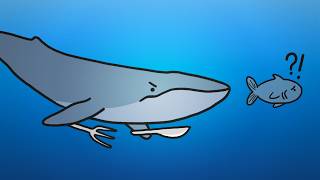
Why do giant animals eat tiny food?
45sThe surprising contrast between massive size and tiny prey creates curiosity and challenges common assumptions.
▶ Play Clip
[00:00] The most massive land animals in the world all eat little stuff, grass, and leaves. And almost all of the most massive aquatic animals also eat something itty bitty. Tiny crustaceans called krill. Why do such big things eat such small things?
[00:14] Hi, I'm David, and this is MinuteEarth. The most ginormous animals all need to eat a huge amount of calories to fuel their massive bodies, but there aren't enough big super calorie dense meals around for them to eat. And even if there were, the giant's massive bodies aren't mobile or agile enough
[00:28] to actually capture that food. Instead, these mega creatures meet their mega calorie quota with something that's super abundant and requires almost no effort to procure little pieces of grass and leaves. And for our purposes, we're going to consider leaves to be little,
[00:41] even if they do come off of bigger things. And sure, leaves and grass aren't very calorie dense compared to things other animals eat, but the giant's giant digestive tracks can hold a lot of them at once. We're talking hundreds of kilograms.
[00:53] Plus, the bigger an animal is, the longer the food stays in its digestive system, and the more microbes there are in there to break it down. All of that means that the giants are able to ring a lot of calories from grass and leaves, enough to meet their huge calorie demands.
[01:05] The abundance and ease of finding leaves and grass, and the specialized digestive systems to deal with large quantities of them, are why, at least on land, you see the same pattern in every biome. The very biggest animals are the wars.
[01:17] Even back in the day when dinosaurs roamed the Earth, the biggest animals weren't predators like T-Rexes. They were lumbering, or the eating vegetarians. But what about the ocean? Like their counterparts on land, sea giants like Blue Whales are relatively unadgel and have giant guts.
[01:30] So it makes sense that they'd eat the ocean equivalent of grass. Huge blooms of tiny plant-like microorganisms, called bidoplankton. But these ocean behemists need so many calories every day, that bidoplants, even lots and lots and lots of them,
[01:43] just aren't calorie dense enough to meet the demand. Luckily, those big bidoplankton blooms attract something else. Billions of calorie-packed krill that come together to graze in huge, slow-moving, easy-to-find swarms. A blue whale that lunges back and forth through a swarm
[01:57] can easily take in more than enough calories to power its huge body. The equivalent on land would be if there were huge, slow-moving swarms of grasshoppers that elephants could munch on instead of the grass itself. In that case, the packaderms could pack in even more calories
[02:09] and likely get even bigger. Either way, though, the same truth holds. For the biggest animals on Earth, it turns out food things come in small packages.
[02:24] For the biggest animals on Earth, it turns out food things come in small packages. For the biggest animals on Earth,
⚡ Saved you 0h 02m reading this? Transcribe any YouTube video for free — no signup needed.