
AI Summary
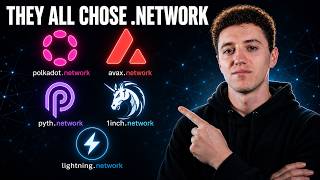
The video explains why major Web3 protocols like Polkadot, Avalanche, Pyth, 1inch, and Lightning Network all use the .network domain extension, highlighting the benefits of relevancy, availability, and authority. It also promotes a giveaway for the domain tge.network and encourages viewers to contact identity.digital for premium .network domains.
Chapters
Different teams, backers, and problems, yet all major Web3 infrastructure builders use the .network domain extension. The video aims to explain why this convergence happened.
Identity Digital is giving away the domain tge.network (token generation event). Viewers can enter via a form in the description. Also, premium .network domains like go.network, x.network are available by contacting [email protected].
Polkadot, created by Gavin Wood (Ethereum co-founder), is a layer-zero network of chains with a $2.2B market cap. It uses polkadot.network to capture its essence as a network of chains.
Avalanche (avax.network) processes 4500 TPS and allows custom subnets. Deloitte and Amazon build on it, making it infrastructure for building blockchains, hence .network.
Pyth (pyth.network) provides 380 price feeds across 40+ blockchains, with data from Binance, OKX, Jane Street, etc. It secures $100B in cumulative trading volume, making it a critical oracle network.
1inch (1inch.network) started as a hackathon project, now has $300B cumulative volume. Its Pathfinder finds best prices, and Fusion makes trades gasless and MEV-resistant, forming a routing network.
Lightning (lightning.network) is Bitcoin's layer two for near-instant, near-free payments, adopted by Kraken, Bitfinex, Cash App, Strike. It makes Bitcoin usable as a payment network.
1) Relevancy: .network signals to search engines and AI models. 2) Availability: Exact match names are still available. 3) Authority: It inherits credibility from other major protocols.
.network domains include homographic attack blocking at the registry level, preventing phishing sites. The infrastructure handles 60.4 billion DNS queries daily with 100% uptime, registry lock, and DNSSEC.
The pattern is clear: major infrastructure builders chose .network. The video urges viewers to consider .network for their own protocols and reminds about the tge.network giveaway.
The video concludes that the convergence of major Web3 protocols on .network is an organic pattern, not a marketing campaign, and encourages builders to secure their .network domain before the window closes.
Mentioned in this Video
Study Flashcards (8)
Which domain extension do major Web3 protocols like Polkadot, Avalanche, and Pyth use?
easy
Click to reveal answer
Which domain extension do major Web3 protocols like Polkadot, Avalanche, and Pyth use?
.network
00:01
What is the market cap of Polkadot mentioned in the video?
easy
Click to reveal answer
What is the market cap of Polkadot mentioned in the video?
$2.2 billion
01:49
What is the transaction throughput of Avalanche?
medium
Click to reveal answer
What is the transaction throughput of Avalanche?
4500 transactions per second
02:14
How many price feeds does Pyth provide?
medium
Click to reveal answer
How many price feeds does Pyth provide?
380 price feeds across more than 40 blockchains
02:41
What is the cumulative trading volume of 1inch?
medium
Click to reveal answer
What is the cumulative trading volume of 1inch?
$300 billion
03:11
What are the three reasons infrastructure builders chose .network?
medium
Click to reveal answer
What are the three reasons infrastructure builders chose .network?
Relevancy, availability, and authority
04:43
What security feature is built into .network domains at the registry level?
hard
Click to reveal answer
What security feature is built into .network domains at the registry level?
Homographic attack blocking
06:03
How many DNS queries does the .network infrastructure handle daily?
medium
Click to reveal answer
How many DNS queries does the .network infrastructure handle daily?
60.4 billion
06:31
💡 Key Takeaways
Polkadot's .network Choice
Illustrates how a leading layer-zero protocol uses .network to reflect its network-of-chains architecture.
01:34Avalanche's Subnet Infrastructure
Shows that infrastructure for building blockchains is inherently a network, justifying the .network domain.
02:14Three Reasons for .network
Provides a clear framework (relevancy, availability, authority) for why .network is a strategic choice.
04:43Homographic Attack Blocking
Highlights a unique security benefit of .network domains that protects users from phishing.
06:03Full Transcript
[00:01] Different teams, different backers, different problems we're solving, and somehow all the same domain. Today, I want to show you why that happened. to make thousands of decisions. Consensus mechanism, token model, audit
[00:16] firm, security architecture. Most of those decisions your users never see. Your domain is seen before anything else. Before the app loads, before they read a single line of copy, before they even decide whether to trust you with
[00:28] their keys. Your domain is the first thing your protocol ever says. And the biggest infrastructure builders in Web 3 all said the same thing. They said, dot network. I want to show you how that happened. And why once you see it, you
[00:41] to know that they are going to be giving to know that they are going to be giving away the domain tge.network, which is absolutely amazing. I mean, tge, token generation event, is one of
[00:53] the most important events that a project has. And they are giving away the domain tge.network. Whether you want it to be token generation event, or whatever you makes sense in my eyes. You guys can enter the giveaway of this domain.
[01:08] whether you are interested in the domain, maybe you just want to flip the you. Really simple to enter, you just need to fill out the form in the description below, provide all the necessary information, you will have
[01:22] obviously, if you're searching for an amazing dot network domain, like go.network, x.network, my.network, you.network, i.network, and many more. If you are
[01:34] sure to contact [email protected]. Just shoot an email with your inquiry, and I'm sure they'll hook you up. Let's Polkadot.network. Gavin Wood, one of the people who
[01:49] actually wrote Ethereum, decided his next big thing would be a layer zero. Not a chain, a network of chains. A project that independent blockchains plug into to share security and talk to each other. 2.2 billion dollar market
[02:02] cap. Active parachains running DeFi, gaming, identity, RWA, and bridges. Now, What domain captures what it actually is? polkadot.network.
[02:14] Of course it does. avalanche.network. 4500 transactions per second. And here's the part that matters. Their subnet architecture means any team can spin up their own custom blockchain, their own validators, their own rules, their own
[02:27] token, all inheriting Avalanche's security. Deloitte is building on it. Amazon is building on it. This isn't a blockchain. It's an infrastructure for building blockchains. An infrastructure by definition is network. avax.network.
[02:41] pyth.network. 380 price feeds across more than 40 blockchains. Data flowing directly from Binance, OKX, Jane Street, Virtu, Jump Crypto, the biggest names in both traditional and on-chain finance. 250 applications. 100 billion dollars in
[02:57] cumulative trading volume. Secured on institution-grade price data. Without Pyth, DeFi is pretty much guessing. Thanks to Pyth, every protocol knows the correct price of everything in real time on chain. What is that if not a network?
[03:11] pyth.network. Let's move on to 1inch.network. Two developers at a hackathon in 2019. 300 billion dollars in cumulative volume the rest of DeFi runs on top of.
[03:25] pathfinder.network. Pathfinder finds the best price across hundreds of protocols in real time. Fusion makes those trades gasless and MEV resistant. Think about trade on a DEX aggregator, there's
[03:37] orders move through the space. 1inch.network built that infrastructure and they knew what to call it. 1inch.network. And then there's lightning.network. Bitcoin's layer two. Near instant, near
[03:50] free. Adopted by Kraken, Bitfinex, Cash App, Strike. Without lightning, Bitcoin is just a store of value. Brilliant, but slow, expensive to move. With lightning, it's a payment network that settles in seconds. Satoshi wrote a peer-to-peer
[04:03] electronic cash system. Lightning is how that vision actually works at scale. And the name of the protocol that makes Bitcoin usable for everyday payments, I just want to remind you guys, if you haven't already joined the giveaway,
[04:16] haven't already joined the giveaway, they are giving away tge.network. project or whether you're going to flip it and sell it later on, you can enter Make sure to check it out. It's a really simple form. And once you fill it out,
[04:29] officially entered the giveaway. It's a golden opportunity. I wouldn't miss it. the description below. Five protocols, the blockchain of blockchains, the oracle layer, the routing layer, the payment network, the multi-chain hub. No
[04:43] share investors, no coordination, no campaign. All on dot network. When the most important infrastructure in web3 converges under one domain extension, independently, organically, without anyone telling them to. That's not a
[04:57] marketing story. That's a pattern that already exists. The only question is whether you're in it. So, why did this convergence happen? Not because of a campaign, because of three things that infrastructure builders understood.
[05:09] First, relevancy. When someone reads pi.network or polkadot.network, they page even loads. That's not just user experience. It's a signal that search engines and AI models pick up every single time they parse that URL. Your
[05:24] domain extension is doing relevancy work for you and for your protocol around the clock, for free, forever. That compounds. Second is availability. The name your protocol actually deserves. The clean, exact match, descriptive name
[05:38] that says exactly what you built is still available on dot network. Not squatted, not locked behind a six-figure deal. Available right now. That window is closing. And the builders who grabbed their names early are going to look
[05:50] prescient. And number three, authority. A descriptive domain extension is itself a credibility signal. The moment your URL ends in dot network, you're inheriting the pattern that Polkadot, Lightning, Pyth, and 1inch already
[06:03] that credibility from scratch. You just had to recognize it. There's one more where users sign transactions, pay close attention. Every dot network domain comes with homographic attack blocking built in at the registry level. That
[06:18] means if someone tries to register a Unicode similar domain, the kind of phishing sites to steal your users' passwords and keys, it's blocked before the registration even goes through. Not flagged, not reviewed, blocked before it
[06:31] even exists. No configuration, no extra cost, lifetime coverage by default. The infrastructure running dot network handles 60.4 billion DNS queries a day handles 60.4 billion DNS queries a day at 100% uptime with registry lock and
[06:46] DNSSEC available on every name. This isn't hosting. This is the kind of security backbone your protocol deserves to be standing on. So, here's what I biggest infrastructure builders in web three, the ones running the oracle
[06:58] layer, the ones routing hundreds of billions in trades, the ones building the payment rails for Bitcoin, they already made this call. Not because you're building something that actually is a network, naming it anything else
[07:11] feels dishonest. The name your protocol deserves is sitting on a registrar right now. Clean, available, waiting. You've spent months making the hard calls. The architecture, the audits, the tokenomics, this one is pretty simple
[07:24] and unlike many of the decisions you've made so far, this one is still available the way, before we end the video, I want to remind you guys about the giveaway. If you haven't entered, please make sure to enter. It's an amazing opportunity.
[07:37] Again, they're giving away tge.network. It's an absolutely crazy domain. It's Whether you're going to keep it or you're going to sell it, make sure to and once you fill it, you are officially in the giveaway. So, make sure to check
[07:52] If you are interested in any of these domains, make sure to contact [email protected]. Just shoot an email with your inquiry, keep going. >> Polkadot.network, avax.network,
[08:07] pyth.network, 1inch.network, lightning.network. They already chose .network. The pattern is already there. The only question is is already there. The only question is whether you're in it.