
Why Your Business Flatlines After a Boom
55sAddresses a common, painful business problem that many entrepreneurs face, creating immediate relatability and curiosity.
▶ Play Clip"Title accurately reflects the content: a deep dive into why businesses stall and how to sustain growth, with concrete examples from Airbnb."
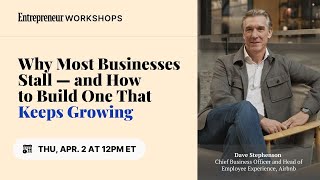
Entrepreneur Magazine's editor-in-chief Jason Pfeiffer interviews Airbnb's Chief Business Officer Dave Stevenson about why businesses stall and how to build one that keeps growing. Stevenson shares insights from his experience at Amazon and Airbnb, emphasizing the importance of focusing on the core business, understanding customer pain points, and using expansion to reinforce the core.
Businesses often grow in bursts then flatline; this is a common problem for entrepreneurs.
Amazon and Airbnb focus on the customer's North Star; Airbnb started by solving a problem (rent and lack of lodging).
Founders often focus on their solution rather than the customer's problem, leading to incremental improvements instead of breakthroughs.
Airbnb and Amazon use working backwards: start with the desired outcome and design backward, not from the product.
During COVID, Airbnb lost 80% business; they cut non-core areas (Lux, Plus, flights, magazine) and protected the core stays business.
After perfecting the core, Airbnb expanded into experiences, services (grocery delivery, airport pickups) to make trips better and reinforce the core.
Before expanding, ensure the core is fully monetized; it's easier to serve existing customers than acquire new ones.
Act with speed, clarity, humility; keep long-term North Star; take care of employees and community (e.g., gave hosts $250M, helped laid-off employees find jobs).
Airbnb's partnerships (Olympics, FIFA) are symbiotic; both partners benefit. Small businesses can find complementary partnerships (e.g., Trip x Calm).
Events highlight customer pain points (lack of lodging); Airbnb proves value during peak demand, leading to repeat usage.
Better to have a dozen people who love your product than thousands who think it's okay; find more of those passionate users.
Airbnb is expanding into experiences and services to make the trip seamless, aiming to be the best way to travel.
To avoid stalling, focus on solving customer pain points, protect and perfect your core business, and use expansion to reinforce that core. Leadership during crisis requires clarity, humility, and a long-term perspective.
What percentage of Airbnb's business was lost during the COVID-19 pandemic?
80%
06:00
What two companies does Dave Stevenson use as examples of a 'working backwards' process?
Amazon and Airbnb
04:30
What did Airbnb cut during the pandemic to protect its core business?
Lux, Plus, Hotel Tonight, flights, magazine, and other non-core areas.
06:00
What is the 'North Star' for Airbnb according to Dave Stevenson?
To connect people in the real world and make the trip easier.
10:00
What is the key principle for deciding whether to expand or focus on the core?
Ensure the core is fully monetized before expanding; it's easier to serve existing customers than acquire new ones.
11:00
How did Airbnb support its hosts during the pandemic despite financial losses?
It gave hundreds of millions of dollars back to hosts.
15:00
What is the 'painkiller' concept mentioned by Dave Stevenson?
A service that solves a customer's pain point to make the experience better.
24:00
What advice does Stevenson give about product love vs. scale?
Better to have a dozen people who love your product than thousands who think it's okay.
22:00
Falling in Love with Solution
Highlights a common founder mistake: focusing on the solution rather than the customer's problem.
03:00COVID Crisis: Protect the Core
Demonstrates how Airbnb survived by cutting non-core areas and doubling down on its unique value.
06:00Maximize Core Before Expanding
Key principle for growth: ensure full monetization of existing assets before adding new ones.
11:00Mutually Beneficial Partnerships
Explains how partnerships work best when both parties benefit, not just a transaction.
17:00Product Love Over Scale
Emphasizes quality over quantity in early-stage product-market fit.
22:00[00:00] businesses grow in bursts. You have that great sales, you have that lucky quarter, you have that thing that goes viral that just drives a lot of growth and a lot of business. And then it starts to just flatline. You can't figure out why. Why? Why is this business that is growing suddenly not? Well, If that sounds familiar, then you've come to the right place. We're hosting this because that is such a common problem. So many entrepreneurs
[00:26] deal with it. And that is what we talk about here at Entrepreneur is how to start and grow businesses and face the challenges and navigate the challenges that come along the way. Hi, I'm Jason Pfeiffer. I'm the editor in chief of Entrepreneur Magazine. And today I am so delighted to have a conversation on this very important subject with someone who knows it incredibly well. Dave Stevenson is the chief business officer at Airbnb. Airbnb, a company you
[00:53] have used, a company I use all the time. It kind of looks like I'm in an Airbnb right now, but I'm actually in my wife's childhood bedroom because my kids are on spring break. Dave has an incredible resume to talk about this subject. He is a former CFO who's guided the company through a pandemic, wiped out 80% of its business overnight. He has led one of the most successful IPOs of 2020, helped scale Airbnb to its
[01:19] first Fortune 500 ranking. And today we are going to talk about what it means to build a company and get past that stagnant point, how to lead through crisis without losing ground, where to expand, how to identify what the opportunities are beyond your core. And let's look into a little bit of the lessons from Airbnb. its biggest revenue wins, how to scale globally, and so on. Dave, it is so exciting to have you here and really
[01:45] appreciate the great work that you and your colleagues do at Airbnb, because like I said, it is a service that I use all the time. So great to have you and talk about this important subject. Jason, thanks for having me today. Excited for the conversation. So Dave, when I say this, the title of what we've come here today to talk about, why most businesses stall and then how to build one that keeps growing, What comes to
[02:12] mind? What are the mistakes that you see many founders make? What are the things that they're overlooking and not recognizing what is holding that business back? Yeah, one thing that I might think about, you know, I spent almost 20 years at Amazon and, you know, Amazon is famously, you know, tries to be the world's most customer-centric company. And it kind of thinks about that North Star, about what is it that the customer really needs? What do
[02:38] they want? And how can we deliver that? And if they keep an eye on that North Star, I think it helps a lot. Airbnb is very similar. It's focused on guests and hosts and communities and solving problems for them. I mean, right when Brian and Joe first shared their home in San Francisco, put two air beds on the floor, they were solving a problem. They couldn't pay the rent. There weren't enough places for people to stay
[03:04] for this amazing design conference. They put those problems together and they invented Airbnb. And so I think that starting from The problem that you're solving, starting from the customer is a great place to start. And Dave, I think that that might sound obvious to someone and the reason why it's an important thing to talk about. And so let's unpack this and I'm just going to hypothesize this and then you tell me, but the reason why it's
[03:31] an important thing to talk about is because oftentimes a founder might think that they're starting with the problem and think that they're serving the consumer, but actually what they've done is fallen in love with their solution. And so they're so focused on making and then pushing the thing that they think is a good idea that perhaps they haven't stepped back and really understood and identified the delta between what they think is a great idea and what
[03:57] the actual problem is that the consumer has that they would be willing to spend money on. Is that right? I think that's spot on, right? If you assume that you know what the solution is and you start with the product and then you work on incremental improvements on the product, then you end up with incremental solutions. And again, this is where, and I'll use analogies for both Airbnb and Amazon, they each have their own kind of
[04:23] working backwards processes, right? They look at the end result that they want to achieve. At Airbnb, we're trying to design to solve a problem in the future. work from that problem, that design problem, and then work backward to, okay, what are the processes that we need to kind of build the capabilities we need to have in order to solve it? Don't start with a product and then try to be incremental along the way. Amazon simply, you
[04:50] know, it's the PR FAQ, the press release and frequently asked questions. They start with that solution. What are we going to talk about? What are we going to deliver? And then how do we get there? It's just a really great orientation of the problem. I'd love to hear you take this practice and then put it into reality. Let's maybe pick something at Airbnb, whether it's The very famous case study now that I mentioned at the very
[05:16] beginning, which was that Airbnb's business dropped insanely during the pandemic and for obvious reasons. And then you guys had to be incredibly smart about figuring out how to understand what Airbnb was in that moment and how to position it for growth going forward. So whether it's talking about that or maybe something even more recent where you have a thriving company that everybody knows, but you still have to think about what does growth look like tomorrow? What
[05:42] is the evolution continued evolution of this business. Talk to me about how Airbnb has and how have you stayed so close to understanding the consumer and their pain points such that you can take those insights and build it into growth. Yeah, let's go those two different kind of places, you know, go back to 2020. You know, we were expanding into all these new areas, right? We had Lux and Plus and Hotel Tonight and we were working
[06:08] on flights. We had a magazine. We were trying to do all these things. COVID hits. We started to lose 80% of our business. We lost a billion dollars of cash in the first quarter of 2020. We actually had negative revenue, if you could believe it. And so what we had to do, we had to go back and say, okay, what is the core of our business. What is it that makes us unique and different? And how
[06:35] do we make sure that we can sustain ourselves through this crisis? And as by focusing on what is unique and different and core to us and that for us was stays. Those are the homes business that was also the core hosts, right? It's just the essence of a regular person sharing their home with others. How do we perfect and make sure that that core essence of the business not just only survives, but thrives. And so when
[07:01] we made some of the hard choices, unfortunately we had to lay off 25% of the company, we made drastic cuts and got rid of a lot of these new areas of investment. But what we did was we protected that core and we knew that once we're not sure how long COVID is going to last, how bad it's going to be, but we know we're going to get through it. And on the other side, we need to
[07:27] have a strong business that we're ready to grow again in the future. And that was all about that, staying with that core business. And so we spent a lot of time, who are we, what are we about and how do we make sure to perfect that core business? And that's what we did. And we focused on the things that are unique, right? Again, these individual hosts, people sharing their homes. And we made sure that all of
[07:54] the support capabilities that we had continued to support that. And I think that was critical because you could have cut even deeper saved even more money, but then not have the capability to be successful on the other end. Or we could have tried to keep a little bit of all these things going, And then I don't think any of we would have been successful because you would have just had a little pieces of everything. So we
[08:20] fully invested in what we knew was important and we shared the other areas, but then now let's flip it to the other part. So then what it enabled us to do is once we kind of perfected that core, then we ended up going back, going public, having a successful IPO. And because everyone's traveling on Airbnb, right? Everyone's going to the cabins in the woods and they were even driving places they wouldn't, weren't having to hop on
[08:46] a plane to. But then as we got better and better, we were like, okay, now we're ready to expand again. So we had to come back and certainly we had to pick back up some of these investment areas that we had shed before. And it took us longer maybe to get back to those areas because we cut them. But because we had such this strong core, then we were ready to do this expansion. And as we
[09:13] think about the expansion, again, I think thinking about the problem you're trying to solve, right? We are trying to use technology to connect people in the real world. Like it's very different. There's so many technology companies that are about using technology to attach you to your phone or to your device or to the thing, to their product. And what we actually wanna do is the technology should kind of fade to the background. We want the service,
[09:39] this amazing trip, this amazing experience in real life to come to fruition. And so as we come back out of focusing on the core into expansion mode again, that's the way we kind of think about it. It's like, we want to have more connection in the real world better travel experience, a better trip for people. How can we do that? And so we feel like we could do that by having amazing experiences. The majority of people
[10:05] when they travel want to actually experience the place they're in and actually understand what's unique and different about each of the cultures they're in and then make it easier for the trip. So those are all the services like, you know, sometimes you're staying in a a home and you don't have some of the amenities of a hotel, but now you can have, you can bring in a massage, you can bring in a chef. And now we
[10:32] just need to launch with a welcome pickups, airport transfer, which is just super simple, but it just makes the trip easier. And so our, our North star is to connect people in the real world, make the trip easier. And now we've kind of expanded. So I think those, it was two juxtapositions. How do you navigate in a crisis? And then how are you ready to kind of expand again? You know, What I'm going to ask might
[10:58] sound like a puzzle, but as you're talking about this expansion, what I'm thinking about is going back to this original setup that we have, which is, you know, why does a business stall on growth and then how to unlock that growth? And Dave, I think a lot of people think that the growth has to come from the expansion, that maybe if the growth is stalled, that's because the core product has already reached its maximum value and
[11:24] that to build more is to add more. And we could even take this out of a more complex business like Airbnb and just think about it as a simple business like a beverage brand. So maybe you launch with your hero product and then once growth stalls, you think, well, I got to get more flavors out. I got to get more form factors out. And I would love to hear your guidance on founders who are in that
[11:51] moment as they think about whether or not what they need is expansion and newness, or what they need is to understand whether the core still has problems in reaching its full potential. Is it about that the core hasn't been marketed properly, that the core hasn't been refined properly? In other words, how do you know when it's a core problem? How do you know when it's truly time to start expanding? Yeah, it's a great question. I'm not
[12:17] exactly sure, but maybe we can kind of talk through it a little bit. I spent 10 years at Procter & Gamble before I joined Amazon. Procter & Gamble is maybe more famously the former, what you're talking about. Let's have line extensions. I'm going to do new flavors of toothpaste or a new type of packaging and try to appeal to a few more customers and add some incremental. It works really well. It works really well in the
[12:43] consumer products industry. But you think, and then you go to Amazon and some of the ways that Amazon is growing, yes, there are extensions and new products, but then through things like the Prime program, it's like, how do you just become more of the fabric of a person's life and make it just easier for them to acquire anything that they might want to do? And then I'd say, and so that was famously like the flywheel, right?
[13:10] You end up with, you know, more selection, lower prices, you know, lower prices leads to, you know, more customers, more customers, more selection, it kind of goes around this flywheel. I'd say Airbnb has a different flywheel. It still really is about the stay. It is really about the home. But if and the extensions of experience and services will add incremental revenue. But as important as the revenue from experience and services are, by making the trip better,
[13:36] you're actually making the stay better, which makes a person more likely to come back and increase their frequency and engagement. Cause they're like, wow, when I have a trip with Airbnb, it's just such a better experience. And if we can keep making that better, then you're right. You you've done this expansion, it adds revenue, but you've just made the overall product and service better. And therefore your core gets stronger too. And so I love it when
[14:02] they're a self-reinforcing elements like that. And that's what I'm excited to see us do here at Airbnb. Yeah, that's a really great insight there about how even when you're thinking about expansion, it sounds like what you're doing is looking at it through the lens of even as we add more lines of revenue and can better monetize the customer for the core product, how do we make sure that this is also essentially reemphasizing the value of the
[14:29] core product so that there's a longer lifetime value of the customer? And it makes me think back to something that we published in the very early days. Dave, I've been here for 10 years and possibly in my first year here, we used to have this advice column in the magazine and somebody wrote in and they said, I've got a gym and I'm trying to decide whether or not to open a second location of the gym as
[14:55] the way to expand. What am I not thinking about? And the guy who wrote the advice column at the time, Adam Bornstein, said, you got to take a look at whether or not you are maximizing the monetary value of every minute that your current gym is open. Because if you're only essentially at 70% monetization of that gym, then it doesn't make sense to spend all this money investing in another gym when you can instead just think
[15:21] about how can I make some more money at the existing gym? Are there services that I'm not yet offering the people who are coming to my gym? Because of course, it's easier to make more money off of an existing customer that trusts you than it is to try to find and convert a completely new customer. So there's this line that has to be drawn in this evaluation that has to be made about whether or not our
[15:47] core product has reached some kind of saturation point. And when is it time to start adding more things? nuance that you're adding to it and here i'm just saying this to hear you react to it but the nuance that you're adding to it is yes but also make sure that when you are adding those new lines when you are doing that expansion that you're thinking about it in the service of continuing to grow and emphasize the
[16:14] core am i right i think you're exactly right i i love the the way you put it it's like um are you getting enough out of the activity that you're currently doing, right? The number of customers we have, it's easier to fulfill the existing customers and have them interact with you more than to go try to find a new one. That's the most expensive thing, right, is to go try to find a new customer. And so
[16:40] if you're not maximizing what you can do with your existing customer base, you know, I think you are under leveraging the opportunity. So I think you're spot on. Yeah. And then let's talk about just before we move fully away from that COVID moment. And I mean, look, everybody's heard COVID stories a million times. So this isn't really asking about COVID, but rather in particular, I'm wondering what you took away from that moment in terms of leadership
[17:06] through a moment of instability in a company. Because when any company, even if it's a startup, and you've had a half a year of really great growth, and then it starts to flatline, I think a leader often doesn't exactly know what to do. They may not know how to identify the problem. They don't know how to message that to their teams. And so I'd love your insights in leadership through big or small crisis and how to
[17:33] make sure that you're keeping that focus on that consumer. Yeah, well, we all have various stories from COVID and we all kind of had to deal with it in our own unique ways. For Airbnb, like I said earlier, I think a key for us was to know that we're going to get through it. We don't know how long it's going to be, how bad it's going to get. But we know that in the end, we want
[17:59] to be back with the strongest company we can have in the future and support our guests and hosts and communities as best we can. And so that was still our North Star. And we want to make sure that we anything we did supported that longer term. And then we tried to move with speed, with clarity, with humility, you know, with us impacting a lot of people's lives. And so, you know, we also tried to take great
[18:25] care of our employees and the communities and our guests and our hosts. You know, one of the big things that we did, like, we didn't have a lot of money. We lost a billion dollars. We, you know, we had to go raise two billion dollars of debt just to keep afloat, you know. But one of the things we tried to take care of our host community as best we could Even when we gave guests back their
[18:52] funds, we gave hundreds of millions of dollars back to host to try to help them get through it. Even when we had to lay off 25% of our company, we worked really hard to try to find jobs for the people that were leaving Airbnb. We had like a job posting board. We actually put our recruiters at work to try to find jobs for the people that were leaving. So we tried to take care of people as
[19:18] best we can. So, you know, I'm really proud about how we kind of navigated it because we kept the long-term in mind and while trying to act as decisively as we could. Let's talk about another area of growth opportunity, which is partnerships. Airbnb does a lot of them. I know that you, I think, recently announced a multi-tournament partnership with FIFA. And I'd love your insights into how, well, either you approach partnerships at Airbnb, but also just
[19:44] more generally how you think founders should think about partnerships, because the right one can be incredibly mutually beneficial. And also, I think that small brands often think, well, you know, partnerships aren't really available to me. It's pool and all that a company the size of Airbnb can create a partnership with FIFA, obviously. But like, you know, if I'm a small business owner, I can't do something like that. So why even bother thinking about that? But what
[20:11] I've seen personally is that if they're creative enough, even very small businesses can come up with really smart, unexpected partnerships. So I'd love to hear your thoughts on how you think partnerships should be formed and how founders should think about them. Yeah, it's interesting because Airbnb was founded on this design conference, right? It was a design conference taking place in San Francisco. There weren't enough rooms for people to stay and Joe and Brian earned money by
[20:37] inflating air mattress put on their floor. And then they're like, wow, when they started thinking about this business in the future, they're like, the Democratic National Convention is coming up. It's probably in another place where during that time, there aren't enough rooms and we could have Airbnbs as a service for the Democratic National Convention. And we started doing this, became part of the DNA as events. The Super Bowl is an event where there just aren't enough
[21:03] rooms at a given peak point in time. So Airbnb actually didn't start with the partner. They started with, again, the problem and the solution, which was around events. And then what we've done for partnership is like actually just doubled down on that. So in 2019, we signed an agreement with the Olympics, similar thing. Each of the Olympics is oversubscribed, usually doesn't have enough lodging and places like, you know, the Paris Olympics couldn't have actually survived without
[21:30] the support of Airbnb. We had almost 700,000 people staying in Airbnb over the Olympics and Paralympics. And so then we're realizing that, okay, we should make this a partnership because we think we can leverage more out of it. And this symbiotic relationship between now FIFA and Airbnb is really strong because the FIFA brand is strong. The commitment there is great. They need Airbnb at the same time. And I think the partnerships work best in a situation
[21:56] like that, where it's not just a transaction, it's actually mutually beneficial. We benefit from the event activity, they benefit from our support and i think that's more than just a branding moment it's actually a product moment so if people can find a partnership where it it cuts both ways that both partners can benefit i think that's where you end up with a lot more strength yeah and it's complementary is what you're describing here these these two
[22:22] pieces are i mean they're obviously completely uh they're doing different things in the world but they have a an interlocking purpose and I see that in ways big and small. I'll just give you one example from a founder that I recently talked to, which is the co-founder and CEO of Trip, which is like the relaxing beverage. It's based in London. And one of the pioneers of this kind of functional, relaxing beverage space. And they built a
[22:49] partnership with Calm, the meditation app, so that you'll actually see the Calm logo on the can or at least some of the cans and then you can scan a QR code in the back and it drives to some kind of freebie or something. And where that came about was a number of conversations between the founders of Tripp and Calm and I said, how did you navigate that? Because you're a small brand relative to the scale of
[23:15] and the consumer awareness of Calm. And she said, yeah, but Calm doesn't have any type of retail presence. They're an app and there's functional software and nobody was offering them a way to show up on a store shelf. So that was actually really unique and distinct for them and turned us into a unique vehicle so that we could have this kind of partnership. So I say that as a way to build upon this thing that you're
[23:41] talking about, about how these businesses can be extremely complementary to each other. But also, I want to have you double down on that insight about how Airbnb started around events, because as you were saying that, Dave, the thing that I was thinking about, and I'd love to hear your thoughts, are how what was really happening there was that these events were perhaps a extreme use case for the service, right? Because this is a time in which
[24:08] everyone absolutely recognizes the need for something that feels like an alternative to hotels, which had maxed out. And then also you're able to offer in a way in which the pricing then isn't insane the way it is if you try to get a hotel during an event time. So what you're doing is you're proving your value at a moment in which the consumer's pain point is at its highest. And that's a very interesting way to think
[24:34] about either entering a market or growing your market is to just go look around and say, where is my consumer in the most pain? Is there a very specific period of time for that? And if so, can I be their hero? And then they're going to use me at other times too. Am I on the right path there? I think you're absolutely on the right path. And Brian has famously talked about it at Y Combinator when
[25:00] what they tried to do is make sure that you have a that even a small number of people just absolutely love. You'd rather have a product that you have just a dozen people that think is the most amazing thing in the world, and then you end up finding more of those customers than having thousands of people think that the problem is just okay. And when you can solve that problem for maybe a narrower set of users,
[25:27] but have it just be amazing, then that's the thing that you can kind of double down on and find a place to kind of expand. Because I think it's easier to find more of those types of people that have that kind of problem necessarily than to try to just be an average provider of some service or product. That's great. Hey, Dave, we've just got a few minutes left. Really appreciate your time here today and all your
[25:53] great insights. Tell me what you're most excited about right now at Airbnb. You know, we've been talking about growth and, you know, you guys, as we've established here, aren't just focused on doing the core product over and over again, though you're always thinking about reemphasizing the value of it, improving the value of that core product. But you're also lining up, you're rolling out partnerships, you're rolling out new products, rolling out new projects. So what are you
[26:19] most excited about right now that you want people to know about at Airbnb? Well, I think it's exactly what we talked about today. It's we are excited about expanding Airbnb beyond that core of making the kind of core product even better through that expansion. So we're going to continue to see us do more and more with experiences, more and more types of services that we provide, more unique services, but also some more basic things, things like
[26:45] our, you know, grocery delivery and airport pickups are just one way that they sound simple, but you just make that so seamless and you end up with a better product. So it's this expansion into the new categories. and making a trip on Airbnb the best way to travel so that you don't even think about going anywhere else. Because when you know that you have an event or a trip or a family gathering, that by doing on
[27:12] an Airbnb, it's going to be the best way to travel. You're going to experience the place you're in. You're going to be present with your family and friends, and you're going to keep coming back to Airbnb. And I think it's cool to hear you talk about that. while also thinking about what you said at the very, very beginning. So anyone who joined late, make sure that you watch the replay and see what Dave said at the
[27:38] very beginning there about how this all starts with and growth in any business all starts with understanding the pain points of the consumer. Because what you're really saying there in these moments of expansion is we at Airbnb, spent time understanding, well, what does the consumer need next? All right, they've got the Airbnb, they're having a good experience there. But what else do they need? There are still pain points. There's still right, there's still pain points about
[28:04] about like, what does it mean to be in the space that they're in to, to move around more easily. And in that you find the opportunities that you can then launch and grow with, right? That's exactly right. In fact, sometimes we call them painkillers. Like this is what is the painkiller that we are providing to make the experience better. So I love the fact that you use the word pain points. Oh, that's awesome. I love painkiller.
[28:31] All right. Dave Stevenson, Chief Business Officer at Airbnb. It has been such a pleasure to have you here with us today. Thank you so much for your insights. And again, as I said, to your team for all the great work. I will surely be at some Airbnb very soon. And we really appreciate you. Jason, thank you so much. Really enjoyed the conversation today. A lot of fun. Awesome. And everybody, thank you for joining us today. I
[28:57] hope that whatever you are building, you walk away feeling more inspired to grow, to understand that no matter what kind of stagnation you may see, everyone has experienced it. Airbnb has experienced it. And it is not... about throwing your hands up in the air and saying this thing isn't working. It's about saying, what do people need right now and how can I solve it? Anyway, that's David Stevenson, Chief Business Officer of Airbnb. I'm Jason Pfeiffer, Editor-in-Chief
[29:23] of Entrepreneur Magazine. Have a great Thursday. Thanks for spending some time with us.



⚡ Saved you 0h 29m reading this? Transcribe any YouTube video for free — no signup needed.