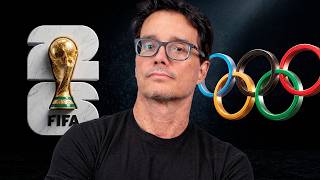

World Cup vs Olympics: Same Revenue, Different Cost
55sReveals the surprising revenue tie between the two events and how the World Cup operates with a leaner structure, sparking curiosity.
▶ Play Clip"Delivers on the title's promise with solid data, but the heavy course plug at the end slightly dilutes the value."
This video analyzes the business models of the FIFA World Cup and the Olympic Games, comparing their revenue, audience engagement, and financial sustainability. The presenter concludes that the World Cup is more efficient and profitable, despite similar gross revenues, due to its concentrated format and lower operational costs.
FIFA generated $7.5 billion during the 2022 World Cup cycle, while the IOC spent $7.6 billion during the Tokyo Olympics cycle, essentially a tie. However, the World Cup is a single-sport, month-long event, making it leaner and cheaper to operate.
FIFA projects $11 billion for the 2026 World Cup (48 teams, US/Mexico/Canada), while the IOC budget for Paris 2024 is $7.7 billion. The World Cup is growing faster.
The 2022 World Cup engaged about 5 billion people, with the final drawing 1.5 billion viewers—the highest for a single sporting event. The Olympics also reached ~5 billion but across multiple sports, diluting peak attention.
Both earn primarily from broadcasting rights (FIFA: $3.4B from TV, ~50% of revenue; IOC: ~60% from broadcasting) and sponsorships. Neither pays for stadiums or infrastructure; that burden falls on host cities.
Olympics often leaves host cities with debt and underused venues ('white elephants'). World Cup stadiums are reused by local clubs and leagues, providing ongoing value.
Both events are powerful platforms for athlete branding. The Olympics creates many new names, while the World Cup produces a few global superstars (e.g., Mbappé, Messi).
Both events monetize attention and brand licensing without taking on infrastructure risk. This model is applicable to content creators: build an audience and brand, then license it to others.
The World Cup wins the economic battle due to its concentrated attention, faster growth, and better legacy. However, the Olympics offers unique brand diversity. The core lesson is that owning attention and brand is more profitable than doing the heavy lifting.
How much revenue did FIFA generate during the 2022 World Cup cycle?
$7.5 billion
00:02
What is the projected revenue for the 2026 World Cup?
$11 billion
02:34
How many viewers watched the 2022 World Cup final?
1.5 billion
03:15
What percentage of FIFA's revenue comes from TV rights?
Almost half (50%)
04:32
Why does the World Cup have a better legacy than the Olympics?
World Cup stadiums are reused by local clubs and leagues, while Olympic venues often become white elephants.
05:35
What is the key business model similarity between FIFA and the IOC?
Both earn from broadcasting rights and sponsorships, and neither pays for infrastructure.
04:20
Growth Disparity
Shows the World Cup is outpacing the Olympics in revenue growth, indicating a stronger economic trajectory.
02:34Concentrated Attention
The World Cup final's 1.5 billion viewers demonstrates the value of peak moments over dispersed attention.
03:15Infrastructure Risk
Highlights a critical difference: Olympics often bankrupts host cities, while World Cup leaves usable assets.
05:10Asset-Light Model
Both organizations own the brand and audience, outsourcing risk—a model applicable to content creators.
08:21[00:02] generated $7.5 billion in revenue for FIFA over a four-year cycle. The Olympic Games during the same period generated $7.6 billion for the Olympic committee, , right? But it doesn't. And when
[00:16] things change completely. Figure. This video is going to go viral right now. Let's go.
[00:28] going to be a mortal-level battle, you're used to that, right? On one side, the most-watched sporting event in human history; on the other, the biggest multi-sport celebration on the planet; and in the end, I'm going to pick a winner, okay? But
[00:42] fan talk. I'm not asking which one is the most beautiful, which one is more moving, that's not it. The question is cold and impersonal. Which of these two events generates more money? And as a business model? Because making a profit is one thing, but having a business
[00:57] that pays for itself is another. And look, this is extremely interesting for anyone who works with content, branding, and audience engagement, because both events are attention-grabbing machines. And most valuable currency there is. So let's dry that up for you. Before we begin, comment
[01:10] below who you think will win, the World Cup or the Olympics. Paste your see if you were right. I'm really curious to see if you guys will get it right. two fighters properly. Let's go. On one side, there's the event that has been happening since 1930,
[01:25] bringing together more than 5 billion people around a single ball that mobilizes practically the entire planet for a month. Present in over 200 territories via television. The FIFA World Cup. On the other hand, there's the event
[01:38] that was reborn in 1896, which brings together more than 200 countries in hundreds of sports billions of viewers and carries the most recognized sporting symbol in the world, those five rings, right? The Olympic Games, two
[01:52] giants. Now let's go to battle, round by round. Round one, direct billing. Well, this is the heart of the matter, right? FIFA spent $7.5 billion during the 2022 World Cup cycle. The International Olympic Committee spent $7.6 billion during the
[02:07] Tokyo cycle, practically a tie, right? But there's one detail that changes everything. The World Cup is a single, month-long event focused on a single sport. The also include the Winter Games, with various sports taking place in different countries throughout
[02:22] the cycle. In other words, FIFA makes almost the same amount of money by concentrating everything on a much smaller and much cheaper event to operate. And what's more, in the next cycle, which is what we're experiencing now, FIFA is already projecting 11 billion
[02:34] dollars for the 2026 World Cup, which is being hosted in the United States, Mexico, and Canada, with 48 teams for the first time. The Olympic Committee's budget for the Paris 2024 cycle reached 7.7 billion. Look at the size of the gap that's opening up.
[02:48] The World Cup is speeding up a lot faster, is n't it? Well, in my view, this round is like the Cup, same revenue, but with a much leaner structure and growing faster. Point for football. Round two, hearing. Well, this is where the
[03:01] real money is, because audience is what brands buy. The 2022 World Cup engaged approximately 5 billion people in total. Only in the end did Argentina and France bring together nearly 1.5 billion viewers. Just so you know,
[03:15] for a single sporting event in history. The average attendance was 175 million history. The average attendance was 175 million people per game across 64 matches. That's absurd. Yes, it's absurd. And the Olympics, Paris 2024, also reached
[03:29] billions, with reports indicating something close to 5 billion reached, depending on the methodology, OK? It's a huge number, no doubt, but it's different in nature. The Olympics draws attention to dozens of
[03:41] sports simultaneously. The World Cup concentrates everything into a single sport, with absurd peak moments. That final, with 15 and a half million people watching simultaneously, represents Olympics rarely achieve in a single instant. You can't. The Olympics can't
[03:55] possibly have a sport that reaches so many people at the same time. There isn't a single sport that reaches that level. For those who come from advertising, concentrated tension is worth more than dispersed tension. That's why this round again
[04:07] acknowledge that, right? In terms of total gross reach, they're both on the same level, right? It's impossible to exaggerate. Round three, the business model. Well, now the fight is going to get really interesting, because they both earn money in
[04:20] similar ways, but live in very different realities. Both FIFA and the Olympic Committee get most of their money from two sources: the sale of broadcasting rights to television and sponsorship from major brands. In the case of FIFA,
[04:32] TV rights alone accounted for $3.4 billion in the 2022 cycle, almost half of the total. At the Olympic Committee, broadcasting is also the main driver, representing close to 60% of revenue. But pay attention to
[04:45] something that almost no one talks about . Neither FIFA nor the Olympic Committee foot the bill for building the stadiums and infrastructure. The city seven or city seven pays for this, and most of the time it's with public money.
[04:57] of the brand and the license than as operators of the event. So, they get the good part, and the risk of the project falls on the local government. Do you understand? Oh, how advantageous it is for those guys. But there's a glaring difference here. The
[05:10] Olympics are notorious for leaving a huge financial hole in the host city. Tokyo's account exploded. The Milan-Cortina project, scheduled for 2026, has already been estimated at around 6 public funds. Many cities that
[05:23] empty stadiums and debt to pay for years. The World Nobody's saying it's free, but soccer has an advantage that the Olympics don't. The stadium continues to be used afterwards. There's a club, there's a
[05:35] national championship, there's a game every week. So the Olympic infrastructure often over. So this round is ultimately about the Cup again. As a financial model, football leaves a more profitable legacy. Round four, the
[05:49] brand effect for those who participate. This one's for you: content creator, business owner, seller. Both events are giant platforms for exposure. Do you agree? Paris 2024, for example, generated more than 80 million
[06:01] new followers for the athletes involved. So can you imagine what it's like for world-famous in two weeks? It's pure gold in same thing, but in a more concentrated way. A player who shines in a World
[06:14] Cup becomes a global spokesperson overnight. Damn, Mbappé, Messi, these guys have built brand empires based on their World Cup performances. So here be fair, right? Because both are machines for transforming ordinary people into well-
[06:28] known brands. The only difference is the format, right? Because the Olympics create many average names, the World Cup creates few giants. Okay, the rounds are over World Cup won in terms of revenue efficiency, won in terms of business model
[06:42] due to legacy, and tied in terms of brand effect. In four rounds, there were three wins and one draw. So, drum roll, editor, go for it. The winner of this epic battle is the World Cup. Did you notice? There's no way around it, guys. And
[06:57] win, man. And I'll explain it to you exactly why, very clearly. First, the money as the Olympics, but it does so with only one sport, in a much cheaper event, much simpler to operate, same revenue, less cost.
[07:11] In any business, this is what separates profit from loss. Secondly, the World Cup captures can achieve elsewhere; it truly captures attention. A final with 1.5 man, there's nothing like it. So, the Olympics spreads things out, the World Cup concentrates them, and
[07:26] concentrated tension is worth more. And third, the World Cup is growing faster, going from 7.5 billion to a projected 11 billion in the 2026 cycle. The Olympics, on the other hand, remained close to 7.7 billion. So the growth curve for the World Cup is
[07:39] much steeper upwards. And the fourth legacy, the football stadium, lives on Olympic infrastructure often turns into a white elephant. The good thing about a good deal is that it continues to This is a legitimate business. It happened during the event, and it continued to happen afterward, right?
[07:54] the title. The World Cup won this epic battle, but to be fair, to be honest, the Olympics have a power that football doesn't have. She's universal in a different way, isn't she? It reaches countries where football is not the number
[08:07] one sport. It creates diversity in modalities. This has a brand value that doesn't let's say it's not a thrashing, it's a solid victory, but with respect for the And I wanted to leave you with a takeaway from this video. Look at what just
[08:21] happened. Both events make money in virtually the same way, by selling attention and licensing their brand. This makes money. Licensing pays a lot of build the stadium, they don't take the biggest risk, right? The risk is not theirs.
[08:35] They own the audience and the name, and they charge others to use them. Does this remind you of anything? I should remind you, because that's exactly what a well-built YouTube channel does on the scale of your reality. You gather
[08:47] attention, become a brand, and then brands come to you to pay to don't need to be FIFA to use the same model. You just need to understand the game. And that's why I built Formula YouTube 2026, because most people
[08:59] Posting a random video, hoping it will go viral by chance. And those who truly make money treat it as such: an asset, a brand, an attention-grabbing machine that can be monetized in various ways. Within the YouTube Formula, I
[09:12] channel formats that don't require you to show your face, so you can build this as a business and not just a hobby. However, an important detail is that the spots in the current batch at the launch price are limited, and once they're sold out, they're sold out. Those who sign up now get the
[09:26] special offer, those who wait pay more, okay? If you're should get in now, because opportunities with deadlines don't wait for anyone, okay? To sports giants teach us is that the big money isn't in doing the
[09:39] hardest work, it's in owning the attention and the brand, concentrating the audience, you know. figured this out, and you can apply this to your scale today without needing comments, were you right at the beginning? Did you think it would be the World Cup or did
[09:54] importantly, is it clear to you why the winner was chosen? Comment here already. And a little, surprised you, please subscribe to the channel, help us by subscribing, us to always bring this type of content to you, and thank you very much.
[10:09] the home. The next video might help you earn money. Perhaps you have step guide, or a course. We do this a lot here. Thanks, everyone. Until next time. Oh no, we don't have that here. Until next time. I went. Uh. Yeah.

⚡ Saved you 0h 10m reading this? Transcribe any YouTube video for free — no signup needed.