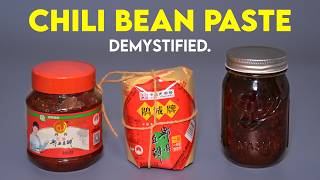
Why Sichuan Food is RED
45sStriking visual comparison of Mapo Tofu with and without red oil bean paste immediately grabs attention.
▶ Play Clip
[00:00] So this product, red oil chili bean paste, it's
[00:07] synonymous with ‘the color red’. Like this is
[00:13] Mapo Tofu that's made without. The stuff, it's
[00:18] really deep fermented bean flavor to it, but it
[00:26] But something that I've seen when people are
[00:30] whatever is honestly… a lot of confusion. Because
[00:38] and it's really a bit more for dipping sauces. You
[00:45] not really the same thing as our red oil chili
[00:51] in Sichuan itself, there are two major different
[00:58] this and there's also this, which is in turn made
[01:10] number one, which is a chili bean paste that's
[01:15] what this product is here, which is honestly for
[01:22] bean paste. If you see a recipe online calling
[01:29] in Chinese, 99 times out of 100, they're going to
[01:34] is by fermenting broad beans together with chili
[01:40] that and aging it together with oil inside of a
[01:46] recipe for the stuff if you're in the market for
[01:51] buy this bottle. It's easy. It's ready to go. But
[02:00] which is a chili bean paste that's been fried with
[02:06] is a homemade red oil chili bean paste that is
[02:14] oil-less Pixian Doubanjiang. This specific
[02:19] but in Sichuan itself at the markets, you can also
[02:25] you'll do is you will get your oil-free Pixian
[02:31] then you'll fry it on low together with a bunch
[02:36] and save it for dishes. So if you've gone online
[02:43] know that it actually is a pretty nice product,
[02:49] just quite yet. Again, you're going to need to fry
[02:56] can fry this stuff. You can also flavor your oil,
[03:01] But first, let's just show you how to get this
[03:06] 100 g of our packaged Pixian Doubanjiang, we're
[03:12] oil that we're using today is this – Caiziyou -
[03:19] traditional in Sichuan cooking. Now, Caiziyou,
[03:26] going to need to cook it. Now, to do so, you
[03:32] you begin to get that up to smoke point. So, for
[03:37] about 230C. Then, we'll swap the flame to low
[03:43] to 40 seconds. Then, shut off the heat and let the
[03:50] whenever you're working with any kind of raw oil
[03:56] in Guangdong or Guangxi, a more kind of artisanal
[04:01] which is our common Caiziyou sub, cooking it first
[04:07] remove its pungency. With most mass-produced oils,
[04:13] do that step. So, you're probably not going to
[04:19] result is, you could try it on the raw natural oil
[04:25] olive. Try the before and after. But anyway,
[04:31] in our Pixian Doubanjiang. And over a low flame,
[04:37] oil to start to stain red, which is going to
[04:43] You're going to be done once the oil's been
[04:47] doubanjiang have started to curl slightly and ever
[04:54] can just toss that in a bowl and jar it up once
[05:00] should probably talk about color because like this
[05:07] the color of the package bottle. Now, this one, it
[05:14] me that it is never going to get as red as the one
[05:19] oil. So, functionally, I think for us as cooks,
[05:27] then type one, it's going to end up with a bit of
[05:32] a restaurant or on YouTube, if you're just cooking
[05:39] super super red. But if you find yourself using
[05:46] bit, three options for you. First, if you're using
[05:53] red fragrant chili powder to your recipe. So
[05:57] like a tablespoon of Pixian Doubanjiang, you could
[06:04] or Gochugaru to your recipe, mixing that in. It's
[06:12] end up kind of splitting the difference. Then
[06:17] this both on hand, you could try going half/half.
[06:23] homemade one for depth, half tablespoon of the
[06:29] option three, you can also fry up your own flavor
[06:37] that really is the benefit of these kinds of packs
[06:43] and make it your own. Now, the most common way
[06:49] of Pixian Doubanjiang. So, today we're going
[06:55] the red one. Three parts of a one-year Pixian
[07:02] part of a three-year Pixian Doubanjiang, which is
[07:09] fermented flavor to it. Now, again, this is just
[07:16] Sichuan. But again, you can just make it your own
[07:22] want - add in a bit of spices and aromatics. So
[07:28] and about 3 inches of smashed ginger together with
[07:34] bowl and wetted with a bit of baijiu liquor… and
[07:40] cup worth of our rapeseed oil just like before.
[07:45] the onion and the ginger and let those fry over
[07:51] toss in our liquor-wetted spices and continue to
[07:58] about 5 minutes more, strain that all and then
[08:03] Pixian Doubanjiangs. We've got 90g of our red oil,
[08:11] Then slowly fry those again, medium low flame for
[08:18] out. And with that, you've got yourself a nice
[08:27] big question whenever you're making any kind of
[08:34] is this actually worth it? Like, is it the bread
[08:40] kind of home fried Pixian Doubanjiang, I would
[08:48] Sichuan food on the regular, I think the easiest
[08:54] can make a good quality homemade chili oil. And
[09:01] the second most important thing, if you can swing
[09:06] obviously a lot more common in restaurant kitchens
[09:13] you can even whip up a simple pork bone stock,
[09:18] needle on your Kung Pao. And then I would put this
[09:25] already have a homemade chili oil and you already
[09:31] of stuff in the homestyle flavor profile, which
[09:37] Pixian Doubanjiang and not all that much else. I
[09:45] I don't think that obligatory. You can also just
[09:53] going to be down in the description box. Free
[09:58] everybody that's supporting us on Patreon. And of
⚡ Saved you time reading this? Transcribe any YouTube video for free — no signup needed.