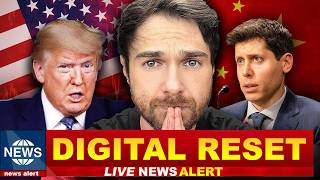

Bible Prophecy Coming True?
45sConnecting ancient biblical prophecy to modern technology creates a controversial and thought-provoking hook that sparks curiosity and debate.
▶ Play Clip"Title accurately reflects the core thesis that money is being reprogrammed via digital currencies and programmable ledgers."
The video argues that a 'digital control grid' is being built, combining programmable money, global digital identity, and surveillance hardware. It claims this system, predicted in the Bible as the 'mark of the beast,' will enable unprecedented central control over individuals' finances, movements, and behavior.
The video opens by linking Revelation 13:17's 'mark of the beast' to modern digital ID and programmable money, suggesting ancient prophecy is being fulfilled.
Sam Altman's company Worldcoin (now World) deploys 'Orb' devices to scan irises, issuing a World ID as proof of humanity. Over 18 million people have voluntarily signed up.
The US passed the GENIUS Act in 2025, creating a legal framework for stablecoins (digital dollars) that can be programmed with rules on where, when, and how they can be spent.
Catherine Austin Fitts identifies three pillars: programmable money, global digital ID, and surveillance hardware. When combined, they allow central planners to control society without laws.
Palantir, named after the 'seeing stones' in Lord of the Rings, is a data analytics company that fuses data from multiple sources into a unified picture, now expanding into healthcare, finance, and government.
Unlike neutral fiat money, programmable money has conditions fused into it (e.g., expiration dates, geographic limits, spending restrictions). The GENIUS Act requires stablecoin issuers to connect to a Treasury Department pipe for KYC/AML.
A social credit score based on behavior (bill payments, jaywalking, political speech) determines access to loans, travel, jobs. China already blocks 30 million flights/train trips annually via this system.
Stablecoins backed by US Treasuries create a new retail market for US debt, propping up demand as foreign buyers decline. Larry Fink predicts all stocks and bonds will become digital tokens on a programmable ledger.
Programmable money requires knowing who is spending, so digital ID and CBDCs are designed to work together. World ID's biometric data is irreplaceable and could be subpoenaed, hacked, or sold.
An arms race in energy and AI infrastructure is underway. The FCC pushes for cell towers every 400-700 feet for triangulation, and satellites can beam Wi-Fi directly to devices. Cars now legally require kill switches.
The video argues a crisis (like a pandemic or financial collapse) will be used to accelerate adoption of the digital control grid, as seen with COVID-19 vaccine passports and emergency powers.
In 2026, supply chain disruptions, high food/gas prices, low consumer confidence, and a 125% debt-to-GDP ratio create an impossible choice for central bankers: defend the dollar or save the bond market.
The video concludes that the convergence of programmable money, digital ID, and surveillance hardware is creating a system of unprecedented control, with a crisis likely to accelerate its adoption. It urges viewers to consider the implications for freedom and financial sovereignty.
What biblical passage does the video reference as a prophecy of the digital control grid?
Revelation 13:17, which says a mark will be required on the right hand or forehead to buy and sell.
00:01
What is the 'Orb' and what does it do?
A silver sphere that scans the iris to obtain a biometric signature, used to issue a World ID.
01:52
How many people have voluntarily scanned their iris for World ID as of the video?
Over 18 million.
02:19
What does the GENIUS Act do?
Creates the legal framework for stablecoins (digital dollars) in the United States.
03:13
What are the three pillars of the digital control grid according to Catherine Austin Fitts?
Programmable money, global digital identity system, and surveillance hardware.
04:54
What is a social credit system?
A score assigned based on behavior (e.g., paying bills, jaywalking, political speech) that determines access to loans, travel, and jobs.
13:07
How many flights and train trips were blocked in China in a single year due to its social credit system?
Over 30 million.
13:50
What requirement is buried inside the GENIUS Act according to Catherine Austin Fitts?
All stablecoin issuers must connect to a Treasury Department pipe that applies KYC, anti-money laundering, and sanctions enforcement.
12:38
What does Larry Fink predict about stocks and bonds?
Every stock and every bond will eventually trade as digital tokens on a blockchain, with each investor having a unique identification.
16:22
What is the 'kill switch' in cars?
A legally required device that can remotely turn off a car, and may disable the car if it thinks the driver is not doing a good job.
22:54
World ID as Proof of Humanity
Highlights a real-world deployment of biometric ID with over 18 million users, framing it as a voluntary but potentially dangerous step.
01:39Three Pillars Framework
Provides a clear, structured explanation of how programmable money, digital ID, and surveillance hardware interconnect to enable central control.
04:54GENIUS Act's Hidden Requirement
Reveals a specific legal mechanism that could link stablecoins to a social credit system, illustrating a concrete path to control.
12:38Stablecoins as Debt Export Tool
Explains a plausible economic motive for central planners to push programmable money: propping up US debt demand as foreign buyers decline.
15:41Crisis as Catalyst for Control
Argues that a crisis (pandemic, financial collapse) will be used to accelerate adoption of the digital control grid, citing COVID-19 as a precedent.
25:52[00:01] that's happening in the world right now was actually predicted thousands of years ago. There's a passage in the Bible written almost 2,000 years ago. Revelation 13:17.
[00:15] It says, "A mark will be required [music] placed on your right hand or your forehead, and without that mark, you cannot buy and you cannot sell." This is called the mark of the beast. And for most of human history, people
[00:29] assumed that this was just a metaphor from the Bible [snorts] kind of symbolic message that [music] ancient texts used to describe power and controls in ways that people could visualize at that time. Cuz obviously nobody could imagine
[00:43] the technology that would make this possible today. But if you're paying attention to [music] the world and everything that's going on today, it almost seems like everything we're watching is part of some manufactured
[00:57] crisis, a transition in human history with a new opportunity to centralize power. >> We are now moving from the industrial age to the intelligent age. We are living in
[01:14] is the transition to a new time which will change everything. It will change how we communicate, how we work, how we live. But now in
[01:26] this new age, the base will be knowledge, data and intelligent [music] insights. Now, in the modern world, people call
[01:39] this prophecy the digital control grid. And I know how it sounds conspiratorial, but I want to show you some things that are actually happening right now. In are actually happening right now. In 2025, a company co-founded by Sam Alman,
[01:52] the CEO of OpenAI, started deploying a device called the Orb. It's a silver sphere about the size of a bowling ball. And what it does is it scans the iris of
[02:04] your eye to get what's called your biometric signature. It's the one thing about your body that's completely unique to you and can never be changed. Now, in exchange for that scan, you will get something called a world ID, which is a
[02:19] something called a world ID, which is a digital proof that you are a real human being. As of right now, over 18 million people have already done this voluntarily. Why would they do that? It's because in a world of AI and
[02:32] robots, how do you prove you're actually a real person? This is how the world ID is now being integrated into apps like Tinder, Docuine, Zoom, Shopify, and
[02:45] dozens of other platforms. Sam Alman has said that proof of human will eventually said that proof of human will eventually be required by every website, every app, >> People are really going to need this and really going to need to do this in a
[02:58] privacy preserving way. So, World ID is our effort at that and our goal is to make World ID be this new proof of human for the internet. At the same time, the United States passed something called the Genius Act, which is a law that
[03:13] creates the legal framework for stable coins, aka digital dollars. And what makes a stable coin different from the cash in your bank account, is that it can be programmed. It can be given rules. rules about where it can be
[03:28] spent, on what and when it expires, and whether it works outside a certain area. The World Economic Forum is also now arguing that water, soil, and even the arguing that water, soil, and even the air we breathe needs to be assigned a
[03:43] financial value. It needs to have a price and it needs to be measured. Now we need to put the economics of water not only in terms of monetary values but also in terms of governance in terms of of recognizing water as a as a commons
[03:57] of recognizing water as a as a commons that we now need to manage as as a broad systems approach. If we're going to protect natural systems, one of the solutions is to bring nature onto the balance sheet, to bring nature into the
[04:10] business to allocate a value to it and to bring mechanisms. >> Basically means the air and water should
[04:22] not be freely accessible. They should be a financial asset. And while all of this is happening, there's been a huge buildout of cameras, satellites, cell towers, and AI data centers in communities all across the world. Now,
[04:36] light by Katherine [music] Austin Fitz, who used to be the assistant secretary of housing under President [music] Bush, and she talks about a specific plan of that there's three parts that are being built that have never existed before in
[04:54] human history. So there are three sort of pillars that I track. One is the programmable money and that's what we at Solaria are trying to stop. Uh the second is the digital ID because you need a global you need digital ID
[05:08] systems that are interoperable globally and then the local hardware and those are sort of the three pillars >> programmable money the global digital identity system and the surveillance hardware to enforce both of those
[05:22] systems. And she says that when all three are complete, the people who control that system, aka the central planners, those people will not need laws to influence society. They're not going to need the police or the courts.
[05:37] If they want you to do something, and for some reason you're not doing it, they'll just turn off some important aspect of our lives. Whether it's the aspect of our lives. Whether it's the money we use, the IDs we need, or they
[05:49] could just restrict our ability to buy and sell or travel somewhere unless we >> My ministers all will also proceed with the introduction of digital ID that will
[06:01] modernize how citizens interact with public services. >> That's why some people believe that this was a prophecy that came from the Bible. So, in this video, I want to talk about what's being built, how this affects the
[06:15] investment markets, and what's going to happen to the idea of money itself. So, with that said, let's get into it. Hi, my name is Andre Jick. Hope you're doing the mark of the beast. Okay, I want to start this video with a little preface.
[06:31] I'm not saying that a digital ID is automatically evil. I'm not saying that a digital dollar is the end of freedom. I'm not even saying that Sam Alman is some bad guy building the mark of the beast. Any one of these things on their
[06:43] own, you could argue has a reasonably good explanation. Like a digital ID is really convenient. I've lost my ID so many times before, it'd be nice just to money could lower the risk of fraud. That's also nice. And cameras can make
[06:58] neighborhoods safer. These are all genuinely true and good reasons, but here's the thing. They're all being built together at the same time by connected institutions that'll be managed by a system that has never
[07:12] of them that allows for the centralization of power in a way that Now, here's something that's going to blow your mind. One of the main the surveillance and data infrastructure for this system is called Palunteer.
[07:29] You've probably heard of it. Palunteer is here to disrupt [music] and make our very best in the world and when it's necessary to scare our enemies and on
[07:41] occasion kill [music] them. >> Check out Palunteer shares surging 22% after the company cited a boom in demand for its AI software from the US government. >> We we're doing it. We're doing it and
[07:53] I'm sure you're enjoying this as much as I am. There's been a lot of videos about this company and people that invested in this stock a couple years ago made a lot of money. But what does Palunteer actually do? Palunteer is a data
[08:07] analytics company founded by Peter Teal, and it works mostly with governments, intelligence agencies, and militaries around the world. Now, maybe you knew that, but what you might not have known is what palunteer means. In Lord of the
[08:21] Rings, a palunteer stone is a magical object that allows its users to predict a remote location. >> It was originally created by the elves. It was meant to be used for good purposes. It is it is potentially a very
[08:35] dangerous technology. It's very powerful. >> The name comes from J.R. Tolkien's Lord of the Rings. And in that story, the of the Rings. And in that story, the palenti are ancient seeing stones and
[08:48] they let whoever holds them see anything anywhere at any time. They are the allseeing eyes of Middle Earth. And in that story, Sauron uses them not just to
[09:01] that story, Sauron uses them not just to watch but to manipulate Middle Earth to show people only what he wants them to see. What is that in the modern day? That's the algorithm to make people believe things that aren't necessarily
[09:14] true. It feeds people their worst impulses and fears. Now, I'm not saying am saying that symbolism like this doesn't happen by accident. And having said all that, let me explain how all of
[09:29] this is going to work. Kathern Austin Fitz says that this system is made up of three different parts. And I think the easiest way to understand the digital control grid is to look at each one of them separately and then I want to show
[09:42] you how they all connect. The first pillar is programmable money which they say is needed in a world where AI will replace all the jobs. The second pillar is a global digital identity system. And the third pillar is the cameras that are
[09:59] going to watch everything we do. Now, if we fast forward to today, 2026, all three of these pillars are either already built or they're in the process. So, let me explain the first part of this story, which is money. And speaking
[10:15] of money, our digital identity and our data is being collected and sold. And random phone calls and emails. And that's because right now there are brokers that are legally collecting our personal information like our names, our
[10:29] home address, phone number, and even our relatives and selling it to anyone with segment is sponsored by Delete Me. I've personally been a member since April 2024, and they've scanned thousands of listings and found over 50 brokers
[10:42] selling my info. Thankfully, Delete Me has removed them, and they've easily saved me over 14 hours of trying to do this myself. Delete Me just runs in the have to do anything. They were just named the number one data removal
[10:55] service by Wire Cutter and real people are actually doing the removal. It's not protect you from the risks of your data being out there in the wrong hands. It link is down below or you can go to join eliteme.com/andre20
[11:09] to get 20% off. Thank you to Delete Me for sponsoring this segment. And now let's get back to it. Okay, so let's talk about that first part, money. And I basic. Right now, the dollar in your bank account is just a number. It has no
[11:23] rules attached to it. You can spend it on whatever you want, wherever you want, you can give it to whoever you want as well. And the bank might ask questions fundamentally the money is yours, and it's what's called neutral. It doesn't
[11:38] care what you spend it on. Programmable money is different because that money comes with conditions fused into the currency itself. So imagine you get a paycheck and it's only valid for a certain amount of time before it expires
[11:54] or it can only be spent within your state or it can't be used to buy certain things maybe a certain cryptocurrency or meat because of a carbon policy or energy is just too expensive. Now I'm not saying that these specific rules are
[12:08] coming tomorrow. I'm just saying that the technology to do all of this already exists and the legal framework to deploy it is being built right now. In the United States, for example, the Genius Act was passed in 2025. That law created
[12:24] the official regulatory framework for stable coins aka digital dollars issued on a blockchain. Now, Kathern Austin Fitz points out that buried inside the Fitz points out that buried inside the Genius Act is a requirement that all
[12:38] stable coin issuers must connect to a Treasury Department pipe. One that applies KYC, know your customer rules and anti-moneyaundering rules and sanctions enforcement. And once this connection exists, it can be integrated
[12:54] with anything, including a social credit system. What's a social credit system? Right? A social credit system is basically a score that gets assigned to you based on your behavior. It's going to measure things like did you pay your
[13:07] bills on time? Score goes up. Did you jaywalk or post something critical of the government online or associate with someone that the system flagged as a problem? Score goes down. And your score determines what you'll be allowed to do.
[13:22] A high score means you'll get access to better loans, faster travel, more opportunities. A low score means you can't buy a plane ticket, you can't get can't buy a plane ticket, you can't get certain jobs. [snorts] This is already a
[13:36] >> Once you're blacklisted, you can no longer get a bank loan, start a longer get a bank loan, start a business, buy an apartment, or even send your children to a private school. In fact, over 30 million flights and
[13:50] train trips were blocked in a single year because of this system. They want you quote on your best behavior. >> Citizens will be on their best behavior because we're constantly recording and reporting everything that's going on.
[14:05] >> Now, the stable coin companies say that they would never do this, but the infrastructure to do this is already technically possible. Now at the same time in Europe, Christine Lagarde, the president of the European Commission
[14:18] said, and this is a direct quote, "It is essential to swiftly adopt the digital euro. >> It is thus essential to swiftly adopt the regulation on the establishment of the digital euro."
[14:34] >> And all of this is sort of framed as innovation, right? As a necessity for the changing world order. Now, beyond this ability to program money, there's actually another reason why central planners want to do this. And the theory
[14:48] behind why they want to do this is to be able to offload their debt onto the rest of the world. And that's because in 2026, the United States government is running a deficit that is completely unsustainable.
[15:02] foreign countries that used to buy US Treasury bonds, the countries that buy our debt, the debt that funds our government, they're now buying less of it. The traditional wholesale market for US debt is getting smaller. And it's
[15:15] getting smaller because nations are trusting the US less and less, especially in the context of the Iran war. So, how do you save the empire? war. So, how do you save the empire? Stable coins.
[15:41] millions of people around the world to hold your digital dollars on their smartphones, which are essentially just treasury bills wrapped in an app, you've treasury bills wrapped in an app, you've just found a new market for US debt.
[15:54] That's where private corporations will be able to issue their own coins and pay their own yields with their own perks and benefits and that's how you can export your debt into the global retail market and that props up demand for
[16:07] treasuries. It preserves dollar dominance and as a bonus every single transaction will be visible, trackable and in theory programmable. Larry Frink, the CEO of BlackRock, which is the biggest asset manager in the world, has
[16:22] eventually trade all stocks and all bonds as digital tokens on the blockchain. >> And that means every stock, every bond will have its own basically QIP. It'll be on one general ledger. Every
[16:37] investor, you and I, will have our own number, our own identification. >> Every stock you own, every bond, and every asset will be on a programmable every asset will be on a programmable ledger. That is a multiundred trillion
[16:50] dollar market. And once it's there, the rules that govern your money can be changed at any time by whoever controls that system. So that is the first pillar. It's the money. The money is the foundation. But to make it work, you
[17:06] need to know who is spending what. Which brings us to pillar two. Pillar two is identity. Cuz here's the problem that programmable money creates. If our money is digital and it has rules, you need a way to enforce the rules on the right
[17:20] person cuz the system needs to know that you are you. You're not an AI behind some deep fake. Which means the money part and the identity part have to be connected. And this is not speculation. The Bank of International Settlements,
[17:33] which is basically the central bank of all central banks, it's the granddaddy bank and the United Nations, right? Both of them have put out documentation that digital IDs and CBDC's are designed to go together. So how do you build a
[17:47] global identity system because people would never vote for that? The way you would do it is that you make it so convenient and so useful for everyday life that people will line up voluntarily to hand over their biometric
[18:01] data, which is exactly what's happening. Go back to World ID. Sam Olman's company did not launch this as a government program, right? They launched it as a solution to a real problem. How do you prove that you are a human being in a
[18:14] world full of AI? It's a genuinely good question. And the answer he came up with is scan your eyeball, get a credential, and use it everywhere. Tinder uses it so that you know your match is real. Docuine uses it so that contracts are
[18:28] it so you know that the person on the other side is not a deep fake. Right? Every single use case is completely reasonable, which is why 18 million people have already signed up to it. The dangerous part about it, though, is that
[18:42] you're giving a private company a biometric signature that is unique and irreplaceable. With a password, for example, you could change it any time. You can get a new credit card, but you can't get a new set of eyeballs. And
[18:55] once the data exists, once it's been harvested and collected, it can be subpoenenaed, hacked, or even sold. it can be given to the government and the company's privacy policy today does not guarantee what happens to your data in
[19:09] 10 years under different laws under different political conditions right and biometric collection is not just coming from world ID you might have noticed that every time you travel you get your biometrics taken things like
[19:23] fingerprints and facial recognition it's everywhere in almost every country you visit that's already the standard at most international borders so now Now the question is how does this connect to the first part? Scott McCullo says when
[19:37] the next pandemic comes and there will be a next pandemic maybe the henta virus or whatever they'll call it'll be way more digital of an experience than the last one. when the next, you know, when Fouch's next pandemic shows up, whether
[19:52] Fouch's next pandemic shows up, whether it's next year or the year after, um, we we're going to have another effort to impose this kind of control state. And this time it will probably be far more
[20:05] digital. And those of us who choose not to comply, whether it's a vaccine or a quarantine or something else, they will use this infrastructure to deny access to your basic human rights. Because all of this is technological, though, there
[20:21] doesn't have to be a law. We saw a preview of this with vaccine passports. In some countries, you couldn't go into a restaurant or a gym or a concert without showing a digital health certificate. Some people were forced to
[20:34] get vaccines otherwise they were not allowed to come to work but that was temporary though the infrastructure that made this possible is now permanent. So when you combine pillar one and pillar two what you get is a system where every
[20:48] transaction you make is attached to who you are and what you've done and whether you're in compliance. But there's still one more thing. None of this will work at scale unless there's some physical infrastructure that can monitor
[21:04] everything you're doing in the real world. And that's pillar three. So pillar three is the hardware. Right now there is an arms race to build out there is an arms race to build out energy and AI infrastructure. Why? If
[21:17] you ask the optimistic investor, they might tell you well because money, stock markets, profits, efficiency, right? But if you ask a pessimistic investor, they might say, "Do you really think that there's an arms race for energy so that
[21:32] you could use Claudebot and image generators more efficiently?" Maybe it's because the energy that's needed to manage and consolidate all the cameras, all the biometrics, and all the data is going to be massive, right? That's why
[21:46] there's a huge push for technologies like spatial control. It's this ability to track where people are and then express that location in real time mathematically. The FCC has been trying to override controls on where cell
[22:01] towers can be placed so they can be installed every 4 to 700 ft which would be close enough together that your phone's location can be triangulated at whether you have location services turned on or not. There's even Wi-Fi,
[22:16] which can apparently locate where you are in real time inside your own house. And then above that, there's now commercial satellites that can beam Wi-Fi directly to devices on the ground, which means even if you have no
[22:29] connection, the network can still reach you. Now, why would they want to do any of this? It's because that that will allow for the ability to program your
[22:41] money specifically such that it might not work more than a mile from your house. This applies to your car as well. There's something called the kill switch. Congressman Thomas Macy is trying to remove it, but it is now
[22:54] trying to remove it, but it is now legally required in every new car sold in America. It's a switch that can remotely turn off your car. That's the law right now. But there is a law that states that every vehicle manufactured
[23:06] is going to have to have a kill switch in it. The car itself will monitor your driving. And if the car thinks that you're not doing a good job driving, it will disable itself. So the car dashboard becomes your judge, your jury,
[23:23] and your executioner. That's why pillar three is the hardware. Cuz think about what it actually takes to run a social credit system at scale. Tracking hundreds of millions of people's financial transactions, their
[23:37] physical movements, their online behavior, their compliance status, and then you have to apply different rules to different people in real time. That is almost an incomprehensible amount of data processing. And you need the most
[23:52] powerful computing infrastructure ever built to do it. which is exactly why and scale that is no historical comparison. But in order for the system to work, all of this has to be stored
[24:06] and interpreted in one place. Someone has to turn this data into a unified picture of every person, right? You have to build a risk profile. And that's exactly what Palunteer was built to do. >> Co-founded [music] by Peter Teio back in
[24:22] 2003. Its mission providing software that customers use to integrate volumes of data from images [music] to spreadsheets into a central platform where it can then be securely analyzed and interpreted. It was built to fuse
[24:36] data from multiple sources into one story about your life. It was built for the military and intelligence agencies. And it is now being integrated into health care systems, financial systems, and government infrastructure around the
[24:50] world, tied together and processed by AI. So, pillar one controls what your money can do. Pillar two knows who you are, and pillar three tracks where you
[25:02] are and what you're doing. And when those systems are fully connected, and they're being connected right now, the result is that everything you buy, everywhere you go, every transaction, and every behavior is attached to your
[25:16] verified identity that is monitored in real time and given a social score. And if your behavior falls outside the system, it just sort of turns off a
[25:28] dial. Like maybe your credit card stops working at the gas station. Oh, wait. You drive an electric car, do you? Well, that's too bad. You can't go beyond your city limits. Or maybe your ID fails verification at the airport, so you
[25:40] can't travel. Or your account gets flagged. Hey, we noticed you traveled a mile beyond the allowable limit since you didn't get a vaccine, right? You're a threat. That is the digital control grid. And the reason I'm making this
[25:52] video right now in May of 2026 is that in order to get this system the kickstart that it needs, there has to be a crisis. in order for the central planners to have their opportunity to fix said crisis.
[26:07] >> In this new world, we have to accept transparency and I would even say total transparency. Everything is going to be transparent and we have to get used to it. We have to behave that way. It becomes, how should I put it? Part of
[26:23] your personality. But if you have nothing to hide, there's no need to be afraid. So, tying all of this together, one of the most interesting theories I've seen that explains what's happening in the world
[26:36] today is not just for the military-industrial complex and its profits. It's not just for an energy disruption and a rerouting. It's basically for the event that makes all of this possible one way or another. And
[26:49] the countries that are trying to resist the vasilization into the financial markets will need to eventually get in line because think about what happened during co within weeks governments around the world rolled out contact
[27:03] tracing apps, vaccine passports, emergency powers, digital health certificates, things that would have taken a decade to pass through normal legislation. But they were passed instantly because people were scared and
[27:17] scared people accept things they would never accept otherwise. That was a test. And a plausible theory is that the hormuse closure is doing the same, but it's putting pressure financially cuz supply chains are disrupted again. Food
[27:34] prices are going up and they're becoming digital at the grocery stores right now. Gas is also back at near record highs. Consumer confidence just hit its lowest level since 2008 and foreign countries that used to buy US debt are buying less
[27:50] of it. The debt to GDP ratio has now crossed 125%. And what all that does is it creates financial stress and a consequence. That consequence is an
[28:02] impossible choice for the central bankers. Do you save your currency or do you save your bond market? Because you can't do both. If you raise rates to defend the dollar, the bond market collapses. If you cut rates to save the
[28:16] collapses. If you cut rates to save the bonds, the dollar loses value. So, which that's one of the main reasons why the stock market could be going up because the market is betting that they're going to pick devaluing the dollar and saving
[28:31] the bond market is the only way out. Option number two, right? And while we bail out the bond markets, the central planners have no choice but to continue the buildout of this digital control grid. And how devaluing the dollar looks
[28:46] grid. And how devaluing the dollar looks like to us is the price of everything, the price of stuff, including assets, goes up. This is the system's way of fighting back. We are digitizing and uploading this debt onto the rest of the
[29:01] world with CBDC's devaluing the dollar and the markets are ripping. So, I guess time will tell if this prophecy is going to come true or if all of this is a coincidence, but I think at this point the evidence and the symbolism makes it
[29:16] really hard to ignore. And I think it's really interesting. Now, if you want to of this and the specific assets I'm holding and what I think of this market and what I'm actually doing with my own money, those videos live in the members
[29:29] and you'll get access to the videos earlier than the main channel. And if below. Thank you for the support. It allows me to take on less sponsors over this one. In the meantime, I'd love to hear your thoughts about this crazy
[29:44] of your day. Smash the like button. Subscribe if you haven't already. I'd Subscribe if you haven't already. I'd love to see you back here next week.


⚡ Saved you 0h 29m reading this? Transcribe any YouTube video for free — no signup needed.