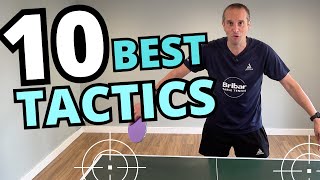

Serve Deep & Fast to Win Cheap Points
56sReveals a simple, counterintuitive tactic that exploits common weaknesses in amateur players, making viewers eager to try it.
▶ Play Clip"Title accurately promises 10 tactics, and the video delivers exactly that with clear explanations."
This video presents 10 effective tactics for winning points in local league table tennis matches, drawn from 20 years of experience. The tactics are designed to exploit common weaknesses at the amateur level, such as poor footwork, inconsistent returns, and lack of spin variation.
Serve deep and fast to three positions: wide backhand, wide forehand, or crossover. Use topspin/sidespin initially, but backspin can catch opponents off guard.
Aim between hip and elbow of playing hand. Amateurs often hesitate and mis-hit due to poor footwork.
When looping backspin, focus on heavy spin with a high arc. Opponents struggle to block or smash consistently.
Use full table width to exploit weak footwork, especially moving from wide forehand to wide backhand.
Accelerate forearm and wrist to load backspin. Opponents often net the ball or loop into the net.
Block low and early, just as ball rises. Amateurs struggle to sustain multiple attacks.
Hit forehand down the line to opponent's backhand. Surprise factor and shorter distance make it effective.
Vary placement (short, half-long, long), spin (back, top, float, sidespin combos), and tempo (slow/fast, toss height).
Develop backhand flick to attack short serves. Surprise element wins points even without perfect quality.
Play at 70% power with consistency. Most amateur rallies break down; staying in the rally wins points.
These 10 tactics are easy to implement and highly effective at the local league level. For further development, the presenter recommends joining his online academy.
What are the three target positions for a long fast serve?
Wide to the backhand, wide to the forehand, or the crossover position.
01:03
Why is the crossover position effective against amateur players?
Because most amateur players have poor footwork and are unsure which side to use.
02:31
What is the key to a heavy topspin loop against backspin?
Load up the spin with a high arc over the net; speed and low net clearance are less important.
03:35
Which corner-to-corner movement is hardest for most players?
Moving from wide forehand to wide backhand.
05:16
How can a push become a weapon?
By accelerating the forearm and wrist to load heavy backspin, causing opponents to net the ball.
06:02
What is the correct timing for a quick fast block?
Make contact just as the ball is rising towards the peak of its bounce.
07:34
Why is a forehand down-the-line shot effective?
It surprises opponents expecting crosscourt and targets the weaker backhand side.
08:54
Name three types of serve variation mentioned.
Placement (short, half-long, long), spin (back, top, float, sidespin combos), and tempo (slow/fast, toss height).
09:41
What is the recommended technique for a backhand flick?
Come in with elbow higher, turn wrist in, and pick up the backspin ball.
12:10
What percentage power does the presenter recommend for consistency?
70% power.
13:33
Long Fast Serve with Backspin Surprise
Most players expect topspin on long serves; backspin variation catches them off guard.
01:03High Arc Heavy Spin Loop
Amateurs struggle with heavy spin even if the loop is slow and high.
03:23Quick Block Exploits Weak Attack Chains
Most amateurs can't sustain multiple strong attacks; a well-timed block disrupts them.
06:56Serve Variation Overwhelms Opponents
Combining placement, spin, and tempo makes returns much harder.
09:41Consistency Wins at Amateur Level
Playing at 70% power with good placement often outlasts opponents' errors.
13:06[00:01] In this video, I'm going to share with you my top 10 tactics for winning points in local league matches. I've been playing local league for about 20 years, and the tactics I'm going to show you in this video have helped me move from the
[00:13] bottom division all the way up to the top division. Watch the video all the way through, then watch it again, then watch it again. The tactics in this video, I guarantee you, are going to help you win more points. This video is
[00:28] sponsored by Bribar, the best table tennis equipment company. Bribar sell bats, rubbers, blades, balls, clothing, tables. They have great offers and they tables. They have great offers and they ship worldwide. Go to bribartt.co.uk.
[01:03] the ball deep on your opponent's side, and it needs to have some speed. In general, you're going to aim for three positions. You're going to go wide to the backhand, wide to the forehand, or hit your
[01:18] opponent in the crossover position. Now, this tactic works simply because a lot of players at the local league level, they just don't quite have the skills to know how to return long, fast serves. So, I'll often be rushed into an error,
[01:33] hitting the ball off the end of the table or dumping it into the net. Now, to begin with, you're probably going to find it easier to do a long fast serve find it easier to do a long fast serve with top spin or side spin. But don't
[01:45] overlook doing long fast serves with backspin. Why? Because most players assume if it's a long fast serve, it's going to have top spin. So, if you can
[01:57] do it a long fast serve with backspin, you can really catch people out. If they don't have the ability to loop, well, honestly, you're going to win so many cheap points. [Applause]
[02:17] Tactic number two, try to target your opponent's crossover position. opponent's crossover position. [Music] The crossover position is roughly this area between the hip, the elbow of their
[02:31] playing hand. It is the area where a player has to cross over from playing player has to cross over from playing forehand to backhand. It's a little area of uncertainty where a player isn't quite sure which side of the bat they
[02:44] should use. Now, why is this effective? Well, because at local league level, amateur level, most players footwork isn't really that good. That's why we're just amateur players. So, when you aim your shots here, you'll often find
[02:58] players will try to do something like this, or they might try to do something like this because they haven't got really strong enough footwork to get into position. So, if you're playing somebody who you just don't think moves
[03:11] that well, aiming for their crossover position is a really good way of winning position is a really good way of winning points.
[03:23] Tactic number three, when you loop against backspin, really load up the top against backspin, really load up the top spin.
[03:35] be that fast and it doesn't have to be that low of the net. You can just really load up the spin, kind of get quite a high arc over the net. And what you'll find is many players just struggle to cope with the spin. If they try to block
[03:51] it back, they'll often keep their bat angle a bit too open and the ball jumps up off the bat, goes off the end of the table. Easy way of winning a point. Other players will try to deal with this higher arc loop by just slamming the
[04:05] ball back. Um, but unless they get their bet angle right, and unless it's a shot that they're confident with, to be honest with you, they'll miss it. eight, nine times out of 10 and it will go flying off the end of the table. So, in
[04:18] our local league matches, it's not as though we have to try to replicate the brilliance of the professional players. Just a really good hierarch spinny loop Just a really good hierarch spinny loop is likely to get you a lot of points.
[04:37] Tactic number four is switching your opponent from corner to corner. opponent's footwork. And by using the full width of the table, your opponent's
[04:53] got to move around a lot more. So, if your opponent isn't great at moving, then being able to cover this angle and then this angle is going to be a real then this angle is going to be a real challenge.
[05:16] Specifically, I think the hardest thing for most people is going from here to there because when you're playing your forehand over here, you can't really get away with a reach. It's a bit of an emergency shot. Okay,
[05:31] they might get the ball back, but it's not going to be very good. Um, so really the only way they're going to get there is they have to move. So most people really struggle going from this position to that wide backhand position. So
[05:45] definitely corner to corner is something that you can try and specifically switching someone from their wide forehand to their wide backhand is super forehand to their wide backhand is super effective.
[06:02] Tactic number five, when you push, really hack at the ball. to be a bit of a safety shot, bit of a defensive shot, but it can be a real
[06:15] defensive shot, but it can be a real weapon as well. And if you can accelerate using your forearm, using a bit of wrist, you can really load up the backspin. And what's going to happen in this situation? Well, often if a player
[06:29] tries to push it back, if they don't quite read the amount of backspin you've the ball into the net. And if they try to attack it, unless they've got really good looping technique, they're going to get a bit intimidated, a bit scared, and
[06:43] they're just going to loop the ball into the bottom of the net. personal favorites, is using the quick fast block.
[07:03] Let's see it. >> So, blocking in the amateur game is really effective. Why? Because most players in the amateur game, they don't really have the ability to string together two, three, four, five really
[07:18] strong attacks in a row, they tend to break down after one or two shots. So, if you can get a quick block when your opponent attacks, you'll often find that they will struggle then to hit another attacking shot. Now, to get this right,
[07:34] attacking shot. Now, to get this right, you need to be low. You need to make that blocking contact just as the ball is rising towards the peak. Just a short motion. Work with the pace of the incoming attack. And that will send the
[07:48] ball back over fast, low, and really cause your opponent some problems. Okay.
[08:11] Tactic number seven, hit attacking shots down the line along the parallel.
[08:26] happy to play crosscourt. So if you start hitting shots down the line, well, it has a bit of this surprise factor. The other players just was isn't quite expecting this to happen because they were expecting you to go crosscourt. So
[08:41] going down the line, shorter distance of the table, it comes at the opponent quite fast and it's not something they're used to. That's why it's effective. That's why it win wins points. And in particular, I find the
[08:54] forehand down the line, playing your forehand down the line to your forehand down the line to your opponent's backhand is super effective. Why? Because at local league level, most players backhands aren't quite as
[09:07] strong. So, you're going to that weaker side. And if your opponent is already moving in this direction, anticipating a crosscourt shot, and all of a sudden it goes down the line, it's very hard for them to get to that ball and you often
[09:22] hit clean winners. Okay? So, if there's nothing else that you do, make sure that you develop a strong forehand attack down the line. Guaranteed way of winning down the line. Guaranteed way of winning points.
[09:41] make sure that you have lots of variation. Now, this could be placement variation. Now, this could be placement variation. It could be serving short, variation. It could be serving short, half long, long, and it can be spin
[09:56] variation. Sometimes serving with backspin, sometimes serving with top spin, sometimes serving with float. doing combinations of spins. Sid spin with back spin, sid spin with top spin. And it can also be tempo variation.
[10:12] Sometimes you're putting in those slower serves. Sometimes you're putting in those faster serves. Sometimes you're height. Sometimes you're tossing the ball higher above head height. There are
[10:25] so many ways that you can vary your serve. And this makes it so much more challenging for your opponent because they have so much so many more things they've got to think about when they're trying to return your serves and they
[10:39] will make far more errors if you can work on all of these variations. Now, in particular, one of my favorites is varying between sid spin and back spin and sid spin and top spin. I try to keep the action relatively similar, so I'm
[10:56] not giving away too many obvious clues. And if I can combine that spin variation between the two spins with the placement variation, then I have a lot of options variation, then I have a lot of options to cause my opponent's problems.
[11:17] Okay. Um, your flick. How many of you when you play your local league matches flick short serves? [Music]
[11:32] >> Normally when um an opponent serves short, we prefer to push. It's the easier option. It's the safer option, right? Um, but this means that if you can develop a flick, could be backhand flick or forehand
[11:45] flick, it has a great surprise factor. And it isn't as though your flick has to be amazing quality. It's just the fact that you have played an attacking shot
[11:57] rather than more of a defensive shot causes some surprise and you can catch your opponent out. they're not quite used to someone returning their serve in that way and all of a sudden the ball's jumping on them and they haven't reacted
[12:10] quick enough. Now, for me, the backhand flick is the more useful shot. It's it's a little easier to do. Come in with your elbow higher, turn your wrist in, and then we can pick up that backspin ball. And with the backhand flick, we can kind
[12:25] of play it in multiple positions across the table. So if you don't flick at all at the moment, try to develop a backhand flick and then when your opponent serves short, you have this surprising attacking weapon which will catch your
[12:40] attacking weapon which will catch your opponent out, win you some points. And finally, tactic number 10, keep the ball on the table.
[13:06] [Applause] Ah, you cannot win at table tennis if you can't keep the ball on the table. Um, but at amateur level, of course, people's consistency isn't always that high. So, if you can
[13:19] keep the ball on the table longer than your opponent, you're going to win more points. Now, this doesn't mean just very gently, safely, just plopping the ball on the table, inviting your opponent to smash the ball at you. We're not looking
[13:33] to do that. Um, but we can just play at 70%, okay? We don't need to always play these wild power shots. If you can play with good quality at 70%, okay? and you
[13:45] can develop the skill of being able to hit six, seven, eight, nine, 10 shots, I rally 95% of people who play local league
[13:59] 95% of people who play local league table tennis. [Applause] [Music]
[14:24] you watched all the way through the video. Now, there are loads more tactics I could potentially have shared. There's loads more tactics that I've used in my local league matches, but I feel the 10 that I've shared with you, um, they're
[14:36] pretty easy to add into your game, and quite honestly, they're they're probably the most effective. Now, if you do want to develop your tactical game even more, then I very much recommend you join my online academy at tommsacademy.com.
[14:55] I've just launched my new tactical toolkit where I will be sharing a whole library of tactics that you can use in the matches that you play. So, if you want to get access to that toolkit as well as lots of online courses, training
[15:10] well as lots of online courses, training drills, video analysis, uh live sessions, lots and lots of things, then go to tommsacademy.com. Thank you very much for watching. I will have plenty more videos soon.
⚡ Saved you 0h 15m reading this? Transcribe any YouTube video for free — no signup needed.