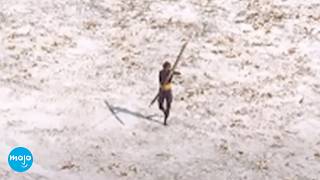

Uncontacted Tribe Spotted in Amazon
45sThe discovery of a new uncontacted tribe sparks curiosity about hidden civilizations.
▶ Play Clip"The title promises mysteries and delivers, but the content is more of a broad overview than deep investigation, with some padding from sponsor reads and rhetorical questions."
This video explores the mysteries surrounding uncontacted and isolated indigenous peoples worldwide, from the Amazon rainforest to the Andaman Islands. It examines their history, the threats they face, and the ethical questions about outside contact.
The video introduces the topic of uncontacted and isolated peoples, focusing on the Amazon and other regions, and hints at the mysteries surrounding them.
The Amazon rainforest contains more uncontacted peoples than anywhere else, with the Vale do Javari being a large area inhabited exclusively by indigenous people, many from uncontacted tribes.
The isolation of regions like the Vale do Javari has led to illegal activities such as fishing and cocaine running, which threaten the tribes and their environment.
The Sentinelese on North Sentinel Island are the most isolated people, with an estimated population of 40-500, and have been cut off for thousands of years, possibly since the last glacial maximum.
The Flecheiros, meaning 'arrow shooters,' are a mysterious Amazon tribe known for using poison arrows to defend their land. Their language and origins remain unknown, and they deliberately avoid contact.
Uncontacted tribes face threats from cattle ranchers, loggers, gold miners, and drug runners, leading to massacres and land theft, often with no recourse for the tribes.
The legend of a city of gold in South America may have been inspired by real civilizations like the Muisca, whose gold customs and relics found in Lake Guatavita support the myth.
The Sentinelese have responded with violence to all documented contact attempts, raising ethical questions about continued efforts to communicate with them.
The Korowai people of New Guinea have a documented history of cannibalism as capital punishment, though it may have ended with increased contact, and they may encourage the myth for tourism.
Explorer Percy Fawcett vanished in 1924 while searching for a lost civilization 'Z' in the Amazon. His fate remains unknown, with theories ranging from tribes to natural elements.
The Man of the Hole was the last survivor of an uncontacted Brazilian tribe, living alone until his death in 2022, with his language and name never known.
Despite isolation, uncontacted tribes are affected by climate change, pandemics, and deforestation, facing a world they don't understand, with their future uncertain.
The video concludes that uncontacted peoples face profound threats and mysteries, from violence and disease to the loss of their way of life, leaving their future uncertain and raising ethical questions about outside intervention.
What is the Vale do Javari and why is it significant?
It's an area in the Amazon larger than Australia, inhabited exclusively by indigenous people, with about two-thirds from uncontacted tribes.
00:42
How many people are estimated to live on North Sentinel Island?
Between 40 and 500 people.
01:33
What does 'Flecheiros' mean and why are they named that?
It means 'arrow shooters' because they use poison arrows to defend their lands.
02:40
What is the origin of the El Dorado legend?
It may have been inspired by the Muisca culture's gold customs, with relics found in Lake Guatavita.
05:40
What happened to Percy Fawcett in 1924?
He disappeared during an expedition to find a lost civilization 'Z' in the Amazon, and his fate remains unknown.
08:33
Who was the 'Man of the Hole'?
The last surviving member of an uncontacted Brazilian tribe, who lived alone until his death in 2022.
09:22
Vale do Javari's Uncontacted Majority
Highlights the scale of uncontacted populations in a specific region, emphasizing the importance of the Amazon.
00:42Flecheiros' Defensive Tactics
Illustrates how tribes actively resist contact, showing their agency and the dangers they face.
02:40El Dorado's Real Roots
Connects a famous myth to actual historical cultures, providing a factual basis for the legend.
04:44The Man of the Hole's Legacy
A poignant example of the tragic consequences of outside encroachment on isolated tribes.
09:22Global Impact on Isolated Peoples
Emphasizes that even uncontacted tribes are affected by global issues, challenging the notion of complete isolation.
10:45[00:00] We go far enough upriver, we might even see car-wise people who have never before seen outsiders. Welcome to WatchMojo, and today we're looking at various mysteries about uncontacted and isolated peoples around the globe.
[00:16] So if you watch, leave it with the first. What's in Vaildew Jivari? Stretching thousands of miles across South America, the Amazon rainforest is one of the largest regions in the world,
[00:30] containing more unconnected peoples than anywhere else on the planet. When you're this remote, the conditions for survival can be severe. Many of those people live in the Valle du Javari,
[00:42] an area larger than Australia inhabited exclusively by indigenous people. Those living in the valley are speculated to have various levels of contact with the outside world,
[00:54] with some estimates speculating that around two-thirds of the people living in the valley are from uncontacted tribes. Look closely. These thatched roof huts indicate the dwellings of what's thought to be a new, uncontacted indigenous tribe in the Brazilian Amazon.
[01:08] However, the region being so isolated has historically been a hotbed for illegal activity from fishing to cocaine running. and how this affects the tribes living in the area remains a mystery.
[01:20] He says that unless drastic measures are taken, many more endangered species will continue to be smuggled out of the indigenous territory, threatening nature. How long have the Sentinelese been isolated?
[01:33] The people living on North Sentinel, an island in the Bay of Bengal, are said to be the most isolated people on the planet. It's estimated that 40 to 500 people could be living there. They can take it on the Indian Wolf and leave a hunter together a life cloud.
[01:48] They are part of a larger ethnic group that inhabits the Andaman Islands, speculated to have arrived at the islands during the last glacial maximum around 26,000 years ago. In fact, the jury is still out as to whether they arrived from Asia or Africa.
[02:05] In my weird, nerdy, historian way, I just became a little bit obsessive about North Sentinel Island and the multi-layered story in this place. As glaciers melted and sea levels rose, it's possible the tribes on the scattered islands eventually lost touch with one another.
[02:22] Maintaining hunter-gatherer lifestyles and living on an island the size of Manhattan, hundreds of miles from the mainland, they could have been cut off from the outside world for thousands of years.
[02:40] Who are the fleets hereof? Perhaps the most mysterious of the uncontacted tribes living in the Amazon are the fleets heroes literally translated to arrow shooters so known because they use poison arrows to defend their lands against any intruders Little is known about the reclusive tribe living deep in the rainforest And access to the area they inhabit is limited by the Brazilian government
[03:07] Even their relation to other tribes in the surrounding area remains a question, as the tribe linked closest to them ethnographically has an entirely distinct language. They are hiding deliberately, it would seem, from the outside world.
[03:21] Whether the tribe has existed as is for centuries or was formed by groups that came together in the 1970s as a result of turmoil coming from outsiders is also unknown. Perhaps strangest is the question of how they started raising their crops, including sugarcane and plantains, both native to Asia.
[03:41] Who is hunting them? There are a number of dangers faced by indigenous and uncontacted tribes, many of which come from the rest of humanity. There's no coincidence that this all happened in Amazon's borderlands,
[03:54] but we find sounds very far away from our respective capital cities. While some of these threats are indirect, others are more unambiguous when it comes to their interaction with civilization,
[04:06] both the land in which they live and their lives come under threat from violent outsiders, particularly for those tribes living in the Amazon. This is a real destruction of our land.
[04:18] And that gives me a very big anger. Cattle ranchers, loggers, gold miners, settlers, and drug runners are all culprits for those that have massacred tribes and stolen their land.
[04:30] With organized crime moving quietly and illegally to hunt down people with no real option for recourse, those responsible have often tragically remained concealed. It dies at any moment.
[04:44] And we feel the climate changing, and the world needs the forest. We need the forest. Did El Dorado exist? One of the most enduring legends about uncontacted people
[04:56] came from the days when the Spanish first landed on the shores of the New World. Stories of a city made of gold somewhere in South America
[05:12] first circulated among explorers in the 1500s, driving many to search for it to claim its riches for themselves.
[05:25] Whether an isolated city like this ever existed, or was a legend born from the greed of the conquistadors remains conjecture. Nevertheless, evidence exists that real-life civilizations did at least inspire the tale.
[05:40] The Muisca culture and customs involving gold are thought to have influenced their accounts, and the gold relics found at the bottom of Lake Guatavilla continue to give credence to those that believe the myth.
[05:52] Listen Mr High and Mighty we both be sailing out of here with a mountain of gold if you had Just listen to me Why are the Sentinelese so violent towards outsiders After their long history of isolation it only relatively recently that the Sentinelese have had documented interactions with outsiders
[06:12] They are the most isolated tribe on Earth. Since the first known contact with the outside world, the people on the island have responded almost exclusively with violence. Over the years, a number of attempts have been made by the likes of explorers, anthropologists, and missionaries to make contact, with dire consequences.
[06:31] Journal entries from Chal's last days show that he was well aware of the danger. The Sentinelese have made it very clear that they have no interest in what outsiders have to offer, leading many to question the ethics of those still attempting to establish communication with the islanders.
[06:47] Therefore, we will likely never know what incident or circumstance from their past made them so aggressive to all they see. It's really important that people respect the rights of uncontracted tribes to not have problems.
[07:01] Are the Korowai cannibals living in tall tree houses in the jungles of New Guinea? The Korowai people have a fascinating culture with many practices that are foreign to outsiders. Is that one of the most amazing houses you've ever seen?
[07:13] It's the most amazing house I've ever seen. Some of these are beautiful, as they have a profound oral tradition relating to their religious beliefs, reincarnation myths, and folklore. However, there are reportedly some darker aspects to their culture as well.
[07:29] Anthropologists have documented that the tribe was cannibalistic, using the practice as a form of capital punishment. It's just normal. I don't feel safe with anything like that.
[07:41] As the tribe has deepened contact with outsiders, some believe that the practice has ended. But not everyone is convinced. It's even been suggested that the Korowai themselves have encouraged the idea that they are still cannibals,
[07:55] as many work as tour guides. It certainly makes a good story. What happened to Percy Fawcett? British explorer Percy Harrison Fawcett spent decades of his life looking for the remains
[08:07] of a lost civilization deep in the Amazon. The supposed ruins, which Fawcett dubbed Z, were believed to house the remains of a complex civilization. The stories that you've heard from the indigenous tribes
[08:20] are now matching up with a manuscript in a library. Over the years, the explorer would head a number of expeditions into uncharted territory, launching what would be his final trip in 1924.
[08:33] Fawcett warned that should he and his party disappear, no one should come after them as they would be crossing near tribes aggressive to outsiders. By the spring of 1927, Fawcett has been gone for two years, and the newspapers haven't heard any more from him.
[08:50] There's absolutely no word. Indeed they did vanish with numerous indigenous tribes assumed to have been potential culprits Still no definitive evidence has ever proven if it was an uncontacted tribe bandits or simply the elements of nature which sealed Fawcett fate
[09:08] We know so much about this world. But you and I have made the journey that other men cannot even imagine.
[09:22] Who was the man of the hole? A survivor of atrocities committed by settlers in the 1970s and 90s, the so-called Man of the Hole was the last surviving member of an indigenous tribe in Brazil.
[09:44] What language he spoke, who his people were, and even his name itself were unknown. as he understandably avoided contact with the rest of the world.
[10:07] He lived a nomadic hunter-gatherer lifestyle, building a straw hut before eventually moving on, always leaving behind a deep hole of unknown purpose. He would escape an attack by armed ranchers again in 2009,
[10:19] ultimately passing away peacefully in 2022. His passing marked the end of a tribe we will never know. All my respect to the man of the hole and his legacy.
[10:31] Before we continue, be sure to check out WatchMojo's 24-hour livestream. All of your favorite videos in one place, 24-7. Always on, always live. What impact are we having on them?
[10:45] Perhaps the biggest mystery related to the isolated and uncontacted tribes is how the outside world has affected them. Despite seeming totally cut off from the rest of the world,
[11:10] it's truly impossible for these people not to be affected by the changes that civilization has brought. They live the way they were born, and they continue to live the same. Whether it's climate change, global pandemics, deforestation, or any number of other issues,
[11:27] these tribes are facing a world that is unlike anything they understand, and often inescapable and imperceptible. How exactly these changes have already directly affected them,
[11:39] and what their future holds for them, is a chilly mystery. What mysteries about the world's uncontacted people do you wonder about?
[11:53] Let us know in the comments below.




⚡ Saved you 0h 11m reading this? Transcribe any YouTube video for free — no signup needed.