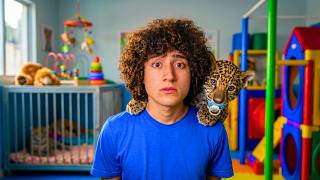

Spider Bite That Amputates Your Penis
44sThe shocking and taboo medical consequence grabs attention and sparks curiosity and controversy.
▶ Play Clip"Title implies a violent act against a mother jaguar, but the video is about rehabilitation, causing false expectations."
This video documents the rehabilitation of a jaguar named Balam, who was rescued from captivity. The team prepares him for return to the wild by teaching him hunting skills through enrichment activities. It also explores the dangers of the Amazon rainforest and the importance of combating animal trafficking.
The team cleans Balam's enclosure to prepare for enrichment.
Examining Balam's feces to monitor health, noting similarities to elephant dung.
Installing a large log for Balam to practice climbing and hunting birds.
Fishing to provide fresh food, emphasizing the difficulty and importance of natural diet.
Demonstrating how to check fish freshness by examining gill color and movement.
Replacing unnatural cement floor with leaves to mimic jungle environment.
Blending liver into a popsicle as a treat that also encourages foraging behavior.
Finding the most venomous snake in the Amazon, lethal to jaguars and humans within hours.
Observing caimans performing the 'death roll' to tear prey apart.
A banana spider bite can cause painful swelling of the penis, potentially requiring amputation.
Urging viewers not to support animal trafficking, as it causes suffering and long rehabilitation.
The video emphasizes the lengthy and difficult process of rehabilitating a wild animal for release and urges viewers to combat animal trafficking.
What is the most dangerous snake in the Amazon?
Shusupe (bushmaster).
09:36
What happens if a jaguar is bitten by a bushmaster?
100% probability of death.
09:36
What is the 'twist of death'?
A technique used by caimans to tear apart prey by spinning rapidly.
18:46
What effect does a banana spider bite have on men?
It causes painful swelling of the penis, potentially requiring amputation.
19:27
Why must live food not be given to captive animals?
There is a rule prohibiting it.
03:51
What is the purpose of the vine ball?
To make the jaguar work to find food, simulating natural foraging.
07:54
How is the freshness of a fish checked?
By looking at the gills; they should be red and vibrating.
03:38
What is the Chuya Chaki?
A mythical guardian of the jungle that appears to loggers who harm the forest.
16:37
What is the Tunche?
A myth that whistles and calls people in the jungle, leading them astray.
16:11
How long does the rehabilitation process take?
One to three years.
05:22
Encounter with Bushmaster Snake
Demonstrates the extreme danger jaguars face in the wild, with a 100% mortality rate from bites.
09:23Caiman Death Roll Technique
Illustrates a specific hunting behavior that is critical for jaguar prey.
18:46Message Against Animal Trafficking
Stresses the moral urgency and long-term consequences of wildlife trafficking.
23:02[00:02] travel 2500 km to meet Balam, a jaguar who was kidnapped from farm to the airport, 100 km, from Colombia to Peru, 2000 km. arrived. In this [music] video we'll see how
[00:16] In this [music] video we'll see how it feeds, how it learns to hunt, and how it becomes a great predator before returning to freedom. predator before returning to freedom. Come on.
[00:29] this jaguar under human care where it is safe and sound 24 hours a day and the difference from how it lives in the jungle where everything is a danger. First I need to clean the hive right now. That's it , I finished applying all the
[00:41] water to make sure it was nice and clean. And now I have the scooper because, . It won't be the first feline poop I've smelled , but it will be the first jaguar poop. This one does look disgusting.
[00:55] Hele, very similar to that of the elephant. Ugh, that one is really disgusting. Not even the one with the tiger elephant poop, but you don't know, just accept it. Half a kilo of Ah, cool. The first mission to make him wilder, that is, to make him feral, is to
[01:10] goes out he knows how to climb trees and catch birds from there to eat them. So, a 3m pole in it so we can put the food there and he has to climb large log is needed. It's this tree trunk right here. The problem is that it's too long,
[01:25] so it has to be cut with a chainsaw.
[01:37] hole. It's tough, but we've already done it. I just realized that the soil here farm, when I dig holes to bury posts, a lot of stone comes out and it becomes that came out here was too soft. That's very good. So, to make it
[01:51] tighten, we put several sticks [music] in it and now it moves a little, but fresh food because that's how nature finds it. Then let's go fishing. We are on a bridge about 500m from the reserve and we have been here before to
[02:03] try to fish. We came here a long time ago. Look, we have these lakes here ? We couldn't last time. We came out with a broken fishing rod and were badly stung . It's not an easy task, but hey , we came prepared with the fishing rod.
[02:16] fish. The bait is chicken. I almost forgot, we can't make too much noise can hear. If we make a lot of noise, we might scare them away. Simply put, [music] is grabbing the bait and throwing it in the hook. Make sure this is well hidden
[02:29] there and wait for a good fish to come out because remember, well, it's a big fish, right? I'm going to try to throw it all the way to the bottom. something jump. I suppose I was a fish, but maybe I'm not. It could be a
[02:45] fishing for an alligator? No. And I kept trying and I kept trying and I kept trying and I kept trying and I kept trying. [music] No matter how many times they tried, I wasn't going to give up until I got Balam a big, fat, juicy fish.
[02:58] none of us had been able to catch a single fish so far. What weight? What did I catch? impressive, but it's to invent a jaguar. We did it. I really thought we weren't also saw this species the last time we were looking after them, but we saw it on the
[03:11] family, if not the same one. So anyway, look, he's got a really big mustache. but for now that's what we have in an hour. It's difficult. Look, I'm stroke of luck because we spent another hour fishing and we didn't have to leave, we did
[03:25] n't catch anything else. There was a change of plans. The fish I caught we had to and we felt bad about it. In other words, he could still grow up, start a family, and then we could the jagwar does. Look, we caught another bigger one. Now you'll tell me, "Didn't he
[03:38] going to show you. To find out if a fish is fresh, you open this part here. That thing you see there, that guy vibrating, must be really red. If it's already So, to make it clear, we caught him right there. Now we simply
[03:51] put it in this pool and let him come and eat it. It would be much wilder and fish were alive and trying to escape the jaguar, wouldn't it? What's happening? It can't be done. There is a rule that prohibits giving live food to animals, such as
[04:03] many places that do the same, they don't care, but I'm not here to talk about that. I left the fish there. We're going to collect all this debris that has fallen from this part of the cement and make it look more natural because it's going to lie down on the
[04:15] because it's going to lie down on the leaves. We're going jungle. Since it's full of trees, the rockrose falls, so he sleeps on that to change because look at all of this stuff that's available. It's like giving it a second life.
[04:30] When it gets dirty, you simply do the same thing. make a small adjustment to its operating area. If you notice, this
[04:42] has cement in it, it's not natural, and in its previous cage, that is, the one the person who have cement either, and this is very bad because it sleeps here, so it gets the jungle, well, there's no cement. Yes. So, to break him of this habit, we need to
[04:55] put a floor on it, something special. Now, back to the habitat. You sleeps. You absolutely have to get used to this. There it
[05:08] the entire cement once filled with fallen leaves? And when you do these kinds of processes with wild animals, you have to do it little by little. His release could be in a year, two, three, or so; animals that don't follow
[05:22] their brain doesn't understand it because they don't do it in nature, can be taught to sit in a day. Not him. Let's start by putting it here, if he doesn't get more, we'll put more and little by little he'll get used to it. That's why you still
[05:35] Next we'll make a vine ball, like a yarn ball for cats, to achieve this, we will have to venture deep into the jungle. Let's make from a tree that also fell down. So they're already dead. So we're going to
[05:51] give them a second life. The idea is to be able to cut pieces as long as possible so we can drag them back to camp and make a much, to be honest. It feels like she's really dead. Look, it's already empty
[06:04] inside. It was eaten by termites. To cut. wasn't cutting them, ah, it's carrying them to the reserve, because of course, this stuff is heavy and
[06:17] we're 650 m away. So, being able to get this there is the being able to get this there is the hardest part. But anyway, here we go.
[06:30] he'll have to tear it, climb it, and exercise a lot to background is a monkey we have here next door .
[06:44] If you hear things in the background, don't bother me. Yes, that's normal. But hey, vines now and the idea is to be able to twist this. going to break, but you still need to be careful. So, let's do
[06:56] ball. And the idea is to make many circles of this so that there is a hollow in quite complicated. Several men are needed because they will understand that several starting to exert much more force. If I do it like that right now, I might
[07:10] of these, it's going to be very difficult to manage them. Wait, before we get to the enrichment with the vines, we're going to do something really disgusting: we blend them and make a liver popsicle for the jaguar. It may sound very
[07:23] is, because this smells quite strong, but for him it is a tremendous delicacy. So, we simply blend it. God, it's disgusting. Look, it looks like an egg over there. It is
[07:41] This is what I meant. There's already a giant ball of vines left, lifted, but I can only do it because I have hands. The jagwar won't be able to do this. Or then the idea of this is, look, if you notice, there are many spaces, but
[07:54] the food inside and make the jaguar have to find it, that is, put its in order to feed itself. Not just to have it served there and that's it, but because that's ultimately how it would do in its natural environment. So, that's it, let's
[08:09] put the vital energy bar in and fill it with food. Oh yes, it weighs a good 40 kg. penduline tit nest. This is it right here. It's a rather rare sound, but it's a marvel of sound at the top of Las Palmas and we find him fallen. Well, it usually falls.
[08:25] the eggs had already hatched, so it no longer fulfilled a function as such. If we because it will eat from inside and besides that, it will smell it, and it will come down looking for the bird. So we're going
[08:39] leave them inside their habitat. He puts in the ice cream, which has already melted a but it will refresh him. We're going to leave this here in the leaf litter, covered up come, dig, use his mind and senses, and eat it. And besides that, he was
[08:53] motivated to be on the rockrose and just as I thought, he loved it. love it too, even though it smells disgusting. disgusting. [music]
[09:06] all his riches. This gradually teaches him how hunt for his food, work hard, and rely on his instincts to survive and, well, have the life he deserves in complete freedom.
[09:23] that doesn't mean it's not in danger. Now I will show you what a jaguar must face in the dark Amazon rainforest. And to achieve this I will have to walk more than 10 km into the jungle, encountering snakes,
[09:36] spiders and lizards. Come on. We have just encountered the most venomous snake in the entire Amazon. She is Shusupe. It is so dangerous that if a jaguar bites, the probability of death is 100%. Any animal she bites will definitely
[09:48] We, who have technology and medicine, would only have 3 get the necessary antidote to save us. If we don't succeed within these 3 hours heart starts to beat and the blood starts to
[10:01] poison; basically, it's a certain death. She is 80 cm long and even though she lethal enough to kill any animal. He's staring at me a lot. I almost dying because of Suspeo the
[10:15] went 2 km further into the jungle. I just realized that I'm leave and we don't want that. Bring a camera trap. Right now we're going to until we reach some swamps where we know there are caimans and we know we
[10:28] survive. We don't know. We're going to set up this camera trap so that during we're doing that—going to see the alligators [music] and resting—we can a bridge here and it's the only way to cross from here to the other side of
[10:41] The jaguar might pass by. You can't see much of it right now, but believe me, by day it's a beautiful, incredibly giant natural bridge. But anyway, I've already you already know how. We already set it up, the trap camera is placed
[10:55] If an animal passes by, it will be recorded. So, the idea is to come falls. Before continuing, I wanted to apologize for the quality, because, well, with the camera right now, but since we're going to the swamps where the water reaches up to
[11:07] and I don't want it to get damaged. So, we brought the phone to record if we have the quality of a guide, Mauricio. Okay,
[11:21] A cicada. A cicada, but blue. Are you Mauricio chance we might get a little wet. Come on. We're getting animals suddenly appear. Look, this is a bullfrog. It's a
[11:37] other one fills everyone with milk [music] . What this does is release escape. You have to handle it with gloves. And well, let's go after the alligators. We minutes and came across the footprints of a puma. Look, here is the
[11:51] four fingers. The night is going to be very entertaining. Now we encounter a poisonous spider. Fun fact: all spiders are poisonous. And look, right now she little eggs there, which is that white thing you can
[12:03] what she's going to do is this: slowly close the leaf with her webs and stay eggs. It's like a way of setting up camp so they can keep their young see me easily and kill me. Very intelligent.
[12:18] record because by the time we get the camera out, it is very difficult to capture them. a tree very quickly. She had babies and everything, but we couldn't film her. We just went to a huge structure about 50 m tall. Check this out.
[12:31] We passed by here last night and heard some strange noises upstairs. We don't no. Who knows? Oh no , turned off. The thing is, yesterday we heard some footsteps up here at this structure. We've been coming here for
[12:44] and it reaches the top of a tree. In other words, we don't an animal, we don't know what it is. So, let's go up and explore it. And Mauro, seen in several videos, is going to tell us things that have happened to him here because he has been
[12:57] he leaves at 1 a.m. and arrives, what time? Amazon rainforest. A lot has happened, but I think I can And we'll take advantage of this and see what's there, because yesterday we really heard footsteps.
[13:14] full of monkeys. It's a good thing they were monkeys. It can be up to seven monkeys. But isn't that heavy that we were saying, "That has to be either a jaguar, which is a heavy animal, n't climb up here." Well, it was a gang of monkeys, but it's
[13:29] of monkeys, but it's moving. I mean animal, it scares you." He says, "No, animals scare you." Oh. Well, Nobody is calm. Nobody is calm. We are very
[13:45] Noises can be heard all night. It's like there's definitely a frog or a cat. that you wouldn't imagine were birds. Before continuing with this journey, have happened to him. I think I heard it once before , I'm not sure. It's very
[14:00] a screen. We are in the middle of the Amazon at 12:34 in the morning . We are far from home. Listening to this here, believe me, is very different, but oh well. Tell us. I'm going to tell you about the only time I've ever
[14:13] that at night I went about 2 km away and I was with my camera on the ground and I turned off my flashlight and it was completely dark. Only the light from the flash was visible. And Everyone can imagine that a tapir makes a lot of noise when you walk by. That's a
[14:27] lie, they're ninjas. I was lying on the floor and I just heard it and I jumped up and well if it had been a jagwi, I would n't be here right now. And he would have taken me . He approached like a ninja. He thinks she weighs 200 kg and
[14:39] appeared out of nowhere. Look at the tree we're in. This tree has a large diameter. This tree is enormous. Look over there, it's of tree, or we don't know the species . Okay, that's it, experience with an
[14:52] animal, I mean, a 200 kg animal came and scared you. Living through it is very scary, usually do activities inside the jungle. We're going with three volunteers and there was another staff, another part of the staff that was in charge of
[15:04] went out, each did our own activity, and we had to return at the same time. landed right. I asked him why he had taken so long No, he was delayed. I arrived on time. I arrived on time, but he didn't return
[15:19] half later and I was already scared because I wondered what had happened. And when he seemed kind of scared." And I said to him, "Why?" And they were in a back part of the dealership where, according to them, there were two guys who told me they
[15:31] saying, "Ah, guys, this way. It's Mauricio, please, please, here, please." And they swore to me on their lives that they had heard me. I ." In other words , someone heard your voice and it wasn't
[15:44] And not just your voice, which was you saying your name, which was me saying my name me, they started circling and when they saw that the voice was going follow it." They returned to the camp as if to ask for help. But when they saw me,
[15:58] moved. I arrived an hour and a half ago, and no, but we're looking for you, we we heard your voice." Something similar happened, but here, right on this road, to happened here? It was almost the same with my voice.
[16:11] No, no, look, look, look, I'm in this real moment. I'm scared. because the tunche is one of those myths we have, that the tunche calls you. The myth. The tunche is a myth. It's a legend here in
[16:24] the jungle that he whistles at you, makes you feel something, or calls you, right? So you can get myth, the other guardian of the jungle, would be the chuyaqui, that the chuya is the one who makes the hunters, the loggers who come to harm the
[16:37] the rainforest. Yes, okay, okay. I like it. That's why never seen a chuya chaki because I've never hurt is that Mauro went to a timber concession, a place where they extract wood. I
[16:51] animals they could see. And among all the animals like the jaguar, the tapir, the monkeys, the natives, the loggers said that they could see the Chuya Chaki, which which makes people who come with bad intentions to the
[17:05] in the root of the chihuahuaco. The root of the chihuahuaco is a tree. The hardest woods in the world. It is in danger because it is being cut down a lot. Yes, there is a lot of human pressure. And the thing is, legend says that
[17:18] the chuyachaki lives in its root. So, since these logs are putting a lot of makes them lose it. I remember I was driving in with the truck and I asked "Ah, you're going to find jaguars because it's jaguar mating season. Uh, you're going to have to be
[17:30] anacondas cross. We just saw some deer around kilometer then. It was years ago, and I said to him, 'What 's a chuya chaki?' He said, 'Oh, no, they're little ones like this.' And you'll see that they always have a little goat's hoof, and it's
[17:42] you go out at night, you're going to have to be careful because you see them a lot. I going to tell him [music] that this, and years later I met a biologist, and he told me that he really believed in the chuya chaki, that for him it's real, for
[17:55] never seen it until now. Let's go look for it. scared, honestly. I swear. I'm Scared. I wish I weren't recording this video. record a video. But whatever, let's go deeper into the jungle. We're going to
[18:07] look for caimans. We want to see more snakes. We want to see frogs. Chuecha we find. We've officially just arrived at the first swamp. We're not going to the animals might hear us and get scared. But the idea is to look for a caiman here.
[18:20] In fact, Mauro tells us there's one that hates him that's 2 meters long. We hope we don't not? The thing is, this is literally black water, I mean, down here we don't know what's there, but hey, we have good flashlights. Let's look for a caiman.
[18:33] We have a flashlight there. Happy. We've been in the swamp for about 3 minutes, bottom. Let's see if we can get close enough to grab them and show is that they practice something called the twist of Death. Basically, they
[18:46] circling it a lot, a lot, to tear it apart so they can eat it. We just swamp where we'd already found caimans. And on the way, we here is a centipede. You might see it as a normal centipede, but it
[19:00] 's actually a scorpion. It's a really venomous insect, and its medical treatment; I mean, if it bites me for any reason, we'd have to which is about an hour away by boat. This wouldn't kill a jaguar, but it would still
[19:14] if this bit it. You know, it's called a centipede. This one is small; it can I touched one by accident once; found a spider; it's called a spider. Banana spider. Its legs are yellow, and that's what
[19:27] a banana spider. What's so special about this spider? Well, if it bites hurt a lot, it's going to affect her a lot, but it's more deadly in men. Why? thin. What happens? It starts pumping it very fast, very fast, and since
[19:42] sends it to the man's penis. It makes it so swollen, because it's going to be like that for many hours, I mean, more than 5 hours, 8 hours—what can happen is that the blood can clot, and the solution is to amputate it. I mean,
[19:56] time, they have to amputate his penis; that's like dying. We were just walking along normally, and out of look." And we just grabbed it, put on our gloves, and washed ourselves. Look, why is it called a monkey frog, but it's toxic? What Mauro was telling us is that
[20:09] animals do too—because, well, you know, nature is very wise, they why would I eat it if I'm going to die? It's swamp, and you're not going to believe this. We already found two caimans. I know this is
[20:21] expecting. Now we're picking them up, first to show you that this is , sees them, and eats them in one . We're going to see if we can get them closer to their mother, who's in another swamp, but anyway
[20:33] sound he's making. Let's see, that's to call his mother. She might We're officially in the big swamp. We're already finding more babies. That's a good sign because the mothers might be around here too.
[20:46] Oh, two minutes ago we saw one that was a meter long and Halfway there, but it got away. There are so many repellent we have, they still bite us. When they're little, it's really hard to probably a white caiman. When they're little, they don't eat meat; they
[20:59] just eat insects, spiders, crickets that fall in there. And I know for a fact they believe me. We're going with our flashlights, and we see everything lit up with eyes because there are Hopefully, the mother is around, and we can see her. [laughs] There, there, there, there.
[21:13] deer. I just freaked out. I swear. I saw it look down. I a cat." We're just seeing a jaguar. Oh, no, it wasn't a jaguar. That this beautiful thing we just found. It's a snake.
[21:26] It's from the genus Atractus. Atractus is a difficult German name. This one, mistaken for another snake that is venomous, and they sadly kill it. This harmless, but it's quite beautiful. Look, it's so small. Quite
[21:41] beautiful. We definitely did n't find any caimans in the forest. Or found a big one. It got away; we couldn't catch it. And on the way back, we found some feline tracks here . This isn't a jaguar; it's not a
[21:53] well, it's a feline. We went back to the spot. I already checked the whole tree trunk and didn't indication that one had been there, but we did find a but remember, this is wood. So, the only thing we're going to do
[22:06] check because this is the only thing that will tell us whether or not there was one. It's not that have them. Well, I just took the memory card out of the camera trap, and recordings here, about 30. Many are ours because I walked right in front of
[22:21] movement and recorded me, so those don't count. And then there are only three recordings of animals. The first one is of an opossum, right? I mean, it looks [music] this one won't do. This isn't a jaguar. The opossum is also valuable,
[22:33] also this one that I thought was a jaguar because it was so fast, but . It's very beautiful, it's a big feline, but it's not a jaguar. but this one is from nighttime, and you can't see much because it recorded the last
[22:47] disappears from the video, but anyway, this one was at night and also There's a watin, which, a tiny rat. It's quite cute, but there's no jaguar, at least a month ago, and right now Balam is still recovering and
[23:02] adapting so he can soon be king of the Amazon rainforest again. And well, we're heading back to Lima now. Remember, Peru is key. I basically made this video to try to reach someone who might be thinking about trafficking an animal.
[23:14] probably will never do it or have never done it, but even so, if doing it, please stop. Believe me, there's a huge problem behind this problem of taking something from its habitat that probably won't return
[23:27] might return, but it's a very long process—we're making an animal suffer. Look at Balam's whole story . His mother died, he was small cage. Imagine the stress. Imagine if you were a
[23:39] happen to them, even if they were any animal. So, remember, let's not support animal trafficking in any way. Let's not buy animals. There are many education. If there's a school watching this and we can teach
[23:51] the new generations that this isn't done in 20 years, this won't be a grow, and no one teaches the new generations that it's wrong. It these kinds of videos, but institutions. We're leaving now, and we hope to be
[24:04] release. I don't think it will be soon, but we hope it continues to be a good that if you liked this video, you can like, share, subscribe, and well, you know what to do. [music] Bye farmers.
⚡ Saved you 0h 24m reading this? Transcribe any YouTube video for free — no signup needed.