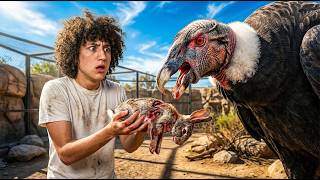

Feeding 60 Mice a Day to a Baby Condor
55sThe shocking amount of food needed for a condor chick is surprising and visually engaging.
▶ Play Clip"Delivers on the promise of showing a condor hatching, but the title's urgency is slightly overblown."
This documentary-style video provides an exclusive behind-the-scenes look at the breeding and conservation of the Andean condor, the world's largest bird, at a reserve in Colombia. It showcases the meticulous care involved in incubating eggs, feeding chicks, and preparing them for release into the wild, highlighting the species' critical endangered status.
The egg is incubated for months in a lab, with staff providing round-the-clock care. Chicks are fed a diet of mice, with one 26-day-old chick consuming approximately 60 mice per day.
Food is prepared by heating mouse torsos to 85g portions. A puppet is used to mimic the parent bird, avoiding human contact to prevent imprinting. The chick is not fed directly but stimulated to peck at the puppet.
Eggs are weighed and examined using an oboscope (candling machine) to monitor embryo viability. Light reveals veins and movement, confirming the chick is alive.
A 26-day-old chick weighed 200g at birth and now weighs 10kg, a 50-fold increase. This rapid growth is supported by the high-protein mouse diet.
The older condor, Rafi, is housed in a large enclosure. Staff wear camouflage to avoid visual or auditory contact, ensuring he remains wild for future release.
A female condor that imprinted on humans cannot be released. She is calm near people but would not survive in the wild, highlighting the importance of minimal human contact.
The video documents the third condor born in Colombia in over 20 years. The birth took 66 hours from first crack to full hatching, with staff assisting by removing shell fragments.
The condor is Colombia's national bird, with fewer than 1,000 left in the country. The reserve emphasizes public awareness and support to prevent extinction.
The video underscores the critical role of captive breeding programs in preserving the Andean condor, a species on the brink of extinction in Colombia. It calls for public support and awareness to ensure the survival of this iconic bird.
How many mice does a 26-day-old condor chick eat per day?
Approximately 60 mice per day.
01:45
What is the purpose of using a puppet to feed the chick?
To avoid human imprinting and mimic the parent bird.
02:09
What does an oboscope do?
It uses light to see inside the egg, revealing the embryo's movement and veins.
03:31
What was the weight of the condor chick at 26 days old?
10 kg (born at 200g).
04:12
How long did the hatching process take for the third condor?
66 hours from first crack to full hatching.
11:03
Why can't the female condor in the video be released into the wild?
She imprinted on humans and would not survive independently.
06:43
What is the approximate population of Andean condors in Colombia?
Fewer than 1,000.
13:54
Feeding with Puppets
Demonstrates the delicate balance of care to prevent imprinting while ensuring nutrition.
01:33Astounding Weight Gain
Quantifies the rapid growth from 200g to 10kg in 26 days, highlighting the species' metabolic demands.
04:12Historic Reproduction
First successful condor reproduction in Colombia in over 20 years, underscoring conservation urgency.
04:49Third Condor Birth
Rarity of the event; egg had complications from father's attempts to break it.
08:21National Symbol in Decline
Connects the condor's cultural significance with its critical endangerment.
13:16[00:01] video we're going to take care of the world's largest seedling, literally from wing to wing it measures more than 3 m. It's bigger than me. What's more, there in this enclosure they have a large one, but don't worry, we'll see how it's born, how it feeds. Thousands
[00:15] of mice and many other things that this surely had never seen. Come on. It all started in this laboratory right here. Believe me, it's too epic. Here they cared for the egg for many months, they
[00:28] incubated it. Then once the chick was born , they took care of it, fed it very meticulous process and currently he has a sister Guaira. And apart from that, there's also another egg from which a chick will hatch. Hopefully, we'll see it
[00:41] going to show you the whole process of this lab because I went in year ago and it's so epic, but here I have to control myself because sometimes I get excited and here I can speak loudly so please keep a moderate tone of voice
[00:54] , like a condor egg incubating, so you can see how meticulous this is. Welcome to the laboratory. Before going in to see the sister named going to make, we are going to prepare the food for her and that's all. Look, they're
[01:07] mouse torsos. So, we need to heat it here in a water bath. So, I'm so you can understand. We have a cup, the mouse pieces, and hot water. scale for weighing the amount of food that will be given, and it
[01:20] amount of food that will be given, and it has to be 85 g. Phew! Almost. Let's see, 84.3. 87. And now we're really going to warm up the mice. Can you believe that a chick that is only 26 days old, just a small chick, already eats
[01:33] impressive. To warm up, the technique here is simply to put this in here and technique here is simply to put this in here and measure the temperature.
[01:45] mistake. One eats g in a day. In other words , this is just like breakfast for her. It's too much of a mouse. To give you an idea. It eats approximately 60 mice in a day. Quite a lot, isn't it? Now we're going to go in and feed her. We ca
[01:57] because the idea is that she doesn't get used to the human voice, and it's a dark room. I don't know how I'm going to show you, but we already have the feed her, he plays with the help of these puppets, which are actually quite
[02:09] incredibly good. In other words, the quality is noticeable. Over here we have the food and behind this black tarp, inside this box is the perfect environment for her, which has a mirror effect that does n't let her see us, but we
[02:22] food, put both hands in, one has the food and the other has the puppet and you start to stimulate the condor directly, you don't give the food to the chick in its mouth. So, all that's done is to make certain
[02:34] father brought the food and the condor begins to feed. It's quite delicate, even though it seems quite big, it's still really play very carefully and be quiet the whole time, he can't
[02:48] hear us for anything. She is beautiful. I can't say much yet, but basically here's the gist of it. That's the condo's egg . The idea is to get it out. We're going to
[03:00] put it on this scale to weigh it. Next, we have to note the weight to make sure everything is in order, and then we turn off the light and it will be placed in this machine called a copier. This emits light and will allow us to see the embryo.
[03:18] carefully remove the egg because remember that the condor only broken for anything in the world, okay? But they are experts. Then it is weighed to find out how much it weighs, logically, and it is noted down to keep a record and in case
[03:31] resolve it. Since I don't know, I'm not a professional, but that's what I was told. Then there's this blue machine that's way too pro. I have a black one, but it and it's an oboscope which is basically a machine that generates a lot of light to be able to
[03:44] see inside the egg, since the shell layer is not very strong done to find out what the egg is like inside, whether there is anything there or not. In this case it's the condor; it's alive because if you look closely, you can see it moving and you can see little veins.
[03:59] is perfectly fine. And well, they're going to do it soon , you have to see it. It is carefully left where it was. Please do not alter anything.
[04:12] couldn't see it very well, but that's how it was . And I just received a fact that impressed me greatly: she is 26 days old and weighed 200g when she was born . Today he weighs 10000, that is, he has gained 1 kilo in weight. That's too much
[04:24] for a chicken. I mean, for a chicken, for a bird, that is. But look at that. He ate everything. Lots of mice for their diet. A true star. They are , they were the ones who didn't sleep so that the egg wouldn't break, to take care
[04:37] of the chick as soon as it was born. I mean, really, without them this wouldn't be possible. historic, because when was the last time a condor was able to reproduce More than 20 years ago. More than 20 years ago. And thanks to them,
[04:49] . So, in editing we're going to add some applause. add some applause. Two of you clap, boys. Applaud. They are the best. I'm just showing it here. They are the ones who truly
[05:02] And after all that process you just saw, I came to see the big boss, Rafi, who is Guaira's older brother, in disguise. Why? By this mean, a lot of things, and he still can't even hear us. Oh, sorry, I just get
[05:17] hear us nor see us. That's why I'm camouflaged, because if there's a margin of error and he happens to see us from somewhere, what he'll see is a plant. I'm completely camouflaged. This is his compound. It's quite large. Rafi,
[05:31] who is approximately one year and one month old, will be released at age 3. When his sister has two, they are released together so that in this way they create a gang, a [laughs] pack and can go out together and survive. Because
[05:44] free themselves together. If they are released on their own, they may experience going to show you this. Look, it has a lot of things. First, this here is completely covered up. He is behind this enormous structure. If I peek out
[05:59] flew really close and I don't want it to see me. We were just acting normal and then suddenly it flew and came right up to this part of the world. And look, this room here is where we can monitor it.
[06:13] Miguel is in there right now recording, and that room there has two doors one of them is left open due to human error, the other one won't, preventing anyone from getting out. Inside that room see the Condor, but the Condor doesn't see us, so we can
[06:29] food and check for any injuries without it realizing that the human is looking after it. All of this has been done without the condor knowing that there is a human behind it. She is another condor, her name is
[06:43] can no longer be released simply because she has already had contact with humans. If you notice, I'm 20 cm away from her and she's not scared. It already detects the voice; it already knows that the one who took care of it is a human. Unlike Rafiki, who
[06:57] is on the other side because he has never seen a human, and she is known to be the female because her eyes are quite red. Look into his eyes. It's quite an epic animal, you have to admit. It's too beautiful. Yes, she can
[07:10] human raised her, if she is freed, she will wait for a human to come and feed her. She's not going to get her food. He loses to his wild instincts. It's like the difference between a wolf and a dog. The wolf is wild, it hunts for its own
[07:22] dog expects the human to take care of him. It's the same with them. And you might ask, where does it get its feed? Well, it has this gate here which is quite small, but it's big enough for the
[07:35] rabbits, which are the main basis of its diet. Then you open it here, put diet. Then you open it here, put the food in through there, and then he comes and eats.
[07:53] Perfect. And look, their enclosure goes all the way to the other side. The only part that doesn't top part so that, logically, it can see the sun and be more in contact with nature and have them inside. But it's quite big up there,
[08:07] released soon. Wait, before we continue, I know you want to see a birth egg, how they care for a small condor, a large one, how it lives, but the many, many years. In other words, it would be historic if it could be recorded, and if
[08:21] difficult to get in and see it and document it for you to see. So, it's something very impossible to see, but come and see me. And well, a question. Why were we so meticulous with all the condors, and
[08:36] I mean is that he can see us, he can hear us. Isn't everything supposed to be top secret? No, calm down. When they are born, they are almost blind and don't hear much, so it's possible. I had to make this audio
[08:49] separate room because I was so impressed that I was just saying silly , what's moving is the peak. Yes, look, he has two membranes and at this point he can already see,
[09:02] right? They are born in May. And what is that spray? the membrane. Oh, let it be easier. And the temperature. So, at this point, even by looking at the beak, we can't tell if it's
[09:14] truth is I had no words to describe what I was experiencing. And I know normal, but believe me, this is too historic to achieve this in a country where it has only happened twice, and well, the third time with this is too
[09:26] incredible, and to be able to see it in person, well, it gives me a great privilege. Basically, what I had to do was remove the little shell and help it impressive, but let's remember that they are born quite strong and large. It's not
[09:40] is a chicken, it's not like a baby, you know, which is delicate, right? They are born and within days they are already walking, they are recracks. This historic fact alone deserves a historic fact alone deserves a like, please.
[09:56] achieved. Many of you may not historic. It is the third condor born in Colombia. Honestly, this is something very done for the third time and that it has turned out well, even though the
[10:10] egg had so many complications because the father tried to break it, well, so to speak, it's a different kind of feat. It was achieved. What great guys. That's where he Here's everything that was needed to make it seem like the whole hatching thing was happening
[10:23] See what it looks like inside. It really does look pretty impressive. It looks like something dinosaur-like, something really weird, because I've never seen green strange to me. And the shell is really hard. Look, it's quite sturdy. And
[10:38] here the dad tried to break it and couldn't. Perhaps they also realized it in would have broken in seconds. It's a large animal, but how could it have been born in its natural habitat? Yes, so , does his dad help him? I
[10:51] honestly don't know. It's something truly incredible. So, how long did Rafiki's birth take ? We left it for 60 hours, which was like the 60 Since it broke. Since it breaks.
[11:03] last? Ar lasted 66 hours and we see that it has a fluid, there was no bleeding, which is positive. That is, she broke up 66 hours ago
[11:15] . Ah, okay. Yes, what we mean by 66 hours is that it broke the egg 66 hours ago because we did n't, well, Fernando didn't do that broken because if you noticed, when we started it had its beak sticking out and
[11:32] that, it's the first time I'd ever seen it and it was in a short time, it was 6 minutes, really, seeing it is very impressive, it's very impactful. She 's fast asleep. I don't know, [laughs] I don't
[11:44] impressive. Do they also know why? Because of the color of the one on her head. I mean, I've seen chicks hatch and they come out completely yellow, but this one is really dark, you know? It's like, I don't know, kind of wrinkled. It
[11:58] looks like a life. Happens. Okay. They just explained to me what green means. It's the S. I did n't know they were already pooping even inside the shell. Incidentally, a curious fact that not many people know, but the animal is essentially the egg white, because
[12:11] for example in humans the baby feeds on what the mother eats, but in already inside the egg? Well, it feeds on the yolk. In other words, the yolk is the food of the bird while it is growing inside the egg. Many
[12:23] fact that needs to be shared. They are three protective barriers. The clear one. imagine the shell, which is the first barrier, and then comes the egg white. So, the bacteria and such don't manage to get through, and meanwhile, because imagine the yolk
[12:37] full of food protein, uh, it would be like the perfect broth, and in fact, bacteria, and so on and they die. Exactly. could show you about the condor, or at least in the reserve, because there's
[12:49] actually much more to it. I mean, I'd like to go to the moor and show you how animals they eat, how they survive, what How many likes do we need, Felipe? About 50,000
[13:03] likes and we'll go to the moor, camp there, go exploring and stay for eat, so they can arrive and we can observe them with camera traps and find out how many there are in the moor and maybe we'll make a new discovery or something.
[13:16] because for those who are not from Colombia and don't know, the Condor is the Colombian national bird and we have very few left and there was a time when it was proposed to few left they wanted to remove it. That can't be right. None of that,
[13:30] specimens have already been born in Colombia; we must continue to take care of them. who live in the moor, that's a complicated issue, really. I can't become aware and really realize that it's a very
[13:42] important animal that controls many things in the ecosystem and that it can't be allowed to become least I'm speaking about it in Colombia, because there are other places where they are, like thousands of condors, in Colombia there are less than 1000 left, it's something
[13:54] take care of them. If you see him, let's not attack him. It is a really important function. If there is anyone here who wants to make a contribution, wants to help write to me on my Instagram. Anything goes. The idea is to help the world.
[14:10] subscribe and share it. And I forgot some, you know. Goodbye forgot some, you know. Goodbye farmers.


⚡ Saved you 0h 14m reading this? Transcribe any YouTube video for free — no signup needed.