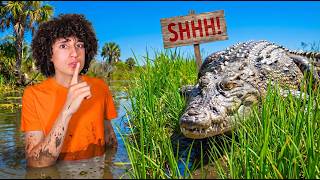

Crocodile Fact: Speed & Eyes
42sEducational facts about crocodile speed and unique eye membranes surprise viewers.
▶ Play Clip"Delivers on the promise of a dangerous safari with genuine close encounters with crocodiles, anacondas, and a jaguar."
This video documents a dangerous safari in Colombia's Orinoquía region, where the host seeks to see a jaguar, Orinoco crocodile, anaconda, and caimans. It provides close encounters with these animals and discusses conservation challenges.
Caimans are spotted with scaly armor, resembling dinosaurs. They are about 130 cm tall and powerful enough to kill a human.
Caimans differ from crocodiles by having a wider mouth and smaller size. Orinoco crocodiles can reach 6-8 meters.
Caimans have a nictitating membrane to see underwater and can run up to 30 km/h. They are intelligent and avoid humans.
The Orinoco crocodile is only found in Colombia's Orinoquía region. It is a huge reptile with large teeth.
A large Orinoco crocodile is seen up close. It is dangerous and could kill a human. It hunts turtles and other prey.
After hours of searching, a female anaconda is found with only its head visible. It is estimated to be 4-5 meters long.
Anacondas are peaceful but killed due to fear from movies like 'Anaconda'. They help control capybara populations.
Seeing a wild jaguar in Colombia is almost impossible. The team searches on horseback and then by safari cart to reduce noise.
The team successfully spots a large male jaguar near a puddle. It is a rare privilege, as even experienced guides have never seen one.
Local communities use non-invasive tourism to profit from jaguar sightings, offsetting the cost of livestock lost to jaguars (80 cows and 60 horses per year).
The safari successfully showcases Colombia's incredible biodiversity and the importance of coexistence between humans and apex predators, highlighting conservation efforts through responsible tourism.
How long can an Orinoco crocodile grow?
6 to 8 meters.
02:07
What speed can caimans run?
Up to 30 km/h.
02:35
What is the function of the nictitating membrane in caimans?
It allows them to see underwater and protects the eye during fights.
02:21
How do anacondas kill their prey?
By constriction; they squeeze and suffocate the prey.
09:17
Why are anacondas often killed by locals?
Due to fear and stigma from the movie 'Anaconda'.
08:39
How many cows are eaten by jaguars per year in the area?
Approximately 80 cows and 60 horses.
18:04
Where is the Orinoco crocodile endemic?
Colombia's Orinoquía region.
03:42
What causes the water color in the crocodile area?
Capybara poop causing a chemical reaction.
04:26
What is the main difference between a caiman and a crocodile's mouth?
Caimans have a wider mouth; crocodiles have a narrower mouth.
01:38
How many times did the guide's friend come to see a jaguar without success?
10 times.
15:32
Endemic Orinoco Crocodile
Highlights the uniqueness and rarity of the species found only in Colombia.
03:42Anaconda Stigma
Explains the unjustified fear and killing of anacondas due to media portrayal.
08:39Tourism as Conservation
Shows a practical solution to human-wildlife conflict by making jaguars economically valuable alive.
17:37Economic Impact of Jaguars
Provides concrete numbers (80 cows, 60 horses per year) illustrating the cost of coexistence.
18:04Rare Jaguar Sighting
Emphasizes the extreme rarity and privilege of seeing a wild jaguar.
14:52[00:02] I came on a safari because I'm going to try to see a jaguar, which is very difficult. jaguar ate me. But today's idea is indeed that, to to watch it. What do you mean it's impossible? We are the sheep farm and we're going to
[00:18] make it. We're going to see maybe very large anacondas, crocodiles unique in the world, birds never seen before. We'll have to travel by carriage, on horseback, it doesn't matter because we are men. And we're going to see that water. Finding our
[00:32] crazy. We had to cross a lot of amazing landscapes, walk for a long time, and travel the roads in safari carts, searching everywhere . Everything was very calm, until suddenly we saw something moving near the
[00:45] give you a hint. He is an excellent ener. It has scaly armor and dinosaur. Do you already know which animal I'm talking about? Well, you'd better see it for yourselves. We just came across several caimans. Look, this one here isn't
[00:59] the crocodile we're looking for. It 's also very impressive to be this close because I feel calm because it's so big, it's about 130 cm tall powerful enough to kill me. They practice something
[01:12] grabbing their prey and spinning it around a lot to tear harm they could ever do to me. In other words , if one of them were to lose it, but not my life. They are called caimans, that's what they're called
[01:25] in this part of the country, but basically they are all crocodilomorphs. What they were of a crocodile. What differentiates them from the crocodile we are size, because the one we're looking for is much bigger. And secondly, they have a
[01:38] wider mouth, the crocodile has a slightly narrower mouth and they are to these parts of the wetland to camouflage themselves better. I don't think they do it intentionally, but when they come out of the water they come out with algae and the plants
[01:51] that are on the swamp so they can perhaps also cool off. They are quite enormous. I know I said these are a little smaller. Note that, although they can still reach 3 to 4 meters in length. The crocodile we are looking for is
[02:07] 6 to 8 m long. I'm surprised at how calm they are being with me so close, because it 's a huge lizard. Imagine being a capybara and knowing that in the same these animals are waiting to feed on you [music]. It's
[02:21] too impressive. They have something called a you just saw there. If you notice, [music] when you try to close your eyes, allows you to see underwater. They also use it when they are
[02:35] fighting because it covers their eye without having to close it completely. Another very important fact about them is that they can run up to 30 km/h. theory, if they wanted to attack me in a certain way, I wouldn't be able to beat them by
[02:49] are also very intelligent animals and are they know that humans are the most dangerous animals on the planet. They camouflage themselves extremely well. In fact, deep down there is one. Oh, it just went
[03:02] underwater. The water has just been brought in. It's there, but it's barely impressive, yes. Well, it looks very good. After that surprise, we went wildest and most incredible animals in this entire
[03:15] anywhere else in the entire world, only here in Colombia. Basically the Colombian Orinoquía region. Let's see, try to guess who I'm talking about. I'll give you another clue. It's a huge reptile, it has very large teeth and it loves to
[03:28] to me it looks like a real-life dragon . You already know which one it is, so pay attention because we saw it up close and this is epic. Now we're going in search of the crocodile, the Orinoco. This one here is much bigger; it's endemic to the
[03:42] only found in this part of the world. If you want to see it, the only way Australia, there may be many types in the United States, but this one is only found here. So, that's it, let's go find it.
[03:57] a very good indicator of why. Logically, where there are babies, there are tell us that a few days ago they found two crocodiles mating here, so This happened before, and now it's happened again. Most likely,
[04:13] the animal we are looking for, the Orinoco crocodile, is located in this same area. We've got it. He seen, to be honest, but he has greenish eyes. By the way, the water is that color because of the capybara poop, because there's some kind of chemical reaction there
[04:26] . There's even a chigwiiro way back there , it's full of turtles. biodiversity. We're going for the crocodile. Look, I swear, we're too close. I'll tell you in advance, I think I'm
[04:39] seeing it from afar, but first, look, its cave is over here. went in and saw that there were a lot of eggs, and afterwards the place was full , we found a baby, we found a cave. Most likely,
[04:52] if we take a little look around here at the birthplace, we'll find it. Let's go there . He's getting involved. No, run. [music] It ca n't be. We have it. God, it's enormous. It's gigantic. It's very
[05:05] careful. Because? Yes, it's more dangerous. He could actually kill us, [music] I mean, he would feed on us because he pees a good 4 meters and he's just standing there watching us. Oh, it just hid. I'm climbing up from here
[05:17] because there's another cave I had here. It happened that it collapsed and well, it was covered up. [music] Look, it came out again, it kind of peeked out, I mean, it's kind of peeking out, but its all the turtles that are there. It's quite noticeable. We are a
[05:30] too powerful, and could food that is not so difficult for him to hunt [music], like for example that Nature is very wise, and that includes reptiles. For example,
[05:43] are in a place where the water quality and the quality of life are not so their needs are not so great. It just appeared very hard. There it is. He too fast and we also have a way of defending ourselves and he could [music]
[05:57] knows that they don't have a veterinarian to take care of them. So he's not going to knows [music] that he could also lose something and he doesn't want that to happen. huge, I swear. I had never seen such a large one free in [music]
[06:12] captivity. Yes, because I have cared for children under human supervision, but not like this. After became a little more tense. We received a warning that gave us one of the most gigantic, stealthy and feared predators in
[06:26] all of nature moving among the shadows. a creature so immense it seems straight out of a immense it seems straight out of a horror movie.
[06:41] tell us that a large female Anaconda was sighted a few days ago . Note that in that same place they also once filmed someone expelling a pig. What's are many people, so there are farms. Those farms have a
[06:54] Basically, farm animals are food for . They also once saw an anaconda of that same size, let's be honest, eaten it and well, then it expelled it. We're going to go see how big
[07:07] this one is, because we were told it might be around here . I don't know, let's go look for her Reaching their hideout was an extreme mission. We walked for hours, vegetation so thick that it almost prevented us from advancing. And the craziest thing was,
[07:21] territory of bavillas and other snakes hidden in the jungle. We we took. After overcoming all these dangers, we reached a dark swamp where we couldn't see anything below. Wow!
[07:38] of hours, passing alligators and all kinds of animals, we finally found the anaconda. We are literally next to the anaconda [music]. She's there. . It only has its head sticking out; we do n't want to bother it
[07:50] too much or move it around too much to make it stick out, but I want you to see it properly. There it is , look at it. That, that thing you see there is the anaconda. This one here is a female, she just know how big it is because we can't take it out, obviously. Look how
[08:02] is in this place, it's just that we don't see it. What's going on? Of course, they stay there, wait for the capybara to come, grab it, and eat it. What's surprising about this is that look, here's the anaconda and a few meters away
[08:14] the predator [music] and the prey a few meters away. In other words, n't know that there's probably a 4-meter-long anaconda there that could eat him. We did it. We just found another one. This one is much
[08:27] bigger. Watch it. My head was literally there. God, this anaconda measures 4 or 5 meters. Oh . Uh n't be alarmed. These animals are extremely peaceful, I swear. What
[08:39] the cattle and pigs of the people who live nearby. Logically, I I am literally invading my space. What's going on? They are killed because they are highly stigmatized thanks to this movie Anaconda. Because of
[08:52] afraid of wonderful animals like her. What's happening? They kill them out of fear that they will eat a dog, that they will eat a child. When this is not often the we have to take care of them, we have to value them. They help us control
[09:05] the population of other animals, such as capybaras. Then, poof, nothing, it was found. I don't think I've ever been so close to an anaconda. Forgive me happened that I got a little nervous. Something else that's
[09:17] that they are constrictors. What do I mean? They kill their prey by suffocating it. For going to do [music] is hug him so tight that she breaks him, suffocates him, and then she'll eat him. And once he eats it, he [music] keeps saying it for several days
[09:31] and with that energy, phew, I'm just in shock, but well, it was done. After the madness with the anaconda, we focused on the final boss of this safari, the great jaguar. Seeing one of these felines
[09:43] free in nature here in Colombia is almost impossible because they are the kings of We knew that if we really wanted to fulfill this dream, we had to n't stay in the car anymore because we're making too much
[09:57] car anymore because we're making too much noise. He plays on horseback. Come on. the floor is covered in dirt. Basically, a hand is this. It's like
[10:12] and filled with earth. And that's it, we'll just be hanging around here . Let's go through the savanna, let's go through the forest. This is very biodiverse; we might encounter it at any time . We've reached this other part. This is an estuary. Since this
[10:24] is a floodable savanna in the winter season, all of this is flooded. It notice, everything is dry. Here the callus can't move quickly because very dangerous, but it doesn't dry 100%, there's always a little bit left. What are we going to
[10:38] back where there's a little puddle of water. Generally, when it's summer, the little animals, so since there's not much, they all go there. We're going there. look for it because if there's little water and the jaguar is thirsty, it will go to those
[10:51] places to drink water. This horse is awesome. This man is as fast as they come in 20. We haven't reached the place I told you about, found this. If you notice, the
[11:03] is a reed bed; it's basically a small wetland, and I'm told it's especially good for anacondas because in the summer it holds water well, and you already saw. So basically there might be an
[11:17] anaconda there, but we've already found it. We're going to look for the jaguar. We arrived at the place, there's the horses a little rest. They already drank some water, huh? And we have to keep an eye on it too, because even if we don't see it in Jaguar. There are
[11:30] in Jaguar. There are caimans here, there are more snakes, there are you see that moves, that's an anaconda. It's awesome. What helps us? There is livestock. There are cows on that side . What's happening? The genetics of these
[11:43] no longer afraid of the jaguar, but rather they scare it away. So what looking scared to one side, we have to go there because that's where helps is that these calluses have a lot of experience. They already know where to
[11:55] a little bit of a loose end and he walks. It's already small problem and that is that we can no longer continue with the horses. The only good thing is that the jaguar comes out at this time, [music] so we don't go in them, but
[12:09] we had to explore totally new areas and cover much more ground. on the safari carts to continue searching. To be honest, the hours passed and we saw absolutely nothing, and I was already
[12:22] I really felt that [music] we were going to go home without being able to fulfill one of my biggest dreams. All the effort seemed wasted until suddenly we were told that they had seen the jaguar. So let's go quickly right now because it
[12:35] likely, if we arrive calmly and serenely, we will see it. first time in my life I'd ever seen a jagw that hadn't seen a human and hadn't been fed by a human. We're on our
[12:48] remember, they're very stealthy animals. We have to approach gently, but quickly, because otherwise it will leave. I swear, we were going so slowly, we were going so gently. because Hawaii is here." Let's go all out. This is too epic.
[13:08] because the car passes it without any issues. And look, God. The entire tire is alligators there. I don't think they'll be able to see them now .
[13:21] speak too loudly because remember, he is a very stealthy animal that any happens? They are flying a drone and the drone is about 500 m away and ? It's most likely coming here because there's a puddle of
[13:35] drink water and prepare to spend the whole night hunting. So, we'll just wait for the sun to go down a little more so that hopefully it will get closer and we can only the drone recording. I'm going to show you. They can be seen in the
[13:48] intrigues me is that they're recording it and we're so close, but nobody seems want to see it. We know he's not going to attack us. And well, really [music] let's wait for the sun to go down a little more and hopefully it will really come here.
[14:01] This cattle here has a genetic predisposition that makes it unafraid of the jaguar. that cattle, looking in that direction. Because? Because the jaguar is near. watching the jaguar. I'm going to stop talking for now because we're getting
[14:15] close. So, we can't talk anymore because we might scare him away, and I don't want us to change cars. Let's go here the whole package. Oh my God, I'm so nervous. I've never seen a jaguar this
[14:27] close except in captivity. Let's go in here by this little lake and in theory we'll see it. Look, look, look, look at the car. My God, this, I swear, this is the happiest moment I have ever lived in my
[14:40] life. I think we're about 20 seconds away from seeing it. God, I'm making it dark. We're almost there, we're so close to achieving it. I see it, I see it, I see it, I 'm seeing it. I can't believe I 'm seeing it. We're seeing the
[14:52] hard. I can't believe this. I can't believe it. I can't believe it. I mean, no, I can't my eyes are seeing. I just saw him urinate. We're making moves to see if we but I don't think we'll succeed. Likewise, we have already accomplished the mission. I'm
[15:06] grasp what has to happen for me not to be able to live through this. In other words, we're on time by plane, a lot of time on the road, and even more time in these little cars going into the savanna. That's the protocol. Now one can do
[15:19] all that and not see it. We were among the few people who had the privilege of being able to see it. Sebas was just telling us that he literally has a friend who is a cameraman, who has come 10 times and has never seen him.
[15:32] That gentleman has come 10 times but has not had the luck, and we on the first try and we already have him in front of us. Besides, look at the whole scene, all the people here, all the livestock there, and over there in the background there are wild pigs.
[15:46] Ah. Mission accomplished, a lot was happening, he got involved. We thought we'd never see him again, and then he came out again. Look, all very good indicator for one to know if there is something nearby or not, because of course, they already have a
[16:01] be more alert to surprises. He is lying down looking upwards with his belly up. The thing is, you can't see it very well because it's kind of next to some elchos. It has enormous legs, I mean, you can read legs, but
[16:14] it's a male. It's a male. He is a large adult. I mean, the man is quite big large adult. I mean, the man is quite big . Just for this. Comment if you made it this far in the video, and take the opportunity to like and subscribe to
[16:27] entertain you and help you learn something well-deserved, right? Like Honsck's farts, that crap. Let them see this. A few meters from seeing the jaguar, some cow bones, literally the jawbone, the ribs. the vertebra. This is real. And
[16:43] exciting moment of so much suspense, fear, even for some, I'm back end this video without giving the reflection of the day. And if you Jaguar. This is a very special moment for me because it's really the first time I've
[16:57] seen him in person, and I spend all my time in the mountains. Nothing, I just wanted to explain a take up too much of your time, what the danger is that the jaguar noticed, there is a lot of extensive livestock farming . What does this mean?
[17:10] the person who owns that forest or that land, so to speak, does is but in much larger quantities, I mean hectares, hundreds, cattle. What's the problem? We're destroying the jaguar's habitat
[17:24] because then it has nothing to eat, and the rivers dry up. Well, there are many here I'm going to ramble on a bit. Well, nowadays these communities that Jaguar, or so close, right? Those who live in the Jaguar's home engage in a type
[17:37] of tourism that is not so invasive in order to spot it and that, in a way, it is jaguar is in their lands. Yes. done in many places today, is that, of course, if the jaguar comes and
[17:51] eats their livestock because the jaguar is a carnivore and sees a cow or a eat it, so they would kill it or poison it or basically the jaguar course, nowadays what they do is this type of tourism that attracts people and
[18:04] sustain themselves economically to be able to pay for the expenses generated by the jaguar. I do an example is that in this place where I was, approximately 80 cows and 60 horses are eaten per year. That's a lot of money. For someone who doesn't know about
[18:19] farms, that's quite a lot of money. But since people also go there "Okay, fine, eat the cattle." It doesn't just eat livestock; logically, it animals we saw in the video. It's like we're learning to live with the "
[18:32] that. Remember, I 'm not an expert, I just wanted to this animal is and all the beauty there is in the Colombian plains, because there are swear, [music] I've been to some really cool places too, it's the first
[18:45] time I've seen them and being so close to what it is in my country. If you want to learn more expert people who explain it; I 'm not the right person to ask. Remember, schools video you can like, comment, subscribe and share it, and if I
[18:58] forgot any of them, you know what to do. Goodbye farmers.
⚡ Saved you 0h 19m reading this? Transcribe any YouTube video for free — no signup needed.