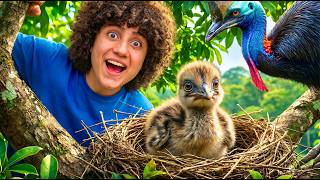

Condor's Carrion Feast on Mountain
51sThe graphic, raw reality of condor feeding habits shocks and fascinates viewers, driving high engagement.
▶ Play Clip"Delivers on its promise to find the largest bird, but the journey is lengthy and includes many diversions."
The video follows a team searching for the Andean condor in the high-altitude paramo of Colombia. They encounter extreme weather, find evidence of condors, discover Colombia's largest owl, and witness the careful extraction and incubation of a condor egg, culminating in a historic sighting of a condor family.
The team begins a 9-hour drive to search for the 'lord of the skies' (the condor) in the high paramo.
At over 4000m, the terrain is rocky and cold, with difficult conditions, including rain and freezing temperatures.
Weather (fog, rain) makes condor spotting impossible, and the team is forced to abandon the first search point.
They find a dead calf used to attract condors, showing the birds' feeding habits and the strategy of local farmers.
After 5 hours of hiking at 6000m, they find a fresh condor feather, a promising sign of recent activity.
They find condor poop on a cliff, indicating perching and possible nests, and begin scouring the area.
They search for Colombia's largest owl, the horned owl, and find evidence including poop and feathers.
They successfully find the horned owl camouflaged in a crevice, describing its silent flight and ability to turn its head 270°.
A pair of condors laid an egg, and a team prepares to retrieve it for incubation to prevent loss.
The team carefully removes the egg, using special cloth and handling procedures to avoid damage.
The egg is measured (11 cm long, 7 cm wide, 328 g), candled with an ovoscope, and placed in an incubator at controlled temperature and humidity.
After many hours, they spot a female condor on her nest – the first active nest in Colombian history.
They see the mother, chick, and father, a historic event showcasing the entire family.
The egg from the video hatched later, adding to the success and resulting in the fourth condor born with the team's help.
The video highlights the challenges and rewards of conserving the Andean condor, showcasing a successful intervention and a historic sighting that contributes to the species' survival.
What altitude did the team reach during the search?
6000 meters above sea level.
05:10
What is the largest bird in America?
The Andean condor.
00:33
What special ability does the horned owl have?
Silent flight and the ability to turn its head up to 270 degrees.
15:05
What is the name for the light used to check condor eggs for cracks and fertilization?
Ovoscope.
20:01
What percentage of its initial weight must a condor egg lose during incubation?
14%.
21:12
How many condors have been born with the help of the conservation team?
Four condors (including the one from the egg in this video).
25:41
Carrion as Bait
Demonstrates a practical method used by locals to observe and study condors.
03:23Horned Owl Discovery
Highlights the biodiversity of the paramo and the team's patience in finding a well-camouflaged predator.
14:35Careful Egg Extraction
Shows the delicate process involved in condor conservation, emphasizing precision and care.
18:28First Active Condor Nest in Colombia
A historic milestone for conservation, proving the success of habitat protection efforts.
24:37Egg Hatches Successfully
Provides a tangible outcome of the conservation work, inspiring hope for the species' future.
25:27[00:02] will have to drive for more than 9 hours. [music] Well, not me, my dad. Okay, move aside, move aside. I still don't know how to drive. I ca
[00:14] , so you won't know if it's north, south, east, or far east. The only person who can know is my dad.
[00:33] In this video we will go in search of the world's greatest flyer or as I like to call it, the lord of the skies.
[00:58] complicated because, as you can see, it 's raining. My face is frozen because it's too cold and the breeze isn't helping either. rockier, more dangerous because a fall here hurts three times as much, but hey, nobody
[01:12] here hurts three times as much, but hey, nobody 's forcing us either.
[01:24] altitudes of over 4,000 m manage to separate wild animals from very difficult to build. I'll stop by to show them to you. separate their animals. Besides that, they also use fencing and
[01:37] close? There are so many stones here, making holes in the ground is very difficult. They opt for this security, which is very heavy, and it's entirely possible for an animal to knock it over and very heavy, and it's entirely possible for an animal to knock it over and escape.
[01:53] steps. We are not just anywhere in the world. [gasp] I think we have, I think it's there.
[02:06] Oh, God. First opportunity for the lost chor. We climbed to the highest part where there were no more shelters. What 's the problem? The day. It's too , there's a lot of fog, and when the weather is like this it's
[02:19] completely impossible for the condor to come out. But it's okay. It's not our last chance, but this one is already lost. I
[02:31] it's this one [laughs] right here. But anyway, we only have this last stretch left and in a few words we've got it. A very interesting fact about this place is that everything you see before you know it, and thanks to that, the rocks have their current shape. If you look
[02:44] it's divided into many parts. It looks cracked. Basically, what happened is that when it was just one, the snow started to get in and started to break, break, break, break, break all of it until it gave it that brain-like shape.
[02:57] Now we have officially reached the highest point of the moor. If you look closely, it's a rocky wall, but the camera doesn't do it justice. In fact, we can't have more stability we have to crouch down. It is a cliff of about 500
[03:10] km. It's quite dangerous, to be honest, because a fall here is a guaranteed death. Over there in the background you can see sheep belonging to farmers [music] who live in the area. And look, my brother doesn't want me to fall, he's holding me up because,
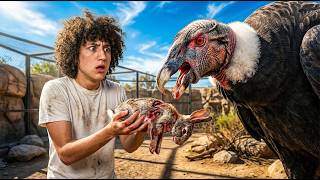
[03:23] they do at these high points to be able to control all the the entire condor population in the area is to put out carrion. What is carrion? decomposing animal. That is the condor's main food source. And [music] here it is
[03:37] to see, really, in person, but if you notice, this is a very dead little calf. But look, you can see its legs here. It seems the condor has already area where the bone is, well, it's already bone. All the meat that was there, the
[03:51] condor pecked at it, tore it apart. They even notice here that he tried to tear this hoof n't manage to tear it all apart. And well, he did leave the other three untouched. It was well, I hadn't noticed, and there's another
[04:05] pretty impressive. If you're not used to seeing things like this, be careful. But look at this sheep, you can see its entire jaw. There are more bones here than the condor, logically it tried to eat. You can see his ribs over here. This
[04:18] is the back. Their little hooves are there too. Seeing hooves. And yes, indeed, it is a sheep, I just realized, it has wool. A palette here and see parts of
[04:30] completely shattered, leaving him as skin and bones. [music] once they are already dead and decomposing. How impressive this is to see . Look, Rocky joined us. It's the dog
[04:43] when we were coming here it was going into a puddle. Naturally, the water here is freezing cold and you trembling. But hey, he's used to it because he lives here, he's more used to it than we are. That's right, Rocky C. It's time to like
[04:57] the video. Don't do it for me, do it for Rocky. He accompanied us here and kept himself for Rocky. He accompanied us here and kept himself warm just to take care of us. I'm starting to need oxygen, and I think it's never been this high in
[05:10] my life. We are about 6000 m above sea level. We're on our way be careful because what I'm telling you , one wrong step, one dangerous fall, we get to the camp. Good news, we found a
[05:25] news, we found a condor feather. [laughs] 6,000 m in altitude. A journey that took us approximately 5 hours to complete took us approximately 5 hours to complete .
[05:40] started to rain, many things happened, but we kept hope alive. The first . The problem is that today we traveled too far and found nothing but a feather. You might say, "Well, it's a feather, it could have fallen off
[05:53] dry now, but when we pick it up it's kind of wet, so when the feathers are kind of wet it's because they're fresh. It is most likely it, for now it's completely possible. The weather already indicates that it's
[06:05] that it may be closer than we think. Rest for today. think. Rest for today. We continue the mission tomorrow.
[06:25] This time the mission might be a little easier for us. Why? It turns out that the mountains here are also very rocky, but they are steeper. If you look closely, there's a huge stone wall over there, and there's condor poop. That
[06:39] means that's where they perch. We've even been told that there may still be active nests there. So, my first mission of the day is to try to smell condor poop, and well, for that we're going to scour the whole mountain trying to
[06:51] we find a nest, God, the probability of that happening in life is extremely difficult, but not impossible, and that's why we're here. Let's go. This whole mountain in the background. Take a look down here at how the cows are doing. How is the high plateau?
[07:06] How the mountain is full of stones. Epic. And we've just made a attentive to that mountain, which is where I tell you that the Popocatépetl of Ecuador is located. noise, because it might be out there camouflaged and we wouldn't see it. Suddenly there
[07:21] were these huge rocks with craters and I looked out here and there is light on the other side and in the background it looks more hollow. That means it's a cave. There is literally a cave down here. What's more, I want to see because if I get a
[07:33] little closer I can see. No, you can't see much. The camera doesn't do it find the entrance. By the way, at this point we are already on the second level, therefore we had to climb 500m more up the mountain.
[07:46] 500m more up the mountain. We have to go down these rocks. and asked them if there was a chance of seeing the condor inside
[08:01] because this point is too low and the we have to go even higher. But look, if you peek over here, look, you can 2 minutes ago you can see the beam of light coming in. There might be
[08:15] animals too, but I don't see many. I see several ways out. Look, we can exit this way and continue our journey, or we can go that way, which is narrower. Well, I have to n't go on too long because we have to take advantage of the good weather.
[08:29] Remember, the condor likes the sun, so I'm really getting into epic places here, the condor might be flying above me and I won't see it. So anyway, let's pick up the pace. Believe it or not, we came with my dad. The thing is,
[08:42] lost it. He went ahead. I don't know how he managed to get through here, I don't know. here. Why are we going to leave my dad with food? Because after that, the road climbing involved. And well, my dad is in his sixties. The fact is, he can't
[08:57] take this much longer. We're almost there. In this area it is very common to see that they have quite a bit of sheep poop here on the floor. You go walking and you find a lot. And we just amazing. And look at this here, it's a moorland fruit. Look, if you
[09:11] thought it was edible because there's a very similar one that's not ideal to visit, you can't eat anything there, it's animal food. But I'll take one to show you. I was told that this was formerly
[09:23] sheep's wool. So, if I open it a little and do it like this, look how it dyes. It dyes very hard, a purplish color. Awesome. And the fruit is, well, it doesn't look like a blueberry at all. It looks like a radish. I punched really hard.
[09:36] the valley. The main economy of this place is based on sheep, on the breeding and sale Yes, we've arrived at the place. Look, there's the house where my dad is going to
[09:48] stay. And here there are many sheep of various colors. I'm going to show you this. basically a sheep pen. And well, they 're all nice and naked, nice and big, nice and chubby, nice and pretty. The lambs
[10:03] red ribbon around their necks. This is to scare away the eagle because when they are big there, well-built, but that's all skin and has wool already. If there is an eagle, the great moor eagle, it can
[10:16] carry him off to eat him. Then they put that ribbon on it and the color of the listener is already there. He's Of course, in these valleys where there is so much food for her, it must be normal that she
[10:31] but God, we're literally talking about him right here next door, and he has the threat behind him. We are getting closer and closer to the highest point, and along the way, look, we find more of the sheep. Do you know what you just tripped over? With a
[10:45] sheep skull. He's not going to go into details. I don't know what this thing ate, but look at all the sheep here. The amount is impressive. There are also goats them, and you basically put it there on the stone.
[10:58] That. Let's see, I know how many there are. The person who says in the comments how many sheep there are will be followed, okay? Watch it and comment. It's simple. They pause, they count them and they comment.
[11:32] much noise. What's going on? In Colombia there is a buúo that measures 60 cm in in Colombia. It's a huge war and peace that seems to be happening nearby.
[11:44] noise anymore. The situation is somewhat complicated because all the paths are getting narrower and more difficult to navigate. head open, and we're so far from the hospital. Well, this is the area
[11:59] where the owl is supposedly located. Locals told us they have found a nest. As I told you, it is the largest owl in Colombia and it is found throughout this canyon that you can see from this edge. It's like a hollow and it
[12:13] can basically be in that mountain over there, inside this hollow, or on the inner wall of the mountain. So, we'll walk very quietly because they are also birds of prey, that is, they are also very attentive to their surroundings.
[12:25] any moment we might hear him, or we might not, because remember, he's nocturnal. You have to walk all of this and explore it. Come on, let's decide to what it looks like from the inside. I mean, this place is too, too epic. And down there it
[12:39] with all the vegetation and all the greenery. Uh, we just came across some owl bones. Ah, they're roots. For a moment it looked like they were the bones of some mouse is medium-sized for making mouse bones, but it doesn't look like a root. But
[12:54] look, we just came across owl poop. Look, that's great because , we don't know. It may be there, it may not be there. It's not a at least we already have a trace of it, which is its poop. And you know the
[13:07] tradition. You have to smell it. What does the poop of Colombia's largest owl smell like? It 's already very dry. I arrived late. It's already very dry. It doesn't smell like anything anymore. Ah, well , look, we found this here that you were explaining to me. It's called a
[13:19] owls do when they can't digest something is that they vomit it up. So, look, over here there's something like this, it's like a beetle. Look, if you notice. Yes. . He couldn't digest it properly and [music] vomited it up. There are even little
[13:31] bones. This could be a bone from some rodent. Wait, I'll clean it. a miniature bone. I don't know what I can do. It's most likely from a could even be from some other bird, because remember that owls also eat
[13:44] birds. You know, the vomit of owls is called hegagropile. You can give a little of your diet. Beetles, mice, birds. Ah, I hope we find it getting closer and closer . Here on this stone, literally, was this owl feather. Come closer
[13:56] feather from its chest because if you notice, it's kind of fluffier and very soft, it's not stiff at all. The stiffer the feathers are, the more rigid they are on the wing of the owl, because [music] imagine an owl with feathers like that on its
[14:10] necessary structure and strength to be able to do so. So, literally in their entire ecosystem. In fact, if you look closely, there's it. There might be one there, we don't know, but it's also kind of
[14:22] white on the outside. That's because there was a booby there and it's messing things up . We will continue searching. We found it. In what part? We can't speak harshly. I can't believe it. What did you think? Look at it. There
[14:35] [gasp] it is. It's literally in one of the gaps. It just can't be. I find it moments like these because having encounters like this is just too shocking. I do n't know how Fernando managed to see it, because it's literally camouflaged. It just can't
[14:51] be. Do you see it? This is the horned owl, the largest owl in Colombia. its talons are stronger than an eagle's and its flight is completely silent, making it an invisible hunter. An incredible fact is that those
[15:05] horns, which are not actually horns, are tufts of feathers to camouflage itself, and since it cannot move its eyes, it turns its head up to 270º.
[15:19] impressive because of the little hairs it has here, I don't know, personally it's one of my favorite animals, I have to admit it. And I'm looking for the feather because, of course, the feather was a very good indicator. What's going on ? It's too fresh,
[15:32] look at it. I mean, it's like water, like sweat, like heat. It's noticeable that it was a few meters away, making it quite difficult to see, but oh well, [sigh] the mission was accomplished. We are still searching for
[15:46] the condor, but at least we managed to see the largest owl in Colombia. Leave we managed to see the largest owl in Colombia. Leave . I don't want to bother him. Incredible.
[15:58] all the feathers. Did you see the ones I showed you? I told them they're the ones on the chest so I can keep him warm because they're soft. Look at the feathers for flying. These are already wing feathers, much harder. Look, I can show you the
[16:10] difference. An owl's breast feather and a wing feather. It's too different. Update on what's happening. We continued to a very high part a little quickly because it started to hail. Basically ice chips and
[16:25] glue. Oh, it hits hard. Look, look. You can see it here. Here you can see it. It's raining ice, literally. Look at it. Oh, we have to turn around quickly because starts to rain hard and hail, it could hurt us because
[16:38] much larger balls of ice can fall and it starts to get terribly cold. This is the wasteland, girls. Ah, while we were surviving the extreme climate of the pair of Condors were laying an egg. This is a historic event; it means there will
[16:53] soon be a birth. So we need to go and investigate. first condor born in Colombia or in captivity. But watch out, man, and we're
[17:08] large team of experts. If you notice, we have some nets here, we have some basically what we're going to do. At this moment a pair of countesses has just laid another not going to raise it, they are not going to take care of it and it will probably break. What
[17:22] in and take it out. What's happening? We cannot make noise, because in this same enclosure is Rafiki, the condor that is going to be released and to this day does not know the human being. So, look at them, they're there, keeping an eye on everything, monitoring everything
[17:34] so they can go in and get the egg. I was going to do it, what's going on? It because I don't know much about what's going to be done, but basically, come on, here's the pair of condors that laid the egg.
[17:46] They have to enter very carefully, trying to avoid being attacked by the condor because it can become a bit aggressive, and get all this out without the little condor seeing them. It's quite a complex job, but hey, they're very well-
[18:00] educated people, basically they're cracks. What you see back here, I mean, secret room to be able to see the coor, but the coor can't see us because it's Then they went in there, checked that the condor and the little condor were already
[18:14] went in to be able to take out the egg. We have to be very careful because this happens breaks, it would be very sad, it would be very tragic. So nothing, the team already went in and that's it, basically just waiting for them to come out with the egg. I'm really
[18:28] but I can't go in. That's it. My God, it went by so fast. God, see it, see it, see it. It's gigantic. And that egg, how long has it been there? They saw that everything happened very quickly, but they have been working for years to make this
[18:41] happen so well. You can see how the process isn't just about grabbing it in your hand; they the egg is okay. Look, there's something like cardboard there, it has a special little cloth to make sure everything goes well. You have to be very careful, I mean, even though it's
[18:53] an egg, it's still very fragile. Back there
[19:06] Colombia, so thanks to them this would be the fourth condor they can do. Rafiki, Guira, and Ar. I actually recorded that process for them, but if they today, it would be easier for him or her to be born because they already have much
[19:20] more experience. So, this seems normal, but it's history in Colombia and around the world. By the way, now it's time to put it in the incubator and well, I'll show you, but they're coming very slowly, I mean, it
[19:32] here. We're going to take twice as long to get to the incubator really good care of the egg, nothing can happen to it . So, the team is going at a rate of things are done. To ensure success, we decided to put the egg in an
[19:47] birth and avoid the risk of the parents accidentally incubation laboratory, which is this place. In fact, I remember that I had already shown them all the tools to make this a reality are located. So what's going to be done? The
[20:01] complete monitoring. So, here it is already faer. What is done is that it is measured with that device, then it is weighed. Once it is weighed, it is passed to the loboscope, which light so that it becomes transparent and we know that it does not have any cracks and that
[20:15] everything is okay. And finally, it goes into the incubator. It fell on me. Check this out. Millimeter precision, because remember, it's delicate. It measured 11 cm and a few millimeters in length. Then they write it down . Okay. And it just measured
[20:31] 7 cm wide. I asked because I didn't know, and what's the point of measuring it? Basically, monitoring because there are some eggs that come out strange, like they come out longer, wider. In this case, it came out wider than normal, so
[20:45] [music] you can roughly estimate the mass of what the chick might weigh the experts already know, but I try to explain them to them so they understand. Once the measurement is taken, it has to be weighed with that, well, with that
[20:59] small scale. We have to be very careful. It also just weighed 328 g. And why is this important? Because basically I did been in this lab several times. Throughout the entire
[21:12] breaks out of the shell, it has to lose 14% of its there. Well, yes, if you notice, it has a little bit of blood on it. What I told you is that it's normal, but it has a little blood, and that happens, really, in all
[21:28] [music] when they lay very large eggs, they bleed a little, and now the lights go out. There's the machine. So, what they're going to do is put the egg in and see what color it turns. It becomes almost transparent. I
[21:42] think so. Yes. Okay. Okay. Well, it seems so because, let's see, imagine that there is the yolk of the egg And from the nucleus there is a little thing called the germinal disc, and from the germinal disc
[21:57] the structures begin to form. So, you no longer see the yolk concentrated in one even place, but you see a small spot. It's hard to see, but there's like a little blacker thing here.
[22:10] and if I move it a little bit you can see it as a point that moves here. Apart from providing a basic diagnosis of whether or not it is fertilized, [music] the light also helps to determine if the eggshell has small fractures and
[22:24] whether more care should be taken. There will be a lot of care, but all these factors must be analyzed, especially in an animal as delicate as the condor. It has just been that the incubator [music] has to keep rotating the egg. So, to find out
[22:36] what's happening with the brand, we already know. On one side an X is made and on the other side a circle. Now it's time to put it in the incubator. This here is basically a thermometer, honey humidity, and this is a thermometer, and then you
[22:48] put the egg in and that's it. Already in the incubator, officially day 1 of incubation. Hey, [applause] and for those who have seen the latest ones we recorded are. Awesome. Comment "condor" if
[23:02] you've made it this far and don't read anyone's comments. We're going to confuse anyone's comments. We're going to confuse people. [music] Last level. 7,000 m high.
[23:18] . We had searched every corner of the moor without finding anything. We knew that searching for such a rare animal was a huge risk, but this time the much heavier than when we searched for the spectacled bear. We really felt
[23:32] and that we would go home without managing to spot the condor. This would be the first time this has happened to us. Or so we thought until suddenly we started we thought until suddenly we started running, running, running. They just told us they saw
[23:46] one. Quickly, we have to get ahead because our gone to another part of the mountain. So we have to catch up with them because they're and basically if we delay, well, it's an animal that can go very
[23:59] far, we'd lose the opportunity to see it. We saw it, we saw it. Well, we had to calm down. Indeed, we are here now with Fernando and yes, there is a condor. There you have it. It's a female, you can see it by the color of her eyes, but well, these
[24:11] are things that one has to look at in great detail and it's very far away. I mean, we miles away, but hey, it was done. Indeed, there is a cor. And mind you, this is no small matter; it is the first active nest in the history of Colombia. In
[24:24] this has never been seen before. Yes, we had seen eggs, but never a chick. We finally did it, farmers. God, exploration, advanced techniques to be able to make the sighting, we have it
[24:37] in front of us. And not just one copy. We're seeing the whole family. Mom, son or well, it's not known if it's sown or male. And Dad is talking about it too. This is true, it makes us surpass the level by
[24:49] 1000%. The goal was to see one. And we saw the whole family. This is historic. It is literally the first record of this in Colombia, and very happy. I don't know how to describe this feeling. To continue the
[25:02] conservation of the condor, it is necessary to take care of its habitats such as the moorlands, forests and plains with wetlands. Productive activities must go hand in hand with conservation, since we need
[25:14] food production, but we also need to guarantee a future where nature, humans coexist. [music] We invite you to make every action count towards the conservation of this bird that is so emblematic for Colombia. Wait, wait a moment. Stop everything,
[25:27] Juliet. Stop everything, please. So, in this video , the game you just saw has hatched, there's another condor there; I was coming from another trip. It was born in the early morning; I was on a plane. But
[25:41] condor we've seen born. And well, leaving aside the one we saw in this video, in its wild, four condors, too historic. Since I wasn't there, I team was recording there and they let me show you these images exclusively
[25:56] . So, I won't ramble on. Check out this epic thing.
[26:20] surreal? But anyway, that's all for today's video. Remember if I forgot any, you already know. [laughs] Bye farmers.

⚡ Saved you 0h 26m reading this? Transcribe any YouTube video for free — no signup needed.