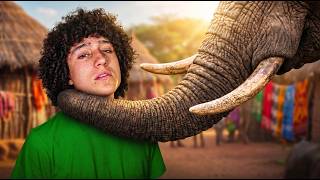

The Most Dangerous Job in the World?
31sStarts with high stakes and introduces massive elephants, grabbing attention immediately.
▶ Play Clip"Title overstates danger; video is informative about elephant care but not the most dangerous job."
This video documents the daily routine of caring for three African elephants at a conservation center, highlighting the immense scale of their needs—from feeding 600 kg of grass daily to cleaning over half a ton of manure. It also showcases medical procedures like dental and foot care, and emphasizes the intelligence and social nature of elephants.
Three African elephants: Kim (40 years, 2.6 tons), Pirinolo (50 years, 5.5 tons), Maggi (43 years, 3.4 tons). They are cared for at a conservation center.
Each elephant eats 300 kg of grass per day, totaling 600 kg for all three. Food must be spread out to prevent fighting.
Doors have three locks: a spring, a pin, and a padlock. Structures are reinforced with iron and cement to withstand elephant force.
Kim receives treatment for an abscess on her incisors caused by a previous botched procedure. The abscess is cleaned with antiseptic and water.
Pirinolo's foot is maintained by cleaning the frog (holes) and trimming overgrown foot tissue to prevent infections.
Display of Asian elephant bones: femur half the size of a human, heavy skull, and vertebrae. The myth of Cyclops may have originated from elephant skulls.
The three elephants produce 522 kg of manure per day, which is over half a ton. Annually, that's 190 tons, or 63 tons per elephant.
Elephant tusks are actually incisors (front teeth). African elephant trunk acts like a pincer; Asian like a shovel.
Elephant skin is sensitive and prone to sunburn. They use mud baths to protect themselves from UV rays.
These elephants were rescued from illegal trafficking and cannot be released into the wild. Conservation centers are vital for their survival.
Caring for elephants is an immense responsibility requiring daily dedication, specialized knowledge, and robust infrastructure. The video underscores the importance of conservation efforts for these majestic animals.
How much grass does an African elephant eat per day?
Up to 300 kg per day.
01:27
What is the weight of the largest elephant in the video?
Pirinolo weighs 5.5 tons.
00:33
How many locks are on the elephant doors?
Three locks: a spring, a pin, and a padlock.
04:10
What dental procedure did Kim undergo?
Cleaning of an abscess on her incisors caused by a previous botched procedure.
05:44
How much manure do three elephants produce per day?
522 kg per day.
14:14
What is the difference between African and Asian elephant tusks?
African tusks are square in cross-section; Asian tusks are pointed.
12:33
Why do elephants take mud baths?
To protect their sensitive skin from sunburn.
25:43
How does an African elephant's trunk differ from an Asian elephant's?
African trunk acts like a pincer; Asian like a shovel.
22:35
Huge Feeding Requirements
Highlights the scale of elephant care—each animal consumes 300 kg of grass daily.
01:27Medical Care for Elephants
Demonstrates the complexity of veterinary procedures for large animals.
05:44Manure Production
Quantifies the immense waste output, emphasizing the cleaning workload.
14:14Conservation Importance
Explains why rescued elephants cannot be released and why centers are essential.
26:09[00:01] you know who I'm talking about? The African elephant. talking about? The African elephant. [music]
[00:17] the lives of these three African titans depend on me . [music] I'm because the work has to start now. Her name is Kim. It is an adult African elephant. He is 40 years old and weighs 2.6 tons. It's huge, but not as big
[00:33] as Pirinolo, who is the biggest in the pack. He weighs 5.5 tons, that's equivalent to 5,500 kg, he is 50 years old and he is the only male in the place. And finally, there's Maggi. She weighs 3.4 tons, is 43 years old, and is
[00:48] incredibly beautiful. But it also commands a lot of respect. There are two species of elephants in the world. The Asian elephant with India and Southeast Asia, including Thailand, Malaysia, Indonesia, and Cambodia.
[01:02] And then there's the African elephant, a titan that can weigh up to 7 tons with tusks that can measure up to 3 m. And that will be today's mission. They already know them. Let's get to work. The
[01:15] shown you with many animals, is to give them their diet. But what's going on? We're talking about an animal weighing over 2 tons. So, the dimensions are too, too different. They are much bigger.
[01:27] So, we have 15 kg of grass here and we have to give him 300 kg in the morning. In total, the three elephants eat 600 kg and many safety measures must be taken behind them providing support so that in case something happens, they can be on the lookout. And
[01:42] well, here we're going to push the grass hard to the left. The spiny elephant is the largest elephant of all those here and weighs around same thing that can happen to a truck, much more so than a car. No, no, this
[01:55] understand a little better, farmers, an elephant can eat up to 300 kg of grass a day. For a cow to do the same, it would need a week of its life to reach this same amount of food. Now we're going to
[02:08] feet. She's going to have some things checked regarding her teeth and undergo many kg of grass must be taken to their habitat so that when they are released, they will basically go out and eat another 190 kg of grass. It may
[02:21] we're talking about the three elephants weighing over 10 tons . This is a small bite for them . We are moving towards the external habitat. Its external habitat measures approximately 6,550 m². They have two swimming pools and
[02:37] even a mud bath to cool off in. Now the entire food distribution will be carried out . And now we've reached the external habitat. Look, it's all this two. Here is another habitat where one of the elephants will be, because there
[02:49] are three in total. There is an elephant, the very large one you already saw, called Pirinolo, and there are two female elephants. One will be here and the rest over there. They are not together. As you saw, structures and everything are mega reinforced with iron and cement,
[03:02] car, that is, a fierce elephant can overturn a truck. Food should be spread throughout the habitat. That. Go for it, go for it. It seems like I'm doing it very horses, not elephants. We need to make five piles of these in the
[03:16] quickly because the elephants are waiting. It should be well spread out and compete for food. Remember, they are very intelligent, they know there is enough food, but they are still wild animals that
[03:29] compete, they can fight, and it can go very badly because we're talking about animals weighing 3 tons and 5 tons fighting, so what good can come of that, right? And apart from that, they are kept well separated so that they can move around the
[03:41] place, and a still animal wo n't do that. In other words, the idea is that they are also active. We're going to close this door now, and it's too heavy. I'm n't usually move like this. It actually has a pulley system, but that was
[03:54] to show you how heavy, tall, and huge it is. And these bars, imagine the force of an elephant. I want you to determine the size and thickness of the walls so that they can support the weight and strength of one of these animals.
[04:10] with rebar. The entire habitat is very well reinforced because these n't see it on camera, but if you're ever seen and I've seen a lot. We're going to bring out Magi now, she's one of
[04:22] I want you to see the security of the doors, because they have three locks. intelligent. So, the first one is this spring here, about the same size as this spring here, about the same size as my hand. Check it out here. If I pull it,
[04:36] the door can't be opened isn't enough. It also has this other pin to make sure that it definitely cannot be opened anymore. And if that's not enough, it has a lock
[04:49] to make sure it's completely secure. So, nothing, to let go. In the endless plains of Africa, the elephant doesn't just walk, he dominates the isn't just brute force; we're dealing with one of the most brilliant minds in the
[05:02] animal kingdom. Their intelligence is so advanced that they can recognize themselves in a mirror and our own. The most incredible thing is how they live. They are not lonely, they are pure family. They move in packs united by a bond of loyalty that lasts a
[05:15] who is the wisest grandmother and the one who keeps all the secrets to character, they are the definition of a noble giant. They are calm, curious, and very playful. But be aware that this peace has its limits. If anyone dares to
[05:28] threaten his young, that peaceful temperament transforms into that of an perfect combination of wisdom and power, a true masterpiece of nature.
[05:44] dental treatment. Unfortunately, she had a rather serious problem with her incisors, or as many know them, canines. And unfortunately, thanks treatment for life. Basically, what is done is to clean it to remove
[05:57] prevent an infection that could even cause death. It's quite serious, but well, it gets cleaned, all the excess inside is removed, and to avoid any misfortune. Fortunately, the team is quite
[06:11] to help make this as safe as possible for both her and us. . Remember, it won't be too loud so as not to distract but look, basically she comes to a place where they tried to remove her
[06:26] incisors, I mean, her teeth, and they didn't do a good procedure. That shouldn't have They left some pieces and over time it grew. Then, it caused him now? Clean them because she already had surgery to finish
[06:39] removing that and so that there are no more residues left so that it doesn't continue, so to speak, and if you notice, there's always someone watching me because, well, remember, he's a very large animal, and any quiet movement of his
[06:51] us. So, you're a professional, if something happens, get me out of here. [music] injected with, well, not injected, it's being put in with syringes, it's an antiseptic to clean him inside, and right now what's going to be done is that with
[07:05] water, it's going to be introduced through his mouth to clean him with water. Go upstairs. What we just chipped away at you is right here, and that's what I was explaining to you. It's done so that when everything starts going well, it's
[07:18] tells the elephant that everything is going well. So, so to speak, I work upstairs. Love, very good. They're using a pressure hose to clean the abscess,
[07:30] tweezers they just removed all the remaining organic material, such as grass clippings, because being completely free... and Here we still have an accumulation of certain organic material that is part
[07:44] certain organic material that is part of the healing process. a lot more material, which is like a kind of pus, comes out on this side. They already explained it to me, it's not material that the elephant generates for internal healing. He's not going to explain it
[07:59] very well, so you should be aware if you go there. if you go there. Oh, very good. [music] Two. What we are looking for is to create antiseptic conditions inside so
[08:12] that it can heal without becoming infected. We're finished. Very good, fatty.
[08:27] very specific procedure, another one needs to be done as well. But now it's Pirinolo's turn, the male of the pack and the largest of the three. Pirinolo has just arrived. So you can see the difference in size between him and the elephant that
[08:40] much bigger. And now what will be done is maintenance of his basically all of this is to prevent anything from happening to him. And well, I'm going to be with the vet, I'm going to listen to him , we're going to bathe him and more.
[08:54] So, I'm going to be your assistant to take care of an elephant. ? These holes are filled with earth, sand, and many other materials
[09:10] bacteria. What is done is that with the help of some tools, it is freed, those bacteria do not accumulate and cause an infection. All of this honestly, to what is done with horses. All those holes that you see,
[09:24] remove them, and clean them. This is the material that is being removed and it is made up of almost the same thing as a fingernail. That's why it doesn't hurt him. If it procedure to be done. But hey, what you're seeing looks pretty
[09:37] an animal of almost 6 tons, which means that any normal movement for him can be deadly for us. In this case we are not in veterinary team is quite professional and has already trained him to give him certain
[09:50] commands so that he can make this procedure much easier for hurt. Here, apart from cleaning the small holes that I already mentioned, we also remove the overgrowth of this material. This
[10:02] material is called foot tissue. And well, to put it simply, it's like we 're cutting his nails because they're too long. In other words, when there is fills up with more soil and there are more accumulations of other types of
[10:15] infection. Then, it's cut and it becomes flatter. Look, it looks very different. This is the elephant. I'm going to tell you what it feels like. Oh yes, it's too hard. I didn't legs and the legs were very soft, the skin is like touching it, it's like it's
[10:32] because it's very hard, but on the outside the skin is softer and it kind of moves. I don't know how to describe it, to be honest, but it's very hard, very hard, like continue I want to show you something and believe me, you're not prepared to see
[10:46] too impressive, and look at all these elephant bones we have here. This is an Asian elephant, it 's not the same species as Pirinolo, or is Asian. And the first thing I want to tell you is that to see these bones, to
[11:00] approximately between [music] 40 and 50 years old. That's a lot. It's my age multiplied more than double. To give you an idea of how big an here. This bone is the femur. That means it's this one right here. It is the
[11:14] A single elephant bone is practically half my body. That's very idea, this here is one of the vertebrae that supports its head. This bone, which to the head, because the human skull is about this small, is what supports
[11:29] this entire bone here. They have seven in total. This, holding such a huge kiss, I mean, it's something that's hard to believe. And finally we have his head, which I'm going to that's saying something. I'm also going to raise my jaw, which is this one here. In other words, the
[11:42] jaw is heavy. It's just too heavy, I swear. But the head must be different. God, I'm lifting it, but I have to figure out how to how many kilos it might weigh, but it's too
[11:54] , I think. And now that you have it here, leave in the comments how much you think the skull of an Asian elephant weighs. And another thing, do you remember [music] who is having the procedure done on her incisors? I showed them
[12:07] . Well, since I have the skull here, I want to show you where we did that process. Look, if you see this space here, my because otherwise both of them wouldn't fit. This is where the process of draining it
[12:20] material that we were already told was not matter. Something was missing. Time to take a close look at some elephant teeth. Note, there is a big difference here, and that is that The African elephants, which are the ones we are taking care of and observing,
[12:33] square. If you notice, the Asian elephant ends in a point. I have to share this very interesting fact that I was just told: the myth of the Cyclopes, that is, that Cyclopes existed, was born thanks to
[12:46] when humans found elephant bones and saw this large structure with a single large hole here, they thought it was a large human with one eye, the cyclops, is where the elephant's trunk comes out. It's just that, I mean, it is visible, but
[13:00] down. So, yes, basically they thought this was an eye and that was it elephants. The entire procedure is now complete . Now the door will finally open for her to go out into the outdoor habitat and join Kim, the
[13:13] her teeth. She will join her and enjoy the grass we recently added . 190 kg. Now, I think of 190 kg as a low number, because when you see this 5.8-ton animal, 190 kg is
[13:26] absolutely nothing. Seeing the size of her nails, the size of her feet is too another planet. I'm sure that what you're about to see is something you haven't seen anywhere else. An elephant taking a bath. No, no, no. This alone makes
[13:40] the video worthy of a like, please.
[14:14] security. It has its resting area and apart from that we have to dig very deep because it's full of elephant poop everywhere its poop is also enormous. I glanced at it and it's kilos and kilos of
[14:28] poop. Make a comparison: if they eat 300 kg of grass a day, how much poop also a lot of food waste inside that is not food waste from a small animal. also amounts to kilos and kilos, which will add up to tons per week. To enter,
[14:41] hard door, which is completely iron, not even hollow, that is, it has many plates, it is about 15 cm thick so that the insurance policies, look. It's not like it can simply go back and forth,
[14:56] but it has locks to ensure that the elephant can't open them with its trunk a very intelligent animal and it will use its trunk very well, so that it knows how to open a lock on these bars here, plus cement,
[15:09] Something that really caught my attention is that this area where the elephant is standing is sand. Well, I don't really know why what caught my attention is normal Africa and it's all sand there. So, it's like they're trying to simulate it here. Okay, I'm
[15:22] The motorcycle that carries everything just arrived and they already picked up all the poop he made right there show you. Pirinolo, who is the big elephant, has his resting area over there. was done to his legs, he had to go through this corridor to reach
[15:36] corridor alone, and this is what he did. This is what he did. It took 10 seconds. No, it's too much. It's very impressive. In other words, tradition to smell the poop to find out what it smells like. So, whatever, I'm going to grab
[15:51] a piece of poop. The truth doesn't matter, beautiful. Wow, it's really fresh, really fresh. It's very fresh. It makes me feel a little disgusted, even though I've handled a lot of an idea because it eats very
[16:05] similarly to a horse. Eat pasta, fruit, but let's see. Phew! This one smells really bad. Oh. Phew! This smells disgusting. Olive tree, disgusting. The poop of Olive tree, disgusting. The poop of
[16:18] smell bad. Yes. I don't know how to explain that process. But the poop of example, the tiger's smell has been one of the worst so far, but beaten it. And this one here is a herbivore, I mean, he eats only plants and
[16:32] only fruit, but ugh, I don't know, it smells like it's been stored, but I don't know, I don't know everything up so this place is clean. Well, we still have one den to clean for, I
[16:44] called, but so you understand, it's his room. The room is because it really impressed me a lot. And look at the doors of the dens. Yes, they are made of a very resistant metal. I mean, look, they're big.
[16:57] resistant metal. I mean, look, they're big. The hallway door is made of cement, and other words, this is metal and cement. I don't know how many tons it can weigh. I think this door might even weigh more than the elephant. and I tried to close it. Completely impossible.
[17:10] I literally used all my strength. And you see, it's impossible there. But if I fully recharge, fully recharge, ah, it doesn't close. It's very heavy. The person
[17:23] who built it built it thinking that it should withstand the force of move it. It's not that I don't know, I don't know how many shovelfuls of poop it takes. This place is already full and we haven't finished
[17:37] cleaning it all up yet. Look, there's more over there. There is still grass to be gathered. They can't [snort] grasp the amount of poop that needs to be collected daily because we 're talking about this place being cleaned last time yesterday.
[17:50] Appreciate the work of those who care for the elephants. Not just anyone can do it.
[18:09] collected in a place where they make fertilizer with elephant poop. have the scale here that they use to weigh elephants, let's day, [music] which is the whole cargo truck full, look, it
[18:22] finally filled up and made a tremendous mountain of dung, to give an estimate of how much dung an elephant can produce in a year and so that you can understand the size and magnitude [music] of the animal that it is. Yes, it's a scale.
[18:34] I currently weigh 66 kg. I think it could weigh more and be stronger, because many times the elephant also needs to be weighed, so it's much exit corridor, and get an estimate of how much it weighs. But I won't go on about it any longer.
[18:48] Let's weigh the loaded Motarguero first . Come on. We unloaded the poop and empty motarguero again to subtract the weight with and without the load and find out how much poop the elephant made [music] today. Well, the three elephants.
[19:07] 78 kg short of making a ton. So, now what needs to be done is to take the cargo motorcycle to the unloading area, remove the feces, and come back here and put the cargo motorcycle back, but empty, so that from these 922 kg we can
[19:19] subtract the weight of the device and know how much feces came out. And there, well, quite simple, but I'll explain it to you so you understand.
[19:32] how much the cargo motorcycle weighs and find out how much food the three elephants made how much food the three elephants made in one day. Okay, I've got it. show you the result, leave in the comments how many kilos of
[19:44] elephants [music] made in one day. I wait 5 seconds for him to in one day. I wait 5 seconds for him to comment on it. Cco 4 3 2 1. Let's see who hit it. If the cargo motorcycle weighed 922 kg with its poop and 400 kg empty, that
[19:59] weighed 922 kg with its poop and 400 kg empty, that means 922 - 400 = 522. 522 kg of poop in one day, enough for three elephants. That 's more than half a ton. That's a lot. Now I want to do a calculation. 522 kg
[20:12] for 365, which is one year. Yes, that means that in one year three elephants produce 190 tons of poop. I divide three to get an average. That's 63 tons per elephant per year. No, no, this is too much poop. It's
[20:25] crazy. It should be clarified that much more poop was missing because we did not collect poop from the external habitat, only from the lot of tons in the calculation, but hey, it's known that [music] is a
[20:38] because they have to spend the whole night here, remember. And what I have to do now is give them their food, that is, their concentrate, and give them plenty of too much. And I have to do this quickly because they're already waiting for us and I can't
[20:50] tons waiting. Okay, let's do this quickly.
[21:02] hydraulic system for the doors because, as you noticed, I couldn't any other human mechanism, so to because the doors are really too big. So they have this
[21:15] hydraulic mechanism that we see here as normal, a button with numbers and an emergency stop, but if we open it here it is a tremendous mechanism to be able to control all the doors. It has a lot of electricity, it has a lot of stuff.
[21:28] of not letting all this go wrong. It's a lot of technology, as usual, but it's tremendous equipment to make sure everything goes well and the doors don't end up closed or open improperly. So, we just
[21:40] come and eat. And as a safety measure, from now on we cannot Because? Because there are elephants there and they can hit us, or any action harmless to them, like moving forward, can be lethal for us because
[21:54] they don't know, but they weigh tons, so for us it can be very Maggie, who are the two elephants and the elephant eating. If you saw, he arrived and Later he will continue with the fruit, the grass, the elm. The truth is that here
[22:07] he can eat however he wants and spend the rest of the night peacefully eating. An interesting fact about them is that their teeth are not canines, they are see there, which we often
[22:20] call by incorrect names, we call them horns, we call them antlers, they are actually these are not even his fangs. I honestly thought they were fangs, front teeth. And there is a big difference between the African elephant and the
[22:35] Indian elephant. If you look closely at its trunk, it has the shape of a clamp. This is that is very desert-like; the little plant material that is there, such as grass, has to be India it's very different; they do a very different job. So, its
[22:49] trunk works like a shovel, the African elephant's like a pincer. Ah, you remember the hydraulic system I told you about? Well, I just coming in. I don't know, wait, but I really wanted to go in to eat, I guess.
[23:02] means of liquids and hoses. It's So, what that does is activate a machine that pushes a liquid generates pressure and pushes the door, thus closing it.
[23:16] It generates too much pressure to be able to move a door of so many kilos because it weighs failed. And look, here are the beautiful creatures eating. [music] Look at this living legend. He is Wanton, one of the last superkers or
[23:31] planet. It is called that because its tusks are so massive that each Imagine, they almost touch the ground when they walk. How much lives on the slopes of Mount Kelimano in Kenya and has managed to survive for more than 50 years by dodging
[23:45] danger and poachers. His existence is vital because he is a giant tusks are a rarity of nature that we must protect at all costs. But what is most amazing is that despite his absolute power, he is a noble and
[23:58] peaceful giant who walks across the savanna with a calmness that commands respect. What is not just an elephant, is a living monument to African history that reminds us why it is worth fighting for wildlife.
[24:11] noticed, when the elephants came out , the first thing we did was clean their habitat inside. Now they are in their indoor habitat. What we outdoor habitat. We're going. There will probably be a lot of poop and a lot of things
[24:23] to pick up too. So, we have to pick it up in the cargo motorcycle, take it out so leave they find everything clean and have a decent space where they are .
[24:37] . Well, now the moment has arrived for "Oh, I've crashing. Please understand that I don't know the dimensions. all the poop. And well, let's see how much it costs now because it's still a
[24:51] lot. So, let's start with the Maggom area. This morning it's way too filthy,
[25:03] much easier to be here because you only drive, you don't pick up. That's a lie, we have to clean up. Okay, my brother, let's get down to business. brother, let's get down to business. Elephant poop. I
[25:19] because of them. And although it may seem very impressive, those in charge of doing all this work daily are two people with a lot of patience, a lot of strength love for animals, because it's not like you can say to the elephant,
[25:31] "Forgive me, today is my birthday, I can't feed you." No, you have to come every day. There's a huge gap. You might ask, why? It turns out that elephants have very sensitive skin and can get burned.
[25:43] have no hair, there is nothing to protect them from the sun. Then, with the help of their teeth, what they do is make holes, [music] with the rain mud forms, they get wet with the mud and bathe with the mud and are covered with
[25:56] sun's rays and they don't get burned. She has very sensitive skin. It might not seem like it, delicate. [music] And to finish off the day, you have to pick up all the poop from their outdoor habitat and leave it nice and clean, because remember
[26:09] Before we finish, I want to pause for a on everything you just saw in this video. All the elephants we illegal trafficking and exploitation, and that's why they arrived here with very
[26:22] lost all connection with their pack and therefore cannot return. And we often wonder why they aren't simply released, let loose into their habitat with other elephants so they can eat and live a
[26:34] normal life like a normal elephant. Unfortunately, this can no longer happen because they have already been taken from their habitat and have developed mean by this is that they [musicians] are no longer used to looking for their
[26:47] giving it to them. So, basically, it would be releasing them into a place where they don't know how die, which is most likely to happen. That's why it 's so important to understand, conservation centers, because if they can no longer be released and
[27:01] someone must take care of them to give them a dignified life. That's why cease to exist in the future, because all the animals [music] are already in their traffic, but unfortunately, that is not the case at the moment
[27:14] they can live here peacefully. I want to thank record this incredible experience [music] and these invite all of you farmers, if you'd like to come and learn
[27:28] would be amazing. Believe me, you're going to enjoy it a lot. And again, record and show you all a little bit of all the work that goes into all these animals. Thank you so much. But anyway, you know, don't
[27:42] remember that if you liked this video you can like, comment, subscribe, well, you know. Goodbye farmers.

⚡ Saved you 0h 28m reading this? Transcribe any YouTube video for free — no signup needed.